" We don't sell the wine without touching the vine "
| BUY MORE! SAVE MORE! | ||||||||||||||||
|
| Country: | Italy |
| Regions: | Tuscany Chianti |
| Winery: | Coeli Aula |
| Grape Type: | Sangiovese |
| Vintage: | 2022 |
| Bottle Size: | 750 ml |
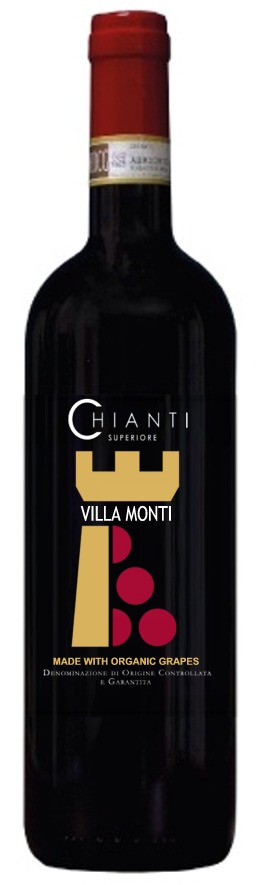
Villa Monti Chianti Superiore DOCG Organic is made from 90% Sangiovese, 5% Canaiolo and 5% Colorino.
Ruby red color, with delicious fruity and floral aromas, with a pleasant structure and tannic density, leading to a balanced and persistent finish.
The grapes are coming from Le Tire, Paradiso La Fonte parcels with good sun exposure that gives the wine a lot of roundness and juiciness.
Red meat, Game, Cheese.
As early as the 9th century, there are testimonies regarding the parish church of Santa Maria a Coeli Aula, around which the Cadolingi Counts and the Badia Fiorentina owned possessions. Agriculture was vital for the families who lived in the area, and thus, over the years, wine and olive production have developed.
Tenuta Coeli Auli was developed within the parish grounds. It is located in the hills of Montespertoli, just outside of Florence. Giuseppe Barni purchased the Monti farm in 1949, building the wine business by planting vines, emphasizing vineyard care and increasing production. Today the estate is run by the family’s fourth generation, who maintains the same goals as their ancestors – care for the vineyards in full respect of nature. They began converting all of their production to organic farming in 2015, and today they are a fully organic winery.
Tenuta Coeli Auli has 103 acres (42 hectares) of vines & an annual production of 9,500 cases.

All older vintage wines have been purchased from a single collectors cellar. Pictures can be requested before shipment.

Ruffino Romitorio di Santedame Chianti Classico Gran Selezione DOCG is made from 90% Sangiovese, 10% Colorino.
Romitorio di Santedame, a limited-production Gran Selezione from Castellina in Chianti, pays homage to a rich history while embracing a bright future. It originates from a single vineyard within the Chianti Classico's "golden basin" (Conca d'Oro) and is crafted from an exclusive blend of Sangiovese and Colorino. The latter is a native Tuscan grape variety that was nearly extinct but has experienced a revival through dedicated research and promotion efforts.
Fruity aromas typical of Sangiovese, including black cherry and ripe plum, with violet and complex chocolate and black pepper notes. The palate offers sweet tobacco and balsamic hints, while its balanced structure with refined tannins and lively acidity makes it suitable for extended aging.
Review:
You feel the oak here, suggesting vanilla and clove character, but it’s very well complemented by the dark fruit, ranging from blackberries to mulberries to dark cherries. Full-bodied, dense and decadent with a regal structure and muscular tannin backbone. The acidity cuts nicely through on the long finish and provides freshness. Drink from 2024.
-James Suckling 94 Points

Salvadori Chianti Riserva DOCG 2017 is made from Sangiovese 90% , Merlot 10

Brize Clos Medecin Anjou Villages Rouge is made from 60% Cabernet Franc and 40% Cabernet Sauvignon.
This is the flagship of the Estate. Clos Medecin has been produced at the estate for 90 years. All the grapes for this wine come from a very special parcel. The wine offers red fruit aromas. It is fresh, round and ample in the mouth.

Busi Chianti Rufina Riserva is made from 100% Sangiovese
Vineyards: Travignoli, a name which literally means “Tra Vignoli” (between the vineyards) is located in the middle of Frescobaldi’s Nipozzano vineyard in the heart of the Rufina zone. There is documented evidence that wine was first produced there in the 5th C BC by the Etruscans who called it “Nectar of the Gods”. The Church acquired the land and constructed the cellars in 1100.
Count Busi and his family acquired the estate in the 1800’s. Overall, 91
hectares belong to the estate. The 60 hectares of vineyards are excellently
position on the slopes with a southerly exposure at an elevation between 270 to 370 meters. Clay, marl and calcareous soil with a large percentage of rocks and stones for good drainage. Vines are an average of 10–25 years old.
Harvest: October– by hand.
Yield per hectare: 40 Quintals per hectare
Vinification: Fermentation in stainless steel at controlled temperatures for 7 to 8 days with an additional 7 to 8 days on the skins. The wine is then racked and goes through malolactic. It is then racked again and stays another 3 months in stainless steel.
Aging: 25 to 30 hectoliter barrels of Slavonian oak for 18 months and 3 months in Allier barriques. There is a period of refinement of 4 to 5 months in the bottle.
Alcohol: 13% by vol.
Color: Ruby red with garnet reflections.
Bouquet: Intense, ethereal bouquet with hints of leather, tar and ripe cherry fruit.
Taste: The flavor is full of mature fruit with nuances of leather and liquorice. The taste is complex and round and rich with character. The finish is persistent and satisfying.
Foods: Grilled, braised or roasted meats, dishes flavored with mushrooms, or rosemary. Excellent with polenta dishes.
Total Production: 3,300 cases
Enologist: Mauro Orsoni

Cueva de las Manos Cabernet Sauvignon Organic is made from 100 percent Malbec.
Cueva de las Manos translates to "Cave of Hands". There are a series of caves in Patagonia containing stenciled paintings of hands, dating back over 9,000 years ago. The caves have been named a World Heritage Site, and they are the inspiration for the label on these wines.
The wine offers an intense bouquet on the nose, with notes of green pepper. On the palate it is smooth and well-textured with a long and elegant finish.
Pair with game meats and pasta with heavy sauce.

• 100% pure Sauvignon Blanc, crafted from grapes grown in the most notable and warmer regions of California’s coastal hills. Each block contributes a distinct element to the blend, resulting in a layered and complex style.
• The harvest dates were determined by physiological maturity, which varied widely in the 2023 vintage due to the wet winter leading to a cool summer. Nevertheless, the extended hang time reduced grapes with low sugar, firm acid, minimal pyrazines, and intense flavor expressions.
• Upon arrival at the winery, the whole clusters underwent a gentle pressing, and the juice underwent a cold settling process for two days. Subsequently, it was racked off the heavy lees into stainless steel tanks, where it underwent a chill fermentation with native yeast – which contributed to the balanced mouthfeel, set against a backdrop of minerality and acidity.
• Following fermentation, the wines remained in tank, with the lees being stirred weekly for nearly four months before the final blend was assembled. No malolactic fermentation was allowed, preserving the vibrant fruit and floral notes, alongside the natural tension characteristics of this blend.
Color:
Medium yellow straw hue.
Aroma:
Asian pear, honeysuckle, passionfruit,
green melon, and a citrus bouquet.
Palate:
Refreshing stone fruit, grapefruit, and tropical flower. This wine has a well-balanced mouthfeel with bright and lively acidity.
Food Pairing:
Oysters on the half shell with mignonette sauce,
niçoise salad, a blue cheese pear tart and crab cakes.

Marco Capra Langhe Nascetta is made from 100% Nascetta - 15 years old - 1.73 acres
Aged 6 months in stainless steel vats
The name "CONNA" is a sweet nickname after his wife Monica.
Bright straw yellow with greenish hues, with an intense and interesting perfume of grapefruit, apple and aromatic herbs. Floral, fresh, focused, good acidity. Refreshing and bright, full bodied with an aromatic persistence, it is savory and tasty on the palate with a smoothness that enhances the rich character of the wine
Altitude: 400 m above sea level.
Soil composition: lime and sand.
Plant density: 5000 vines / hectare.
Cultivation system: traditional Guyot.
Yield per hectare: 6 tons.
After a short period of maceration on skins, the grapes are soft pressed. The clear must obtained ferments slowly in stainless steel vats at a controlled temperature of 16-17°C. The wine spends a long period of time on the fine lees, with frequent “batonnage”
Ideal with apetizers, shellfish and other fish dishes.