" We don't sell the wine without touching the vine "
| Country: | Argentina |
| Region: | Mendoza |
| Winery: | Nuna |
| Grape Types: | Chardonnay Sauvignon Blanc |
| Vintage: | 2018 |
| Bottle Size: | 750 ml |

La Despensa Boutique Pool Blend 75% Cinsault, 15% Pais, 5% Marsanne and 5% Roussanne.
A genuinely unique wine - La Despensa is the only producer of Cinsault in Colchagua and Pais from this valley is also extremely rare! The Cinsault and the 2 whites come from a new vineyard planted in 2017 and the Pais from a 150 year old, dry-farmed vineyard in Pumanque about 20 minutes from the winery that they run themselves organically. The Cinsault and Pais give notes of raspberry and strawberry and the white Roussanne and Marsanne a little mouthfeel and a hint of tropical fruit.
Organically grown grapes (not certified) from our own vineyard in Santa Ana, and Pumanque in the Colchagua Valley. Irrigated as sparingly as possible via drip irrigation (dry-farming for the 150 year old Pais). Hand harvested and sorted personally by me in the vineyard (I personally check every single bunch), then destemmed with the crusher removed from the destemmer. Grapes are fermented in open top bins and concrete tank and blended immediately after pressing. MLF occurs with the wine already blended. Wines are racked in November and again in January before being bottled after about 10 months ageing in 50% neutral oak barrels and 50% Flextank.
Versatile, goes well with beef, chicken, pasta, great for Summer BBQs
Review:
"The red blend 2021 Wines Pool Blend was produced with an unusual blend, especially for a wine from Colchagua, of 75% Cinsault, 15% País and 5% each Marsanne and Roussanne. It has kept a moderate 13.5% alcohol and retained good freshness (pH 3.44) after maturing exclusively in Flextank and being bottled unoaked. This is fruit-driven and straightforward, with a medium-bodied palate and fine tannins. 2,400 bottles produced. It was bottled in March 2022. - Luis Gutiérrez"
- Robert Parker's Wine Advocate (April 2023), 90 pts
La Despensa Boutique Pool Blend 75% Cinsault, 15% Pais, 5% Marsanne and 5% Roussanne.
A genuinely unique wine - La Despensa is the only producer of Cinsault in Colchagua and Pais from this valley is also extremely rare! The Cinsault and the 2 whites come from a new vineyard planted in 2017 and the Pais from a 150 year old, dry-farmed vineyard in Pumanque about 20 minutes from the winery that they run themselves organically. The Cinsault and Pais give notes of raspberry and strawberry and the white Roussanne and Marsanne a little mouthfeel and a hint of tropical fruit.
Organically grown grapes (not certified) from our own vineyard in Santa Ana, and Pumanque in the Colchagua Valley. Irrigated as sparingly as possible via drip irrigation (dry-farming for the 150 year old Pais). Hand harvested and sorted personally by me in the vineyard (I personally check every single bunch), then destemmed with the crusher removed from the destemmer. Grapes are fermented in open top bins and concrete tank and blended immediately after pressing. MLF occurs with the wine already blended. Wines are racked in November and again in January before being bottled after about 10 months ageing in 50% neutral oak barrels and 50% Flextank.
Versatile, goes well with beef, chicken, pasta, great for Summer BBQs.

Mascot is a small-production label founded by Will Harlan in Napa Valley. The wines under this label are made from the younger vines of Harlan Estate, BOND, and Promontory, but The Mascot bottles share an exclusive preview at the development of their estates. Founded as an initial experiment to see what the young vines were capable of producing, the wines were initially only shared with close friends and family. By 2008, Will officially released the first vintage to the public since production had increased significantly. They create just one wine made from Cabernet Sauvignon, and the bottle is aged for five years before release. Assembled into a single, youthful expression, this wine shares a glimpse into the evolution and pedigree of its parent estates.
Tasting Notes:
Following a vintage full of changing conditions and demanding decision points, the steady and pleasant progress of the 2018 vintage left our team, at times, in limbo. Contradictory as it may seem, the dramas that sometimes punctuate the definitive months for the growing season help to frame the winegrowing team’s course of action; yet the tranquil succession of weeks that emerged between spring and fall in 2018 left almost entirely open the question of when to harvest. Healthy rainfall in March and April preceded a benevolent summer, whose mildness was interrupted only briefly by a few warming periods. The fruit of the young vines maintained a measured balance that gave the team little indication that harvest was imminent. Fog and temperate days followed in September, when—relying more on instinct than empirical cues—we began to pick. This judgment—as well as the gentle nature of the season—is confirmed in the subtle, ethereal power of the vintage, which reveals itself first in the deep, brooding aromas of dark fruit, black tea, and herbal notes. The texture expands around a lifted structure, as powdery tannins gently resolve. This diffused, enigmatic softness is anchored on the mid-palate by a gratifying density, which prepares the senses for a flourish of hidden energy and vivid detail that illuminates the finish.

A tribute to the family patriarch, Henry Trione, this deep red wine is an artful blend of the five classic Bordeaux varieties: 35% Cabernet Sauvignon, 34% Merlot, 13% Petit Verdot, 13% Cabernet Franc and 5% Malbec. Cabernet Sauvignon forms the base structure and Merlot contributes fruit flavors and velvety texture; the Malbec, Cabernet Franc and Petit Verdot add depth, color and spice. We harvested the fully ripe grapes from select blocks on three Trione ranches in Alexander Valley, just ahead of early rains.
Winemaker Notes:
Aromas of black currants, blackberry pie and warm spices are the wine’s first impressions. On the palate Henry’s Blend is soft and supple, a seamless integration of ripe fruit, French oak and fine-grained tannins. Delicious now, the solid structure and abundant fruit suggest this wine will age well for 6–7 years with proper cellaring.
Review:
"This is a rich and flavorful red with aromas of plums, currants, mocha, cloves and burnt sage. Fleshy and textured, with a full body and polished, broad tannins. Lovely creamy texture, with a long and toasty finish. 35% cabernet sauvignon, 34% merlot, 13% petit verdot, 13% cabernet franc and 5% malbec. Drink now or hold."
- James SUCKLING (June 2023), 92 pts

Argot Chardonnay Sonoma County is made from 100 percent Chardonnay.
Pouring a green-tinted gold, our Sonoma County Chardonnay is a beautiful wine from word go. Radiating from within, a blast of apple/pear fruit informs this wine both aromatically, and on the palate. As flavors unfurl, a progression of orange blossom, pineapple, white peach, and hazlenut are followed by a finish dominated by ginger, baked apple, with a trailing kiss of mint’s freshness. A stunning wine — wholly informed by the perfection of 2018’s growing season — defined by its dichotomy of massively intense flavors, and superb acidity and freshness.
Raised by minimalistic methods, often associated with the classic Chardonnay winemaking techniques of Meursault. With a focus on the coolest Chardonnay region in Sonoma County, 2018’s long, even growing season favored our vineyards’ moderate climate, old vines and deep volcanic soils. These grapes were allowed an extended ripening period on the vine, resulting in perfect balance and concentrated flavors.

Avennia Justine Red Blend 56% Grenache, 31% Mourvèdre, 13% Syrah
Justine reflects our belief that Washington is capable of producing world class blends of grape varieties traditional to the Southern Rhone region of France. The name is inspired by one of the great heroines of recent literature, who also sprung from the imagination of the Mediterranean. Dark, seductive, complex, with a chasm of depth: The Justine is a great reflection of Avennia's mission of expression, and Washington's generous terroir.
Tasting Note: Big black cherry, blackberry, hints of orange peel, fresh herbs and loam on the nose. Plush and round on the palate. Dark earthy fruits from the Mourvedre, along with citrus high notes, mountain flowers, jasmine, and savory herbs. Balanced and complex without forgetting its hedonistic roots in the Southern Rhone.
Review:
A blend of 56% Grenache, 31% Mourvèdre, 13% Syrah brought up all in older oak, the 2016 Justine offers a great core of black fruits as well as lots of peppery herbs, earth, and classic meatiness. It looks to be a great vintage for this cuvée."
- Jeb Dunnuck (April 2018), 92-94 pts
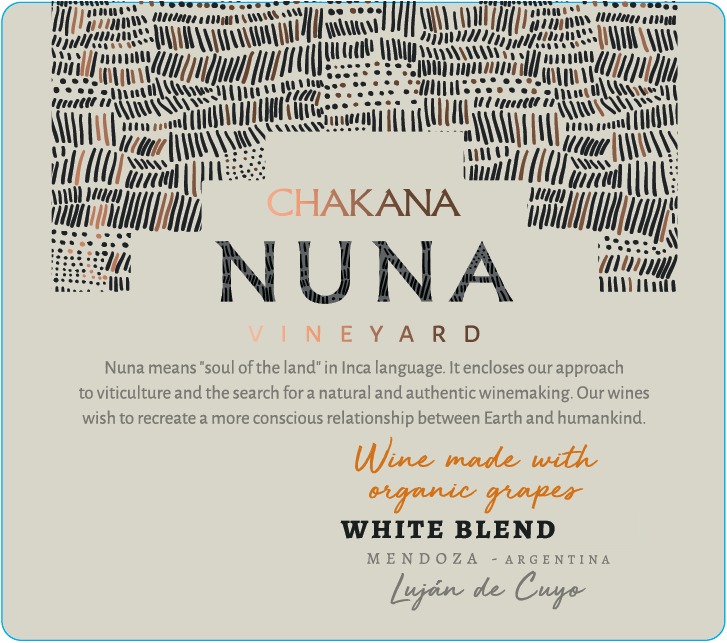
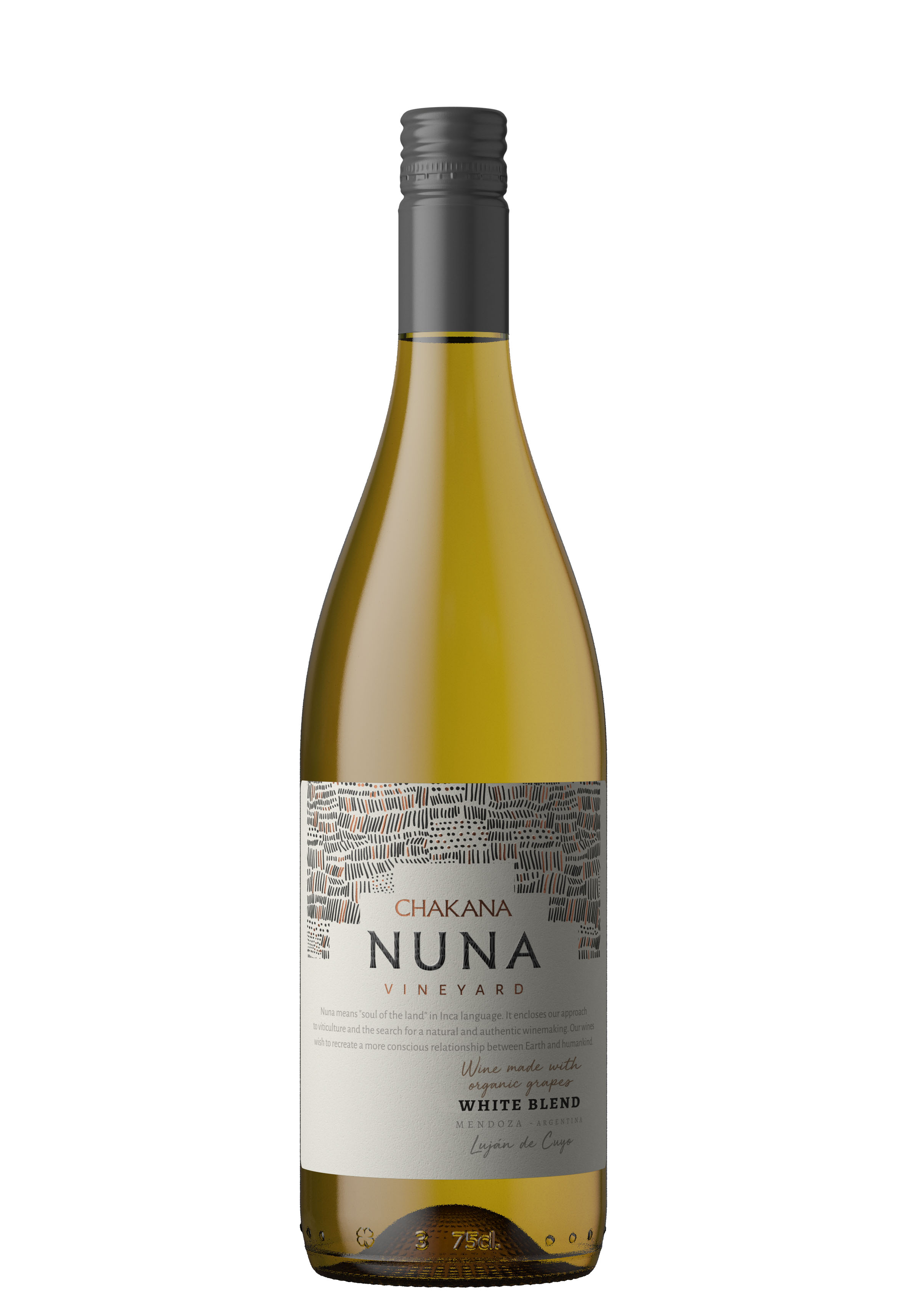
Nuna Estate White Blend is made from 40% Sauvignon Blanc, 40% Chardonnay, 20% Viognier
The wine captures the efforts to express the identiy of the soils and the people of the land. The field blend of international white varieties offers intense aromas of pineapple, honeysuckle, peach and apricot. The wine is medium-bodied with fleshy mouthfeel and excellent purity.
Manual harvest.The grapes are organically grown in Lujan de Cuyo, at 960 meters on the foothills of the Andes Mountains.
The Nuna Estate
Looking for Chakana's other labels?
Click below:
Nuna is produced in a state-of-the-art winery, Chakana, built with the purpose of achieving outstanding quality.
Chakana winery was founded by Juan Pelizzatti on May 2nd, 2002. Juan was driven to enter the wine industry first and foremost by his passion for wine, and also by the desire to invest his time and money on a product of agriculture. Although Juan did not know it at the time, the company was founded on the same day the Chakana was celebrated on the Andes highlands: on that same day, the Southern Cross (the Chakana for the Inca people) becomes vertical in the night Andean sky.
Juan's mission is to create an integral experience to introduce world consumers to the taste and culture of the Andes. His vision is to become one of the top 20 exporters of wine from Argentina, by consistently offering outstanding value for money.
Wine is currently produced in four different levels at Chakana, by winemaker Gabriel Bloise:
Entry Level: Maipe
Reserve Level: Maipe Reserve, Cueva de las Manos, Nuna
Estate Selection
Ayni
The winemaking process is focused on treating the grapes with great care and with strict control of every step of the production.
Wines are designed under the responsibility of the renowned international wine consultant Alberto Antonini.
The winery is located on a 150 ha. estate, 34 km South of the city of Mendoza, in Agrelo, Lujan de Cuyo.
The grapes grown are 35 year-old Malbec, Bonarda and Cabernet Sauvignon.
Deep and textured soils facilitate plant development and confer great body and structure to the wines.
The year-long sunny and dry conditions allow almost organic viticulture practices. The outstanding feature includes a great daily thermal amplitude, with mild days and cold nights, permitting a particular richness of polifenols that improves the wines flavors and color.
A drip irrigation system has been set up to achieve a precise control of the vegetative cycle and a rational use of water. Waters are processed and used in the vineyards.
The Nuna Estate Vineyards
Chakana sources grapes from their own four estates:
Agrelo
Acreage: 150 ha, 120 ha with vineyards
70 ha entry level
40 ha reserve level
10 ha estate & ayni
Acreage by varietal at Agrelo Estate:
Malbec: 50 ha
Cabernet Sauvignon: 30 ha
Syrah: 10 ha
Bonarda: 10 ha
Tannat: 2,5 ha
Petit Verdot: 2.5 ha
Cabernet Franc: 1.5 ha
Aspirant Bouchet: 2.5 ha
Ancellotta: 2 ha
Sauvignon Blanc: 4 ha
Viognier: 2.5 ha
Chardonnay: 2.5 ha
Wine Profile: Medium bodied, elegant, fresher fruit. Round tannin on gravels.
Terroir: Very heterogeneous – deep clay to sandy clay gravels; cool climate
Altamira I
Acreage: 15 ha, Malbec high density. Planted in 2010, not in production
Wine Profile: Full bodied, impressive tannic structure and roundness, spicy and complex.
Terroir: Sandy clay gravel, limestone; cooler climate
Altamira II
Acreage: 36 ha, 26 ha with vineyards
20 ha malbec, estate and ayni level
4 ha chardonnay, entry level and reserve
2 ha pinot noir (used for sparkling wine)
Wine Profile: Medium bodied, elegant, fresher fruit. Round tannin on gravels.
Terroir: Very heterogeneous – deep clay to sandy clay gravels; cool climate
Terrada
Acreage: 21 ha, all in vines
100% malbec, old vines, high density
Reserve – Estate Selection
Wine Profile: Complex, ripe fruit, medium bodied, elegant.
Terroir: Sandy clay gravels, 70cm. soil depth, Some limestone; warmer climate.
They also source wines from contract suppliers in Ugarteche and Medrano, for entry level wines, and in Vista Flores, for Estate Selection & Ayni levels.

Certified organic, ungrafted vines over 130 years old; a "grand cru" site of Paso Robles. Transcendent. Lovely sweet red fruits, loads of spice and pepper, violets, chalk, even a hint of pineapple grass on the nose. White stones and wild strawberries in a lovely pas de deux on the palate, with vibrant energy and finesse. What a knockout.
Review:
Broad-shouldered and powerfully structured yet detailed and stylish, with deep flavors of blackberry and cherry accented by bittersweet chocolate, orange peel and fruitcake spices that gather tension and richness on the slightly firm finish.
-Wine Spectator 95 Points

The 2022 Jayson Chardonnay achieves a beautiful equilibrium of richness, buoyancy, and intricacy. Aromas of sweet Meyer lemon, crushedalmond, and grilled pineapple lead to a concentrated palate of bright lemon curd and orange blossom honey underscored by fresh pear andtoasted nuttiness with a hint of baking spice. The texture is classic Pahlmeyer, plush and detailed, while the presence of bright Carneros fruitbrings energy and litheness. Flavors are lifted and extended on a spine of bright acidity, the lingering finish striking an ideal balance betweenopulence and mouthwatering freshness.
Review:
This generous, buttery and spicy wine is sourced from several parts of Napa Valley and brings gorgeous richness to the nose, palate and finish. Elements of brown butter, marzipan, toasted almonds and poached pears flood the flavors, with vanilla bean and a touch of sweet coconut. Barrel fermented in 36% new French oak, it’s full-bodied and nicely viscous in texture.
James Suckling 93 Points