" We don't sell the wine without touching the vine "
| Country: | France |
| Region: | Loire |
| Winery: | Maison Alain de la Treille |
| Grape Type: | Gamay |
| Organic: | Yes |
| Vintage: | 2021 |
| Bottle Size: | 750 ml |
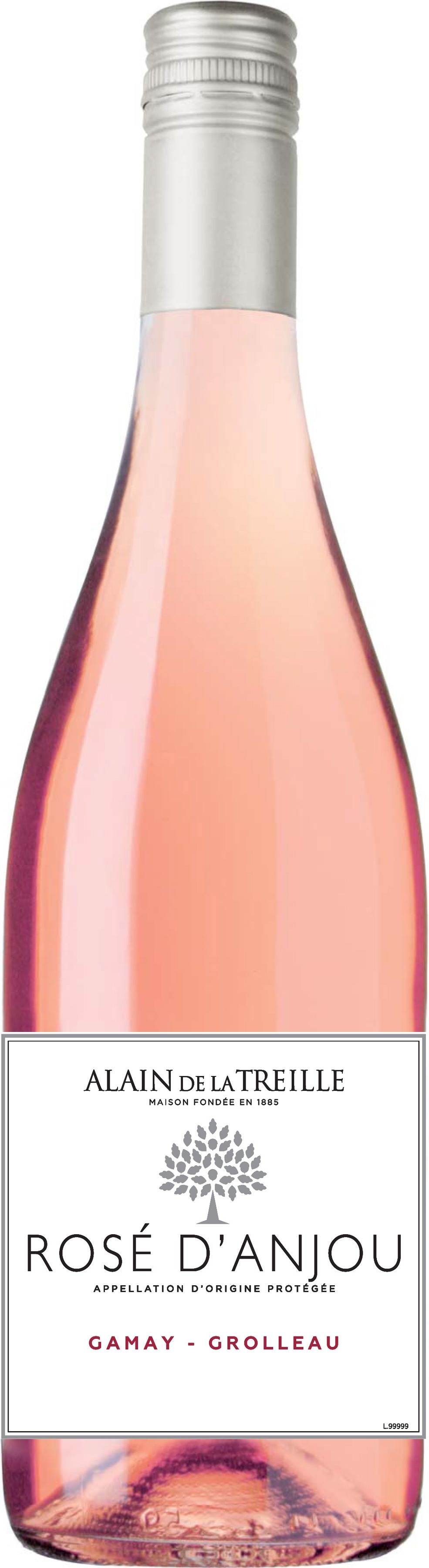
Alain de la Treille Rose d'Anjou is made from 50% Gamay, 50% Grolleau
The Rosé d'Anjou AOC, also known as Anjou Rosé AOC, produces medium-sweet rosés. Wines are made predominantly from Grolleau, with percentages of Cabernet Franc, Cabernet Sauvignon, Gamay, Malbec and Pineau d'Aunis permitted. Anjou soils reflect the geological identity of its border position between Armorican and Parisian basins. The terroirs consist of metamorphic and crystalline rocks (schist, sandstone) known as Anjou Noir, and ‘Terres Blanches’ (white earth) limestone known as Anjou Blanc. The AOC covers 1,890 hectares (4,668 acres).
The Grolleau grape derives its name from the French word ‘grolle’, meaning crow – a reflection of the dark black color of the grapes.
Crisp and refreshing with vibrant aromas of strawberry and raspberry. Juicy and well-balanced with a long finish.
Selective juice extraction to preserve color & aromas. Temperature controlled fermentation is followed by aging on the fine lees. No malolactic fermentation; no oak.
To be served chilled (10°C/50°F) with barbecued meats, salads, any spicy food, poultry dishes and of course appetizers.
This dry Rosé is very aromatic on the fruitiness with a great style and elegance.
Average age of the vines is 25 years old.
We produce a part of this cuvee with 12 hours skin maceration and another part from directly pressed grapes.
Wine was slightly filtered before bottling to insure the wine remains stable.
This wine is the perfect friend for barbecue, salads and of course aperitif. This is ideal for warm days in the garden, as well as elegant poultry dishes.
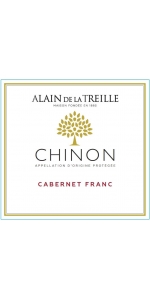
Alain de la Treille Chinon is 100 percent Cabernet Franc.
Our Chinon, with its bright intense purple colour, offers complex and mineral aromas and finally red fruits scents like blackcurrant and blueberry.
MAISON ALAIN DE LA TREILLE is located in the heart of Loire Valley since 1885. Vineyards owner and winemaker, ALAIN DE LA TREILLE creates diverse and delicate wines on the most prestigious vineyards: Muscadet, Touraine, Vouvray, Sancerre.
Average age of the vines is 20 years old.
Classic red vinification and Maturation in stainless steel vats
Wine was slightly filtered before bottling to ensure wine will remain stable
Pairs with roasted meats, « charcuteries » or any good cheese.
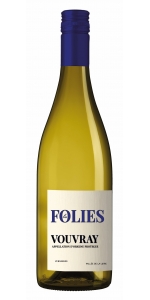
Alain de la Treille Les Folies Vouvray is made from 100 percent Chenin Blanc.
This is our newest Loire valley project, with an Eco friendly lightweight bottle and a screwcap.
Les Folies Vouvray is stunning with its elegancy and freshness which is carried through the ripe fruity palate, manned with hints of honey and apricots.
Les Folies Vouvray goes well with Asian food, fishes, charcuteries, BBQ pork spareribs or simply as an aperitif.
Alain de la Treille Les Folies Vouvray is made from 100 percent Chenin Blanc.
This is our newest Loire valley project, with an Eco friendly lightweight bottle and a screwcap.
Les Folies Vouvray is stunning with its elegancy and freshness which is carried through the ripe fruity palate, manned with hints of honey and apricots.
Les Folies Vouvray goes well with Asian food, fishes, charcuteries, BBQ pork spareribs or simply as an aperitif.
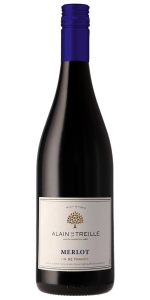
Alain de la Treille Merlot is made from 100 percent Merlot.
This Merlot has a deep red color. On the nose aromas of red fruits with a herbal note and spicy scents.
It is the perfect match for grilled meats, game and red meats.
Alain de la Treille Rose d'Anjou is made from 50% Gamay, 50% Grolleau
The Rosé d'Anjou AOC, also known as Anjou Rosé AOC, produces medium-sweet rosés. Wines are made predominantly from Grolleau, with percentages of Cabernet Franc, Cabernet Sauvignon, Gamay, Malbec and Pineau d'Aunis permitted. Anjou soils reflect the geological identity of its border position between Armorican and Parisian basins. The terroirs consist of metamorphic and crystalline rocks (schist, sandstone) known as Anjou Noir, and ‘Terres Blanches’ (white earth) limestone known as Anjou Blanc. The AOC covers 1,890 hectares (4,668 acres).
The Grolleau grape derives its name from the French word ‘grolle’, meaning crow – a reflection of the dark black color of the grapes.
Crisp and refreshing with vibrant aromas of strawberry and raspberry. Juicy and well-balanced with a long finish.
Selective juice extraction to preserve color & aromas. Temperature controlled fermentation is followed by aging on the fine lees. No malolactic fermentation; no oak.
To be served chilled (10°C/50°F) with barbecued meats, salads, any spicy food, poultry dishes and of course appetizers.
Review:
"Vivid, onion skin color. Ripe, spice-accented orange, white peach, rose oil and a touch of honey on the fragrant nose. Weighty and dry on the palate, offering chewy pit fruit and red berry flavors that firm up steadily through the back half. Closes energetic, taut and long, with the peach and spice notes repeating. - Josh Raynolds"
- Antonio Galloni's Vinous (July 2022), 90 pts
MAISON ALAIN DE LA TREILLE is located in the heart of Loire Valley since 1885. Vineyards owner and winemaker, ALAIN DE LA TREILLE creates diverse and delicate wines on the most prestigious vineyards with the same passion and aim: Offering the best expression of the French Terroir, keeping the highest respect of land and people.
Lionel Métaireau is the winemaker of MAISON ALAIN DE LA TREILLE since 2008. He is native of Le Pallet in the Muscadet Vineyard, close to Nantes. Belonging to the 6th generation of his family domain, Lionel is born in the winemaking world. He joined the MAISON ALAIN DE LA TREILLE in 2008 with the aim of revealing French varietal grapes with a local and unique style.
Vines are located outside the AOC boundaries, hence the wine is classified as Vin de France.
The winery is quite modern and the stainless steel tanks are thermoregulated in order to achieve specific profile (cold maceration).
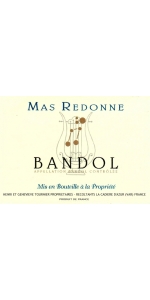
Mas Redonne Bandol Rose is made from 55% Mourvèdre, 35% Cinsault, 10% Grenache.
Nice light salmon color, typical of Bandol.
The wine expresses some citrus, Pomelos (a delicious type of grapefruit) and lots of white fruit aromas and minerality.
The flavors are fresh, fruity and very aromatic with tons of apricot and mango.
Grilled salmon, chicken dishes as well as salads, sushi and sashimi.
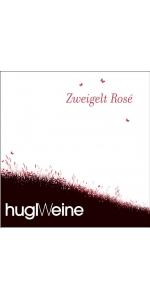
Despite its relative youth, Zweigelt is actually an Austrian classic. This variety was created in 1922, when Dr. Fritz Zweigelt crossed two grapes - St Laurent and Blaufränkisch. Originally, it was intended for the new variety to be called Rotburger, referring to the place where it was born, Klosterneuburg. But this name never took hold, and instead, Zweigelt was named after the man who was the key in its development.
Today, Zweigelt is the most widely planted red variety in Austria, growing in nearly 9% of this country's vineyards. It is a robust grape, highly resistant to dryness, frost and various diseases.
The wine boasts a pale rosé color, it has plenty of fruity aromas, with red cherry and wild strawberry flavors. It is medium-bodied, but it still have a nice long and pleasant finish with a light cinnamon type of spice to it.
Only the best grapes are harvested with a lot of experience and know-how and further processed. The grapes are fermented directly gently pressed and cooled. The fermentation takes place exclusively in stainless steel tanks.
Perfectly at home on any picnic, delicious with fried chicken, and tames the heat when paired with spicy dishes. There is also a slight watermelon note that makes it perfect for spring and summer. A great pairing with barbecued shrimp.
The Stone Terraces 2021 Vintage Port has incredibly fresh and lifted aromas with the hallmark tropical fruit character. The wine is concentrated whilst being supremely refined with polished tannins and taut acidity combining to deliver sublime elegance and balance.
Review:
What a polished and beautifully structured vintage port with ultra-fine tannins that run the length of the wine. It’s medium-bodied with a terrific intensity and brightness. Seems slightly drier than normal for a Graham’s vintage. Fantastically fine tannins. Black berries and tangerines with other tropical fruits. Hints of nuts at the end. Racy and muscular.
-James Suckling 95 Points
Peter Michael 'L'Esprit des Pavots' Estate Red is made from 59% Cabernet Sauvignon, 22% Merlot, 11% Cabernet Franc, 8% Petit Verdot.
The saturated garnet 2022 ‘L’Esprit des Pavots’ features an intense nose of cassis, black cherry, ripe plum and blackberries with hints of black olive, black tea and baking spices. The soft, supple entry and round generous tannins combine for a plush mouthfeel and elegant finish. This is a fleshy vintage of ‘L’Esprit des Pavots’ which can be approached in its early years but will continue to expand with age.
Review:
“The deep ruby/magenta-colored 2022 Cabernet Sauvignon L’Esprit Des Pavots is a blend of Knights Valley and Oakville… fruity upfront… rich and concentrated… polished tannins and a great finish. A great value in the vintage.”
- Jeb Dunnuck 95 points