" We don't sell the wine without touching the vine "
| Country: | France |
| Region: | Rhone |
| Winery: | Alain Jaume |
| Grape Type: | Grenache |
| Vintage: | 2017 |
| Bottle Size: | 750 ml |
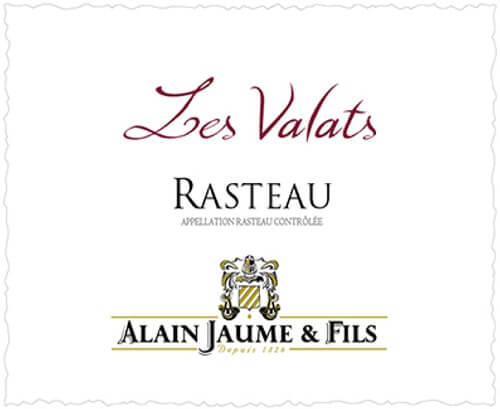
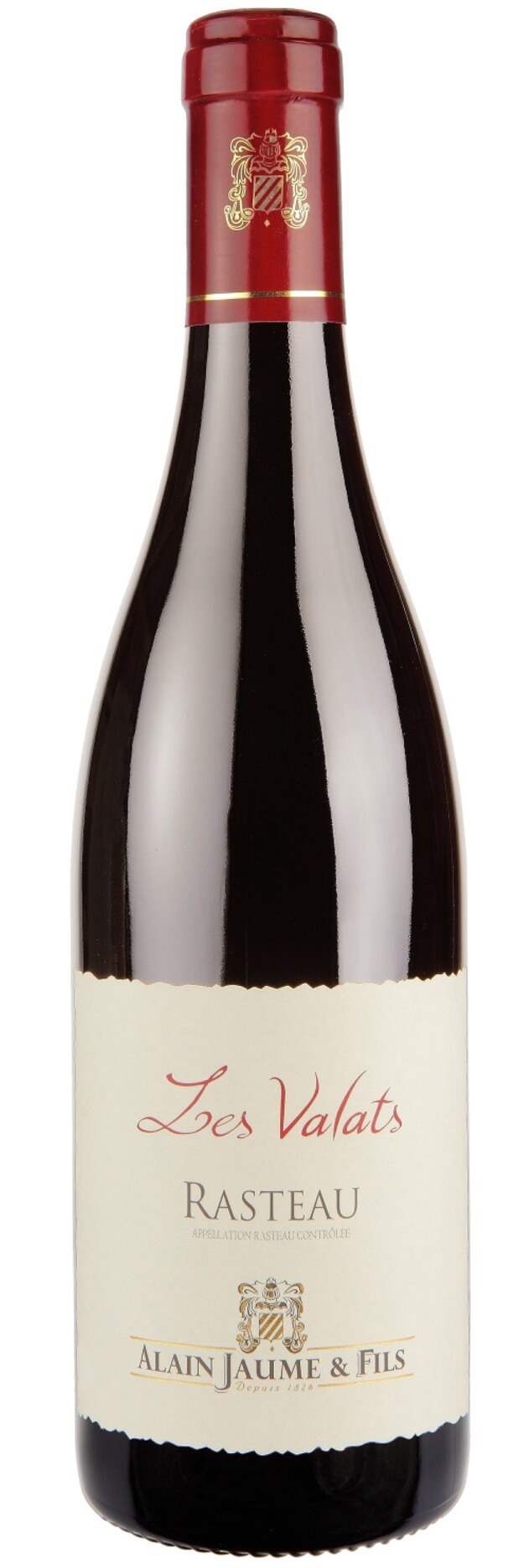
Alain Jaume Rasteau Les Valats is made from 80% Grenache, 10% Syrah, 10% Mourvedre planted on clay and stones based soil.
Located in the northern part of the Vaucluse, the soils are mostly on slopes with limestone and rocks, at medium altitude (until 350 meters).
Grapes usually ripeness in late September. The soils are poor and the Mediterranean climate allows to produce concentrated and well balanced grapes. The place is well-known for producing wines with strong identity.
From the Cotes du Rhone Villages classification, RASTEAU has been upgraded to Cru level since the 2009 vintage.
The wine shows a deep red garnet color and a nose of fresh red berries. On the palate, the richness of the fruit and tannins harmonizes with the roundness of the wine. The finish is long, with spicy and mineral notes. Complete and authentic.
Alain Jaume Cairanne Les Travees is made from 65% Grenache, 35% Syrah, 5% Mourvèdre.
Our selected vines for this cuvée are on slopes facing south.
.
The wine delivers an intensive nose, with loads of black fruits.
Starting full and concentrated, with silky tannins, the mouth reveals blackcurrant and a cherry fruit typicity.
It finishes with typical notes of pepper and earth.
Enjoy with roasted lamb or braised or BBQed pork. gpoes also very well with mild cheese, such as brie or camenbert.
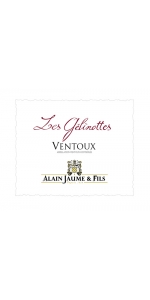
Alain Jaume Ventoux Les Gelinottes is made from 50% Grenache and 50% Syrah
The colour is intense, purple-tinged garnet. The aromatic range of the nose goes from fresh berries to black fruit (blackcurrant, blackberry). The palate is full-flavoured, with very soft tannins and aromas of the fruit already mentioned. This is a gorgeous style of wine, fruity driven, for every day drinking...anytime !
Soil types
The wine is produced from hilly vineyards that are mainly planted on sandy and clay soils. They are located on the East side of the Rhone valley, in the Vaucluse area. Welcome to the foothills of the well known “Mont Ventoux” Mountain.
Winemaking and aging
Stainless steel fermentaion at cool temperature to preserve the fruits and typicity. Bottling 8 months after the harvest.
Goes well with quite a lot of food such as Pizza, Pasta, hamburger, mild cheese or even on its own.
Alain Jaume Ventoux Les Gelinottes is made from 50% Grenache and 50% Syrah
The colour is intense, purple-tinged garnet. The aromatic range of the nose goes from fresh berries to black fruit (blackcurrant, blackberry). The palate is full-flavoured, with very soft tannins and aromas of the fruit already mentioned. This is a gorgeous style of wine, fruity driven, for every day drinking...anytime !
Soil types
The wine is produced from hilly vineyards that are mainly planted on sandy and clay soils. They are located on the East side of the Rhone valley, in the Vaucluse area. Welcome to the foothills of the well known “Mont Ventoux” Mountain.
Winemaking and aging
Stainless steel fermentaion at cool temperature to preserve the fruits and typicity. Bottling 8 months after the harvest.
Goes well with quite a lot of food such as Pizza, Pasta, hamburger, mild cheese or even on its own.
Alain Jaume Ventoux Les Gelinottes is made from 50% Grenache and 50% Syrah
The colour is intense, purple-tinged garnet. The aromatic range of the nose goes from fresh berries to black fruit (blackcurrant, blackberry). The palate is full-flavoured, with very soft tannins and aromas of the fruit already mentioned. This is a gorgeous style of wine, fruity driven, for every day drinking...anytime !
Soil types
The wine is produced from hilly vineyards that are mainly planted on sandy and clay soils. They are located on the East side of the Rhone valley, in the Vaucluse area. Welcome to the foothills of the well known “Mont Ventoux” Mountain.
Winemaking and aging
Stainless steel fermentaion at cool temperature to preserve the fruits and typicity. Bottling 8 months after the harvest.
Goes well with quite a lot of food such as Pizza, Pasta, hamburger, mild cheese or even on its own.
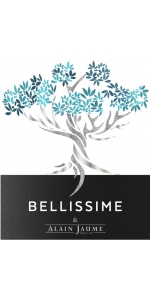
Alain Jaume Bellissime Cotes du Rhone Rose is made from 50% Grenache Noir, 25% Cinsault, 20% Syrah and 5% Mourvedre
Salmon-pink color, clear and brilliant. The nose is fruity and spicy, reminiscent of wild strawberry and fine Provencal spices. The palate is full, well-balanced and fruity, with a long, fresh finish. A beautiful and delicate rosé.
A part is drawn off the skins with short maceration and the other part is from direct press. Fermentation in stainless steel at cool temperature. Bottling 5 months after harvest.
Alain Jaume Rasteau Les Valats is made from 80% Grenache, 10% Syrah, 10% Mourvedre planted on clay and stones based soil.
Located in the northern part of the Vaucluse, the soils are mostly on slopes with limestone and rocks, at medium altitude (until 350 meters).
Grapes usually ripeness in late September. The soils are poor and the Mediterranean climate allows to produce concentrated and well balanced grapes. The place is well-known for producing wines with strong identity.
From the Cotes du Rhone Villages classification, RASTEAU has been upgraded to Cru level since the 2009 vintage.
The wine shows a deep red garnet color and a nose of fresh red berries. On the palate, the richness of the fruit and tannins harmonizes with the roundness of the wine. The finish is long, with spicy and mineral notes. Complete and authentic.
Review:
"A blend of 90% Grenache and 10% Syrah, the 2017 Rasteau Les Valats is a classic example of this terroir and offers a darker, smoky, earthy, and chocolaty vibe as well as a rich, mouthfilling style on the palate. Nicely balanced, with a fleshy, expansive mid-palate and great tannins, it’s total charmer to enjoy over the coming 7-8 years."
- Jeb Dunnuck (October 2020), 90 pts
"Very open red-fruit aromas and a rather cool, slightly minty personality make this a good introduction to this underrated Southern Rhone appellation. Good harmony and rather lively for its age at the clean finish. Drink now."
- James Suckling (February 2022), 90 pts
The Alain Jaume Winery
Established in 1826 in the Northern part of Chateauneuf du Pape, the Alain Jaume Winery boasts both the exceptional terroir of the Southern Rhone Valley and a long line of dedicated winemakers. Alain Jaume works in accordance with certified organic agricultural practices for both the Grand Veneur and Clos de Sixte vineyards. They strive to let the true terrior be expressed in their wines.
The principal winemaker is Alain Jaume. His sons Sebastien and Christophe are both heavily involved with the winery in sales and marketing and winemaking respectively. The Alain Jaume winery consists of 40 acres in Chateauneuf du Pape, 50 acres in Lirac, and 75 acres of Cotes du Rhone vines. The family produces wines under two labels: Domaine Grand Veneur and Alain Jaume.
In 1320 Pope Jean XXII planted the first vines of Chateauneuf-du-Pape, but it was only in 1360 that the wines of the region first gained fame. Oddly, the wine that gave Chateauneuf-du-Pape its original reputation was the White and not the Red. The white wine was a favorite of Pope Innocent VI. The Domaine dates back to 1826, having been founded at that time by Mathieu Jaume. Since 1979, Alain Jaume has run the Domaine and now has the help of his two sons: Sebastien and Christophe.
"Popes throughout history have liked their juice, and when the papal see moved to Avignon in the 13th century, that juice was Chateauneuf-du-Pape ("the pope's new castle") made from grapes grown nearby in the Southern Rhône. The castle is a ruin now, the papal court long gone back to Rome, but the wines that bear the pope's coat of arms emblazoned on the bottle are still produced more or less according to the long-standing recipe. Not every winemaker uses all 13 of the grapes in the proscribed blend, though. At Domaine Grand Veneur, an estate that dates to 1826, Alain Jaume and his sons Sebastien and Christophe emphasize Grenache blended with Syrah and Mourvèdre."
- Los Angeles Times
"Improved Chateauneuf with very accomplished, stylish reds since the late 1990s; also very good Vacqueyras and Cotes-du-Rhône Villages." - Anthony Dias Blue's pocket guide to wine 2006
"Grand Veneur is one of the most brilliant estates in Chateauneuf du Pape as well as the force behind the negociant wines sold under the Alain Jaume label. Virtually everything they produce has merit. Some of this estate’s 2009 red wines are just hitting the market as they are bottled early to preserve their fruit and freshness. I can’t say enough about the job Alain Jaume’s two sons, Sebastian and Christophe, have done with this estate. The impeccable attention to detail in the vineyards, the meticulous vinification, and the careful bottling benefit every consumer." - Wine Advocate (#190, August 2010)
"Great bargains continue to emerge from Domaine Grand Veneur as well as from their negociant arm of the business, labeled Alain Jaume" - Wine Advocate (#195, June 2011)
"One of the best-run and highest quality estates of the Southern Rhone is Domaine Grand Veneur, now run by the younger generation of the Jaume family, Sebastien and Christophe. The brothers have done a fabulous job taking over for their quality-oriented father, Alain. These are their less expensive wines, but I will follow up later this year with my reviews of their 2010 Chateauneuf du Papes as well as the 2011s, which I have not yet tasted. They have certainly gotten a good start on their 2011 less expensive Cotes du Rhone selections. The Jaumes are some of the finest practitioners of white winemaking in the Southern Rhone and showcase that with their least expensive offerings, which are creative blends that over-deliver." - Wine Advocate (Issue #201, June 2012)
Some wines by Alain Jaume Winery:
Any Alain Jaume wines we have in stock are listed below, if you don’t see the wine you are looking for please don’t hesitate to ask for it.
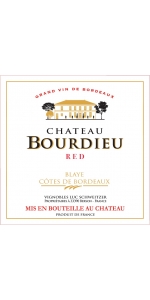
Bourdieu Blaye Cotes de Bordeaux is made from 87% Merlot, 10% Cabernet Sauvignon and 3% Cabernet Franc.
Chateau Bourdieu Blaye Cotes de Bordeaux offers a beautiful red ruby color deep and intense. It exhales red fruits and blackcurrant aromas, completed by notes of redcurrant. The mouthfeel is round and juicy, with a smooth, well integrated tannins that offers a nice structure and a long finish.
Perfect with a magret de canard (duck breast) or a filet of beef.
Review:
"Brooding blackcurrant, black cherry and cassis combine beautifully with fine tobacco and cedar notes. Persistent and concentrated with satin tannins and supporting acidity. Long and finessed."
-Decanter, (July 2024), Gold Medal - 95 points
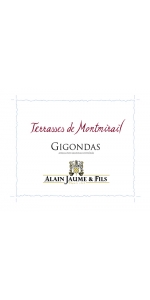
Alain Jaume Gigondas Terrasses de Montmirail is made from 65% Grenache the rest Syrah, Mourvèdre by less than 15%.
Deep red garnet color. Aromas of ripe and black fruits. On the palate the wine is rich, powerful and harmonious - well balanced with wild berry and pepper dominating.
Soil types
Located in and around the famous area called “Dentelles de Montmirail”, the landscape typicity is made by a rocky bar (between 100 and 600 meters high). Soils are made of clay and sand with limestone. The “Dentelles” appeared thanks to the pressure between the Pyrenees and Alps mountains. This is a land of predilection to produce both powerful and fresh wines. Nights are cooler and the grapes ripeness usually comes in late September.
Winemaking & aging
Traditional wine-making in stainless and concrete vats. Crushed and destemmed grapes. Average of 18 days of vatting with pigeages. Ageing in vats mostly and oak barrels. Bottling after 12 – 14 months.
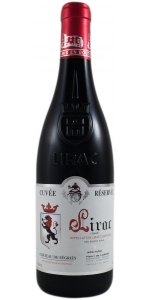
Segries Lirac Rouge Cuvee Reservee is made from 50% Grenache, 30% Syrah, 10% Cinsault, 10% Mourvèdre
Dark garnet in color. Expressive Red fruits and spicy. Sweet tannins and good length
Ageing up to 10 years
Vineyards Clay and limestone Area: 24 hectares Age of Vines: 80 years Yeild: 24 Hl/Ha Production: 570 Hl Harvest and VInification Harvest by hand and 100% destemmed. Maceration for 21 days in cement tank - Fermentation with controlled temperature at Château de Ségriès.
Pairs well with Stews, Grilled meats, Game, Various cheeses
Review:
The 2022 Lirac Cuvée Réservée is also brilliant, with a juicy, layered, incredibly Provençal profile that has so much to love. Ripe black cherries, leather, peppery garrigue, and spice notes all give way to a medium to full-bodied, round, lush Southern Rhône that's balanced and has beautiful fruit as well as outstanding length. Based on 50% Grenache, 30% Syrah, and the balance Cinsault and Mourvèdre, destemmed and brought up in concrete, drink bottles over the coming 5-7 years.
-Jeb Dunnuck 93 Points
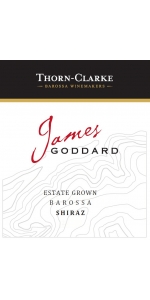
James Goddard was an ancestor of the Clarke family. Born in West Sussex, England in 1823, James spent his 74 years as a sailor, a whaler, a bullock driver, farmer, prospector, miner and hotel keeper. From an illiterate runaway living rough on the streets of London, he became a rich, successful and admired pillar of South Australian society.
James arrived in Adelaide in 1839 as a 16-year-old sailor. Twelve years later, his life changed forever with the news of gold findings. For the next 20 years, James roamed the country learning the geology that improved his chances of prospecting.
James Goddard Shiraz is made from 100 percent Shiraz.
In 1870, he tried his luck near his farm in the Barossa Valley and discovered the region’s first gold deposits, creating the prosperous Lady Alice Mine. The Lady Alice Mine, though it is no longer operational, was & still is the most successful gold mine in South Australia. From these roots, the Thorn-Clarke family has been connected to the region for the last 150 years.
James Goddard Shiraz is a blend Shiraz sourced from the Milton Park vineyard in the north of Eden Valley, and the St Kitts vineyard in the far northern area of the Barossa. Fruit is harvested in the cool of the night to maintain maximum flavour and freshness and it is fermented for 8 days. The ferment is pumped over twice daily to extract the colour and flavour from the fruit. Once finished fermentation the wine was then matured in a blend of French and American oak for a period of 10 to 12 months depending on the vintage.
Deep vibrant red with purple hues to the rim. The nose shows lifted plums, vibrant purple berries and a delicate spice note. The palate has concentrated satsuma plum, blackberry with lovely charry oak in the background. Long, juicy and even with plush fruit on the finish.
Review:
“Blended from two estate vineyards, St. Kitts and Milton Park, this shiraz offers its richness without any aggression or overt perfume. It’s just lush and delicious, a friendly embrace of firm tannins and purple-red fruit. The texture and flavor combine in a saturated meatiness, for Korean barbecue.”
- Wine & Spirits Magazine, 92 points
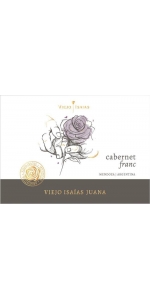
Viejo Isaias Juana Cabernet Franc is made from 100 percent Cabernet Franc.
Cabernet Franc has an intense bright velvety red color. In the nose this wine reveals a complex expression marked by fresh berries followed by hints of floral aromas. It also displays some smoke and vanilla from the oak barrels. It is rich and balanced in the mouth with an elegant tannic structure and long fresh fruit end.
Vineyard information:
Location: Perdriel, Luján de Cuyo, on the highest area of the Mendoza river - Mendoza.
Altitude: 950m above sea level.
Soil: Stony, from Alluvial origins
Coming from our estate vineyards in Perdriel and Lujan de Cuyo.
Aged in 50% French and 50% American Oak barrels for 12 months. First and second use only.
Wine was slightly filtered before bottling.
Excellent when paired with red meats, pasta with spicy sauces, matured cheeses.
Review:
"Hints of plums and dark berries with some dried flowers, following through to a medium body with round tannins and a juicy finish. Bigger in nature. Drink or hold."
- James Suckling (March 2022), 92 pts
Alain Jaume Cairanne Les Travees is made from 65% Grenache, 35% Syrah, 5% Mourvèdre.
Our selected vines for this cuvée are on slopes facing south.
.
The wine delivers an intensive nose, with loads of black fruits.
Starting full and concentrated, with silky tannins, the mouth reveals blackcurrant and a cherry fruit typicity.
It finishes with typical notes of pepper and earth.
Enjoy with roasted lamb or braised or BBQed pork. gpoes also very well with mild cheese, such as brie or camenbert.

All older vintage wines have been purchased from a single collectors cellar. Pictures can be requested before shipment.
Clear and deep ruby in color, lightening at the rim, with light staining in the glassand moderately thick tears. Medium intensity on the nose with rich red plum, blackberry jam, cocoa powder, and savory tea leaf. A vein of earthy minerality brings complexity to juicy fruit and autumn spice. Oak lends warm vanilla, caramel, and allspice. Dry and full-bodied with intense, youthful red fruit on the palate. Bing cherry and blackberry notes are layered with leather, espresso, and nutmeg, and the long finish is accented with well-integrated tannin and an element of acidity that keeps the wine from being heavy.
The bold fruit and spice character of this 2022 Reserve Cabernet Sauvignon would pair perfectly with balsamic braised beef with creamy parmesan polenta, or an earthy, complex dish such as eggplant moussaka.
Review:
Here is a big, powerful Cabernet that pushes the envelope. The 2022 vintage was another drought year, and Paso Robles experienced late season heat waves. Made from 100% Cabernet that was aged for 21 months in French oak, 50% of it new, it clocks in at 15.5 % alcohol. However, when tasted blind, it offers an aroma of ultra-ripe black berries, chocolate, and spices that by the final swirl is absolutely gorgeous. Full-bodied with very juicy black fruit flavors and spice backed up by toasty oak, it all holds together seamlessly thanks to integrated tannins. The finish ends on a light toasty oak note. The real challenge is to pair it with a comparably robust main course.
-Wine Review Online 93 Points