" We don't sell the wine without touching the vine "
| BUY MORE! SAVE MORE! | ||||||||||||||||
|
| Country: | France |
| Region: | Rhone |
| Winery: | Alain Jaume |
| Grape Types: | Grenache Syrah |
| Vintage: | 2023 |
| Bottle Size: | 750 ml |
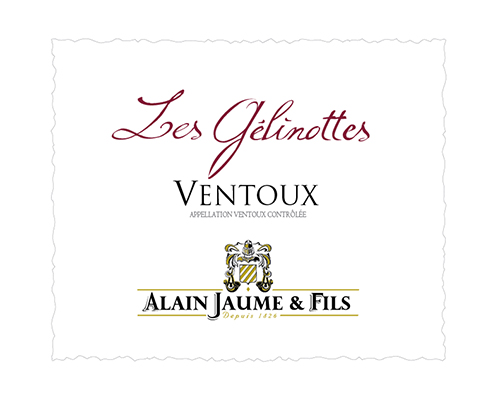
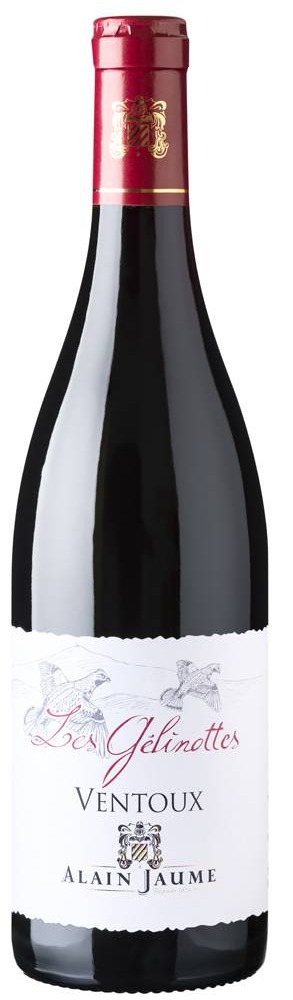
Alain Jaume Ventoux Les Gelinottes is made from 50% Grenache and 50% Syrah
The colour is intense, purple-tinged garnet. The aromatic range of the nose goes from fresh berries to black fruit (blackcurrant, blackberry). The palate is full-flavoured, with very soft tannins and aromas of the fruit already mentioned. This is a gorgeous style of wine, fruity driven, for every day drinking...anytime !
Soil types
The wine is produced from hilly vineyards that are mainly planted on sandy and clay soils. They are located on the East side of the Rhone valley, in the Vaucluse area. Welcome to the foothills of the well known “Mont Ventoux” Mountain.
Winemaking and aging
Stainless steel fermentaion at cool temperature to preserve the fruits and typicity. Bottling 8 months after the harvest.
Goes well with quite a lot of food such as Pizza, Pasta, hamburger, mild cheese or even on its own.
The Alain Jaume Winery
Established in 1826 in the Northern part of Chateauneuf du Pape, the Alain Jaume Winery boasts both the exceptional terroir of the Southern Rhone Valley and a long line of dedicated winemakers. Alain Jaume works in accordance with certified organic agricultural practices for both the Grand Veneur and Clos de Sixte vineyards. They strive to let the true terrior be expressed in their wines.
The principal winemaker is Alain Jaume. His sons Sebastien and Christophe are both heavily involved with the winery in sales and marketing and winemaking respectively. The Alain Jaume winery consists of 40 acres in Chateauneuf du Pape, 50 acres in Lirac, and 75 acres of Cotes du Rhone vines. The family produces wines under two labels: Domaine Grand Veneur and Alain Jaume.
In 1320 Pope Jean XXII planted the first vines of Chateauneuf-du-Pape, but it was only in 1360 that the wines of the region first gained fame. Oddly, the wine that gave Chateauneuf-du-Pape its original reputation was the White and not the Red. The white wine was a favorite of Pope Innocent VI. The Domaine dates back to 1826, having been founded at that time by Mathieu Jaume. Since 1979, Alain Jaume has run the Domaine and now has the help of his two sons: Sebastien and Christophe.
"Popes throughout history have liked their juice, and when the papal see moved to Avignon in the 13th century, that juice was Chateauneuf-du-Pape ("the pope's new castle") made from grapes grown nearby in the Southern Rhône. The castle is a ruin now, the papal court long gone back to Rome, but the wines that bear the pope's coat of arms emblazoned on the bottle are still produced more or less according to the long-standing recipe. Not every winemaker uses all 13 of the grapes in the proscribed blend, though. At Domaine Grand Veneur, an estate that dates to 1826, Alain Jaume and his sons Sebastien and Christophe emphasize Grenache blended with Syrah and Mourvèdre."
- Los Angeles Times
"Improved Chateauneuf with very accomplished, stylish reds since the late 1990s; also very good Vacqueyras and Cotes-du-Rhône Villages." - Anthony Dias Blue's pocket guide to wine 2006
"Grand Veneur is one of the most brilliant estates in Chateauneuf du Pape as well as the force behind the negociant wines sold under the Alain Jaume label. Virtually everything they produce has merit. Some of this estate’s 2009 red wines are just hitting the market as they are bottled early to preserve their fruit and freshness. I can’t say enough about the job Alain Jaume’s two sons, Sebastian and Christophe, have done with this estate. The impeccable attention to detail in the vineyards, the meticulous vinification, and the careful bottling benefit every consumer." - Wine Advocate (#190, August 2010)
"Great bargains continue to emerge from Domaine Grand Veneur as well as from their negociant arm of the business, labeled Alain Jaume" - Wine Advocate (#195, June 2011)
"One of the best-run and highest quality estates of the Southern Rhone is Domaine Grand Veneur, now run by the younger generation of the Jaume family, Sebastien and Christophe. The brothers have done a fabulous job taking over for their quality-oriented father, Alain. These are their less expensive wines, but I will follow up later this year with my reviews of their 2010 Chateauneuf du Papes as well as the 2011s, which I have not yet tasted. They have certainly gotten a good start on their 2011 less expensive Cotes du Rhone selections. The Jaumes are some of the finest practitioners of white winemaking in the Southern Rhone and showcase that with their least expensive offerings, which are creative blends that over-deliver." - Wine Advocate (Issue #201, June 2012)
Some wines by Alain Jaume Winery:
Any Alain Jaume wines we have in stock are listed below, if you don’t see the wine you are looking for please don’t hesitate to ask for it.

Alain de la Treille Les Folies Vouvray is made from 100 percent Chenin Blanc.
This is our newest Loire valley project, with an Eco friendly lightweight bottle and a screwcap.
Les Folies Vouvray is stunning with its elegancy and freshness which is carried through the ripe fruity palate, manned with hints of honey and apricots.
Les Folies Vouvray goes well with Asian food, fishes, charcuteries, BBQ pork spareribs or simply as an aperitif.
-150x300.jpg "Alexandre M Vouvray Brut Methode Traditionnelle NV")
Alexandre M Vouvray Brut Methode Traditionnelle is made from 100% Chenin Blanc.
Tasting: Nose lime tree flower and brioche.
Mouth: complex and very expressive, so fresh and balanced with a smooth touch in mouth, bubbles so small who just tease the tang, light and good length.
ZERO DOSAGE !
Aperitif, seafood, oysters, light hard sheeses, and just for fun

Gentilhommes Vire-Clesse is made from 100% Chardonnay.
A gentilhomme is a gentleman characterized by his delicacy, thoughtfulness, and courtesy. "Les Gentilhommes" was created by brothers Richard and Stephane Martin as brand embodying the gentleman's character combined with Burgundian know-how.
From the work in the vineyard to the vinification in barrel, they are inspired to share these noble values. Quality, authenticity and long family tradition are the foundation of these wines.
This single-vineyard Chardonnay is produced in the village of Clessé, in the heart of the Mâconnais region in Burgundy, from 45 year-old vines planted on the limestone based soils of the Mount Epin.
Brillant robe with golden reflections. A nose with pear and white peach notes. Fresh, ample and full-bodied, a great balance in the mouth, with tension and subtle wooden notes. The elegance of this pure wine lingers on the palate.
Harvest is made by machine on non-irrigated vineyard. The wine has been aged on fine lees for 10 months with the major part in a stainless steel vat and the remaining in new oak barrels made out of French oak of a high quality.
No use of sulfites during harvest and vinification.
Fresh, ample and full-bodied on the palate, the wine is perfect by itself as an aperitif and delicious during the meal with grilled fish tacos or a Pad Thaï.

Kasteelberg Pinotage is made from 100 percent Pinotage.
The Kasteelberg range of wines, celebrates the discovery of Riebeek and the Kasteelberg mountains in 1661. Kasteelberg stands sentinal over the fertile valley below. From the slopes of the mountians, hand-selected grapes are expertly crafted with care to produce rare and expressive wines. The Kasteelberg range truly is the pinnacle of our Winemakers'art.
Harvested from an exceptional vineyard in the heart of the Swartland, the Kasteelberg Pinotage is characterised as a well-structured wine, offering layers of flavours and aromas. Seductive rich plum flavors with notes of captivating dark chocolate follows through in a smooth and lingering palate of intense flavors integrated with the freshness of ripened cherries.
Grapes used for this wine are coming from vines that are 10 years old in average. It is also sustainable farming used for this plot.
The grapes were cold-soaked for 3 days at 10°C to extract as much color as possible before fermentation. After cold-soaking, the temperature is increased to around 18°C and yeast is added to start fermentation. Regular pump-overs are done to enhance skin contact which improves the flavor and color profiles. Fermentation temperature between 22 - 26°C. Fermented dry on skins, pressed. After malolactic fermentation, wine is transferred to barrels. French oak barrels, 2nd, 3rd and 4th fill barrels for 12 months.The grapes were cold-soaked for 3 days at 10°C to extract as much color as possible before fermentation. After cold-soaking, the temperature is increased to around 18°C and yeast is added to start fermentation. Regular pump-overs are done to enhance skin contact which improves the flavor and color profiles. Fermentation temperature between 22 - 26°C. Fermented dry on skins, pressed. After malolactic fermentation, wine is transferred to barrels. French oak barrels, 2nd, 3rd and 4th fill barrels for 12 months.

Alain Jaume Ventoux Les Gelinottes is made from 50% Grenache and 50% Syrah
The colour is intense, purple-tinged garnet. The aromatic range of the nose goes from fresh berries to black fruit (blackcurrant, blackberry). The palate is full-flavoured, with very soft tannins and aromas of the fruit already mentioned. This is a gorgeous style of wine, fruity driven, for every day drinking...anytime !
Soil types
The wine is produced from hilly vineyards that are mainly planted on sandy and clay soils. They are located on the East side of the Rhone valley, in the Vaucluse area. Welcome to the foothills of the well known “Mont Ventoux” Mountain.
Winemaking and aging
Stainless steel fermentaion at cool temperature to preserve the fruits and typicity. Bottling 8 months after the harvest.
Goes well with quite a lot of food such as Pizza, Pasta, hamburger, mild cheese or even on its own.
Alain Jaume Ventoux Les Gelinottes is made from 50% Grenache and 50% Syrah
The colour is intense, purple-tinged garnet. The aromatic range of the nose goes from fresh berries to black fruit (blackcurrant, blackberry). The palate is full-flavoured, with very soft tannins and aromas of the fruit already mentioned. This is a gorgeous style of wine, fruity driven, for every day drinking...anytime !
Soil types
The wine is produced from hilly vineyards that are mainly planted on sandy and clay soils. They are located on the East side of the Rhone valley, in the Vaucluse area. Welcome to the foothills of the well known “Mont Ventoux” Mountain.
Winemaking and aging
Stainless steel fermentaion at cool temperature to preserve the fruits and typicity. Bottling 8 months after the harvest.
Goes well with quite a lot of food such as Pizza, Pasta, hamburger, mild cheese or even on its own.

Alain Jaume Rasteau Les Valats is made from 80% Grenache, 10% Syrah, 10% Mourvedre planted on clay and stones based soil.
Located in the northern part of the Vaucluse, the soils are mostly on slopes with limestone and rocks, at medium altitude (until 350 meters).
Grapes usually ripeness in late September. The soils are poor and the Mediterranean climate allows to produce concentrated and well balanced grapes. The place is well-known for producing wines with strong identity.
From the Cotes du Rhone Villages classification, RASTEAU has been upgraded to Cru level since the 2009 vintage.
The wine shows a deep red garnet color and a nose of fresh red berries. On the palate, the richness of the fruit and tannins harmonizes with the roundness of the wine. The finish is long, with spicy and mineral notes. Complete and authentic.

Alain Jaume Cairanne Les Travees is made from 65% Grenache, 35% Syrah, 5% Mourvèdre.
Our selected vines for this cuvée are on slopes facing south.
.
The wine delivers an intensive nose, with loads of black fruits.
Starting full and concentrated, with silky tannins, the mouth reveals blackcurrant and a cherry fruit typicity.
It finishes with typical notes of pepper and earth.
Enjoy with roasted lamb or braised or BBQed pork. gpoes also very well with mild cheese, such as brie or camenbert.

Alain Jaume Chateauneuf Du Pape Rouge Vieux Terron is made from 85% Grenache, 10% Syrah, 5% Mourvèdre
An intense purple color is followed by ripe red fruit aromas, such as sweet black cherry.
The palate reveals clearly the aromatic complexity: spices and black fruit are boasted with soft tannins. The finish is long with aromatic hints of liquorice and pepper. Red raspberries, star anise and hints of cinnamon.
It will accompany game, red meat or meat in sauce and strong cheeses.
Soil types
Châteauneuf du Pape vineyards are mostly located on plateaux. Stony-clay soil covered with large rolled stones. Some plots are more sandy.
Winemaking and aging
Harvest is destemmed and crushed. Fermentation temperature is controlled at 30°C. Vatting period of 18 to 21 days. Matured in vats (80%) and oak casks (20%).

Alain Jaume Cotes Du Rhone Rouge Haut de Brun is made from 60% Grenache, 30% Syrah, 10% Cinsault
The colour is purple-tinged garnet.The aromatic range of the nose goes from fresh berries (wild raspberry, blackcurrant, blackberry) to spices.The palate is big and full-flavoured, with silky-smooth tannins and aromas of the fruit already mentioned. The finish introduces touches of liquorice and pepper. A Côtes du Rhône with great complexity for an every day drinking.
A classic Rhône to drink between 1 and 4 years. Best poured at 17°C.
Traditional wine making and ageing is performed in vats only. Bottling after 10-12 months.
Ideal throughout the meal, but particularly with poultry and other white meats, as well as mild cheeses.

Hailing from over two dozen vineyards across the beautiful Golden State, the Turley Juvenile is more of a clear bellwether for a vintage than any other wine we make. Fragrant, lifted aromas of ripe dark fruits like black raspberry and blood orange on the nose. Superb balance between acidity, tannin, and spice, with a succulent, profoundly satisfying texture.
Review:
The 2024 Zinfandel Juvenile is a very pretty entry-level offering from Turley. Crushed flowers, sweet red berry fruit, spice and mint give this mid-weight, perfumed red tons of character. The 2024 is an especially delicate, gracious Zinfandel. What a beauty.
-Vinous 91 Points