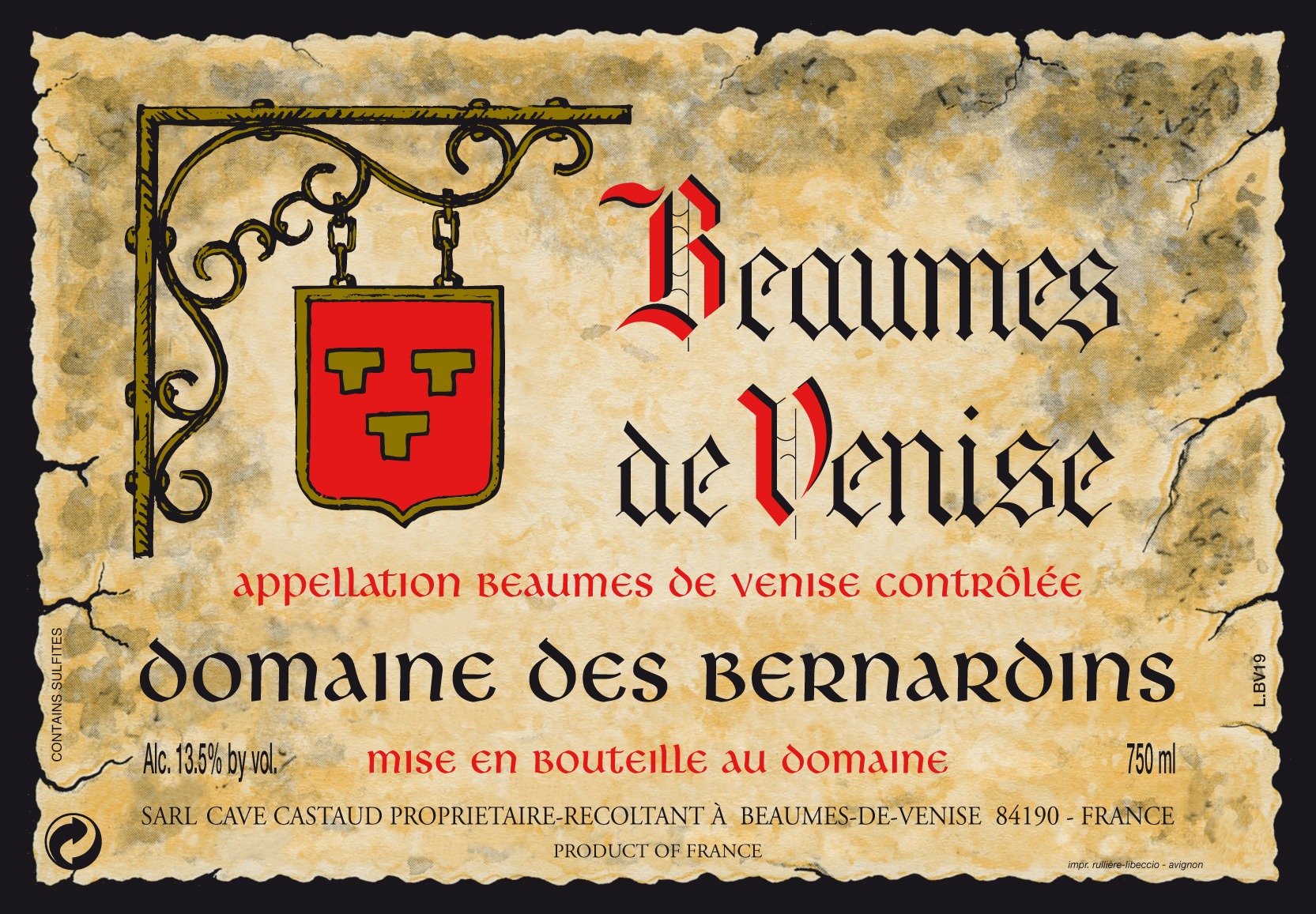
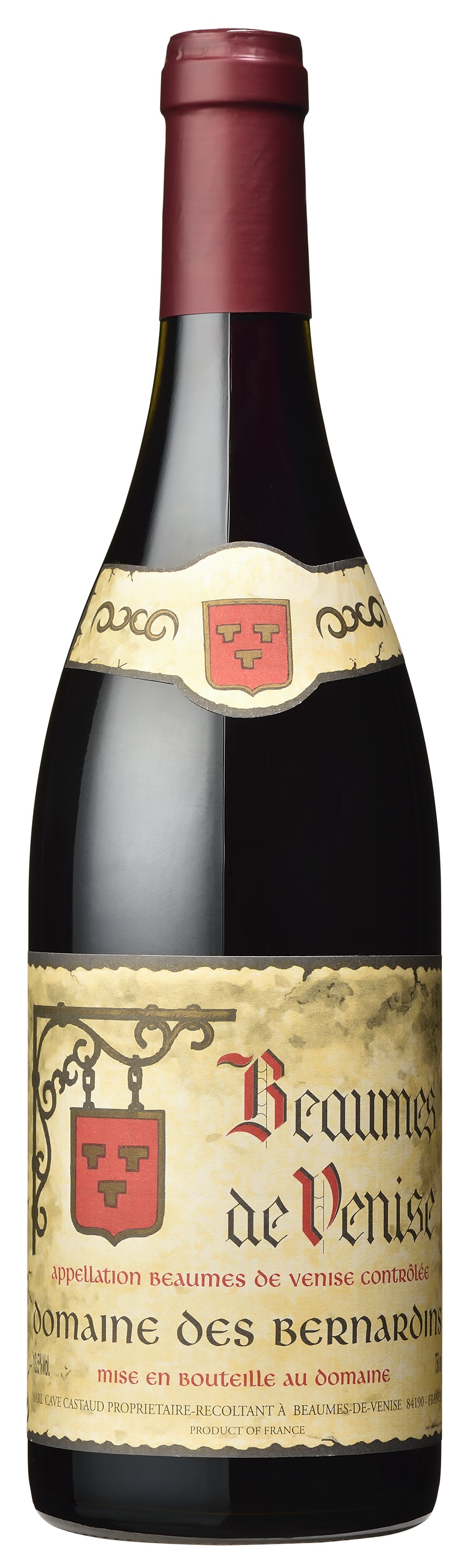
" We don't sell the wine without touching the vine "
| Country: | France |
| Regions: | Rhone Beaumes de Venise |
| Winery: | Bernardins |
| Grape Type: | Grenache |
| Organic: | Yes |
| Vintage: | 2019 |
| Bottle Size: | 750 ml |

Bernardins Beaumes de Venise Rouge Cru Cotes du Rhone is made from 65% Grenache, 25% Syrah, 5% Mourvedre and 5% Grenache Blanc.
Bright ruby color with cherry tinges. Complex black fruit aromas on the nose enhanced by spicy notes. Rounded palate with good length.
The wine is drinking well right now and can be kept for another 10 years.
Situation
Spreads out over the south-east side of the Dentelles de Montmirail hills, in Beaumes de Venise in the southern part of the Rhone valley.
Terroir
On a poor sandy, hungry and arid soil consisting of tender limestone and gritty zones of sandy mollasse.
In the vineyard
The vineyards and their terroir are the essence of our wines. This is where everything starts and where we focus our efforts throughout the year. You can’t make great wine without great grapes.
The viticulture is essentially done by hand. Five people work full-time in the vineyards. They are supplemented by seasonal employees who work during bunch thinning and the harvest in order to bring out the very best in our vines. Working by hand and the attention each vine gets are fundamental. Pruning, de-budding, trellising, leaf removal and picking are thus carried out by hand with the utmost care.
We prepare the soil by using good old-fashioned ploughing. Organic compost is made from grape marc (the discarded stalks and skins).
As a way of protecting the plants, we only use phytosanitary products when necessary and within strict guidelines by staggering the treatments appropriately, to minimise the amount of chemicals used. We prefer to use as much as possible manual and organic techniques . Leaving natural grass cover, removing buds and leaves from the vines, preserving biodiversity around the vineyard: olive, almond and cypress trees, wild rosemary and capers.
Winemaking
We make two red wines at the estate. Terroir wines shaped by the two classic Côtes du Rhône varieties: Grenache and Syrah. We don’t follow any winemaking recipe but are constantly searching for the perfect expression of terroir and each vintage’s particular characteristics. We don’t go for overripe grapes and over-extraction, as we think the wine has to stay refreshing and balanced.
Leaving the wine for 15 days in concrete vats, we try to gently extract the tannins and anthocyanins essential for the wine’s structure and colour. The wine doesn’t come into any contact with wood during ageing. This way the characteristics of our terroir can fully express
Serve with a meal especially red meat, game and cheese.
Review:
-James Suckling 93 Points
Bernardins Beaumes de Venise Rouge Cru Cotes du Rhone is made from 65% Grenache, 25% Syrah, 5% Mourvedre and 5% Grenache Blanc.
Bright ruby color with cherry tinges. Complex black fruit aromas on the nose enhanced by spicy notes. Rounded palate with good length.
The wine is drinking well right now and can be kept for another 10 years.
Situation
Spreads out over the south-east side of the Dentelles de Montmirail hills, in Beaumes de Venise in the southern part of the Rhone valley.
Terroir
On a poor sandy, hungry and arid soil consisting of tender limestone and gritty zones of sandy mollasse.
In the vineyard
The vineyards and their terroir are the essence of our wines. This is where everything starts and where we focus our efforts throughout the year. You can’t make great wine without great grapes.
The viticulture is essentially done by hand. Five people work full-time in the vineyards. They are supplemented by seasonal employees who work during bunch thinning and the harvest in order to bring out the very best in our vines. Working by hand and the attention each vine gets are fundamental. Pruning, de-budding, trellising, leaf removal and picking are thus carried out by hand with the utmost care.
We prepare the soil by using good old-fashioned ploughing. Organic compost is made from grape marc (the discarded stalks and skins).
As a way of protecting the plants, we only use phytosanitary products when necessary and within strict guidelines by staggering the treatments appropriately, to minimise the amount of chemicals used. We prefer to use as much as possible manual and organic techniques . Leaving natural grass cover, removing buds and leaves from the vines, preserving biodiversity around the vineyard: olive, almond and cypress trees, wild rosemary and capers.
Winemaking
We make two red wines at the estate. Terroir wines shaped by the two classic Côtes du Rhône varieties: Grenache and Syrah. We don’t follow any winemaking recipe but are constantly searching for the perfect expression of terroir and each vintage’s particular characteristics. We don’t go for overripe grapes and over-extraction, as we think the wine has to stay refreshing and balanced.
Leaving the wine for 15 days in concrete vats, we try to gently extract the tannins and anthocyanins essential for the wine’s structure and colour. The wine doesn’t come into any contact with wood during ageing. This way the characteristics of our terroir can fully express
Serve with a meal especially red meat, game and cheese.
Review:
-Decanter 95 Points
-Decanter 93 Points

Alain Jaume Cotes Du Rhone Rouge Haut de Brun is made from 60% Grenache, 30% Syrah, 10% Cinsault
The colour is purple-tinged garnet.The aromatic range of the nose goes from fresh berries (wild raspberry, blackcurrant, blackberry) to spices.The palate is big and full-flavoured, with silky-smooth tannins and aromas of the fruit already mentioned. The finish introduces touches of liquorice and pepper. A Côtes du Rhône with great complexity for an every day drinking.
A classic Rhône to drink between 1 and 4 years. Best poured at 17°C.
Traditional wine making and ageing is performed in vats only. Bottling after 10-12 months.
Ideal throughout the meal, but particularly with poultry and other white meats, as well as mild cheeses.
Review:
-International Wine Review 92 Points
Alain Jaume Cotes Du Rhone Rouge Haut de Brun is made from 60% Grenache, 30% Syrah, 10% Cinsault
The colour is purple-tinged garnet.The aromatic range of the nose goes from fresh berries (wild raspberry, blackcurrant, blackberry) to spices.The palate is big and full-flavoured, with silky-smooth tannins and aromas of the fruit already mentioned. The finish introduces touches of liquorice and pepper. A Côtes du Rhône with great complexity for an every day drinking.
A classic Rhône to drink between 1 and 4 years. Best poured at 17°C.
Traditional wine making and ageing is performed in vats only. Bottling after 10-12 months.
Ideal throughout the meal, but particularly with poultry and other white meats, as well as mild cheeses.

Xavier Vignon Cotes du Rhone Rouge Vieilles Vignes is made from 70% Grenache, 15% Mourvèdre and 15% Syrah
Grenaches are almost hundred years old, Mourvèdres more than 60 years old and Syrahs are 45 years old in average.
There's a spicy, green peppercorn edge to the Cotes du Rhone Vieilles Vignes. It's medium to full-bodied, with svelte, supple tannins and plenty of plummy fruit that exhibits more savory notes and spice on the long finish.
Review:
-James Suckling 92 Points
-James Suckling 90 Points

Bernardins Muscat de Beaumes de Venise Hommage is made from 75% Muscat petits grains blancs, 25% Muscat petits grains noirs.
The wine shows a golden hue with orangy highlights. Endearing nose of grape, orange peel and a honeyed accent. Mild at point of entry, spendid aromatic intensity, sultana, candied orange, rose petal and refined spice. Our Muscat de Beaumes de Venise has a great age ability.
For every vintage of our Muscat de Beaumes de Venise, the grapes are picked by hand. We press them straightaway to ferment the juice without skins. We don’t add any yeasts and keep the alcoholic fermentation in check by temperature control. Vin Doux Naturel winemaking involves stopping fermentation to preserve the grapes’ natural sweetness. During vinification, we watch the vats day and night and add 95% grape spirit just at the right moment. At this stage, the wine’s final balance is at stake. For the Hommage, we blend different vintages, aged in stain steel vats, to create the complexity of a long lasting wine.
The Hommage is a versatile companion to many deserts. Most expressive with dry biscuits and dry fruits, it retains all its character served with a fruit tart, puff paestry and chocolate or coffe desserts. To appreciate as well with duck breasts and figs. Served with a roquefort or a silton, it is marvellous. Simply as an aperitif with some dry fruit or grilled almonds. It's also a good compagnion for a classy cigars.
Bernardins Beaumes de Venise Rouge Cru Cotes du Rhone is made from 65% Grenache, 25% Syrah, 5% Mourvedre and 5% Grenache Blanc.
Bright ruby color with cherry tinges. Complex black fruit aromas on the nose enhanced by spicy notes. Rounded palate with good length.
The wine is drinking well right now and can be kept for another 10 years.
Situation
Spreads out over the south-east side of the Dentelles de Montmirail hills, in Beaumes de Venise in the southern part of the Rhone valley.
Terroir
On a poor sandy, hungry and arid soil consisting of tender limestone and gritty zones of sandy mollasse.
In the vineyard
The vineyards and their terroir are the essence of our wines. This is where everything starts and where we focus our efforts throughout the year. You can’t make great wine without great grapes.
The viticulture is essentially done by hand. Five people work full-time in the vineyards. They are supplemented by seasonal employees who work during bunch thinning and the harvest in order to bring out the very best in our vines. Working by hand and the attention each vine gets are fundamental. Pruning, de-budding, trellising, leaf removal and picking are thus carried out by hand with the utmost care.
We prepare the soil by using good old-fashioned ploughing. Organic compost is made from grape marc (the discarded stalks and skins).
As a way of protecting the plants, we only use phytosanitary products when necessary and within strict guidelines by staggering the treatments appropriately, to minimise the amount of chemicals used. We prefer to use as much as possible manual and organic techniques . Leaving natural grass cover, removing buds and leaves from the vines, preserving biodiversity around the vineyard: olive, almond and cypress trees, wild rosemary and capers.
Winemaking
We make two red wines at the estate. Terroir wines shaped by the two classic Côtes du Rhône varieties: Grenache and Syrah. We don’t follow any winemaking recipe but are constantly searching for the perfect expression of terroir and each vintage’s particular characteristics. We don’t go for overripe grapes and over-extraction, as we think the wine has to stay refreshing and balanced.
Leaving the wine for 15 days in concrete vats, we try to gently extract the tannins and anthocyanins essential for the wine’s structure and colour. The wine doesn’t come into any contact with wood during ageing. This way the characteristics of our terroir can fully express
Serve with a meal especially red meat, game and cheese.
Review:
"Immediately interesting on the nose, the herbs and flowers come first, thyme and lavender, then the raspberry fruit. Medium-bodied, good sense of freshness and definition to the fruit and structure, with good acidity and crispness of flavor. Fresh, savory, delicious. Great value. 60% Grenache, 25% Syrah, 6% Marsanne, 5% Mourvèdre, 4% Grenache Blanc, no destemming. Drinking Window 2021 - 2028 - Matt WALLS" - Decanter (October 5th 2020), 93 pts
The Bernardins Estate
Domaine des Bernardins is a sixth generation family owned estate on the edge of the tiny village of Beaumes de Venise. The owners are Elizabeth Hall (the granddaughter of Louis Castaud) and her husband Andrew Hall. The area has been populated since the time of the cave dwelling peoples (the name "Beaumes" means caves) who came from the town of Venise which existed near Carpentras. The first Beaumes de Venises granted A.O.C. status was in 1945 with the 1943 vintage.
The Bernardins Vineyard
The vineyards consist of 22 hectares (54.34 acres) in total, 15 hectares of Muscat (which yields 30 hl/ha) and 7 hectares of red grapes (Syrah and Cinsault) for Cotes du Rhone Rouge production.

Roland Champion Champagne Blanc de Blancs NV is aged for minimum 30 months (the minimum for NV is 15 months). This cuvee is made from 100% Chardonnay and is produced from the free run juice only. The current release is the result of the blend of the 2005, the 2006 and the 2007 vintage.
Fresh and delicate, its fine bubbles and wide range of aromas will be perfect as an aperitif. This Champagne will also match very well with seafood and shellfish.
dosage : 8 grams per liter
ageing : 30 months on laths
Even if it doesn't say on the label, 100% of the production is RD (Recently Disgorged)
Total Production for this Cuvée : 1,500 cases (9 liter equivalent) per year
Reviews:
"Golden yellow color. Lively, fruity, toasty leesy aromas of honeyed brioche and apple tart with a satiny, tangy, dry-yet-fruity medium body and a sleek, interesting, snappy lemon curd, nougat, and chalk finish with silky, soft, fruit tannins. A classic example of blanc de blanc champagne, delicious."
- Beverage Testing institute , 93 pts
"Spiced with ground anise and ginger accents, this offers notes of poached pear, lemon meringue pie, hazelnut and stony mineral. Very elegant and well-meshed throughout, with a silky finish. Tasted twice, with consistent notes. 1,500 cases made. –AN"
- Wine Spectator 92 pts
"This cuvée made from 100% Chardonnay offers a fresh aromatic nose of light toast, dried yellow fruit and nuances of yeast. On the palate it has a creamy mouth feel of toasted nuts and rich autolytic notes. This is a beautiful wine, rich and complex."
International Wine review 92+ pts
"Small grower. Autumn fruits dominate the aromas of this wine, which is blatantly more like a wine than we normally expect a champagne to be. Some may find that unexpected and even off-putting, while others will find it intriguingly delicious."
- Washington Post - EXCELLENT
"Roland Champion is a small family-owned producer, now with the fourth generation, in the village of Chouilly (”shoo-ee”), which has only Grand Cru vineyards. Made from 100 percent chardonnay grapes, this Champagne offers ethereal grace and poise and harmony; if I were fighting a duel tonight, I would ask for this Champagne as my last beverage. The nose here is about the richness of warm biscuits and hazelnuts, dried fruit and spice, like a Platonic, ineffably light fruitcake; in the mouth, however, it’s about a structure that encompasses an incredible marriage of power and elegance, like the delicacy and strength of the finest bone china. And there’s something porcelain-like about this Champagne, in its notable crisp, lively character, its transparency and its slightly chalky, shale-like mineral elements. Forget the Champagnes that come on with heavy toasty, caramel qualities; here, instead, is a wealth of subtlety and nuance touched with a racy, dynamic edge. Exceptional."
Biggerthanyourhead.net

Paul Hobbs Chardonnay Russian River Valley is made from 100 percent Chardonnay.
Crafted with precision from six pedigreed sites comes a wine that beams with pale straw hue. The newest vintage brings wonderful aromatic intensity: candied lemon peel, white florals followed by crisp green apple. A creamy and viscous texture on the palate is buoyed by white nectarine and dried apricot that’s balanced with a vibrant acidity, bringing focus to the wine’s finish that lingers with hints of flinty mineral notes.
Review:
-James Suckling 94 Points

Rudi Pichler Grüner Veltliner Ried Achleithen Smaragd 2023 is made from 100% Grüner Veltliner.
Grüner Veltliner is the signature grape of Austria and produces a dry white wine with savory aromas, spicy flavors, and good acidity. Grüner Veltliner Smaragd from the Wachau is a full-bodied wine and is rich in style with notes of stone fruit, lemon, radish, and arugula.
Grüner Veltliner’s bright acidity and savory character make it an ideal partner to mildly spiced Vietnamese, Thai, and Chinese flavors. Fish and shellfish are accented by Grüner Veltliner’s citrus and mineral profile while its acidity cuts the richness of pork or ham. It can also work well with foods that are difficult to pair such as bitter greens and asparagus.
Review:
#13 in Top 100 Wines of Austria, 2024. Such an expressive and elegant gruner veltliner. Yes, it has those classic peppery aromas on the medium-bodied palate, but there’s also an entire floral dimension that makes it stand out so prominently. Then comes the extremely long, silky and refined finish that’s incredibly sensuous. Sustainable. Drink or hold.
James Suckling, 98 points