
" We don't sell the wine without touching the vine "
| BUY MORE! SAVE MORE! | ||||||||||||||||||||
|
| Country: | France |
| Region: | Loire |
| Winery: | Domaine de Brize |
| Grape Type: | Brachetto |
| Organic: | Yes |
| Vintage: | 2025 |
| Bottle Size: | 750 ml |
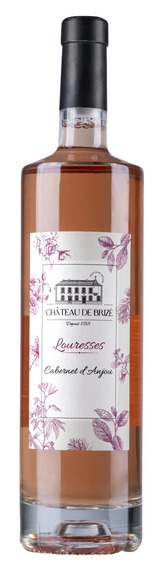
Brize Cabernet d'Anjou Rose Louresses is made from Cabernet Franc.
Cabernet d'Anjou is a semi-sweet rosé wine from the Loire Valley, produced from Cabernet Franc and/or Cabernet Sauvignon grapes. The 'Louresses' designation refers to the specific vineyard parcel at Domaine de Brize.
This charming rosé offers a beautiful salmon-pink color with delicate aromas of strawberry, raspberry, and rose petals. On the palate, it is fresh and fruity with a hint of sweetness balanced by crisp acidity.
Perfect as an aperitif, or pair with Asian cuisine, spicy dishes, or fresh fruit desserts.
Domaine de Brize is located in the town of Terranjou, in the Maine-et-Loire department of the Loire Valley. The 40 hectare-estate was born in the middle of the 18th century, founded by the Delhumeau family. The winery strived between the two world wars under the leadership of Pierre, a young, innovative, ingenious and combative man who compensated the loss of his mutilated hand during the War. He transmitted his passion for wine to his grandson Marc who followed in his footsteps and ran the property for 30 years, with the assistance of his two brothers. His son Luc joined the family estate in 1989, then his daughter Line came on board in 1992 together with her husband Didier. Brother and sister Luc and Line represent the 5th generation of the family winemakers and the 9th generation in the farm.
The vineyard is planted on highly diversified soils dominated by silico-clay, shale-sandstone and faluns. The viticulture practices meet the 'Terra Vitis' approach in respecting nature, people, the environment and the soil.

This dry Rosé is very aromatic on the fruitiness with a great style and elegance.
Average age of the vines is 25 years old.
We produce a part of this cuvee with 12 hours skin maceration and another part from directly pressed grapes.
Wine was slightly filtered before bottling to insure the wine remains stable.
This wine is the perfect friend for barbecue, salads and of course aperitif. This is ideal for warm days in the garden, as well as elegant poultry dishes.

Fullerton Three Otters Rose is made from 60% Pinot Noir, 40% Pinot Gris (7-50 years old)
This Willamee Valley blend hails mainly from three different vineyards in the north, east, and south of the Willamee Valley, with a smaering from five of our other sites. The soils of the vineyards represent the breadth and diversity of the Willamee Valley with both sedimentary- and volcanic-based soils.
Acid: TA 5.6 g/L
pH: 3.45
Aging: 100% stainless steel
Bottled Unfined
Clones: Pommard, Wadensville, Dijon 113, 114, 115, 667, and 777
Winemaker Alex Fullerton and his father and proprietor Eric Fullerton couldn’t decide on a house style for rosé, so they held a friendly competition. They each made a rosé to see whose would win over a crowd. Though the wines were destined to be boled separately, Alex got curious and tried blending the two. Voila! The sum was better than the parts, and a tradition was born. Alex now makes one rosé that is whole cluster pressed and tank fermented, yielding a very crisp and light colored wine, while Eric crafts his rosé from a more robust extraction, which yields a darker and fuller-bodied wine. The two lots are then blended to taste, delivering a crisp, fresh rosé with wonderful structure. The juice spent three weeks on the gross lees prior to fermentation to extract aroma precursers, and then six months on lees post-fermentation.
Pairs with soft cheeses, chicken/turkey.
Review:
-Eric Guido (Vinous) 90 Points

Landes Caprices d'Anais Rose is made from 50% Merlot + 50% Cabernet Sauvignon
This cuvée was created in 2005 to honor Nicolas's first daughter Anais. Caprice d'Anais means "Anais' Whim".
Color: Pale pink with salmon hues.
Aromas: quite aromatic nose dominated with floral (linden and elderberry) and fruity (cherry, strawberry and raspberry) notes.
Flavors: Quite similar to the aromas, with red fruit and floral flavors. The wine is easy to drink with a good fresh and zesty finish.
Great on its own during summer time, it will also pair very well with grilled salmon, salads, roasted chicken or any white meat dish.

Mordoree Tavel Rose Reine des Bois is made from 60% Grenache, 15% Clairette, 10% Syrah, 10% Cinsault, 5% Bourboulenc (biodynamically farmed on a rocky/sandy plateau over clay).
This wine comes from a parcel planted on a pebbled soil covered with stones, whose geology is typical of the grands crus from the Rhone Valley (a base made of marine molasse from the Miocene period covered with an alpine diluvium from the Villafranchian period). 100 % destemming, cold maceration during 48 h., pneumatic pressing, fermentation at 18° C.
To pair with: roasted and or spicy chicken, duck, goose, fish soup, white meat, seafood and a lot of fishes (tuna, John Dorry, red mulet, etc...).Quite all Asian cuisine. Dishes with garlic, dishes with tomatoes.
In the glass the wine is deeply colored pink, almost orange/salmon. Complex aromas of white flowers, raspberry, pomegranate, strawberry, minerals, and citrus rise from the glass. Palate is full-bodied and voluptuous yet retains elegance while delivering great fruit intensity balanced by minerals and citrus. Light tannins appear mid-palate and carry through to the finish, giving it serious structure. Fresh, complex, and very long on the finish. Overall, powerful, textured, and food-driven — a “serious” Tavel that can age 1–5 years. Best enjoyed from June/July 2026 onward.
Review:
-Robert Parker The Wine Advocate 93 Points

Brize Clos Medecin Anjou Villages Rouge is made from 60% Cabernet Franc and 40% Cabernet Sauvignon.
This is the flagship of the Estate. Clos Medecin has been produced at the estate for 90 years. All the grapes for this wine come from a very special parcel. The wine offers red fruit aromas. It is fresh, round and ample in the mouth.

Alain Jaume Bellissime Cotes du Rhone Rose is made from 50% Grenache Noir, 25% Cinsault, 20% Syrah and 5% Mourvedre
Salmon-pink color, clear and brilliant. The nose is fruity and spicy, reminiscent of wild strawberry and fine Provencal spices. The palate is full, well-balanced and fruity, with a long, fresh finish. A beautiful and delicate rosé.
A part is drawn off the skins with short maceration and the other part is from direct press. Fermentation in stainless steel at cool temperature. Bottling 5 months after harvest.

The aging is as Mounir ages his Burgundies: extremely long, never racked, no fining, no filtration. It would be easy to say that we expected the experience running one of Burgundy’s leading producers, Lucien Le Moine, would show in Mounir’s wines. But the actual results need to be tasted to be believed and understood: a wine with beguiling fruit and savory richness, yet extraordinary finesse and detail.
Mounir Saouma likes to describe Châteauneuf-du-Pape as a mosaic, with all the wild traditions and differences together making for very different interpretations. Omnia, Latin for “all,” is his attempt to encompass the entire region’s terroir and winemaking history (and perhaps future) in one glass. The fruit comes from 9 vineyard parcels across all 5 of the Châteauneuf communes, Châteauneuf-du-Pape, Courthezon, Sorgues, Bedarrides and Orange (in early vintages, when the Saoumas did not have all the vineyards they have today, they would purchase fruit; today, Rotem & Mounir Saouma is 100% Estate). The wine is then vinified and aged in foudres, cement and 500 liter barrels – a little bit of everything.
2019 was another warm and dry vintage in the southern Rhône, marked by insistent drought and repeated heat waves during the season. With little disease pressure or frost, the crop was close to normal size, but bunch and berry-size was reduced during the growing season by the lack of water. The grapes were thus concentrated and rich in sugar and acidity, although potential alcohol levels were often quite high. Vineyards at higher elevations – Châteauneuf du Pape and Gigondas in particular — handled the heat better, and the wines from those AOPs are rich yet also remarkably fresh and energetic. Despite the initial concerns about the growing season, 2019 looks to be a watershed vintage in the Southern Rhône, producing rich wines with exceptional concentration and aging potential
Inviting aromas of sliced strawberries, red cherries and rose. Full-bodied with vibrant acidity and succulent fruit. Fine, structured tannins are vertically aligned with the fruit. More dark-fruited than the nose lets on and entirely delicious. I love the subtle spice here.
-James Suckling 94 Points
Very refined, with silky and fine-grained structure carrying alluring bergamot, rooibos tea, incense, dried cherry and lightly mulled raspberry notes along. A long sanguine thread weaves through the finish. Hard to resist now with so much charm, but this will benefit from cellaring. Grenache, Syrah and Mourvèdre.
-Wine Spectator 94 Points

Trefethen Family Vineyards Dragon's Tooth Red is made from Malbec, Petit Verdot and Cabernet Sauvignon.
Our Nana, Catherine Trefethen, was Welsh. Her twin loves of wine and family were the original inspiration for our estate in Napa Valley’s Oak Knoll District. Celebrating our heritage, “Y Ddraig Goch”, the symbol of Wales, adorns this bottle of Dragon’s Tooth, a provocative blend born from the rockiest part of our vineyard.
This wine opens with expressive aromas of cherry and blackberry accented with notes of fig, tobacco leaf, and sarsaparilla. Full-bodied and balanced, the integrated flavors of ripe dark fruit lead to a lush and abundant finish.
Winery Chef Chris Kennedy enjoys Dragon‘s Tooth with earthy and rich cuisine. He suggests pairing it with our Creamy Mushroom Pasta. The complementary flavors, textures, and intensity of both the dish and the wine are stunning.
Trefethen Family Vineyards has farmed Napa Valley's cooler Oak Knoll District since 1968. Dragon's Tooth is their signature proprietary red — a nod to matriarch Catherine Trefethen's Welsh heritage and “Y Ddraig Goch,” the red dragon of Wales — a Malbec-led Bordeaux blend drawn from the rockiest parcels of the estate.
Review:
Aromas of blackberries, licorice, sweet spices and dried herbs. The palate is rich and structured with firm tannins and dark fruit. Bold and savory with a lasting finish. Drink or hold.
James Suckling, 93 points



