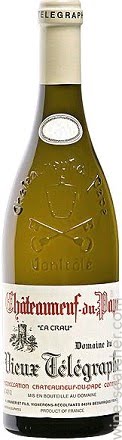
" We don't sell the wine without touching the vine "
| Country: | France |
| Regions: | Rhone Chateauneuf du Pape |
| Winery: | Vieux Telegraphe |
| Grape Type: | Clairette |
| Vintage: | 2015 |
| Bottle Size: | 750 ml |

Alain Jaume Chateauneuf Du Pape Rouge Vieux Terron is made from 85% Grenache, 10% Syrah, 5% Mourvèdre
An intense purple color is followed by ripe red fruit aromas, such as sweet black cherry.
The palate reveals clearly the aromatic complexity: spices and black fruit are boasted with soft tannins. The finish is long with aromatic hints of liquorice and pepper. Red raspberries, star anise and hints of cinnamon.
It will accompany game, red meat or meat in sauce and strong cheeses.
Soil types
Châteauneuf du Pape vineyards are mostly located on plateaux. Stony-clay soil covered with large rolled stones. Some plots are more sandy.
Winemaking and aging
Harvest is destemmed and crushed. Fermentation temperature is controlled at 30°C. Vatting period of 18 to 21 days. Matured in vats (80%) and oak casks (20%).

The nose is a basket of fruits with yellow and white flesh, where peach and exotic fruits dominate. A few notes of vanilla and brioche add a touch of extra fat. The richness of its mouth unfolds in a long sarabande of persistent aromas.
This blend is an ideal companion to a serving of Fillet of St. Pierre fish cooked on the skin.
Review:
Moving to the whites, the 2021 Châteauneuf du Pape Blanc is close to an even split of Clairette, Roussanne, and Grenache Blanc. It has a layered, medium to full-bodied style offering classic aromatics of white peach, acacia flowers, and honeyed minerality. Fresh, pure, and vibrant, it brings plenty of richness and depth. Drink it over the coming 3-5 years or. It will keep longer, if you're so inclined. Best after 2022.
-Jeb Dunnuck 93 Points

Chateau de Beaucastel Chateauneuf-du-Pape Blanc is made from 80% Roussanne, 10% Grenache Blanc and Clairette, 10% Piquepoul Blanc, Picardan and Bourboulenc
The story :
The production of white wine at Beaucastel is limited as we only have 7 hectares of white vines planted. The main variety is Roussanne, representing 80% of the blend.
The vintage :
The 2020 vintage in Southern Rhône was favoured by very good weather conditions, it is a generous vintage, both in terms of quality and quantity. Not as hot as in 2019, this year was very windy, throughout the growing cycle, with light rainfalls. After a fairly mild winter (one single episode of frost was noted during the night of March 24, but only the early ripening plots were very slightly affected). The spring was radiant, quite warm and very windy, which allowed the soils to preserve their freshness. Flowering began on May 18, under very healthy conditions. The good weather continued in June, July and August, with plenty heat but lower temperatures than in 2019, cool and humid nights and wind which continued to blow, preserving the freshness of the vines and maintaining perfect sanitary conditions for the grapes. The harvest, which was fairly early, therefore began under these very good conditions on August 26 with the white Côtes-du-Rhône and continued until the end of September with the Mourvèdre. September was warm at the beginning of the month and then more temperate, offering idyllic harvest conditions and allowed each plot to be harvested at perfect maturity. The harvest was very healthy with beautiful juicy and very ripe grapes, reasonable alcohol levels, good acidity and already a great balance. Yields are slightly higher than 2019 and the first tastings predict a very nice vintage.
Location :
Château de Beaucastel has 7 hectares of white varieties.
Terroir :
Molasse seabed of the Miocene period covered by diluvial alpine deposits (rolled pebbles).
Ageing :
Handpicked in small cases, sorting of the grapes, pneumatic pressing, settling of the juice, fermentation (30% in oak barrels, 70% in tanks) for 8 months. Bottling after 8 months.
Review:
Honeycomb oak on the nose, then quite a broad and generous palate. Sappy acidity, although not as high as some white Châteauneufs this year, and a long finish. This has a good sense of lightness, drinkability and balance. The oak is quite forthright for now, so give this some time to come together. 80% Roussanne, 10% Grenache and Clairette, plus 10% of Piquepoul Blanc, Picardan and Bourboulenc. Part of the blend was matured in two- and three-year-old barriques for a year.
-Decanter 96 Points

Domaine de Beaurenard Chateauneuf-du-Pape Blanc is made from Clairette blanche & Rose, Grenache Blanc & Gris, Bourboulenc, Roussanne, Picpoul and Picardan.
Gold bright green color. Expressive nose with pear and stone fruits aromas (peach, apricot) with jasmine and roasted almonds notes. The mouth is smooth and fleshy like stone fruit we can smell, with a long a nice finish.
Review:
Bright golden yellow, silver reflections. Delicate herbal spices, a hint of chamomile and mandarin zest, pears and blossom honey are underneath. Juicy, elegant, white peach, delicate honeydew melon, mineral and harmonious, fine fruit sweetness, good ripening potential.
-Falstaff 92 Points
A bright, high-pitched style, with makrut lime, green apple and green melon flavors laced with a jasmine note. A subtle mineral edge provides balance on the finish. Drink now through 2024
-Wine Spectator 91 Points

Grand Veneur Chateauneuf Du Pape Blanc La Fontaine is made from 100% Roussane.
Yellow-gold color. The nose is rich in aromas of citrus fruit, tropical fruit, quince and honey, with a touch of vanilla. On the palate, the same aromas appear together with a fatness combining exotic fruit and vanilla : the wine is rich, generous and elegant, with extraordinary length. "La Fontaine" is often considered to be one of the best Châteauneuf du Pape white, and it is by definition a superb gastronomy wine.
Best between 1 and 8 years.
Review:
"The 2021 Châteauneuf Du Pape La Fontaine Blanc is a much more concentrated, serious wine, and it takes plenty of air to show at its best today. Based on Roussanne, it has a medium gold hue as well as rich aromatics of honeyed stone fruits, orange blossom, caramelized peach, and toasted bread. Beautiful on the palate as well, it’s medium-bodied, has a layered, concentrated mouthfeel, good acidity, and a great finish. Give it a year or three in the cellar and enjoy over the following decade."
- Jeb Dunnuck (November 2022), 94 pts

Grand Veneur Chateauneuf du Pape Blanc Le Miocene is made from 60% Clairette, 40% Roussanne
Pale yellow colour with hints of green, aromas of white flowers (may blossom, honeysuckle).
The palate is pleasantly balanced between liveliness and roundness, which brings out characteristics of dried apricot, honey and elderberry. A Châteauneuf du Pape white displaying a great finesse.
Best between 1 and 8 years.
Soil type Coming from the single vineyard named “La Fontaine”, the plot is facing north.It is made of clay-sand and limestone. Thanks to the northern orientation, it is always very well aired. This sector allow the Roussane and Clairette to mature in great conditions without losing freshness, which we believe is key point. Winemaking & ageing Whole-bunch pressing. Vinification in stainless-steel tanks. Fermentation temperature controlled at 15°C.
Brunier Vieux Telegraph Chateauneuf du Pape Blanc La Crau 2015 is made from 40% Clairette, 30% Grenache Blanc, 15% Bourboulenc, 15% Roussanne.
Grapes sourced from La Crau, the lieu-dit that is known for the galet roulés, or rounded stones, that cover the vineyard as far as the eye can see.
Fermentation begins in cement tank. Halfway through fermentation, the wine is transferred to oak (barriques, demi-muids, and foudres)
Aged in wood (barriques, demi-muids, and foudres); 10-15% new oak
70% of wine undergoes malolactic fermentation
Bottled after one year
Review:
This is packed with a range of star fruit, anise, white peach, yellow apple and Cavaillon melon notes that run seamlessly together, gilded with chamomile and orange blossom details on the creamy finish. An echo of wet pebbles adds further range and intrigue. Drink now through 2019. 342 cases imported.
95 points Wine Spectator
One cannot think of Châteauneuf-du-Pape, the most celebrated cruof the southern Rhône, without thinking of Domaine du Vieux Télégraphe. The Brunier family is legendary in its own right, having been rooted to the enigmatic plateau known as La Crau for over one hundred years. The wines of Vieux Télégraphe evoke the concept ofterroir in its purest form: they reflect their dramatic climate, the rough terrain that defines the soil, their full sun exposure at a higher altitude, the typicity of the varietals with an emphasis on Grenache, and of course, the influence of their caretakers, the Brunier family. For many, La Crau is Châteauneuf-du-Pape’s grandest cru.
The Bruniers’ story begins in 1898 with Hippolyte Brunier. A modest farmer who lived off the land, Hippolyte kept less than a hectare of vines to make his own wines. His small vineyard was at one of the highest points in between Châteauneuf-du-Pape and Bédarrides, a stony plateau called La Crau. The elevation of this terrain had prompted the construction of a communication tower in the late 18th century to transmit telegraph messages between Marseille and Paris. Otherwise, the allure of this barren landscape is not immediately discernable—there is nothing but galets roulés, or rounded stones, as far as the eye can see. Up so high, the vineyards are exposed to all kinds of elements—rain, hail, scorching sunshine, and especially the unruly Mistral. This was unwelcome terrain where only the toughestvigneron dare plant, although the notorious Mistral works wonderfully to prevent rot.
However difficult to farm, Hippolyte saw how the wine from his parcel pleased others, and he began bottling more, gradually increasing his vineyard holdings to sixteen hectares. His sons helped work the farm, although most of the grapes were being sold off as premium fruit to négociants. The Bruniers weathered many storms—not the least of which was the ravaging of their vineyards by phylloxera. Hippolyte’s grandson, Henri, eventually joined the family business, and with him came great changes: replanting the vineyards, the construction of a new winery, bringing temperature control into the winery to protect the wines during fermentation, and most importantly, launching the Domaine’s first bottlings under the Vieux Télégraphe label.
After years of closer study, La Crau proved to be a privileged vineyard site. At the extreme southeast of the appellation, a large three-meter trench in the vineyard reveals its stratifications, millions of years in the making. The layers show early alluvial deposits, limestone, silica, and a robust red clay (known as molasse) that has come to characterize this terrain. Sitting on the surface of the soil, the galets hold important functions: they insulate the vines from both the cold and the heat, and they provide ideal drainage for the roots.
Kermit first met Henri and his wife, Maguey, in the mid-seventies. As Henri began to filter the wine around 1980, Kermit asked that his blend remain unfiltered. When the Bruniers had tasted the results of several vintages, they returned to an unfiltered bottling for their entire production. Henri retired in 1988 and left the Domaine in the hands of his two sons, Daniel and Frédéric. The Brunier brothers have significantly expanded the family’s holdings on La Crau to seventy hectares, and have boldly expanded their winemaking ventures into new territory. They created the second label for Vieux Télégraphe known as “Télégramme,” purchased Domaine La Roquète in Châteauneuf, and joined forces with Kermit Lynch to buy the historic Domaine Les Pallières in Gigondas.
The wines of V.T. are classic, displaying strength, rusticity, earthiness, and tremendous longevity. The finalassemblage consists solely of old-vine fruit from La Crau, imparting incredible depth, concentration, and a filtered-through-stones minerality that provides excellent freshness. The greatness of the domaine is just as much a tribute to the Bruniers as it is to La Crau—they have the ability to make great wine even in difficult vintages. Their goal is to find a harmony between aromatic complexity, tannic structure, and richness, which they achieve year after year. The maligned 1984 vintage is still a marvelous wine.
The grapes from the younger vines—still over twenty years old—make up V.T.’s second label, “Télégramme.” The concept was born after the ill-fated 2002 vintage, when flooding around harvest led the Bruniers to downgrade “La Crau” due to the torrid conditions. The resulting wine, dubbed “Télégramme,” saw significant success, prompting Daniel and Frédéric to produce the cuvée yearly from fruit they deem not worthy of the “La Crau” label. They have since supplemented it with fruit from vineyards they acquired upon purchasing Domaine La Roquète, always striving for a more accessible contrast to the earthy, deeply structured style of Vieux Télégraphe. The elegance and velvety texture make “Télégramme” easy to appreciate in its youth, with rich, generous, red fruit, uncharacteristic freshness, and beautifully integrated tannins. Its finesse and drinkability make it the Châteauneuf-du-Pape for restaurant lists and for wine lovers who do not have a cellar for aging.

Morlet Family Vineyards Ma Douce Chardonnay is made from 100 percent Chardonnay.
The cool maritime breeze and mild and sunny mountain climate create ideal conditions for this hillside vineyard located on the second ridge from the Pacific Ocean. Handcrafted using classical Burgundian winemaking techniques, this wine is dedicated to Jodie Morlet. It is ‘My Sweet’ or ‘Ma Douce.’
Full yellow color. Aromas of lemon drop, Crème Brulée and orange zest intermixed with strong notes of minerality (wet stones) and fresh hazelnut. Full-bodied, mineral driven, this wine displays a creamy texture and very long mineral finish. Built to age gracefully for a decade, this wine is already very approachable.
Propietary Name Ma Douce
Name Meaning My Sweet “Douce brize” from the Ocean
Varietal composition Chardonnay
Type of wine Vineyard designated
Appellation Fort Ross-Seaview
Vineyard singularity On the second ridge off Ocean High elevation Goldridge soil
Typical harvest date End of October
Picking Manual, small lugs, refer truck
Sorting Cluster by cluster
Fermentation In barrel through native yeast 100% Malolactic
Upbringing Sur lies with bâtonnage
French oak from selected coopers
Bottling Unfiltered
Cellaring time 5-10 years
Serving Slightly below room temperature Decanted when served young
Review:
"Lots of white peach, quince, white flower, and green almond notes emerge from the 2020 Chardonnay Ma Douce, a full-bodied barrel sample with beautiful depth as well as freshness."96 Points Jeb Dunnuck:

Boussey Savigny les Beaune is made from 100 percent Pinot Noir.
The grapes for this wine arecoming from 3 different parcels of Savigny les Beaune loctaed in these 3 different lieux-dits: Les Saucours, les Petits Liards and Les Fourches.
The wine shows aromas of Red fruits with floral notes. It is elegant with a very pleasant long finish.