
" We don't sell the wine without touching the vine "
| BUY MORE! SAVE MORE! | ||||||||||||||||||||
|
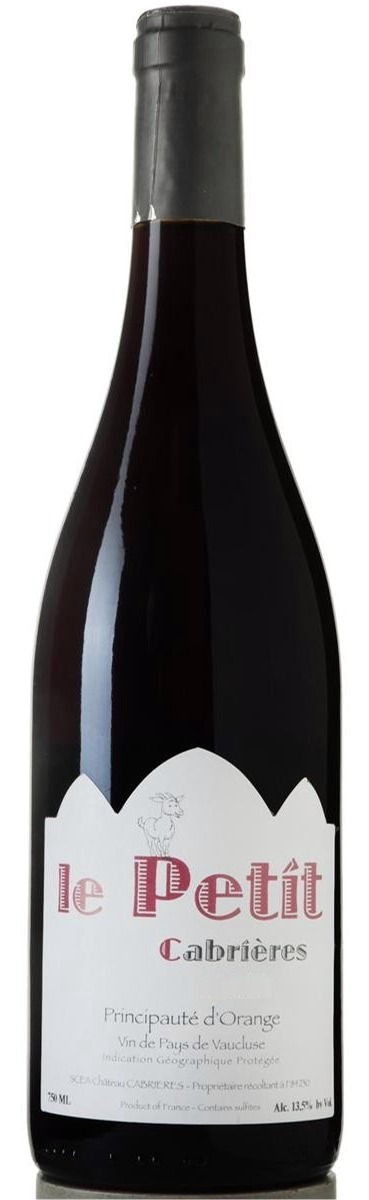
Cabrieres Le Petit Cabrieres is made from 90% Grenache and 10% Cinsault.
Le Petit Cabrieres Rouge is a Vin de Pays du Vaucluse as it is made from grapes grown right outside the Cotes du Rhone geographic designation.
Intense red color with purple highlights. Powerful nose of red fruits. Fruity on the palate with a beautiful freshness.
Pair with charcuterie, hamburgers and cheeses.
The Arnaud family has owned the Château Cabrières property for three generations. In 2009, Guy Arnaud handed over the estate to his daughter, Agnes Arnaud, married to Patrick Vernier. Today, Agnes and Patrick are run the estate together.
The name ‘Cabrières’ comes from the Latin name Capraria, designating a place where goats are raised.
Château Cabrières is located in the village of Châteauneuf-du-Pape, in the Vaucluse department. The property dates back many centuries, indicated by a bread oven door that was discovered and preserved - the stone cut recalls the technique used in the 14th and 15th centuries. This proves the historic nature of the Chateau and its vine stock, both of which benefit from the flinty nature of the local soil, where vines have been planted since 1344.
The CDP vineyard is situated on the high tablelands, which are characteristic of the northern area of Châteauneuf-du-Pape. The terrain consists mainly of alpine diluvium and chalky Miocenian soil, with large flint pebbles covering the surface. These pebbles conserve the heat of the day during the night, thus avoiding too much evaporation.

Cabrieres Le Petit Cabrieres is made from 90% Grenache and 10% Cinsault.
Le Petit Cabrieres Rouge is a Vin de Pays du Vaucluse as it is made from grapes grown right outside the Cotes du Rhone geographic designation.
Intense red color with purple highlights. Powerful nose of red fruits. Fruity on the palate with a beautiful freshness.
Pair with charcuterie, hamburgers and cheeses.

Cabrieres Chateauneuf du Pape Rouge Les Silex is made from 80% Grenache and 20% Syrah .
The vineyard is situated on the high tablelands, which are characteristic of the northern area of Châteauneuf-du-Pape. The terrain consists mainly of alpine diluvium and chalky Miocenian soil, with large flint pebbles covering the surface. These pebbles conserve the heat of the day during the night, thus avoiding too much evaporation.
This 2020 has opened up and is drinking great right now. A blend of 80% Grenache and 20% Syrah. Elegant cherry red color, with expressive notes of red fruits (strawberry and raspberry). Mellow tannins, well-balanced on the palate. I feel I need to point out the freshness, it is bright and lively on the palate, something we don’t see a lot of in this region. This also makes it extremely food friendly as it can hold up to fatty proteins.
Very good with white meat, red meat, charcuterie and cheese.

Silver Oak Alexander Valley Cabernet Sauvignon is made from 95.2% Cabernet Sauvignon, 2.5% Cabernet Franc, 1.9% Merlot, 0.4% Petit Verdot
The Silver Oak Alexander Valley Cabernet Sauvignon 2019 has notes of red cherry, raspberry, blackberry, iris, vanilla and clove. Ruby in color, this elegant wine has great acidity and lift on the mid-palate. Black currant and warm baking spices linger with a deep and fruity finish. It will provide drinking pleasure through 2047 given proper cellaring.
Review:
Plush and sexy, Silver Oak’s dazzling 2020 Alexander Valley Cabernet Sauvignon delivers succulent dark fruit offset by black olive-like nuances. Polished and suave tannins provide support without being intrusive or distracting, allowing for immediate enjoyment with a steak. Good acidity keeps it bright and you coming back for another sip.---- Michael Apstein
- Wine Review Online 93 Points
Cabrieres Chateauneuf du Pape Rouge Les Silex is made from 80% Grenache and 20% Syrah .
The vineyard is situated on the high tablelands, which are characteristic of the northern area of Châteauneuf-du-Pape. The terrain consists mainly of alpine diluvium and chalky Miocenian soil, with large flint pebbles covering the surface. These pebbles conserve the heat of the day during the night, thus avoiding too much evaporation.
This 2020 has opened up and is drinking great right now. A blend of 80% Grenache and 20% Syrah. Elegant cherry red color, with expressive notes of red fruits (strawberry and raspberry). Mellow tannins, well-balanced on the palate. I feel I need to point out the freshness, it is bright and lively on the palate, something we don’t see a lot of in this region. This also makes it extremely food friendly as it can hold up to fatty proteins.
Very good with white meat, red meat, charcuterie and cheese.

All older vintage wines have been purchased from a single collectors cellar. Pictures can be requested before shipment.

Klipsun Cabernet Sauvignon Red Mountain is made from 84% Cabernet Sauvignon, 4% Merlot, 4% Malbec and 8% Syrah.
The 2017 vintage started out with a cool, wet winter, with significantly above average snowfall in eastern Washington. Red Mountain had a 24% increase in rainfall in 2017 over the 10 year average. Going into spring, the cool trend continued. As a result, bud break at Klipsun was behind the historical average and significantly behind the most recent warm vintages of 2013 2016. Bloom was also slightly delayed. Because of the cool weather, set was lighter than usual which translated into significantly less fruit in 2017.
The early part of the summer saw average temperatures followed by above average temperatures in July and August. As a result, he at accumulation was a bit above average for the season, despite the cool start. And because of the smaller than normal yield, harvest began right on schedule, perhaps even a bit early for some of the whites. In the second half of September, when Klipsun traditionally harvests all the reds, the temperatures cooled considerably, which delayed ripening. This allowed for luxurious amounts of hang time without the threat of increased sugar accumulation, stretching harvest into the first week of October. A s a result, all fruit going into the 2017 Klipsun Cabernet Sauvignon could be picked at perfect sugars levels with great fruit maturity and flavors. Overall, the quality of t he 2017 harvest is as high as the 2016. However, the style is slightly different. The 2017 wine has a firmer structure, more spice & mocha in the nose and will take a few mo re years than the 2016 to reach a perfect balance between fruit and tannin.
Review:
The 2017 Cabernet Sauvignon Red Mountain is composed of 84% Cabernet Sauvignon, 4% Merlot, 4% Malbec and 8% Syrah, which immediately emanates with aromas of dark roasted espresso bean, toasted oak, dried tobacco and dusty black fruit tones of cassis, currant and blackberries covered in dark cocoa powder. Full-bodied, generous in complexity and still tight in the mouth, the wine unpacks layers of cedar and vanilla tones with dusty purple flowers and bitter dark chocolate across the mid-palate, giving way to fine-grained tannins that will loosen with time. As the wine sits on the palate, the 100% French oak regimen is on full display for all to see. The wine lingering long and continues to evolve in the mouth, ending with a drying finish that highlights the oak and terroir. It’s still a baby, and I would keep it in the cellar for another few years before popping the cork—this will effortlessly coast for more than a decade. The 2017 vintage marks the second release of this wine, with 6,300 bottles produced. It comes from its namesake vineyard, first planted in 1984 on Red Mountain. I’m keeping my eye on this producer. I’m impressed, and even though the oak may be a bit much at the moment, it's still delicious. - Wine Advocate 94+ Points

Luis XIV Vino Noble is a naturally sweet red wine, made from very late Monastrell harvests. All of its sugar and alcohol comes from the grape itself and has been subjected to a long aging in semi-new American oak barrels. In the mouth it is very intense, sweet without cloying, with aromas of stewed plums and a very long finish of spicy oak wood. RATING: Noble Alicante sweet wine



