
" We don't sell the wine without touching the vine "
| Country: | France |
| Region: | Burgundy |
| Winery: | Capitain Gagnerot |
| Grape Type: | Pinot Noir |
| Vintage: | 2015 |
| Bottle Size: | 750 ml |

Domaine Jean Grivot Clos de Vougeot Grand Cru is made from 100 percent Pinot Noir.
Domaine Jean Grivot is among the great names in Burgundian wine. Étienne Grivot and his wife Marielle took over from Étienne’s father Jean Grivot in 1987. The vineyards are densely planted and farmed organically “sans certification” while the aim in the cellar is for balance and clear expression of terroir.
Jean Grivot’s 38.3 acres spread across 22 appellations with vineyards in the communes of Vosne-Romanée, Vougeot, Chambolle-Musigny, and Nuits-Saint-Georges. Besides the three grand crus, there are 8 premier crus including the much lauded Les Beaux Monts and Suchots in Vosne-Romanée. The grapes are completely de-stemmed and fermentation is spontaneous.
About the Vineyard:
Clos de Vougeot grand cru was acquired by Étienne’s grandfather, Gaston Grivot, in 1919. The total holding is 4.6 acres from the middle of the vineyard to the lower wall and the average vine age is 40 years old. A good Clos de Vougeot should be a complete wine without any one feature standing out. It is a perfect balance of power, aroma, and flavor.
Wine Production:
The grapes are destemmed and maceration à froid usually lasts just a day or two. The alcoholic fermentation is spontaneous and malolactic fermentation occurs in barrel. Depending on the vintage, the proportion of new oak is around 40-70% percent for the grands crus.
Tasting Notes:
The wine shows aromas and flavors of red berries, herbs, and purple flowers. The palate is rich with ripe fruit and medium weight with bright acidity and fine tannins. Aging in 40-70% new Burgundian pièce brings notes of vanilla, toast, and baking spices.
Food Pairing:
Red Burgundy might be the world’s most flexible food wine. The wine’s high acidity, medium body, medium alcohol, and low tannins make it very food-friendly. Red Burgundy, with its earthy and sometimes gamey character, is a classic partner to roasted game birds, grilled duck breast, and dishes that feature mushrooms, black truffles, or are rich in umami.
Review:
This round version is packed with ripe black cherry, violet, graphite and tobacco flavors. The silky texture and vibrant acidity work in tandem, while refined tannins provide support without getting in the way. There are a few edges to be worked out, yet this is long and concentrated.
-Wine Spectator 95 Points

Domaine Jean Grivot Echezeaux Grand Cru is made from 100 percent Pinot Noir.
Domaine Jean Grivot is among the great names in Burgundian wine. Étienne Grivot and his wife Marielle took over from Étienne’s father Jean Grivot in 1987. The vineyards are densely planted and farmed organically “sans certification” while the aim in the cellar is for balance and clear expression of terroir.
Jean Grivot’s 15.5 hectares spread across 22 appellations with vineyards in the communes of Vosne-Romanée, Vougeot, Chambolle-Musigny, and Nuits-Saint-Georges. Besides the three grand crus, there are 8 premier crus including the much lauded Les Beaux Monts and Suchots in Vosne-Romanée. The grapes are completely de-stemmed and fermentation is spontaneous.
About the Vineyard:
Echézeaux grand cru is a large vineyard of 38 hectares divided into 11 individual climats. Grivot’s parcel is in the climat of Les Cruots and lies at the southern end of Echézeaux near the premier cru of Les Suchots. A good Echézeaux should have rich fruit, considerable earthiness, and be very complete on the palate.
Tasting Notes:
The wine shows aromas and flavors of red berries, herbs, and purple flowers. The palate is rich with ripe fruit and medium weight with bright acidity and fine tannins. Aging in 40-70% new Burgundian pièce brings notes of vanilla, toast, and baking spices.
Food Pairing:
Red Burgundy might be the world’s most flexible food wine. The wine’s high acidity, medium body, medium alcohol, and low tannins make it very food-friendly. Red Burgundy, with its earthy and sometimes gamey character, is a classic partner to roasted game birds, grilled duck breast, and dishes that feature mushrooms, black truffles, or are rich in umami.
Review:
A very elegant expression of Echezeaux, with a velvety black plum and rose petal fruit. There is a lovely freshness and so much finesse that the tannin and structure might surprise you at the end. This has the substance to age for decades. Produced from a 0.84ha parcel in Cruots next to Comte Liger-Belair. The vines were planted in 1954 and the destemmed fruit was gently fermented.
This is pure, racy and enticing, hosting aromas and flavors of black currant, blackberry, violet and iron. This is about finesse, grace and precision balance, with saturated fruit flavors persisting on the superlong aftertaste. Needs a decade in the cellar.
-Wine Spectator 97 Points

Clos Saint-Jean is a 41-hectare estate in Châteauneuf-du-Pape run by brothers Vincent and Pascal Maurel. Considered by many critics and wine-writers as the preeminent estate espousing the modern style of winemaking in Châteauneuf, this cellar is one of the oldest in the region, having been founded in 1900 by the greatgreat-grandfather of Vincent and Pascal, Edmund Tacussel. A short time after its founding and well before the AOP of Chateauneuf-du-Pape was created in 1923, Edmund began bottling estate wines in 1910.
The farming at Clos Saint-Jean is fully sustainable due to the warm and dry climate, which prevents the need for chemical inputs. Instead, Vincent and Pascal employ organic methods for pest control, mainly pheromones, to prevent pests from taking up residence in their vines, a process called amusingly enough in French, confusion sexuelle. The vines tended manually, and harvest is conducted in several passes entirely by hand.
Combe des Fous literally means, the hill of the fool. The hill, in this case, is located in the far southern reach of Le Crau which was left barren for many centuries because the layer of galets was so exceedingly deep that everyone assumed vines could never survive there. The fool in this situation is Edmund Tacussel, the great-great-grandfather of Vincent and Pascal Maruel who planted a Grenache vineyard on this site in 1905. That old-vine Grenache form the heart of this cuvée with a small amount of Syrah, Cinsault and Vaccarèse. La Combe des Fous is only made in the best vintages.
Review:
This has good concentration and energy to the dense core of dark fruit and bitter cherry, with great poise and elegance despite its ripeness (an impressive feat for the vintage). Guided by finely crushed mineral accents and tannins, this reveals pretty high-toned floral notes and leafy tobacco. Grenache, Syrah, Mourvedre, Cinsault, Vaccarese and Muscardin. Drink now through 2032. 900 cases made.
-Wine Spectator 95 Points

Bertrand Bachelet Maranges Rouge 1er Cru Les Clos Roussots is made from 100 percent Pinot Noir.
The Maranges appellation is the youngest of the Côte de Beaune family, making its debut in May 1989. It spans three villages: Dezize-lès-Maranges, Cheilly-les-Maranges and Sampigny-les-Maranges. Several hills and slopes make up the appellation; they face south/south-east, at an altitude of between 200 and 400 meters. This appellation produces mainly red wines comprising 95% of total production.
The Maranges 1ers Crus are spread over seven distinct terroirs: "Les Clos Roussots", which represents the second largest terroir of the appellation, spans the Cheilly-les-Maranges and Sampigny-les-Maranges areas.
The wine boasts a beautiful bright red color. The nose provides subtle harmony between red and black fruits, spices and vanilla. On the palate, this wine is both solid and fresh, harmonious and bold.
Enjoy with a veal roast and sweet potatoes or matured cheeses.

Bachelet Bertrand Maranges Rouge Premier Cru Clos Roussots is made from 100 percent Pinot Noir.
The Maranges appellation is the youngest of the Côte de Beaune family, making its debut in May 1989. It spans three villages: Dezize-lès-Maranges, Cheilly-les-Maranges and Sampigny-les-Maranges. Several hills and slopes make up this appellation, that are south/south-east-facing.
'Les Clos Roussots' is a Premier Cru vineyard in Cheilly-les-Maranges, producing wines with depth and structure.
The wine offers deep ruby color with purple highlights. Aromatic nose of dark berries, spice, and a mineral edge. The palate is full-bodied with firm yet silky tannins and a long finish.
Pairs well with roasted meats, game, and aged cheeses.
Bertrand Bachelet Maranges Rouge 1er Cru Les Clos Roussots is made from 100 percent Pinot Noir.
The Maranges appellation is the youngest of the Côte de Beaune family, making its debut in May 1989. It spans three villages: Dezize-lès-Maranges, Cheilly-les-Maranges and Sampigny-les-Maranges. Several hills and slopes make up the appellation; they face south/south-east, at an altitude of between 200 and 400 meters. This appellation produces mainly red wines comprising 95% of total production.
The Maranges 1ers Crus are spread over seven distinct terroirs: "Les Clos Roussots", which represents the second largest terroir of the appellation, spans the Cheilly-les-Maranges and Sampigny-les-Maranges areas.
The wine boasts a beautiful bright red color. The nose provides subtle harmony between red and black fruits, spices and vanilla. On the palate, this wine is both solid and fresh, harmonious and bold.
Enjoy with a veal roast and sweet potatoes or matured cheeses.
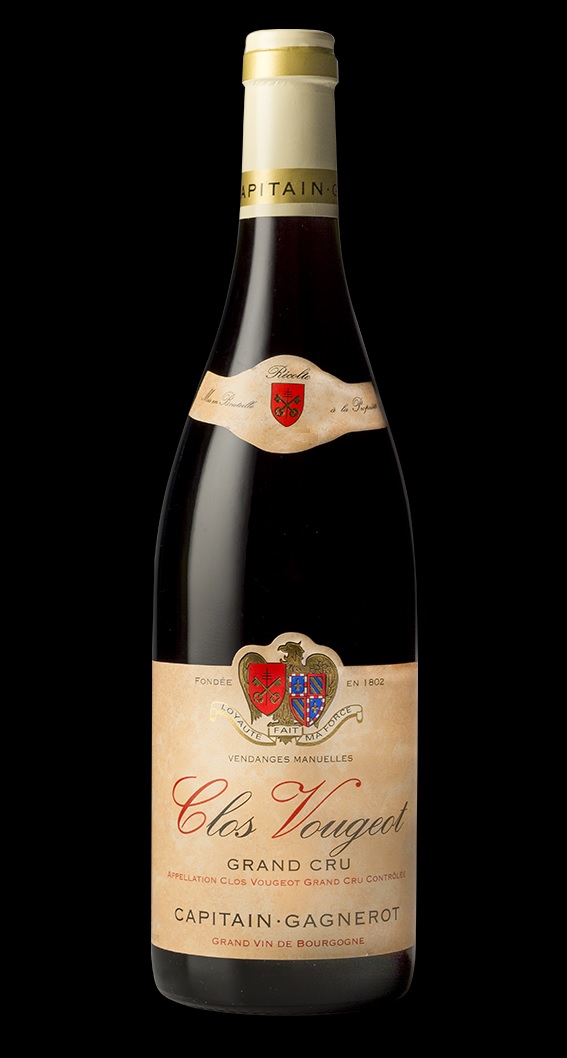
Capitain Gagnerot Clos Vougeot Grand Cru is made from 100 percent Pinot Noir.
SOILSChalky soil with fossils from the Bajocian era mixed with red clay and laves. Heavy earth containing iron.
VINIFICATION / MATURING
Harvested by hand, sorted and destemed.
Alcoholic fermentation in open vats, for about 15 days with 2 punch-down a day at the beginning.
Maturation in oak barrels (10% new barrels) for 12 to 15 months.
ALCOHOL
13,5°
TASTING NOTES
Colour : Deep garnet red.
Nose : Black fruits aromas (blackcurrant, blueberry).
Mouth : Strong structure and powerfull tannins. After 10 to 15 years of ageing, it turns to crystallized fruits aromas with a long finish.
FOOD PARING
Game in a sauce, Burgundy cheese (Citeaux)
The Domaine Gagnerot was established in 1802. In 1864 Marie, Jean-Baptiste’s unique daughter, marries François Capitain, wine trader, native of Champlitte. Together, Jean-Baptiste and François establish the Domaine Capitain-Gagnerot.
After the phylloxera crisis wich ravaged the Burgundian vineyard from the 1870s the the 1880s, Marie then widowed, decides to keep the domaine and to replant it vines. The succession is since made from father to son.
After the Second World War, Roger Capitain inherits 3 hectares of vineyards and a wine trade. His two sons, Patrice and Michel, take over the domaine upon his retirement.
Today, the domaine comprise 16 hectares of vineyards in full ownership, and it is Pierre-François and Delphine, Patrice’s children, who now oversee its destiny, supported by their spouses.
Terroir
The particularity of Burgundy is to produce on diversified terroirs wines elaborated with a single grape variety, which emphasize the specificity of every appellation : Pinot Noir for red wines, Chardonnay for white wines.
Our terroir refers to the specific characteristics of grounds, subsoil, weather conditions and vines, but it is also the result of man’s work and knowhow, refined over a long history.
Located at the junction of Côte de Beaune and Côte de Nuits, the highly defined vineyard of Ladoix is ideally situated on the Coteau de Corton, the only hillside in Burgundy to produce both white Grand Crus and red Grand Crus.
This famed hillside has a geologic profile which comprises two types of soils:
• Marl limestone convenient for great white wines;
• Clay and limestone, yielding red wines of great finesse.
Winemaking
Our wines are produced in accordance with reasoned culture principles, applying at the same time the principles of integrated farming and as often as the weather conditions allow it, those of biodynamic farming. We work in harmony with the vineyard and its ecosystem, by favoring natural treatment products and by limiting our interventions to the minimum, in order to obtain a healthy harvest.
Vineyards are regularly earthed up and ploughed to ensure that the vines draw in depth the typicality and the expression of their terroir. Plowing also avoids rapid erosion of the soil, therefore ensuring optimal growing conditions for the vines.
A rigorous selection of plants, a thorough pruning and an early thinning out of leaves allow the control of quality and yield. To always obtain the best of each plot, there only remains to select the most favorable harvest date for an optimal maturity and quality. We believe that great wines are born in the vineyard.
Completely hand-harvested, grapes are sorted out and destemmed before being placed in tanks to be vinified.
The fermentation of Pinot Noir is naturally made, in open tank, without yeast addition, during 12 to 15 days following the harvest, in a temperature not exceeding 30 degrees Celsius. The wine is punched-down twice a day at the beginning of wine-making.
Wines are exclusively matured in oak barrels during 12 to 18 months. After the malolactic fermentation and a light filtration, they are bottled.
After racking of the must, our Chardonnay ends its alcoholic fermentation in barrels at a temperature between 20 and 22 degrees Celsius to ensure that it retains all its aromatic freshness.
After a minimum 10 month maturing in cask, wines are racked, filtered and bottled.
To protect the character of our wine and its terroir, we do not use more than 10% of new wood.
We believe that wood is solely a support in making good wine, and a slight touch of it is enough to achieve that goal.
Our viticulture and wine-making reflect our will to make genuinely fresh wines, which are the expression of our rich terroir, and of the elegance of the great grape varieties of Burgundy.
The fermentation of Pinot Noir is naturally made, in open tank, without yeast addition, during 12 to 15 days following the harvest, in a temperature not exceeding 30 degrees Celsius. The wine is punched-down twice a day at the beginning of wine-making.
Wines are exclusively matured in oak barrels during 12 to 18 months. After the malolactic fermentation and a light filtration, they are bottled.
After racking of the must, our Chardonnay ends its alcoholic fermentation in barrels at a temperature between 20 and 22 degrees Celsius to ensure that it retains all its aromatic freshness.
After a minimum 10 month maturing in cask, wines are racked, filtered and bottled.
To protect the character of our wine and its terroir, we do not use more than 10% of new wood.
We believe that wood is solely a support in making good wine, and a slight touch of it is enough to achieve that goal.
Our viticulture and wine-making reflect our will to make genuinely fresh wines, which are the expression of our rich terroir, and of the elegance of the great grape varieties of Burgundy.

Obsidian Vineyard Syrah is bathed in terroir. The vines experience severe stress, pushing the roots ever deeper through rock in search of water, producing miniature clusters of intense power. Given the wine’s natural propensity for tannin, we take extreme care in the cellar to chisel/whittle its rough edges and leave room for richness to flatter its distinctive scaffold. The mid-palate supports flavors of roasted coffee beans, sarsaparilla, and dark chocolate. The finish marches on long after most wines have tired.
Our estate vineyard — the six-acre Obsidian Vineyard in the Knights Valley AVA — has an incredibly complex soil structure. It takes its name from a layer of volcanic obsidian rock that was discovered when we drilled for water.
Chocolate ganache, black currants, fig, graphite, and an expansive mouthfeel.
Review:
"Joe Donelan believes his Obsidian Vineyard is one of the world’s greatest sites for Syrah. I’ve visited the site twice, and can say candidly it certainly sits among the most striking vineyards I've ever laid eyes on within the U.S. It sits like a rock on a promontory—two switchbacks to reach the top—and the stones under the top soil, quite literally, never stop emerging from the ground. The place has an ancient, almost sacred, temple-like feel. It is consistently swept by afternoon breezes. The vineyard was replanted in 2017 after fires ravaged it. Winemaker David Milner laid out the site at denser spacing than before, at 2,000 vines per acre to keep yields per vine low while still achieving sensible tonnage, averaging around three tonnes per acre. Viognier was planted for co-fermentations, alongside some Cabernet Sauvignon, for a single vineyard bottling of that grape. ‘God put on his viticultural hat when he designed this site,’ says Milner. The vineyard is planted with ENTA 174, 877, and Alban 1 clones, along with Donelan Heritage selections certified virus-free. The wine, the 2023 vintage release (the first from the new vines), was aged for 21 months in 36% new oak and co-fermented with 1.8% Viognier, using 32% whole clusters. And it is positively gorgeous: composed of nine different blocks, each fermented separately, then assembled through sequential blending, with no racking until bottling. From just five-year-old vines, this wine is utterly extraordinary—something oddly achievable from young vines on rare occasion. I tasted this wine from the same bottle over three days. While the high-toned espresso-bean and cedar accents are present at first pull of the cork, they mellow out a day later, and the fruit profile is so vibrant. This is the sign of an excellent wine. I first tasted wines from the Donelan’s Obsidian Vineyard years ago at Tasting Panel Magazine in the late, great Anthony Dias Blue’s office. Cushing Donelan showed the wines, and to this day, I recall the first moment I put my nose into a glass of Obsidian Syrah. In early January of 2026, as I nosed this brand new release of Obsidian Syrah, I was transported straight back to that tasting twelve years ago. What’s remarkable is that the aromatics are unmistakably the same, yet from these new, more densely planted vines, the aromas are more refined—precision-farmed wines from young vines delivering a level of detail and poise that feels beyond their years. So what’s in the glass? Pure red, black, and blue fruit nuances layered with tobacco, white truffle character, violet pastille, and an intoxicating perfume. White pepper notes emerge on the medium- to full-bodied palate, framed by velvety tannins. Iron-like and crushed slate minerality underpins dazzling black cherry and blackberry fruit, brown spices, and blood orange richness. There’s a velvety, iron-fist quality here that exudes polish, complexity, and undeniable quality. You want to drink it now—and you absolutely can—but it will also reward time in the cellar. Either way, you’ll be utterly wowed. And when you realise the price is under £100, the achievement becomes even more staggering. As these vines mature, what will become of them in subsequent vintages? I suspect that as the vines mature, they'll go in and out of phases, but so long as Mother Nature cooperates, I expect this wine to continue to dazzle each vintage. - Jonathan CRISTALDI"
Decanter (January 5th 2026), 100 points
This is the first vintage of the Obsidian Syrah after wildfires torched the vineyard in 2017, leading to significant redevelopment. Throughout all those years, the Donelans have exhibited remarkable patience and a clear sense of purpose. This is their reward: a truly magnificent, towering wine of the highest level.
Knights Valley is one of the most magical grape-growing districts in the United States, but it is not very well known because only a few estate wineries are located there.
The 2023 Syria Obsidian Estate is one of the most profound, moving wines I have tasted in Sonoma County. Blackberry, gravel, incense, chocolate, lavender, and dried herbs race out of the glass. Delicate yet powerful, the 2023 is spectacular. It is also very fairly priced in today’s market.
Vinous 100 Points

Elvio Cogno Cascina Nuova Barolo is made from 100 percent Nebbiolo.
Born to satisfy the curiosity of consumers keen to have a more immediate understanding of Barolo, the wine is bright garnet red in color with orange tints. Pleasing and immediate, it offers scents of flowers and light, delicate spices. The mouth is agreeably rounded, juicy and fresh, with just the right balance between pleasantness and elegance. The aftertaste is very harmonious with a mineral, aromatic finish.
Review:
This Barolo shows lavender, dried cranberries, licorice and a touch of tile on the nose. The palate is medium- to full-bodied and balanced, with lovely, succulent fruit complemented by incisive acidity. The tannins are fine grained yet chewy, but they gradually resolve toward the bright finish. Better from 2026.
-James Suckling 96 Points



