
" We don't sell the wine without touching the vine "
| Country: | Italy |
| Regions: | Tuscany Brunello di Montalcino |
| Winery: | Castiglion del Bosco |
| Grape Type: | Sangiovese |
| Organic: | Yes |
| Vintage: | 2016 |
| Bottle Size: | 750 ml |

The 2017 Brunello has certainly enjoyed the benefits of a careful selection in the parcels (including the Millecento vineyard). The wine has a wide nose. It maintains crisp fruit and floral notes. In the mouth it is elegant, complete and supported by an excellent acidity.
Review:
Aromas of ripe berries and plums with some flowers and nutmeg follow through to a full body with round tannins and a juicy finish. Slightly chewy, but friendly and succulent. Excellent 2017, despite the dry growing season.
-James Suckling 94 Points

This is a 6 pack with 2 bottles each from vintages from 2013, 2015, and 2016.
***Tenimenti Angelini Val di Suga Vigna Spuntali Brunello di Montalcino 2016:
The 2016 Vigna Spuntali Brunello di Montalcino is the most brooding of the lineup from Val di Suga and is sourced from the southwest of the region on sandy soils. There are aromatics of black raspberry, licorice, menthol, sage, cinnamon, and iron-rich earth. Its Mediterranean influence is felt on the palate with ripe black cherry, dried herbs, and sun-baked earth. This is the fullest bodied and most savory of the Val di Suga lineup, with more roundness and grip. Its structure will benefit from cellaring for several years and will be great drinking over the next 20 years or more. 2026-2040.
-Jeb Dunnuck 96 Points
***Tenimenti Angelini Val di Suga Vigna Spuntali Brunello di Montalcino 2015:
The 2015 Vigna Spuntali Brunello di Montalcino is more introverted on first opening, with notes of black plum, licorice, dried Mediterranean herb, and sun-baked earth. On the palate, it offers a tart dried fruit character, with a building tannin structure that finishes with tomato leaf, and bitter herbs. The most rustic and burly of the wines in the lineup of the 2015 Val di Suga vintage, it will benefit from allowing some time in cellar to see how this matures and its tarriness develops. Drink 2026-2036
-Jeb Dunnuck 94 Points
***Tenimenti Angelini Val di Suga Vigna Spuntali Brunello di Montalcino 2013:
Plenty of spices and fresh herbs on the nose, such as dried rosemary and nutmeg, to match the underlying dried redcurrants and cranberries. Full-bodied with plenty of concentration, but still shows a very sturdy, tannin backbone and punchy acidity, to drive this through to a long finish. Drink in 2021.
-James Suckling 94 Points

Capanna Brunello di Montalcino Riserva 2015
TYPE: DOCG
BLEND: 100% Sangiovese carefully selected in the oldest vineyards and only of the best harvests.
VINIFICATION:
Alcoholic fermentation with maceration of the skins (30-35 days) at a controlled temperature and spontaneous malolactic fermentation, both in truncated cone-shaped Slavonian oak vats.
AGEING:
In Slavonian oak casks of 10 to 25 hl for over 40 months; followed by ageing in bottles for at least 15 months.
NOTES:
Colour: deep ruby red, strong, lively.
Bouquet: very intense and complex, fruity and spicy, with red fruit, jam and liquorice shades; great prospects of future development.
Taste: great structure in the acid-tannin components, well supported by the soft ones; extremely persistent.
Food pairings: roast red meats, game and very aged cheeses.
Review:
Powerful, sparkling garnet red. Rich, very appealing nose with notes of ripe raspberries and fresh plums, some liquorice and fine spice notes in the background. Grippy, fine-meshed tannin on the palate, builds up in many layers, salty, good tension, very long finish in the finish.
- Falstaff 98 Points

Collemattoni Brunello di Montalcino is made from 100 percent Sangiovese.
Color: brilliant red with burgundy reflects; Bouquet: penetrating with memories of wild black fruits, black cherry and noble wood; Taste: warm, dry and persistent
Coming from a parcel with 10-15 year old vines planted in sandy clay and marl soils.
Harvest is 100% destemmed with a soft pressing, fermentation in stainless steel tanks at controlled temperature of 28-30°C, pumping over for the first week of maceration followed by skin-contact maceration for 20-25 days with rack and return technique (delestage).
Malolactic fermentation completed.
Wine is slightly filtered before bottling.
Review:
"Black cherry and plum with a touch of smoke , vanilla. And toast on the nose. Powdery tannins coat the mouth and has a long persistence. Powerful and fresh while a little warming on the finish."
- Decanter Wolrd Wine Awards (June 2023), 97 pts
Collemattoni Brunello di Montalcino is made from 100 percent Sangiovese.
Color: brilliant red with burgundy reflects; Bouquet: penetrating with memories of wild black fruits, black cherry and noble wood; Taste: warm, dry and persistent
Coming from a parcel with 10-15 year old vines planted in sandy clay and marl soils.
Harvest is 100% destemmed with a soft pressing, fermentation in stainless steel tanks at controlled temperature of 28-30°C, pumping over for the first week of maceration followed by skin-contact maceration for 20-25 days with rack and return technique (delestage).
Malolactic fermentation completed.
Wine is slightly filtered before bottling.

Collemattoni Brunello di Montalcino Riserva is made from 100 percent Sangiovese.
Intense ruby red with brilliant burgundy reflects in color. Reminiscent of wild black fruits, vanilla and spices on the nose and dry, warm, slightly austere but velvety in the palate.
This wine comes from the oldest vineyard of Collemattoni: Fontelontano. Less than half hectare. It's one of the few Single Vineyard Brunello di Montalcino riserva.
Coming from a parcel with 15-18 year old vines planted in sandy clay and marl soils.
Harvest is 100% destemmed with a soft pressing, fermentation in stainless steel tanks at controlled temperature of 28-30°C, pumping over for the first week of maceration following by skin-contact maceration for 20-25 days with rack and return technique (delestage).
Malolactic fermentation completed. The delestage and the pumping over are then spaced out along the process.
Wine is slightly filtered before bottling.
Review:
This is intense with aromas of dried cherries, sweet licorice, cloves, crushed walnuts and hints of chocolate and undergrowth. Full-bodied, deep and structured with taut, tightly packed tannins. Long and persistent. Drink or hold.
-James Suckling 94 Points
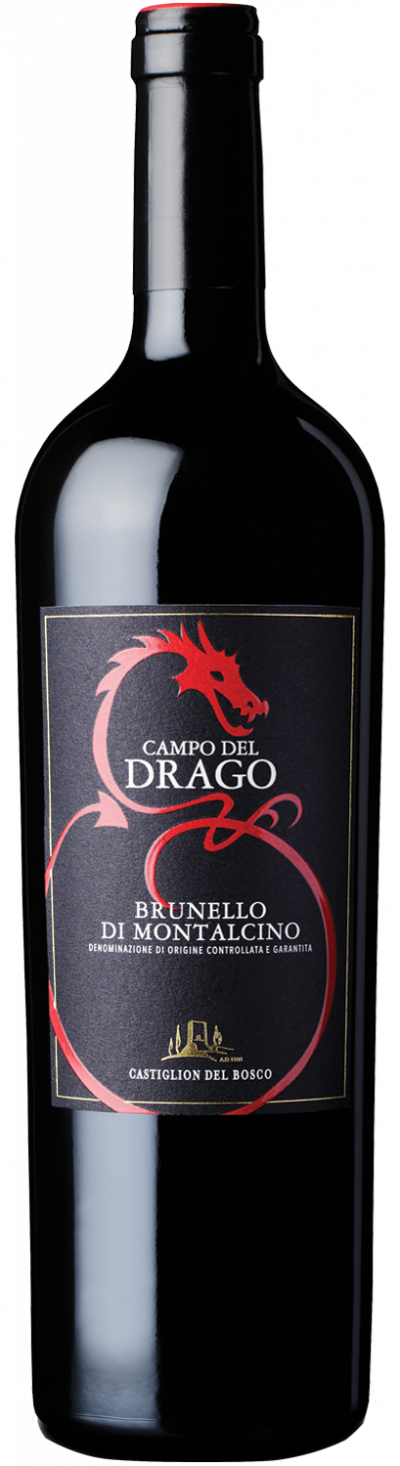
Castiglion del Bosco Campo del Drago, Brunello di Montalcino is made from 100 percent Sangiovese.
Castiglion del Bosco is one of the most prominent producers in Montalcino, both for the history of the estate and for its size, with 5,000 acres unchanged in the last 400 years. In 1967, when the Consorzio del Brunello di Montalcino was born, Castiglion del Bosco was one of its 25 founding members. This extraordinary property whose origin dates back to the 12th century was acquired by Massimo Ferragamo in 2003, who in turn totally restored the property to its original glory.
As Castiglion del Bosco‘s most representative wine, Brunello di Montalcino is an example of the Sangiovese grape‘s perfect symbiosis with the terroir of Montalcino.
Campo del Drago enjoys one of its highest expressions when paired with the succulence and softness of pigeon, whose breast is served here at its most delicate. The bold spicing of the wine is perfectly at one with the flavor combination bestowed to the meat by the beetroot, celeriac and the exotic overtones of coffee.
Review:
-Wine Spectator 96 Points
Tuscany is a region whose countryside never ceases to amaze for its captivating beauty. Castiglion del Bosco also knows how to charm. Nature’s voice is heard loud and clear here, while man’s hand has always respected its verdant spaces and fine balance. The name itself revelas its character: the bosco,(wood), surrounding the Castiglion (walled castle), is the domain of deer, boars and pheasants. And of Sangiovese.
Castiglion del Bosco entered its new chapter in 2003, when it was transformed to its current glory by Massimo and Chiara Ferragamo. Renewal of both the architecture and the winemaking processes commenced immediately and today the wines of Castiglion del Bosco receive worldwide recognition for their excellence. In 2022 Castiglion del Bosco begins a new chapter in its history with its transfer to an international family office, who ensures the continuous development of the entire estate with a spirit of continuity.
The history of Castiglion del Bosco dates back to 1100 A.D., amidst armed struggles, assaults and the inprint of great Sienese families, who settled and brought here the artistic genius of Pietro Lorenzetti, whose precious Annunciazione dei Santi (1345 A.D.) still adorns the hamlets tiny church. Farming was always a mainstay, as seen in the stables, olive groves, farmed land, and vineyards. In more recent history, Castiglion del Bosco became a founding member of the Brunello di Montalcino Consortium in 1967.

Mas Sinen Negre Priorat is made from 38% Garnacha, 22% Cabernet Sauvignon, 23% Carinena, 16% Syrah
Aged in 90% French, 10% American oak barrels for 12 months.
Maceration for 21 days. ML in stainless steel tanks.
Clarification with white egg and soft filtration.
The wine shows great spice and leather components, some minerality and a lot of ripe red fruits aromas as well.
This wine is certified organic.
Review:
"Dark, bright-rimmed ruby. Highly perfumed, mineral- and smoke-accented red and dark fruit preserve, baking spice and floral pastille aromas, along with hints of licorice and black tea. Gently chewy and focused on the palate, offering juicy cherry, blackberry and spicecake flavors that deepen and turn spicier as the wine opens up. Finishes impressively long and sappy, with a lingering floral nuance, well-integrated tannins and a jolt of smoky minerality. Raised in new and used barrels, 90% French and 10% American.- Josh Raynolds"
- Antonio Galloni's Vinous (March 2021), 93 pts

Belle Glos Eulenoch Pinot Noir is made from 100 percent Pinot Noir.
Ruby red with aromas of ripe cherry and juicy blackberry with hints of cocoa. Rich and opulent offering flavors of bakers chocolate, blackberry, and sweet pipe tobacco. Well rounded with supple, refined tannins and a mouthwatering, long finish.
Review:
Brimming with boysenberry, lavender, and black tea, this expressive, well-structured Pinot Noir made with freerun juice aged in (60% new French oak for nine months is equal parts juicy, dense, energetic, and glossy. Sweet tobacco, vanilla wafer, and pomegranate align with supple tannins. Delicious.
-Tasting Panel 96 Points

Mt Monster Shiraz is 100 percent Shiraz
Deep purple in color. Ripe cassis and black plum fruits on the nose with violets. Varietal fruit-driven palate, with cassis and dark berryfruit and spice flavors. Soft tannins compliment the fruit with mouth-filling generous finish.
French & American oak has been used sparingly to ensure maximum fruit expression is retained in the final wine.
Our Shiraz is fermented in static fermenters at controlled temperatures to retain the varietal aromatics. Once complete the wine is left for 7–10 days on skins to aide in the extraction of soft fleshy tannins and build wine structure.



