" We don't sell the wine without touching the vine "
| Country: | France |
| Region: | Burgundy |
| Winery: | Chartron et Trebuchet |
| Grape Type: | Chardonnay |
| Vintage: | 2015 |
| Bottle Size: | 750 ml |

Bachelet Bertrand Chassagne Montrachet Blanc is made from 100 percent Chardonnay.
The Chassagne-Montrachet appellation is located in the southern part of the Côte de Beaune and produces mainly white wines. The vineyard faces east, with varied soil types, characterized by the presence of iron oxide, which gives a red-brown color to the soil.
Bachelet Bertrand Chassagne-Montrachet is produced from two villages, La Canière and Les Lombardes.
The wine offers a golden color, a soft, floral nose with spicy notes. On the palate, the wine is ample and harmonious, combining freshness and tension.
Pairs well with fish (especially salmon) or white meat in sauce (poultry, veal).

Bachelet Bertrand Chassagne Montrachet Blanc Premier Cru Morgeot is made from 100 percent Chardonnay.
The Chassagne-Montrachet appellation is located in the southern part of the Côte de Beaune and produces mainly white wines. 'Morgeot' is located in the south of the village, characterized by compact limestone soil containing iron oxide, which gives the soil its particular red-brown color.
The wine offers a golden color, a subtle nose of white flowers and honey notes. Full-bodied and well-structured on the palate.
The softness of the Chardonnay on the palate makes an interesting pairing with cooked foie gras; it also sits well with lobster, spiny lobster, or even morel mushroom dumplings or Bresse chicken in a cream sauce.

Bertrand Bachelet Chassagne Montrachet Premier Cru Morgeot is made from 100 percent Chardonnay.
The Chassagne-Montrachet appellation is located in the southern part of the Côte de Beaune and produces mainly white wines.
'Morgeot' is located in the south of the village, characterized by compact limestone soil containing iron oxide, which gives the soil its particular red-brown color.
The wine offers a golden color, a subtle nose of white flowers and honey notes. Full-bodied and well-structured on the palate.
The softness of the Chardonnay on the palate makes an interesting pairing with cooked foie gras; it also sits well with lobster, spiny lobster, or even morel mushroom dumplings or Bresse chicken in a cream sauce.

Joseph Drouhin Batard-Montrachet Grand Cru is made from 100 percent Chardonnay.
Producing communes: Puligny-Montrachet and Chassagne-Montrachet.
Site: Bâtard-Montrachet straddles Puligny and Chassagne. It lies right below the famous Montrachet vineyard. Bâtard is one of the greatest white wines of the Côte de Beaune.
History & tradition: according to the often told story, the lord of Puligny in the Middle Ages divided his estate between his children: the eldest was the « chevalier » (knight), the daughters were the « pucelles » (young virgins) and the son born out of wedlock was the « bâtard ».
Soil: located on a mild slope, the soil is a brownish limestone mixed with gravel. The secret of this exceptional terroir comes from the unique interaction between the deep layers of limestone and the roots of the vines.
Tasting a wine of this stature is always cause for emotion. The golden colour has bright reflections. After some aeration, the aromas reveal their rich intensity: grilled bread, almond, honey, exotic wood...What is striking is the structure of the wine, its « monumental » grandeur. There is even a touch of tannin that provides an added dimension. A voluptuous finale, seemingly without end, with precious notes of preserved and ripe fruit..
Supply: this wine comes from grapes harvested on some parcels of the Drouhin Family Properties as well as from grapes and musts purchased from supply partners according to rigorous specifications.
Harvest: grapes harvested by hands in open-work crates. If necessary, a careful sorting is proceeded.
Vinification: slow pressing in a pneumatic press. The juice of the last press is separated from the free run-juice. The juice is transferred into wine barrel after a little settling.
Ageing: the alcoholic fermentation as the malolactic and the ageing are being processed in oak barrels. The proportion of new barrels is around 30%.
The ageing lasts between 18 to 21 months.
Origin of the wood: oak grown in French high forest.
Throughout the ageing process, decisions are taken only after careful tasting evaluation. The data obtained is completed through technical analysis. As with every other Joseph Drouhin wine, absolute priority is given to the true expression of terroir and character of the vintage.

Chavy-Chouet Puligny-Montrachet Les Enseigneres is made from 100 percent Chardonnay.
Les Enseigneres is a coveted village lieu-dit in Puligny-Montrachet, sited right against the great slope near Batard-Montrachet and Bienvenues-Batard-Montrachet, a village-level parcel that consistently reaches toward Premier Cru quality. Domaine Chavy-Chouet of Meursault works old vines here, some sixty-five years of age, on clay and limestone.
Fermented with native yeasts and aged a year in French oak with a fifth new, it is a Puligny to seek out: white peach and citrus over a core of wet-stone minerality, with the tension, depth and long finish that mark the finest whites of the village.

Chavy-Chouet Puligny-Montrachet Premier Cru Les Folatieres is made from 100 percent Chardonnay.
Les Folatieres is among the most celebrated Premier Cru climats of Puligny-Montrachet, climbing a steep, mid-slope incline of thin, marly limestone with the bedrock never far below the surface. In the cellar of Domaine Chavy-Chouet in Meursault it becomes a benchmark white Burgundy, drawn from vines of around fifty years.
Fermented on native yeasts and raised a year in French oak with a fifth new, it is concentrated yet precise, layering ripe citrus and orchard fruit over flint and crushed stone, with the drive, depth and long, saline finish that reward a few years in the cellar.
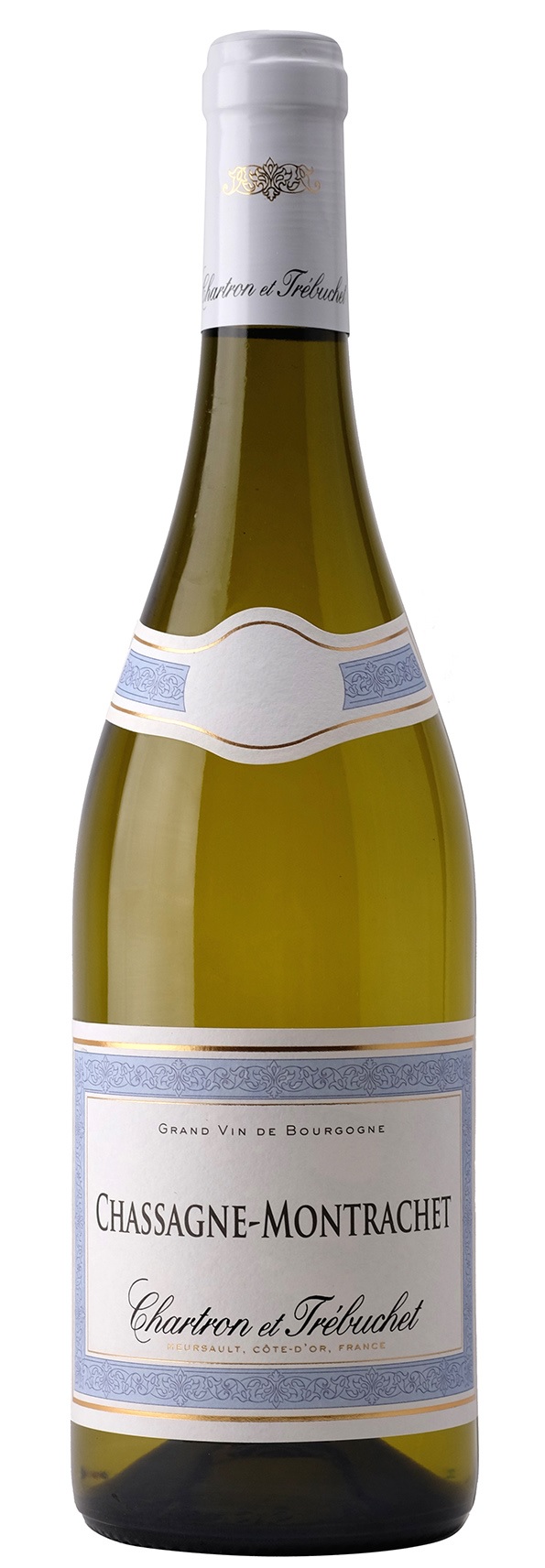
The Chassagne-Montrachet is a pure golden yellow color. The nose opens on complex aromas with vanilla and apricot notes. Spicy aromas can be smelt. Ample and round on the mouth, aromas of vanilla develop, ending with a sweet note of sap.
Average age of the vines: 40 years old.
Traditional vinification in French oak barrels with complete malolactic fermentation.
Pairs with shellfish, fish, goat cheese.
The Chartron et Trebuchet Estate
Owners of Premiers and Grands Crus in Puligny-Montrachet since 1859 with the Domaine Jean Chartron, Jean-René Chartron founded the Maison Chartron et Trébuchet in 1984 with Louis Trébuchet, manager of a wine trading company.
Vincent Sauvestre acquired the company in 2004. His objective is to continue to promote the great white wines of Burgundy, whilst respecting and perpetuating the quality work achieved by Jean Chartron and Louis Trébuchet.
The Maison Chartron et Trébuchet specialises in producing great white Burgundy wines. The know-how of the winemakers begins with a radical selection of the very best plots: the highest-quality terroirs of the Côte are chosen and the grapes are carefully monitored throughout the ripening period. Grapes are hand-picked when the balance between acidity and sweetness is at its prime: the fruit must not be too ripe so that the full potential of the terroir is maintained, including its acidity, to ensure that the wines age properly. All of the winemaking is done in casks: the alcoholic fermentation is followed by malolactic fermentation. A proportion of 20 to 40% of new barrels is used, depending on the appellations and the vintage. Wines are left to age for 12 to 18 months depending on the appellations.
The Chartron et Trebuchet Vineyards
Chartron et Trébuchet's vineyards are all planted on Limestone and Clay based soils. In average, the age of the vines is 30 years old.

Jean-Michel Sorbe Quincy Blanc is made from 100 percent Sauvingon Blanc.
The first nose is expressive and opens up to notes of acacia, citrus (lemon, grapefruit). Full on the palate with lovely freshness. This wine boasts nice balance and good length.
The vines are 15 to 20 years old and are located on the left bank of the Cher River, southwest of Quincy. This vineyard enjoys good exposure to the sun and overlies hillocks composed of sandy alluvial deposits and gravel dating back to the Quaternary Period. Each terroir is managed with minimal intervention in an environmentally friendly approach. Vinification: Slow pressing. Fermentation took place under controlled temperatures (18°C).The wine was aged on fine lees for a minimum of 4 months. It was filtered only once before being bottled.
Pair with crustaceans, asparagus, or goat's cheeses.
After pouring, allow the wine to breathe for a few moments in the glass before enjoying so that it may fully release all of its aromas.

Merryvale Pinot Noir Sonoma Coast 2022 is made from Pinot Noir.
From the cool, fog-swept vineyards of the Sonoma Coast — including fruit from the celebrated Durell and Sunchase sites — this is Merryvale's elegant, Burgundian-minded take on California Pinot Noir. A mix of Dijon and heritage clones (667, Pommard, 777 and 828) was largely destemmed, fermented with native yeasts, and aged about ten months in roughly 40% new French oak — restraint that lets the fruit lead. Expect a perfumed, silky glass: black cherry, raspberry and dark berry lifted by forest floor, cola spice and a whisper of graham cracker, with bright acidity and fine, polished tannins carrying a long finish. Lovely now and over the next decade.
Winery Info: Merryvale Vineyards was founded in 1983 and makes its home in the historic Sunny St. Helena winery on Main Street — a stone landmark built in 1933 as the first winery raised in the Napa Valley after Prohibition, and the cellar where Robert and Peter Mondavi first made wine with their father, Cesare. The Schlatter family has owned and run Merryvale since the 1990s, today led by René Schlatter. At its heart lies the Historic Cask Room, where two stories of century-old 2,000-gallon oak casks line the walls. Four decades on, Merryvale remains a quintessential St. Helena house.
Review:
A wonderful interplay of brightness and savoriness captures the elegance of wines from the Sonoma Coast. Aromas of crushed red raspberries, sauteed mushrooms and wild blackberries. On the palate there’s red fruit and black pepper, with bright, crunchy acidity and taut tannins. The finish is long, with umami flavors. Medium-bodied. Drink or hold.
-James Suckling 94 Points