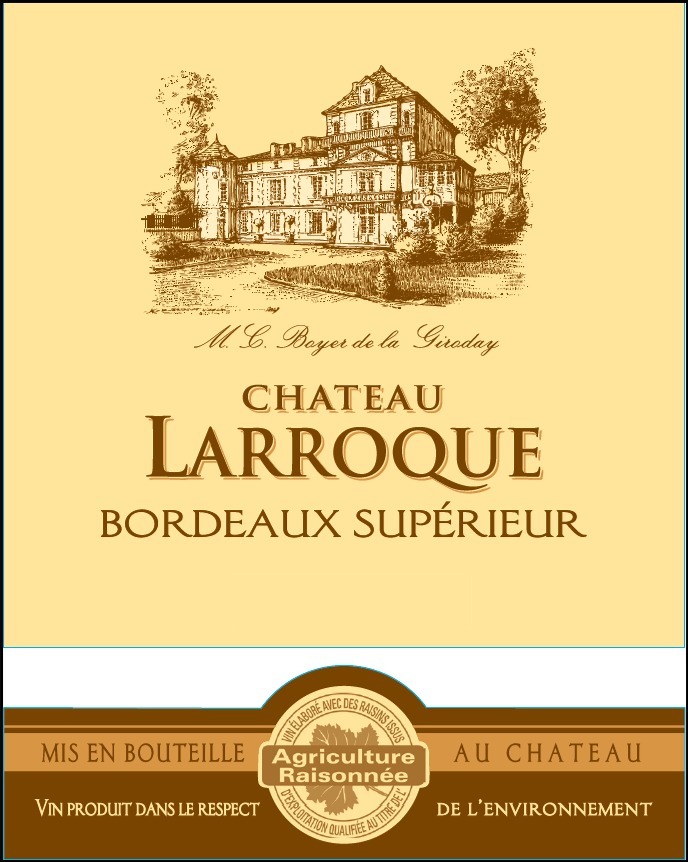
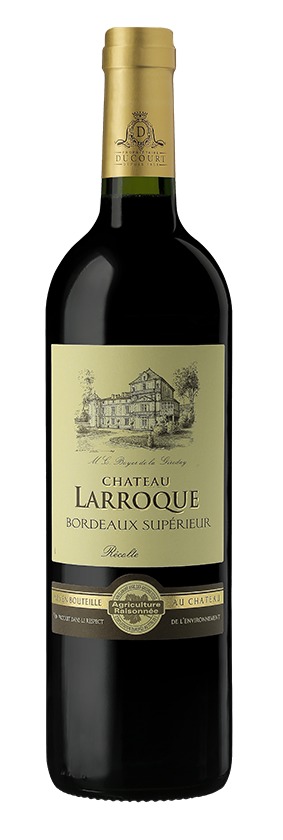
" We don't sell the wine without touching the vine "

Chateau Larroque Bordeaux Superieur Rouge is a blend of 51% Merlot and 49% Cabernet Sauvignon.
Nose : Red fruits, almond and hazelnut, with a faint vanilla aroma.
Mouth : The silky, velvety attack reveals a pleasant, concentrated and well structured wine. It offers a combination of fruits pastes’ flavors, licorice and toasted notes, and an elegant finish.
The 60-hectare vineyard was rapidly replanted and the château building, which dates from 1348, was restored.
Our family now produces three different-colored wines there: red, white and rosé.
Fermentation : Alcoholic fermentation in thermo-regulated stainless steel vats at around 26°C / 78°F then a gentle vatting for 3 weeks at 30°C / 86°F. Running off and pressing,separation of the press and free-run juice. Malolactic fermentation in thermo-regulated stainless steel vats at around 18°C / 64°F
- 2017 Decanter World Wine Awards Decanter 95 Points
Color : Dark garnet hue
Marie-Christine, the daughter of Henri Ducourt, purchased this prestigious left-bank property in 1979, which lies on the border of the Graves appellation.
Grown on loamy-clay soil.
Macération : Pre-fermentation cold maceration of 24 to 48 hours
Enjoy this wine with charcuterie, roasted meats, BBQ, cheeses.

Chateau Arnauds des Bordeaux Rouge is made from 100% Merlot.
The wine shows a deep red purple color and intense aromas of black fruits (blackcurrant, black cherry) with hints of liquorice. Very fruity and well-balanced. It is powerful and well structured in the mouth with round and silky tannins, ripe flavors of black fruits. Strong and a slightly spicy finish.
Grapes are coming from 30 year old vines planted on gravelly soils.
The land benefits from sun exposure, warmth and humidity that are strong assets for the vine culture.
The wine pairs well with game meat and beef on the grill.

Chateau Castegens Cotes de Bordeaux Castillon is made from 80% Merlot, 18% Cabernet Franc and 2% Cabernet Sauvignon.
The wine boasts an intense, deep and lively red color. The nose offers black fruit, blackberry, cigar box, licorice, some delicate and integrated oak flavors as well. The mouth is full of fruit flavors, spice and fine toasty flavors. The structure is rich, but the tannins are well integrated already. The finish is long and a slight mintiness give the wine a great length and some purity.
Pairs great with meat and vegetables on the grill.

Chateau Vermont L'Ame Grand Vin de Bordeaux is made from 40% Merlot, 30% Cabernet Franc and 30% Petit Verdot.
L'AME de Vermont represents the culmination of 10 years of dedicated work, derived from select grapes of Chateau Vermont's best parcels, chiseled to be the ultimate extraction of their terroir and Spirit. This cuvée is the Winemaker's soul. It is a reflection of the requirements, precise work and desire to achieve perfection.
A rare and confidential wine, vinified and matured in new oak barrels. Fine wine, elegant and well-balanced, with vanilla notes coming from the oak aging and subtle scents of ripe black and red fruits. A beautiful structure and great aging potential.

Grand Veneur Chateauneuf-du-Pape Rouge Les Origines is made from 50% Grenache, 30% Mourvedre and 20% Syrah
Matured in vats (grenache) and in oak casks (syrah and mourvèdre).
Deep and brilliant, purple-red colour. An exciting nose with aromas of black fruit (blackcurrant, cherry) spices and vanilla. This great aromatic complexity is found on the palate : the spices and ripe fruit appear with an elegant woodiness and harmonious tannins. The finish has good aromatic length and introduces a touch of liquorice and pepper.
A terrific Châteauneuf du Pape with great concentration and finesse.
Best between 2 and 20 years. Best to decant if young (less than 5 years old).
Soil type Extreme north of Châteauneuf du Pape. This plateau is made with a high quantity of red clay mixed with rocks. This area is considerated to be one of the best to produce rich and powerful red wines. By definition, LES ORIGINES will always deliver a great complexity and ageing potential. Winemaking & ageing Harvest is sorted by hand, destemmed and crushed. Fermentation temperature is controlled at 30°C. Vatting period of 18 to 20 days. Matured in vats (grenache) and in oak casks (syrah and mourvèdre).
Review:
"The 2019 Châteauneuf Du Pape Les Origines is also deep purple-hued and has a classic bouquet of crème de cassis and blackberry fruits intermixed with notions of graphite, chocolate, and spicy wood. Rich, full-bodied, and concentrated, this is beautifully done and despite its more modern elevage, it has plenty of Provençal character and charm."
- Jeb Dunnuck (October 2020), 94-96+ pts
"Warm in feel, with a gush of plum puree and blackberry paste flavors, liberally laced with black licorice and roasted alder notes. A solidly built, modern version, with a nice tug of warm earth on the back end. Best from 2022 through 2034. —J.M."
- Wine Spectator's Insider (June 9th 2021), 93 pts

Mordoree Chateauneuf du Pape Rouge Dame Voyageuse is made from Grenache 90 % Mourvèdre 4% Syrah 4 % Counoise 1% Vaccarese 1% .
Mordoree Chateauneuf du Pape Rouge Dame Voyageuse is a more approachable version of the La Reine des Bois. It is meant to be enjoyable early compared to her sister Cuvée which is made for the long run.
Color : deep ruby red, opaque.
Aromas : red fruits, changing to touches of leather, black truffles and coffee.
Palate : fat, concentrated and full flavored with a very long liquoriced and fruity finish.
Ageing potential : 6 to 10 years.
Surface : 5 Ha.
Yield : 30 Hl./Ha.
Vineyard age: 60 Years
Terroir : Clay-siliceous on pebble stones
Harvest : by hand
Vinification : 100 % destemmed, long 30 days maceration with a maximum of 34° C temperature.
Estate bottled
Review:
"Moving to the 2019s from bottle, the Grenache-heavy 2019 Châteauneuf Du Pape La Dame Voyageuse offers a beautiful array of both red and black fruits as well as classic Provençal notes of lavender, peppery garrigue, and flowers. Rich, medium to full-bodied, and beautifully textured on the palate, this is another terrific vintage for this cuvée, which remains an incredible value in the market today. It will drink nicely for 10-12 years if stored correctly."
- Jeb Dunnuck (November 2021), 95 pts
Chateau Larroque Bordeaux Superieur Rouge is a blend of 51% Merlot and 49% Cabernet Sauvignon.
Nose : Red fruits, almond and hazelnut, with a faint vanilla aroma.
Mouth : The silky, velvety attack reveals a pleasant, concentrated and well structured wine. It offers a combination of fruits pastes’ flavors, licorice and toasted notes, and an elegant finish.
The 60-hectare vineyard was rapidly replanted and the château building, which dates from 1348, was restored.
Our family now produces three different-colored wines there: red, white and rosé.
Fermentation : Alcoholic fermentation in thermo-regulated stainless steel vats at around 26°C / 78°F then a gentle vatting for 3 weeks at 30°C / 86°F. Running off and pressing,separation of the press and free-run juice. Malolactic fermentation in thermo-regulated stainless steel vats at around 18°C / 64°F
- 2017 Decanter World Wine Awards Decanter 95 Points
Color : Dark garnet hue
Marie-Christine, the daughter of Henri Ducourt, purchased this prestigious left-bank property in 1979, which lies on the border of the Graves appellation.
Grown on loamy-clay soil.
Macération : Pre-fermentation cold maceration of 24 to 48 hours
Enjoy this wine with charcuterie, roasted meats, BBQ, cheeses.
Marie Christine, the daughter of Henri Ducourt, purchased this prestigious left-bank property in 1979, which lies on the border of the Graves appellation. The 60-hectare vineyard was rapidly replanted and the château building, which dates from 1348, was restored. The family now produces three different-colored wines there: red, white and rosé.
In 1858, Ducourt family settled at Château des Combes in Ladaux, a small rural village in the south east of Bordeaux, in the heart of Entre-Deux-Mers area. Over time, new generations have followed in their footsteps; a passion for wine has become a profession, and their knowledge and the estate have grown ever greater as they have been passed down the line.
Pierre Ducourt, then his children and his grand-children farmed several hectares of vines that belonged to the estate. The arrival of the grandfather, Henri Ducourt, at the property marked an important turning point in the family business. He, with the help of his three children (Marie Christine, Philippe and Bernard), decided to drastically revitalize the company and turned the family vineyard into one of Bordeaux’s largest winemaking facilities, with 450 hectares of land and 14 chateaus in 6 different AOC's.
The crocodile is the emblem of Henri Ducourt’s vigorous business spirit, which lives on today, as strong as ever, in each family member. And what better ambassadors could exist to remind people that Entre-Deux-Mers is where this family adventure began?
In 1962, Henri Ducourt, a young winemaker, used to work 14 hours a day managing the 20 hectares of vines he had inherited from his father. He had a good friend, his neighbor, who owned 14 hectares and used to work with his two sons. At this time, suffice to say that running a vineyard was not the career that parents wished for their children, preferring instead to steer them towards more stable jobs. Some though, including Henri, were obstinate and unwilling to part from the vineyard. So, hard-working and hard-headed, Henri Ducourt slowly but surely bought the land and the vines of the neighboring producers and found himself by the mid-80’s at the head of almost 300 hectares of vineyards! One day, as much to poke fun as through admiration, the son of his friend drew a crocodile on a sign to represent the tenacity, lucidity and cold-blooded business spirit of Henri Ducourt, then planted this sign among the far-reaching vines of his neighbor.
Amused by the gesture, Henri Ducourt was inspired by the crocodile when he rebuilt the winery and asked that the new vats were decorated with this symbol. Today, Henri’s children and grandchildren manage 450 hectares of vineyards, always persistent, ready for new challenges, and faithful to what their parents have built. The crocodile has since become the emblem of the family.
Graduated as Oenologist in 2002 (University of Toulouse).
Before joining Ducourt in 2014, he worked for various estates :
- Domaine de l’Hortus in Pic Saint Loup
- Les caves de Sieur d’Arques in Limoux
- Chateau Carbonnieux, Grand Cru Classé in Pessac Léognan
The Ducourt's have always known that quality grapes are essential for making a good wine. Therefore they take the utmost care in the vineyards, to get the best from every plot of land. The size of the business also allows them to make numerous investments in the latest tools, which enable to unite traditional knowledge with the latest technologies, and therefore become ever more precise and respectful of the environment in their work.
The latest equipment
They regularly invest in new equipment for two main reasons : a desire to constantly evolve and improve quality while reducing the amount of strenuous and dangerous work undertaken by their co-workers.
With the development of the vineyard's surface, the harvests are now carried out with the help of the latest generation of harvesting machines, which make it possible to collect the grapes in the cool of the morning. Harvest is quicker offering more flexibility and quality improvement.
Among the latest acquisitions is a machine that allows to plant using a GPS guidance as well as an innovative and precise spraying system and flexible frames that allow to reduce waste and the amount of treatment products used.
A Grand-Cru-worthy setup
The family invests in equipment that is worthy of a Grand Cru, and therefore push further in the constant quest for quality, which applies to the entire range of wines.
The new pressing system allows them to press the grapes in a completely inert environment to prevent any oxygenation of the juice and to preserve the aromas of each varietal, to obtain more intense and fresher wines. The wineries and the stainless-steel vats are thermo-regulated in order to keep the juice in the best conditions possible and to maintain complete control over the entire fermentation process. They have also invested in a cross-flow filtration system for filtering wines before bottling, which ensures optimal quality and no waste. Finally, to improve safety for the co-workers they also regularly invest in new equipment such as carbon-monoxide detectors, helping to prevent accidents including asphyxiation during the cleaning of the vats. The most recent investment to date involves the bottling line that was set up with the collaboration of the employees in order to reduce their workload.
6 generations of shared experience
They have the good fortune to be able to build on several generations of winemaking experience and produce wines that respect their local typicity. They frequently organize tastings of two old vintages so as to improve their understanding of the wines’ evolution over time, and so as to be able to really tell people when is the best time to drink the wines.

Laurent-Perrier Grand Siecle No. 26 is a blend of 58% Chardonnay, 42% Pinot Noir
white gold in color with delicate and persistent bubbles, Grand Siecle No. 26 offers a very complex nose which mixes honeysuckle, lemon, clementine and fresh butter aromas, followed by notes of hazelnut and a touch of honey. The feel in the mouth is very delicate and fresh with candied lemon and fresh hazelnut aromas. The palate is silky and mineral with notes of honeysuckle, flaked almonds and clementine.
It pairs with high quality produce and refined dishes, including shellfish, noble fish and white meats such as Thai style langoustine tartare and fine roasted poultry.
Vintage in Champagne is usually synonymous with excellence for Prestige Cuvées. Contrarily, Laurent‑Perrier believes that only the art of assemblage can offer what nature can never provide, that is, the perfect year.
The expression of the perfect year is that of a great champagne wine that has long ageing potential and over time develops depth, intensity and aromatic complexity yet retains its freshness and vibrancy.
Since 1959, Grand Siècle has been revealed only 26 times in bottle format and 23 times in magnum.
The « Grand Siècle » (Great Century) is the name given to one of the most prosperous periods (17th century) in the history of France known for the capacity of man, through his works, to create what nature cannot. Louis XIVth, known as the « Sun King », by creating the « Château de Versailles » and its gardens, was the architect of this model of harmony, balance and perfection.
The symmetry and perspective of the « Jardins à la française », the capacity to grow Mediterranean fruits (especially Oranges inside the « Orangerie ») in such a Northern climate, creating the Grand Canal, the fountains and ponds with no nearby rivers are many illustrations of this ability of man to sublimate natural elements. The name of Grand Siècle was chosen for Laurent‑Perrier’s Prestige Cuvée based on this common vision to reach a perfection that Nature, on its own, cannot provide.
Review:
This is really something. Electric on the palate. The aromas are so complex with sliced fresh and dried ginger, subtle pie crust, tarte tatin and hints of nutmeg with some salted caramel. Toasted bread, too. Always subtle. The palate is full- to medium-bodied yet hemmed-in with a freshness and balance that draws you back. Savory and vibrant. It's full of energy. Spectacular. Fascinating. Symphonic blend of 2012, 2008 and 2007. 65% of the 2012, 25% of the 2008 and 10% of the 2007. Eight grand cru. Chardonnay 58% and 42% pinot noir. Disgorged February 2023. 10 years on the lees. 7g/L dosage.
-James Suckling 100 Points

Maurice Martin Saint-Veran is made from 100 percent unoaked Chardonnay.
White gold color with silver or greenish reflections , shiny and soft. Aromas suggest broom, acacia, green apple, lemongrass, citruses. A fresh, dry and fruity, nervous with a good balance.
The grapes for this wine is coming from 2 famous part of the Saint Véran' appellation: Prissé and Davayé.
The wine went through malolactic fermentation. It has been gently filtered before bottling.
Very easy to associate with his very complete balance : grilled fish, creamy risottos, antipasti, salads, sushis, very pleasant at the aperitif.