
" We don't sell the wine without touching the vine "
| Country: | France |
| Region: | Burgundy |
| Winery: | Chavy-Chouet |
| Grape Type: | Chardonnay |
| Vintage: | 2019 |
| Bottle Size: | 750 ml |

Chavy-Chouet Meursault Premier Cru Les Genevrieres is made from 100 percent Chardonnay.
Fruity flavors and typical nutty nuances. The Genevrières parcels are located in the heart of Meursault's southern premiers crus. "Genevrieres" takes its name from the presence, years ago, of the juniper bushes which covered its slope, and it is sometimes said that the tang of this aromatic berry can be detected in the wine.
The Genevrières parcels are located in the heart of Meursault's southern premiers crus. "Genevrieres" takes its name from the presence, years ago, of the juniper bushes which covered its slope, and it is sometimes said that the tang of this aromatic berry can be detected in the wine.
Fruity flavors and typical nutty nuances.

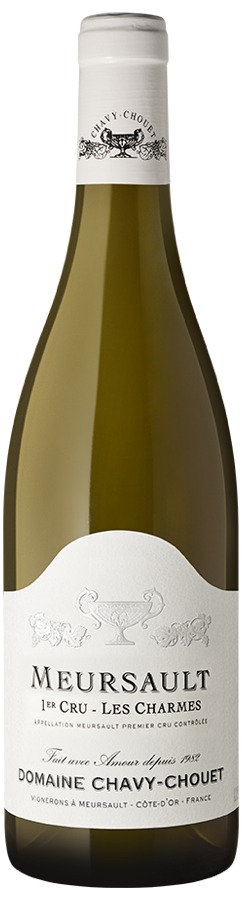
Chavy-Chouet Premier Cru Meursault Les Charmes is made from 100 percent Chardonnay.
This fine and sensual wine, with hints of blossom and roasted hazelnut, has a concentration that makes it discreet in its youth but powerful over time.
Located right next to Puligny-Montrachet, the plot of Les Charmes was planted in 1943 on a sandy clay-limestone soil that produces small, concentrated berries for an intense wine that is perfect for ageing.

Chavy-Chouet Meursault Les Vireuils is made from 100 percent Chardonnay.
The "Les Vireuils" parcel is located on the top of the hill above Meursault, right below the forest.
It is slightly cooler parcel with a limestone soils with a higher presence of rocks. The wines coming from this parcel are always sharp with a vibrant acidity and a lot of freshness.
Tasting notes: Concentrated, powerful, and lively, Les Vireuils has all the classic characteristics of the Meursault appellation. Its sophistication, structure, and assured elegance reflect the character of the soil.
It is a great match with fish in creamy sauce, cheese, white meats.

This fine and sensual wine, with hints of blossom and roasted hazelnut, has a concentration that makes it discreet in its youth but powerful over time. Located right next to Puligny-Montrachet, the plot of Les Charmes was planted in 1943 on a sandy clay-limestone soil that produces small, concentrated berries for an intense wine that is perfect for ageing.

Domaine Chavy Chouet Meursault Les Narvaux is made from 100% Chardonnay from extremely steep vineyards.
Les Narvaux in Meursault sits at the top of the slope on a steep, shallow, limestone plot.
TW Tasting notes: A lively and balanced wine with aromas of white-fleshed fruit. It offers hints of toasted almond on the nose and is very long on the palate. Mineral and energetic, it will only open up fully after a few years in the cellar. In the top 5 of my top Meursault picks.
60 Year old vine
Ageing: 12 months in French oak barrels (20% new)Planting density: 10000
Surface area: 0.5Ha

Chavy-Chouet Meursault Clos des Corvees de Citeaux is 100 percent Chardonnay
Aged in new oak barrels (Allier).
The Clos des Corvees de Citeau is a .96 hectare vineyard located in Meursault. It was part of the appellation of l'Ormeau; an old property of the Cistercian monks who made a two meter wall around the vines. The tall walls create a micro-climate that encourages early growth and ripening.
Thanks to its clay rich soil, the vineyard produces a rich, opulent and luscious wine that can be enjoyed young. This is a powerful and elegant white Burgundy; expressive, fresh and fruity with intense and strong flavors.
Chavy-Chouet Premier Cru Meursault Les Charmes is made from 100 percent Chardonnay.
This fine and sensual wine, with hints of blossom and roasted hazelnut, has a concentration that makes it discreet in its youth but powerful over time.
Located right next to Puligny-Montrachet, the plot of Les Charmes was planted in 1943 on a sandy clay-limestone soil that produces small, concentrated berries for an intense wine that is perfect for ageing.
The Domaine Chavy-Chouet Estate
Romaric Chavy took over the estate in 2014, making him the eighth generation to make wine in his family. Romaric learned from his father, Hubert Chavy, who founded the winery. Chavy-Chouet is one of the oldest families in Puligny-Montrachet. The Ropiteau family (on his mother's side) is the oldest one in Meursault.
Hubert Chavy (known not only for his winemaking but also for his charisma) was able to train Romaric in for a few years before his passing in early 2014. Romaric has become a very smart vigneron with a great philosophy. Making wine has come naturally to him, as if often does in Burgundy when you are next in line.
After six years at a specialist winemaking school and with plenty of experience in winegrowing and vinification around the world under his belt, Romaric has given the estate a makeover, watching over his 15 hectares of vines with a rigorous eye. He is proud of his roots, and his approach combines rigor, tradition, and innovation.
A group from Kysela visits Chavy-Chouet in January each year, carrying on a tradition of tasting from barrels, then bottles, and then finishing with some mystery wines. The group has to guess the appellation and the vintage of wines being poured from magnums...a tough job, but somebody has to do it.
This is a 15 hectare-domaine (37 acres) that produces wine from 14 A.O.C.'s (80% White, 20% Red). The vineyard is divided into 70 parcels planted to vines that are 40 years old or more. He uses Gillet as his cooper, who blends oak from Nevers, Limousin and Allier forests. The barrels receive medium toast. Romaric, just as his father, Hubert, does not fine or filter his wines, as he prefers their purity to shine through.
The winery covers 1,300 square meters, including 800 square meters of cellars, and is a mix of ancient and ultra-modern. The set-up allows him to work hand-in-hand with nature in a well-managed yet pleasant environment, and to meet his very high demands in terms of quality. The wines are put into barrels using gravity, intervention is kept to a minimum, and an irreproachable attitude to cleanliness also symbolize his quest for excellence in the shape of pure and balanced wines that burst with energy.
A corked bottle of 1983 Pichon-Lalande led to my inaugural visit to this Meursault domaine. My precious Pauillac corked, I ordered a bottle of 2015 Bourgogne Les Femelottes from Chavy-Chouet at Brat restaurant in London. It was so damn delicious that I ordered another and emailed winemaker Romaric Chavy that I must visit pronto.
Arriving at the gates, I noticed that there was no doorbell or knocker. When I was noticed loitering outside, the gates finally opened and Romaric Chavy informed me that they do without a doorbell because they have so many visitors. Chavy is a young and confident guy, very media-savvy, which is uncommon in Burgundy. He worked abroad in various countries including South Africa and Greece before taking over Chavy-Chouet at the age of just 22. Before tasting through the 2017s, which had all been bottled, I asked about the background of the domaine.
“The holdings come from two sides of my grandfather’s family. Chavy comes from Puligny-Montrachet, and his wife was part of the Ropiteau family in Meursault. Back then, he sold the wines to Bouchard Père. It was my own father, Hubert, who started bottling his own wine when he married his wife from Pommard and bought this house in Meursault. I started at the domaine in 2006 when we were still selling off grapes. I already had a good network [of potential clients] and so we started to bottle everything and develop exports. My father passed away in 2014. Now we have 15 hectares, mostly old vines located in five villages, producing around 90,000 bottles, of which around 90% is exported. We have three or four people working full-time and we work in a classical way - lutte raisonée and ploughing in the vineyard. This year we approached half the vineyard organically, but when the pressure became too high, we switched back and used spray. We press the fruit for two hours, with a 24-hour debourbage, and then ferment in barrel using natural yeast, a maximum of 20% new oak for between 9 and 12 months, with no lees stirring and a light filtration before bottling. We try to keep as much natural CO2 as possible.”
It is always a pleasure to discover a producer who has skimmed under your Burgundy radar for some time. Chavy-Chouet has built a loyal following here in the UK and I can understand why. These wines are very pure, terroir-driven and focused. Yet they are not challenging or pretentious and give much sensory pleasure. As I mentioned, you can splash the cash on a Premier Cru white if you wish, but do not ignore the 2017 Bourgogne Blanc Les Femelottes. It is unequivocally Village Cru in quality – no real surprise given that its vines are adjacent to Puligny-Village. The 2017 Meursault Charmes is an absolute knockout, whilst the monopole Clos des Corvées de Citeau is superb. This is an address I will definitely return to in the future, though I have made a mental note to phone ahead, so that I can actually get in. - Neal Martin"
- Antonio Galloni's Vinous (2017 Burgundy: A Modern Classic, January 2019)

Dunn Vineyards Napa Valley Cabernet Sauvignon is made from 100 percent Cabernet.
This Napa Valley wine is a blend of their Howell Mountain fruit and a small quantity of valley floor fruit that they purchase. This valley floor fruit contributes to the wine’s earlier approachability and softer tannic structure.
Review:
I loved the 2019 Cabernet Sauvignon Napa Valley, which I think is a step up over the 2018, although both 2019s show a much more elegant profile. Ripe currants, plums, roasted herbs, violets, and incense notes all shine in this medium to full-bodied, ripe, supple, layered beauty, which has fine tannins and a gorgeous finish. Enjoy bottles any time over the coming 15 years.
-Jeb Dunnuck 94 Points

Mortet Bourgogne Cote d'Or Rouge is made from 100 percent Pinot Noir.
A parcel of 90 ares, one part is 20 years old and the other part is 55 years old. Its is called Les Pressonniers, in Gevrey-Chambertin.
Bourgogne Rouge Côte d’Or comes from a plot of Gevrey-Chambertin vines, giving delicate fruit and body, as well as the character and complexity of the Gevrey-Chambertin terro



