" We don't sell the wine without touching the vine "
| Country: | France |
| Region: | Burgundy |
| Winery: | Chavy-Chouet |
| Grape Type: | Pinot Noir |
| Vintage: | 2017 |
| Bottle Size: | 750 ml |

Chavy-Chouet Volnay 1er Cru Sous La Chapelle is made from 100 percent Pinot Noir.
Total acreage for this wine: 0.1 hectare (0.25 acres)Planting density: 10 000 vines per hectares
Age of the vines: 10 years
At the bottom of the slope in the heart of Volnay, this plot lies on clay-sand soil.
Volnay is located on the steep sloping hill of Chaignot in the Côte de Beaune, where the southeast facing vines have been valued for centuries. These vineyards have been valued and exploited for centuries. Long before the French Revolution, the harvests of Volnay went to the Knights of Malta, the Abbeys of Saint-Andoche d’Autun and Maizières, or to the Dukes of Bourgogne and their successors, the Kings of France.
Volnay has a reputation for being among the most delicate, feminine of the Bourgogne wines. Limestone soil dominates the area, with deeper, gravelly soils at the foot of the slope, where Chavy Chouet’s vines are located.
This Volnay is full of character; broad and fruity. Smooth and elegant tannins make it a feminine wine, marked by aromas of black berries and leather.
Review:
-Jeb Dunnuck 94 Points

Chavy-Chouet Bourgogne Rouge La Taupe is made from 100 percent Pinot Noir.
Chavy-Chouet's Pinot Noir is classified as humble Bourgogne Rouge, but the fruit for it comes from an excellent single-vineyard site near Pommard. La Taupe's parcel was once part of the Pommard AOC.
The wine is juicy with a great mouthfeel. It has classic Bourgogne Rouge aromas, with a candied cherry character as well as strawberry, raspberry and spice, yet the structure and length of finish reminds one of a Pommard - ripe & rich with a bigger body.
Average age of the vines: 70 years old.
Density of planting: 10,000 vines per hectare.
Soil: clay
100% distemmed.
Very little intervention. Less pigeage (punch down of the cap) but some remontage (pump-over)
Review:
-Jeb Dunnuck 91 Points
Chavy-Chouet Bourgogne Rouge La Taupe is made from 100 percent Pinot Noir.
Chavy-Chouet's Pinot Noir is classified as humble Bourgogne Rouge, but the fruit for it comes from an excellent single-vineyard site near Pommard. La Taupe's parcel was once part of the Pommard AOC.
The wine is juicy with a great mouthfeel. It has classic Bourgogne Rouge aromas, with a candied cherry character as well as strawberry, raspberry and spice, yet the structure and length of finish reminds one of a Pommard - ripe & rich with a bigger body.
Average age of the vines: 70 years old.
Density of planting: 10,000 vines per hectare.
Soil: clay
100% distemmed.
Very little intervention. Less pigeage (punch down of the cap) but some remontage (pump-over)

Chavy-Chouet Maranges Blanc Les Meurees is made from 100 percent Chardonnay.
Domaine Chavy-Chouet is a well-regarded Meursault house, estate-bottling since 1982 and today in the hands of Romaric Chavy, whose whites have a devoted following and reach the United States only in small quantities. Maranges, at the southern tip of the Cote de Beaune, is one of Burgundy's last great-value white appellations, and Les Meurees is a single limestone plot the domaine farms organically from vines around thirty years old.
Raised fifteen months in French oak with a fifth new, it is pure Chavy in style: ripe orchard fruit and hawthorn lifted by acacia honey, with a bright, mineral, lime-blossom finish. White Burgundy that drinks well above its price.

Chavy-Chouet Puligny-Montrachet Premier Cru Les Folatieres is made from 100 percent Chardonnay.
Les Folatieres is among the most celebrated Premier Cru climats of Puligny-Montrachet, climbing a steep, mid-slope incline of thin, marly limestone with the bedrock never far below the surface. In the cellar of Domaine Chavy-Chouet in Meursault it becomes a benchmark white Burgundy, drawn from vines of around fifty years.
Fermented on native yeasts and raised a year in French oak with a fifth new, it is concentrated yet precise, layering ripe citrus and orchard fruit over flint and crushed stone, with the drive, depth and long, saline finish that reward a few years in the cellar.

Buccella Cuvee Katrina Eileen Napa Valley is made from 100% Cabernet Sauvignon.
Named after our first-born daughter, Cuvée Katrina Eileen is primarily composed of fruit from a vineyard in the Western Hills of Yountville, where yields are miniscule. The extremely rocky soil of the vineyard produces concentrated clusters of perfectly ripened Cabernet Sauvignon. In German, the name “Katrina” represents purity and fittingly, this wine is made entirely from the Cabernet Sauvignon grape, providing a pure expression of this decadent varietal. It also reflects our daughter’s personality with flavors that are complex, unreserved and expressive.
Always a 100% Cabernet blend, our 2017 Cuvée Katrina Eileen is an opulent and mouth-enriching wine. Captivated by the inky-black color, luscious scents of dark espresso and cinnamon stick leap out, along with powerful elements of graphite and cassis. Remarkably rich and seamless, while boasting flavors of blueberry compote, dark chocolate and black raspberries, this is a compelling and luxurious wine focused upon velvety texture, silky tannins and incredible length. An intentional breadth on the palate and length in the finish are hallmarks of this wine.
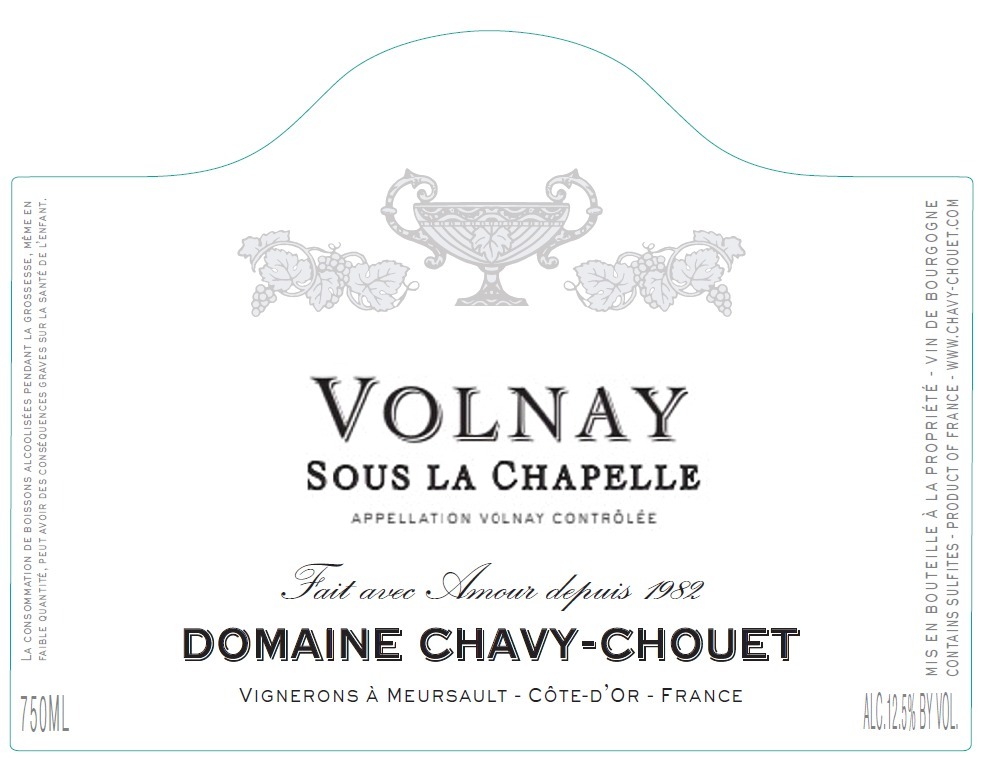
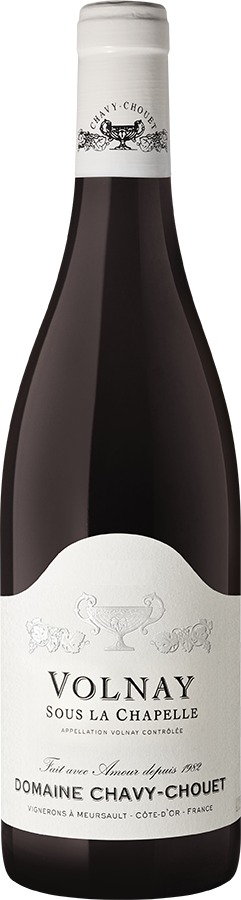
Chavy-Chouet Volnay Sous la Chapelle is made from 100 percent Pinot Noir.
A characterful wine that is broad and fruity. Smooth and elegant tannins make this a feminine wine, marked by aromas of black berries and leather.
Total acreage for this wine: 0.1 hectare (0.25 acres)Planting density: 10 000 vines per hectares
Age of the vines: 10 years
At the bottom of the slope in the heart of Volnay, this plot lies on clay-sand soil.
The Domaine Chavy-Chouet Estate
Romaric Chavy took over the estate in 2014, making him the eighth generation to make wine in his family. Romaric learned from his father, Hubert Chavy, who founded the winery. Chavy-Chouet is one of the oldest families in Puligny-Montrachet. The Ropiteau family (on his mother's side) is the oldest one in Meursault.
Hubert Chavy (known not only for his winemaking but also for his charisma) was able to train Romaric in for a few years before his passing in early 2014. Romaric has become a very smart vigneron with a great philosophy. Making wine has come naturally to him, as if often does in Burgundy when you are next in line.
After six years at a specialist winemaking school and with plenty of experience in winegrowing and vinification around the world under his belt, Romaric has given the estate a makeover, watching over his 15 hectares of vines with a rigorous eye. He is proud of his roots, and his approach combines rigor, tradition, and innovation.
A group from Kysela visits Chavy-Chouet in January each year, carrying on a tradition of tasting from barrels, then bottles, and then finishing with some mystery wines. The group has to guess the appellation and the vintage of wines being poured from magnums...a tough job, but somebody has to do it.
This is a 15 hectare-domaine (37 acres) that produces wine from 14 A.O.C.'s (80% White, 20% Red). The vineyard is divided into 70 parcels planted to vines that are 40 years old or more. He uses Gillet as his cooper, who blends oak from Nevers, Limousin and Allier forests. The barrels receive medium toast. Romaric, just as his father, Hubert, does not fine or filter his wines, as he prefers their purity to shine through.
The winery covers 1,300 square meters, including 800 square meters of cellars, and is a mix of ancient and ultra-modern. The set-up allows him to work hand-in-hand with nature in a well-managed yet pleasant environment, and to meet his very high demands in terms of quality. The wines are put into barrels using gravity, intervention is kept to a minimum, and an irreproachable attitude to cleanliness also symbolize his quest for excellence in the shape of pure and balanced wines that burst with energy.
A corked bottle of 1983 Pichon-Lalande led to my inaugural visit to this Meursault domaine. My precious Pauillac corked, I ordered a bottle of 2015 Bourgogne Les Femelottes from Chavy-Chouet at Brat restaurant in London. It was so damn delicious that I ordered another and emailed winemaker Romaric Chavy that I must visit pronto.
Arriving at the gates, I noticed that there was no doorbell or knocker. When I was noticed loitering outside, the gates finally opened and Romaric Chavy informed me that they do without a doorbell because they have so many visitors. Chavy is a young and confident guy, very media-savvy, which is uncommon in Burgundy. He worked abroad in various countries including South Africa and Greece before taking over Chavy-Chouet at the age of just 22. Before tasting through the 2017s, which had all been bottled, I asked about the background of the domaine.
“The holdings come from two sides of my grandfather’s family. Chavy comes from Puligny-Montrachet, and his wife was part of the Ropiteau family in Meursault. Back then, he sold the wines to Bouchard Père. It was my own father, Hubert, who started bottling his own wine when he married his wife from Pommard and bought this house in Meursault. I started at the domaine in 2006 when we were still selling off grapes. I already had a good network [of potential clients] and so we started to bottle everything and develop exports. My father passed away in 2014. Now we have 15 hectares, mostly old vines located in five villages, producing around 90,000 bottles, of which around 90% is exported. We have three or four people working full-time and we work in a classical way - lutte raisonée and ploughing in the vineyard. This year we approached half the vineyard organically, but when the pressure became too high, we switched back and used spray. We press the fruit for two hours, with a 24-hour debourbage, and then ferment in barrel using natural yeast, a maximum of 20% new oak for between 9 and 12 months, with no lees stirring and a light filtration before bottling. We try to keep as much natural CO2 as possible.”
It is always a pleasure to discover a producer who has skimmed under your Burgundy radar for some time. Chavy-Chouet has built a loyal following here in the UK and I can understand why. These wines are very pure, terroir-driven and focused. Yet they are not challenging or pretentious and give much sensory pleasure. As I mentioned, you can splash the cash on a Premier Cru white if you wish, but do not ignore the 2017 Bourgogne Blanc Les Femelottes. It is unequivocally Village Cru in quality – no real surprise given that its vines are adjacent to Puligny-Village. The 2017 Meursault Charmes is an absolute knockout, whilst the monopole Clos des Corvées de Citeau is superb. This is an address I will definitely return to in the future, though I have made a mental note to phone ahead, so that I can actually get in. - Neal Martin"
- Antonio Galloni's Vinous (2017 Burgundy: A Modern Classic, January 2019)

Piper-Heidsieck Rare Brut Champagne is made from 70% Chardonnay, 30% Pinot Noir.
The effervescence of Rare Millésime 2013 is tinged with an intensely bright, light golden color. The nose, at first subtle and clean, emerges in two stages combining tonicity and elegance. It all begins with the delicacy of white flowers, a hint of black tea and touches of citrus, kiwi and kumquat. Then, notes of lime blossom, green tea and fern give way to aromas of white fruits such as greengage plums. Touches of chestnut honey, sweet spices, vanilla and marzipan round off the wine's rich bouquet. The two facets of Rare Millésime 2013 are confirmed in the mouth: smooth and vibrant, indulgent and dynamic. After hints of meringue, whipped cream and marzipan, kumquat, blood orange and kiwi then provide a refreshing tonicity. On the finish, the comforting texture of Rare Millésime 2013 appears as an aromatic and smoky indulgence punctuated by a freshness and a subtle bitterness. Rare Champagne's iconic signature of tropic minerality is expressed differently in Rare Millésime 2013, extended by a plump and prolonged aftertaste.
Reviews:
Originally a part of the legendary Piper-Heidsieck Champagne house, Rare is moving their Champagne Millésime to a new brand and want it to stand alone. (Think Delamotte and Salon.) The 13th vintage for this cuvée, the 2013 Champagne Millésime is a blend is 70% Chardonnay with the rest Pinot Noir, with the majority of the blend coming from the Montagne de Reims Grand Cru and Premier Cru. A bright yellow hue, its aromatics are exquisite and well-balanced, with fresh notes of key lime, candied apple, fresh croissant dough, fresh pineapple, and honeysuckle. Medium to full-bodied, it fills the palate with a rounded and supple texture and a pillowy mousse. It’s long on the palate and has a silky personality as well as a long, pristine finish. It has fantastic balance of decadence and freshness, and I could drink this all day. It’s going to have a long drinking window. Drink 2024-2044 and beyond. Disgorged December 2022.
-Jeb Dunnuck 97 Points
Like a stallion out of the gate, this shows an initial explosion of power, in the form of mouthwatering flavors and fine texture, before quickly settling into an elegant gait. The racy acidity is seamlessly knit, buoying the lacy mousse and flavors of cassis, toasted brioche and tangerine, with accents of candied ginger, hazelnut and fleur de sel lingering on the long, creamy finish.
-Wine Spectator 97 Points

Alain Jaume Cairanne Les Travees is made from Grenache, Syrah and Mourvèdre.
The selected vines for this cuvée sit on south-facing slopes in Cairanne, one of the southern Rhône's finest villages.
The wine delivers an intense nose of black fruit. Full and concentrated on the palate with silky tannins, it reveals blackcurrant and cherry before a finish carrying the pepper and earthy notes typical of Cairanne. Enjoy with roasted lamb, braised or grilled pork, or a mild cheese such as brie or camembert.