
" We don't sell the wine without touching the vine "
| Country: | France |
| Region: | Burgundy |
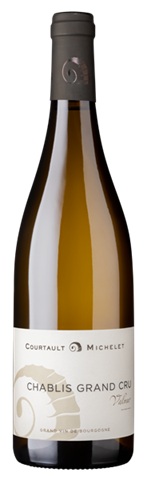
| Winery: | Courtault-Michelet |
| Grape Type: | Chardonnay |
| Organic: | Yes |
| Vintage: | 2023 |
| Bottle Size: | 750 ml |

Corinne Perchaud Chablis 1er Cru Fourchaume is made from 100 percent Chardonnay
Elegant citrus aromas. Concentrated and finessed, combining flavors of dried fruit with slight hints of woody notes. Perfect balance between body and acidity, long and persistent finish. This one is drinking great now, but as with all exceptional Chablis, it is possible to pay it down for years to come.
Made from 35 year old vines. The owners take great care to produce exceptional Chablis wine by keeping the lively Chardonnay fruit and the unique mineral quality imparted by the Kimmeridgian soil, the fruity acidity and bouquet in perfect balance. The grapes are harvested by hand and gently pressed in a horizontal pressoir to ensure the fullest extraction and range of flavors and aromas.
Pair with Scallops Jacques cream, roast veal with oyster mushrooms.

Pernot Belicard Batard Montrachet Grand Cru is made from 100 percent Chardonnay.
Aromas of white peach, white apple, with a beautiful minerality. Also lighty salty, chalky aromas and some bread and brioche flavors and a hint of vanilla.
Poultry with cream based sauces, French cheese, like camembert, but not too strong, also seafood and fish.

Pernot Belicard Bienvenue Batard Montrachet Grand Cru is made from 100 percent Chardonnay.
Aromas of white peach, white apple, with a beautiful minerality. Also lighty salty, chalky aromas and some bread and brioche flavors and a hint of vanilla.
Paultry with cream based sauces, French cheese, like camembert, but not too strong, also seafood and fish.

Wolfberger Riesling Muenchberg Grand Cru is made from 100 percent Riesling.
The Muenchberg facing south terroir located in the commune of Nothalten benefits from a unique microclimate. From the 12th century, the Cistercian monks started cultivating the stony and sandy soils formed by volcanic sediments of 250 million years old. Hence the name of the terroir meaning “monks’ mountain”.
This volcanic stony, sandy soils absorb and retain the sunshine heat. They provide excellent drainage and rapid warming, as the ground in this small valley is protected from the rain. The Muenchberg terroir is perfectly suited for Riesling. The nobility of the varietal is due to its late-ripening character and a rare, real fullness from the exceptional terroir which, while unfertile, helps the vines produce fewer grapes with high concentration of flavors.
This Riesling Grand Cru Muenchberg shows a pale yellow color and gold tints. The nose develops complex citrus aromas, verbena and a mineral character. On the palate the wine is dense, fresh, full-bodied and sophisticated with elegant acidity. The finish develops refined bitterness, citrus peels flavors and a touch of salinity.
This Grand Cru matches well seafood, bass with sauce, sea bream with fennel, dry goat’s cheese, roasted poultry with Riesling sauce.

Grand Veneur Chateauneuf du Pape Rouge Le Miocene is made from 70% Grenache, 20% Syrah, 10% Mourvèdre .
An intense dark-ruby color. The nose develop aromas of ripe black fruit (such as blackberry), cherry and spice box. The palate reveals the presence of tannins, in high quantity and elegant. The finish is long and luxurious. This is the Châteauneuf du Pape expression, displaying all the characteristics of the terroir.
Soil type: Plots are located northern part of Châteauneuf du Pape and the vines are grown under organic process.The soil is marked by the violence wrought by the Rhone river. It consists of a layer of marine molasses of the Miocene period covered by alpine alluvium. The presence of a great number of rounded stones known as "galets" in the earth is evidence of the time when the Rhone, then a torrent, tore fragments of rock from the Alps and deposited them on the plain. The GRAND VENEUR cuvee will express year after year a great power and aromatic complexity.
Winemaking & ageing: Harvest is sorted by hand, destemmed and crushed. Fermentation temperature is controlled at 30°C. Vatting period of 18 to 20 days. Matured in vats and oak casks.

Grand Veneur Chateauneuf du Pape Rouge Le Miocene is made from 70% Grenache, 20% Syrah, 10% Mourvèdre .
An intense dark-ruby color. The nose develop aromas of ripe black fruit (such as blackberry), cherry and spice box. The palate reveals the presence of tannins, in high quantity and elegant. The finish is long and luxurious. This is the Châteauneuf du Pape expression, displaying all the characteristics of the terroir.
Soil type: Plots are located northern part of Châteauneuf du Pape and the vines are grown under organic process.The soil is marked by the violence wrought by the Rhone river. It consists of a layer of marine molasses of the Miocene period covered by alpine alluvium. The presence of a great number of rounded stones known as "galets" in the earth is evidence of the time when the Rhone, then a torrent, tore fragments of rock from the Alps and deposited them on the plain. The GRAND VENEUR cuvee will express year after year a great power and aromatic complexity.
Winemaking & ageing: Harvest is sorted by hand, destemmed and crushed. Fermentation temperature is controlled at 30°C. Vatting period of 18 to 20 days. Matured in vats and oak casks.
Golden color. Very aromatic. White flowers, fresh fruit, lime, citrus aromas as well as a bergamot. Pleasant mouthfeel, supple, crisp, fruity flavors. There is a touch of acidity, revealing a deliciously integrated minerality.
Machine harvested at full maturity (around Sept. 25th - lasts 12-18 days); pneumatic press; fermentation in temperature controlled stainless steel tanks for 8-10 days; M.L (2 months after the harvest); aging on the lees until May (3 month extra compared to the Petit Chablis); racking; fining if necessary; cold stabilization; filtration right before bottling in July.
Ideal as an aperitif, the wine is an excellent companion to seafood, smoked salmon for example.
Domaine Courtault-Michelet Estate
This is a new Estate, founded by Stephanie Courtault and her husband Vincent Michelet.
Stephany is the daughter of Jean Claude Courtault, who runs a family winery founded in 1984. Jean Claude arrived in Lignorelles in 1974 to work as a vineyard manager for one of the village's wine estates. In 1984, JC Courtault purchased 1.5 hectare of 4 year old vines in the Chablis area. Then, he rented a piece of land in the Chablis appellation area that he planted with the help of his wife, Marie-Chantal. This dynamic estate aims to fuse tradition with modernity.
Date Founded: 1984
A native of Touraine, Jean-Claude Courtault arrived at Lignorelles in 1974 to work as Vineyard Manager for one of the village's wine estates.
In 1984, JC Courtault seized the chance to buy 1.5 hectares of 4 year old vines in the Chablis area. Next, he rented a plot of land in the Chablis appellation area, which he then planted up with the help of his wife, Marie-Chantal. And so the Estate Jean-Claude Courtault came into being.
JC Courtault enlarged and worked his vineyard over time, whilst still fulfilling his duties as Vineyard Manager. He began producing wine, and in 1987, the process of bottling and marketing started. That year's wine was rewarded with a gold medal at the "Concours Général des Vins de Paris" competition. This medal was just the first of many awards and prizes that have punctuated JC Courtault's career, a mark of the quality and consistency of his wines.
The 1994 edition of the Guide Hachette gave something of a commercial boost to the Estate Jean-Claude Courtault, after it awarded the 1992 Chablis a favourite buy distinction.
In 1995, with the estate boasting a dozen hectares of Chablis and Petit Chablis, Jean-Claude Courtault decided to devote himself to wine-growing on a full-time basis. He built a wine storehouse that included all the features necessary for optimal operating efficiency.
The estate has continued to develop its vineyard and now boasts a total of 17.60 hectares in production. This development drive is due to continue, with the arrival of Stéphanie, daughter of JC and MC Courtault, and her husband, Vincent Michelet. From now on it will be up to them to take up the challenge of producing Chablis wines.
The estate produces three of the four appellations found in the Chablis wine-growing region : Petit Chablis, Chablis, Chablis 1er Cru and Chablis Grand Cru Valmur
Some 50,000 bottles are sold in France and abroad.
Domaine Courtault-Michelet Vineyards
The wines of the Estate Jean-Claude Courtault are particularly renowned for their strong fruit character, the wine-grower's signature, if you like. These wines are regularly singled out for their quality, as can be seen in the Guide Hachette and various competitions - concours de Paris, Mâcon, Vignerons Indépendants. The Estate Jean-Claude Courtault sells and produces wines that have come from the estate's own vines.
The estate's vines are planted in accordance with the tradition of the Lignorelles area, in other words, every 5 rows, sufficient space is left for a tractor to pass. Planting density is on average around 6000 to 7000 vines per hectare, roughly equivalent to the mean for the Chablis wine-growing region.
This vineyard is sited on relatively hilly ground. Some plots have required considerable work on them before planting, with gradients of up to 1 in 2.5 (40%) possible. The oldest plots have 35 year-old vines.
Grape Harvest generally begins at the end of September and lasts between 12 to 18 days, depending on the year. Our main aim is to harvest the grapes at their optimal ripeness. This allows us to obtain a higher sugar content in the grapes whilst still maintaining pH and acidity at the levels needed to make a well-balanced wine.

Chateau Lascombes Margaux is made from 67% Cabernet Sauvignon, 30% Merlot, 3% Petit Verdot and Cabernet Franc.
An Earth Mother, with velvet-lined blackberry, Bay leaf, graphite, and roasted coffee bean. Chalky tannins grip the teeth, with a dusty grip. From its backbone and vibrant acidity, to its notes of dried violets on the finish, we bow to its elegant nature.
- The Somm Journal, Apr/May 2025 97 Points
Precise, brilliant and engaging, a three-dimensional wine that shows itself in all its splendor. Notes of black cherries, mixed plums, mixed flowers and bergamot describe the secondary scene. Lemon peel and ginger the secondary one. Full body, perfectly extracted tannins and a vertical finish of infinite presence. Better from 2029.
-WineCritics.com 97 Points
Based on 67% Cabernet Sauvignon, 30% Merlot and the rest Petit Verdot and Cabernet Franc, the 2022 Château Lascombes pulls from 40% of the total production and was aged 18 months mostly in barrels (60% new) with a small portion in foudre. This inky hued beauty boasts a rich, concentrated, full-bodied, well-oaked style as well as pure cassis and darker berry fruits, some graphite, scorched earth, and licorice nuances, terrific overall balance, and a great finish.
-Jeb Dunnuck 96+ Points

Ottella Lugana Bianco is produced in South Benedetto di Lugana. 100% Turbiano (clonal type of Trebbiano di Lugana)
The grapes are harvested exclusively from our own vineyards; harvesting is strictly manual in small 17kg-crates. Guyot, double arc training method.
A brief contact on the skin, stainless steel-controlled fermenting.
Intense straw yellow color with green tinges. Exotic notes, candied fruit and citrus, warm and very deep on the nose. Widespread expressive finesse; to the palate the texture is rich and persistant.
Pairs best with fish-based plates, soup, pasta or rice, white meat.

Signature Cabernet Sauvignon is made from 79% Cabernet Sauvignon and nearly equal portions of Petit Verdot, Malbec, and Merlot.
The Signature Cabernet Sauvignon has been a foundational wine for more than five decades. It is a benchmark for the long-lived hillside wines of the Napa Valley, full of structure and aging potential, yet seductively forward in its concentrated varietal character. The dry, rocky soils of Pritchard Hill produce small, intensely flavorful grapes. Crop thinning allows for full, even ripening and elevates flavor complexity.
Review:
Nine different Cabernet clones joined forces for the 2022 Signature, a wine designated in what the winery offers only in extraordinary vintages. The final blend of 82% Cabernet Sauvignon, includes Petit Verdot, Malbec, and Merlot in small quantities. Luscious, as expected, a bath of puréed black cherries and milk chocolate match with teeth-coating plum skin tannins. Spiced red tea, Italian herbs, and a trace of cinnamon-cedar are left behind on the long, silky finish. - The Tasting Panel, July/August 2025
-Tasting Panel 97 Points

Mollydooker Carnival of Love Shiraz is made from 100 percent Shiraz.
WHAT IS THE CARNIVAL OF LOVE?
This is as life should be – a Carnival of Love. A place where everyone wants to be, and no one wants to leave.
TASTING NOTES:
Intense in colour, flavour and aroma, our 2021 Carnival of Love Shiraz captivates the palate from the first sip. Powerful yet delicate, lifted aromas of red cherry, blackberry and turkish delight evolve, while subtle hints of mocha linger. Infectious chocolate cherry, fresh plum and liquorice add to the complexity, while creating a seamless structure and lingering finish.
TECHNICAL NOTES:
The grapes were grown on the Gateway vineyard in McLaren Vale. Barrel fermented and matured in 100% American oak, using 100% new barrels. The required Marquis Fruit Weight™ for the Love Series is 85% – 95%. The Actual Fruit Weight for 2021 Carnival of Love 88%.
Alcohol: 16.5%
pH: 3.66
Reviews:
Another sensational edition of the Mollydooker ‘Carnival of Love’ Shiraz from 2021 — and I am not the least surprised. I’ve had every edition of this wine for more than a decade. This bottling was as usual aged in all new American oak. On the nose this takes on dense black currant jelly, cigar box and shades of creosote with Arabica bean. The palate is soft and inviting with its plush texture and seamless mouthfeel as this effortlessly glides throughout the drinking experience. A joy to drink now so young, this will easily cellar for another ten years and potentially more. But why wait?
- Owen Bargreen 96 Points

Quattro Theory Chardonnay Napa Valley is made from 100 percent Chardonnay.
VISION: Working with cool-climate fruit, Landon achieves a Napa Valley Chardonnay that is more traditional in style with balanced acidity, minimal oak and non-malolactic fermentation to highlight a full range of varietal fruit expression, taking inspiration from the coastal Chardonnays of Sonoma County.
VINEYARDS: The grapes for this Chardonnay are sourced from two vineyards: three blocks in our estate Vista Montone Vineyard located just east of Carneros, and Frasamani, a long-term grower partner vineyard located in the southernmost part of Carneros. These sites were selected for the variety of vineyard aspects (N, NE) and various vine age, soils and clones, which offer a complex palette of aromas, flavors and textures. The grapes are harvested by hand at night in small lots over a few weeks, picked when perfectly poised to achieve the vision for our wine style. GROWING SEASON: 2022 brought dry conditions given the persisting drought. Harvest started earlier given the warm temperatures with the fruit showcasing balanced acidity and freshness with remarkable flavors and textures. Even though yields were down, quality was excellent.
WINEMAKING: Our cellar is set up to handle each lot individually through the winemaking process, with every step intentionally designed to emphasize the natural aromatic and varietal character with minimal intervention. Each pick is whole-cluster pressed over two hours, with 23 check ins to ensure desired style— a gentle, yet labor-intensive program to help retain natural acidity and to isolate the exact desired press of juice. The juice is gently pumped to stainless-steel tanks then chilled to undergo cold stabulation for 5 days, keeping the light juice lees in suspension to enhance aromatics. The juice is then racked off the lees to each vessel and individually inoculated to begin a cold fermentation to completely dry, and then rests on the lees (yeast) for 6 months for a final build of body and flavors before the blend is assembled.
EXPERIENCE: With its expressive flavors and restrained oak presence, this Chardonnay offers the balance, structure and complexity to make it a perfect white wine option to go with food or enjoyed on its own. This wine’s range of fruit flavors includes crisp Asian pear, to stone fruit to tropical fruit. Suggested pairings include pan-seared scallops, butternut squash ravioli and mushroom and mozzarella pizza.
Review:
Bright, fresh green apples in the nose and tangy, appetizing lemon zest and kiwis on the palate give this lively wine a palate-cleansing expression that will be fantastic for pairing with fish, shellfish and poultry.
-Wine Enthusiast 93 Points

Castellare di Castellina 'I Sodi di San Niccolo' Toscana IGT is a blend of Sangioveto (85%-90%) and Malvasia nera (15-10%)
Intense ruby red in color and with a great olfactory concentration, thanks to the presence of a ripe red fruit that leads to notes of jam, but also spices, vanilla and licorice. In the mouth the wine is characterized by a dense and elegant texture, also supported by the important acidity of the Sangiovese, the tannins are absolutely sweet and the finish is long and of great persistence.
Excellent with cured meats and savory meats, with succulent dishes and mature cheeses. Much appreciated when paired with Tuscan Pecorino and Parmigiano.
The masterpiece of Castellare, I Sodi di San Niccolo, has twice placed in the top 100 of Wine Spectator, and has been awarded “Three Glasses” by Il Gambero Rosso.
I Sodi di San Niccolo is produced solely with native varieties: 85-90% of Sangioveto and 10-15% of Malvasia Nera, I Sodi comes from the two best crus of the farm.
The word "I Sodi" was used by the Tuscan farmers to describe those grounds which had to be processed by hand, being too hard (in fact firm) or too steep to allow for the employment of the horses, unlike the "fields" that make the grounds more easily cultivable.
Reviews:
Packed with ripe, juicy cherry, blackberry, pomegranate and floral aromas and flavors, this red is supple and beautifully integrated. Earth, iron and tobacco accents add detail as this winds down on the lazy, resonant aftertaste, showing terrific energy. Sangioveto and Malvasia Nera. Best from 2026 through 2043.
-Wine Spectator 97 Points
#35 Wine Spectator Top 100 of 2024
Vinous 97+ Points



