
" We don't sell the wine without touching the vine "
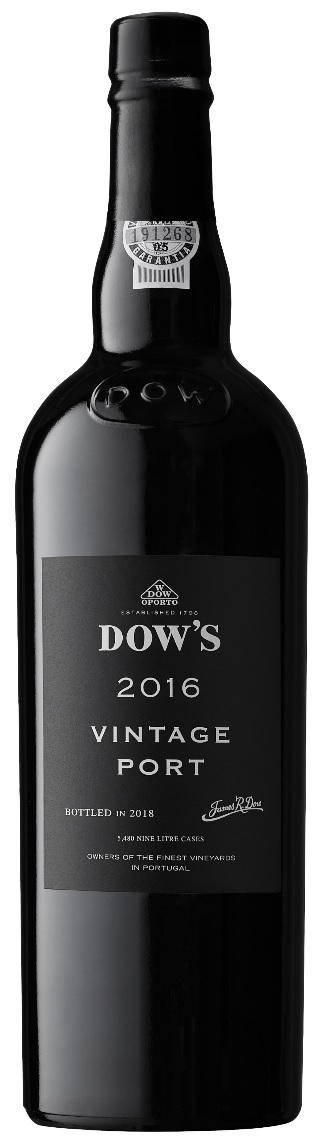
| Country: | Portugal |
| Region: | Douro |
| Winery: | Dow's |
| Grape Type: | Port Blend |
| Organic: | Yes |
| Vintage: | 2016 |
| Bottle Size: | 750 ml |

Dow's is one of the historic houses of the Symington family and a benchmark name in Vintage Port, known for a drier, more structured style built around its Quinta do Bomfim and Quinta da Senhora da Ribeira vineyards. The 2024 is a classically declared vintage — precise, firm and built to age for decades.
Review:
Precise, with a pretty, grainy texture and incisive character. Medium- to full-bodied, long and dimensional. The grainy texture turns saline. Very stimulating to taste. A blend of 38% touriga franca, 34% old vines, 17% touriga nacional and 11% sousao. Drink or hold.
James Suckling 98 Points

Flowering in the Duoro occurred in the last 10 days of May. The weather conditions provided for a perfect flowering season. The Romariz Vintage Port 2003 yielded wines of great color and supple tannins, with a vintage stamp being evident in most wines. Production: 8,000 cases. "Another bright and fruity young Vintage Port with plum, grape and blackberry aromas with just a hint of stems. Serious nose here. Full-bodied, with soft, round tannins and a long, caressing finish. A beauty."
- J.S., Wine Spectator, 89-91 pts
"Bright dark ruby. Deep, perfumed aromas of cassis, licorice, violet and minerals. Lush and high-toned in the mouth but with very good vinosity and spine. Lovely fruit-driven flavors of black cherry, blackberry and dark chocolate. Little sign of the roasted side of 2003. Not hugely concentrated but suave, supple, minerally and sweet. Finishes with ripe tannins and very good spicy persistence. A very good showing. Accessible already but balanced for medium-term aging."
- Stephen Tanzer's International Wine Cellar, 89 pts

Romariz Vintage Port is made from Touriga Nacional, Touriga Franca, Tinto Cão, Tinta Roriz, Tinta Barroca
Deep inky purple color. Intricate nose with aromas of blackberries and logan berries, subtle hints of amber and spring blossom and delicate spice. A tight, well-formed palate with an abundance of dark berry fruit, rich chocolate and liquorice, culminating in a long finish. Firm, closely woven tannins that give the wine great structure and body. An elegant finely constituted Vintage Port which will drink beautifully now or age quietly in the cellar.
A vintage port is made from blended grapes, all from the same vintage year. Vintage ports are historically only declared every 3 out of 10 years. Romariz vintage ports age for up to two years in oak, then go unfiltered into the bottle for further aging.

Charles Krug Peter Mondavi Family Vintage Selection Cabernet Sauvignon is made from 100 percent Cabernet Sauvignon.
Review:
-Wine Advocate 95 Points

Duorum was founded in the Douro Superior by two of Portugal's most celebrated winemakers — João Portugal Ramos and José Maria Soares Franco, the long-time hand behind Barca Velha. Their Vintage Port is a field blend from old, often centenarian vines and is declared only in the finest years. Powerful and built for the long haul, it is a classic expression of the Douro's greatest sites.
Review:
The 2017 Vintage Port, the first declared vintage here since the 2011, is a field blend from centenarian vines. It is equal parts Touriga Nacional and Touriga Franca with 20% Tinta Roriz. This is round and luscious on opening. With some air, it becomes a very different wine, showing its class and its muscle. It shows far more power and pop as it airs out, becoming very persistent. It's always most notable, though, for the rich fruit and velvety texture. It should steadily improve for the next ten to 15 years and age effortlessly for some time after that.
Wine Advocate (Mark Squires) 95 Points

The Stone Terraces 2021 Vintage Port has incredibly fresh and lifted aromas with the hallmark tropical fruit character. The wine is concentrated whilst being supremely refined with polished tannins and taut acidity combining to deliver sublime elegance and balance.
Review:
-James Suckling 100 Points
-James Suckling 95 Points
It is rare to see such tremendous depth and intensity in color as this winedisplays. The freshness of the floral aromas is very attractive with adominance of rockrose, a flower that grows wild around the hills of Senhorada Ribeira. On the palate, it is exceptionally full-bodied, rich andpowerful with black fruit coming to the fore. Gorgeous, ripe fruit isbalanced by the fine tannin structure. On the finish, it is typically Dow,austere and somewhat drier than many other ports. The intense fruit flavors linger long on the palate.
Dow’s Vintage Ports are only produced in years of exceptional quality and represent only a very small part of the total company’s production in that year. On average only two or three times every ten years are the weather conditions sufficiently good to allow for the making of Dow’s Vintage Port.
Throughout the 19th and 20th centuries, Dow’s Vintage Ports have been landmark wines in virtually every great year, consistently setting the standards amongst all Port houses. Vintage Ports such as the remarkable Dow 1896, the 1927, 1945, 1955, 1963, 1966, 1970, 1980 and the Dow 1994 are all legends in the history of this great wine. These Ports are still magnificent today, even when 50 or over 100 years old. Few wines can claim this quality and this pedigree.
Dow's Vintage Ports are drawn from the companies' finest vineyards; Quinta do Bomfim and Quinta de Senhora da Ribeira. Each property contributes to the Dow’s unique and distinctive style. When young, Dow’s Vintage Ports are purple-black, austere, complex and intensely concentrated, full-bodied and balanced with very fine peppery tannins.
Over the centuries, the Dow winemakers have evolved a style that suits the house’s key vineyards; fermentations are a little longer, resulting in a drier Port Wine that has become the hallmark of Dow’s. Abundant fruit flavours with hints of ripe blackberries, give elegance and poise to Dow’s. The nose is deep and powerful with strong overtones of violets when young, these mature into fine cinnamon and rose-tea aromas with age. The very high percentage of Touriga Franca and Touriga Nacional planted on the vineyards result in the powerful structure and aging potential of Dow’s Vintage Ports
Dow’s Ports avoid an over-rich style and requires a very high degree of skill in wine making and great experience in selecting the finest wines of each year and each vineyard. These wines are aged in seasoned oak casks for some 18 months and are bottled without any filtration or fining whatsoever.
Dow Vintage Ports can be enjoyed when vibrant and young or they can be allowed to age for many years in bottle into a soft and delicate wine of velvet-like elegance.
In the 1920’s, the celebrated Oxford Professor George Saintsbury underlined Dow’s outstanding reputation when he wrote in his famous ‘Notes on a Cellarbook’ (first published in 1920), “There is no shipper’s wine that I have found better than the best of Dow’s 1878 and 1890 especially.”
James Suckling, one of today’s leading authorities on Vintage Port was equally impressed by another legendary wine - the Dow’s 1896 - “The ancient {1896} Port still had an amazing ruby colour with a garnet edge, and it smelled of raisins, black pepper and berries. It was full-bodied, with masses of fruit intertwined with layers of velvety tannins. It was superb.” In 1998, when this wine was 102 years old, he awarded this Port an exceptional 98 points.
Review:
This packs a lot of fun, with a wallop of blackberry, fig, boysenberry and açai berry compote flavors working together, laced with a mouthwatering licorice snap note and driven by a fresh, well-detailed finish. A roasted apple wood accent is integrated as well, lending textural contrast through the vivacious finish. Best from 2030 through 2055. 350 cases made, 183 cases imported.
-Wine Spectator 98 Points
The 2016 Dow’s Vintage Port is based around the Vinha dos Ecos vineyard behind Bomfim, populated predominantly by mature Touriga Franca vines that were cropped at just 0.68kg per vine. It has a quite astonishing bouquet with layer upon layer of intense black cherry and cassis fruit, touches of clove, leather and a hint of over-ripe Satsuma. This is a mercurial bouquet that keeps changing in the glass, revealing smoky/burning ember scents with time. The palate is quite magnificent – perfectly balanced with a killer thread of acidity slicing through such pure intense black fruit that there is no heaviness at all. There is a sense of thrust on the finish as it fans out with almost careless abandon, a Vintage Port so self-assured that you can only sit back in amazement. Simply one of the best Dow’s ever made.
-Vinous 98 Points
For over two centuries the name of DOW has been associated with the finest Port from the vineyards of the Upper Douro Valley. Throughout the 20th Century and into the 21st, the Symington family has built on the legacy of the preceding Silva and Dow families. Generations of Symington winemakers have worked at the Dow’s vineyards: Quinta do Bomfim and Quinta da Senhora da Ribeira, creating from them Dow’s superbly concentrated wines that are intense and tannic when young, maturing towards a superlative racy elegance with age and scented with violet and mint aromas. Dow’s attractive and distinctive drier finish is the recognisable hallmark of the wines from this great Port house.
The story of Dow’s is unusual amongst all the great Port houses. It began in 1798 when Bruno da Silva, a Portuguese merchant from Oporto, made a journey which was the opposite to that of the first British merchants. Bruno set up in London from where he imported wine from his native country. He married an Englishwoman and was rapidly assimilated into London society where his business acumen led to a fine reputation for his wines. But the outbreak of the Napoleonic wars put his business in jeopardy. Undaunted, Bruno da Silva applied for ‘letters of marque’ (Royal Assent to equip a merchant ship with guns) to secure safe passage of his Port from Oporto to Bristol and to London. His became the first and only Port company to transport its precious cargo of casks of fine Ports under its own armed protection across the treacherous Bay of Biscay, a strong dissuasion to attack during a period when less audacious companies saw their sales dwindle away.
The Port shipping business was continued by Bruno’s son, John da Silva who in 1862 brought into partnership Frederick William Cosens. Together with John’s son, Edward, they became the active partners in Silva & Cosens. Edward da Silva inherited his grandfather’s business ability and the company continued to prosper. Edward became a highly respected figure in the London wine trade and was one of the founders of the Wine Trade Benevolent Society, the leading charity which survives to this day as the principal British wine trade organisation. Edward da Silva was to be the Benevolent’s chairman and then, from 1892, its president for many years.
With the continuing expansion of the firm, Edward da Silva and Frederick Cosens were joined by George Acheson Warre, whose well known family had been involved in the Port trade since its earliest years. ‘GAW’ joined as partner in 1868 and became its driving force in Portugal.
In 1877, Silva & Cosens merged with another leading Port company, Dow & Co, who’s senior partner was James Ramsay Dow, who had made a name for himself in 1856 with the publication of his important treatise, ‘An Inquiry into the Vine Fungus with Suggestions as to a Remedy.’ The Oidium fungus was at the time devastating the Douro’s vineyards.
Although smaller than Silva & Cosens, Dow & Co had become a very highly regarded Port producer with a particularly fine reputation for its Vintage Ports and when the two companies merged, it was decided to adopt DOW’S as the brand name.
The financial astuteness of Edward da Silva, the driving force of winemaker George Warre and the long experience and tasting expertise of James R. Dow were to consolidate Dow’s reputation as one of the leading names in the Port trade.
The celebrated Oxford Professor George Saintsbury underlined Dow’s unique standing when he wrote in his famous ‘Notes on a Cellarbook’ (first published in 1920), “There is no shipper’s wine that I have found better than the best of Dow’s 1878 and 1890 especially.” James Suckling of The Wine Spectator, one of today’s leading authorities on Vintage Port was equally impressed by another legendary wine when tasted over a hundred years after it was made - the Dow’s 1896 - also made during the management of Messrs Silva, Warre and Dow: “The ancient {1896} Port still had an amazing ruby colour with a garnet edge, and it smelled of raisins, black pepper and berries. It was full-bodied, with masses of fruit intertwined with layers of velvety tannins. It was superb.”

Quintessa Red 2022 is made from 93% Cabernet Sauvignon, 4% Cabernet Franc, 1% Carménère, 1% Merlot, 1% Petit Verdot.
The 2022 Quintessa is a charming wine, opening with intense aromas of black cherry and cassis that are complemented by notes of tobacco, bay laurel, cedar, and dark chocolate. Plush and inviting on entry, this wine’s flavors align with its aromas. The palate reveals dark fruits and an undertone of crushed rocks, tar, and graphite. On the finish, this vintage displays the signature fine-grained tannin of their Quintessa terroir, backed by voluminous texture and fruit.
Review:
-Decanter 99 Points

Bihan Le Revelation Touraine Chenonceaux Sauvignon Blanc 2024 is made from 100% Sauvignon Blanc.
From Maison Le Bihan in the heart of the Loire, this Touraine Chenonceaux “Revelation” pours a limpid, brilliant pale gold. The nose is intense and expressive, layered with floral aromatics, and the palate is dry and harmonious with a tangy edge that carries a long, lively finish.
A natural aperitif, it also shines alongside white meats, Loire asparagus and seafood.



