" We don't sell the wine without touching the vine "
| Country: | Germany |
| Region: | Mosel |
| Winery: | Dr. Leimbrock |
| Grape Type: | Riesling |
| Vintage: | 2018 |
| Bottle Size: | 750 ml |

Dr. Leimbrock Mulheimer Sonnenlay Riesling Spatlese is made from 100 percent Riesling.
A classic in the residual sweet range that impresses with filigree fruit and mineral spiciness.
The circulating mountain "Mülheimer Sonnenlay" represents a geographical feature of the Moselle. Due to the strong meandering of the Moselle, the mountain was surrounded by the course of the river in geological development in such a way that a so-called circulating mountain arose from it. Located in the northeast-southwest direction, vines are cultivated on both sides of the mountain. The site name "Sonne" and "Lay" (Mosel Franconian for slate) combines the most important prerequisites for the cultivation of Riesling vines. Soils are skeletal-rich, weathered clay-ish shale enriched with sand, stones, and clay. At the beginning of the 1930s, the Mülheim winegrowers proudly pointed out that the local wine was served in the elegant restaurant of the airship "Graf Zeppelin" on its world trips and was obviously very popular.
Pair with spicy dishes, soft cheese, cakes.

Dr. Leimbrock Brauneberger Juffer Sonnenuhr Riesling Kabinett is made from 100 percent Riesling.
Brauneberger Juffer and Juffer-Sonnenuhr are one of the most prestigious vineyards in the winegrowing region Mosel. The vineyard faces south and provides best conditions to plant the Riesling vines.
Juicy and aromatic with a wonderful drinking flow and aromas of melon, stone fruit and apple. Makes you want the next sip.
ABV: 9.1%
TA: 7.5
RS: 36.5 g/liter

A heavenly, full-bodied dry Riesling with forceful minerality from 100-year-old vines grown in the blue slate soil of Graach.
Graach is a small village in the Mosel valley. It’s steep slate slopes produce wines that combine elegance with rustic strength. Grosses Gewächs (GG) is the designation for an estate’s best dry wine from a Grosse Lage (grand cru) vineyard. This limited-production wine was fermented with indigenous yeasts and kept in the barrel, on the full lees, for a year before bottling. The extended maturation time allows the wine to develop greater texture and a deeper natural harmony. This is a fully ripe wine, with vibrant aromatics and a pronounced acidity that gives it a brilliant structural precision.
Review:
Convincing proof that 2020 is an excellent vintage for dry GG on the Mosel! Cool and stony with delicate white-peach and white-currant aromas. Really takes off at the intensely slatey and racy finish.
-James Suckling 95-96 Points
Dr. Leimbrock Brauneberger Juffer Sonnenuhr Riesling Kabinett is made from 100 percent Riesling.
Brauneberger Juffer and Juffer-Sonnenuhr are one of the most prestigious vineyards in the winegrowing region Mosel. The vineyard faces south and provides best conditions to plant the Riesling vines.
Juicy and aromatic with a wonderful drinking flow and aromas of melon, stone fruit and apple. Makes you want the next sip.
ABV: 9.1%
TA: 7.5
RS: 36.5 g/liter

Dr. Leimbrock Estate Riesling is made from 100 percent Riesling.
Typical Riesling, fresh and fruity, easy drinking. Grapes come from Brauneberger Juffer and Juffer-Sonnenuhr - one of the most prestigious vineyards in the Mosel winegrowing region. The vineyard faces south and provides the best conditions for growing Riesling.
Pairs well with barbecue meats, pasta dishes.

A late harvest Riesling with fruity sweetness and great aging potential, aromatic bouquet of honey, melon, ripe fruits. Grapes come from Brauneberger Juffer and Juffer-Sonnenuhr - one of the most prestigious vineyards in the Mosel winegrowing region. The vineyard faces south and provides the best conditions for growing Riesling.
Pairs well with pâté, Asian cuisine.
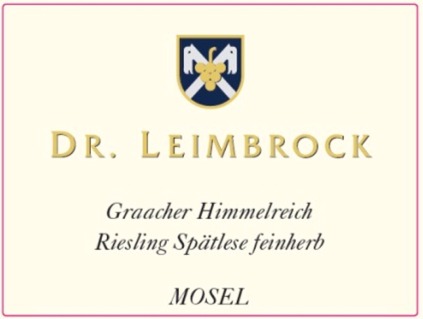
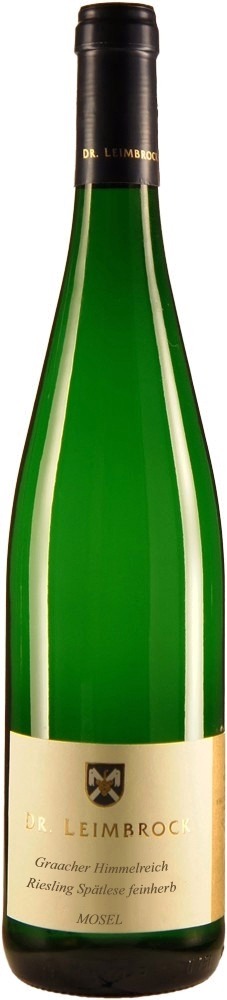
Dr. Leimbrock Graacher Himmelreich Riesling Spatlese Feinherb is made from 100 percent Riesling
Aged in large oak barrels for 6 months
The Graacher Himmelreich vineyard has an excellent southwestern exposure. The cultivation of the vine is done by the classic single pile education.
Harmonious and fruity with aromas of exotic fruit, peach and green apple, candied fruits and hints of honey. Delicate, juicy with well integrated acidity, full-bodied and an attractive finish.
Classic large oak barrel, cultured yeast.
Pairs well with Asian cuisine, Mediterranean vegetables with raw ham, spicy dishes.
Review:
- Wine Enthusiast (April 2021), 91 pts
Dr. Leimbrock has been family-owned for more than 250 years and looks back on a long tradition of producing fine wines. The main focus of our wines are the dry and semi-dry Rieslings. Only when nature allows – which in recent years has increasingly only been possible through the selective picking of the grapes – resulting in the delicate and aromatic Spätlese and Auslese wines. The excellent Leimbrock wines have received both national and international awards. Our wines are only harvested from our own vineyards, only fermented in our own cellars and bottled at our own winery Date Founded: 1750
Owner: Ulrike Oeffling (Leimbrock) Winery Philosophy: Tradition meets Care The Dr. Leimbrock – C. Schmidt winery has been family-owned for more than 250 years and looks back on a long tradition of producing fine wines. The current vineyard of Dr. Leimbrock – C. Schmidt was founded in 1967 by Friedhelm Leimbrock and Lore Leimbrock nee Schmidt from the companies of their forefathers Friedrich Herrmann, Dr. Wilhelm Leimbrock and Conrad Schmidt. Winery/Vineyards Winery Acreage: 22 acres Winery Production: 7,500 cases / 9L cases Varietals Produced: Riesling, Weißer Burgunder, Kerner Winemaker: Dr. Friedhelm Leimbrock We cultivate our Riesling on 8.5 hectares in the best locations in Veldenz, Mülheim, Brauneberg, Bernkastel and Graach.
The soils of our vineyards originate from the ‘Devon’ soil and are composed of weathered slate. 60% of the hills of our vineyard are aptly named – their slopes are 30-80% steep! Ideal locations for Riesling where each area possesses an unmistakable character. Whether Mülheimer Sonnenlay, Veldenzer Bitsch, Brauneberger Juffer, Brauneberger Juffer-Sonnenuhr, Graacher Himmelreich, or the Bernkasteler Badstube, we have some of the best locations on the Mosel. The vineyard is led by Mrs. Ulrike Oeffling. The vines are cultivated in a natural way. We follow guidelines for fertilization, planting and soil protection that are the best for the environment.
The grapes are carefully pressed, the must is fermented in a naturally cooled cellar and the wine is finished in traditional style. Love of the vines, the soil and the wine as well as the certitude of living in one of the most beautiful wine regions is our passion. It is our belief that we can improve our lifestyle through moderate enjoyment of wine. – Lore Leimbrock nee Schmidt, Ulrike Oeffling nee Leimbrock, Rolf-Bernd Leimbrock and Dr. Friedhelm Leimbrock. Acreage per vineyard: Graacher Himmelreich (0,3 ha), Bernkasteler Bratenhöfchen/Badstube (0,4 ha), Brauneberger Juffer-Sonnenuhr (0,6 ha), Brauneberger Juffer (0,9 ha), Mülheimer Sonnenlay (2,8 ha), Other (4 ha)

Gessinger Zeltinger Schlossberg Kabinett is 100 percent Riesling.
Zeltinger Schlossberg is the little sister of the well-known grand cru site Zeltinger Sonnenuhr. Behind the old village center of Zeltingen rises the steep slope "Zeltinger Schlossberg". On the exposed vineyards of blue Devonian slate, juicy wines full of character and minerality ripen.
The Zeltinger Schlossberg Riesling Kabinett is made from fruit picked at around 86° Oechsle and was fermented to fruity-styled levels of residual sugar (42 g/l). It has a quite restrained and smoky nose of anise, Conference pear, bergamot, rose, lime tree, dill, and eucalyptus. The wine proves superbly playful, finely juicy, and fruity on the palate. This rounder and richer side is nicely buffered off by more structure and intensity in the very long and smoky finish. The feel of residual sugar is already well integrated in the after-taste, which is already more off-dry than fully fruity as lime and grapefruit skin dominate.
Acidity 8.6 g/l
Residual sugar 42 g/l
perfect match to Asian cuisine, spicy food as well as BBQ.

Honeyed style, rich minerality and luscious creaminess. Flavors of baked pineapple and pear. Fresh and juicy on the finish.
From the famous Erbacher Honigberg vineyard. Average of the vines is 20 years old.
Cool fermentation, matured on the lees for 2 months before bottling, with a slight filtration.
Riesling Rheingau Erbacher Honigberg Spatlese goes well with Indian Curry and blue Cheese

All older vintage wines have been purchased from a single collectors cellar. Pictures can be requested before shipment.

Golden color. Very aromatic. White flowers, fresh fruit, lime, citrus aromas as well as a bergamot. Pleasant mouthfeel, supple, crisp, fruity flavors. There is a touch of acidity, revealing a deliciously integrated minerality.
Machine harvested at full maturity (around Sept. 25th - lasts 12-18 days); pneumatic press; fermentation in temperature controlled stainless steel tanks for 8-10 days; M.L (2 months after the harvest); aging on the lees until May (3 month extra compared to the Petit Chablis); racking; fining if necessary; cold stabilization; filtration right before bottling in July.
Ideal as an aperitif, the wine is an excellent companion to seafood, smoked salmon for example.