
" We don't sell the wine without touching the vine "
| BUY MORE! SAVE MORE! | ||||||||||||||||||||
|
| Country: | Italy |
| Regions: | Piemonte Barbaresco |
| Winery: | Bruno Giacosa |
| Grape Type: | Nebbiolo |
| Vintage: | 2019 |
| Bottle Size: | 750 ml |
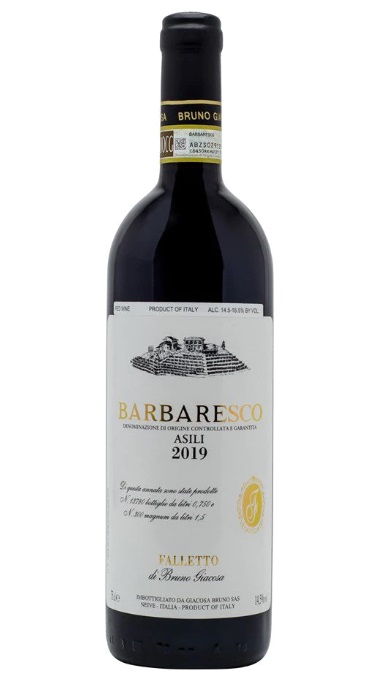
Falletto di Bruno Giacosa Asili Riserva is made from 100 percent Nebbiolo.
Intense red garnet color with orange highlights. Notes of raspberry and wild strawberry are layered with floral aromas of rose and violet. On the palate, good structure is matched with freshness of fruit and sweet, silky tannins.
Review:
Sweet and succulent aromas of tangerines, freshly cut ripe strawberries, cherries and flowers follow through to a full-bodied palate with sleek and dense tannins that run the length of the wine and then fan out into a dense, vivid finish of fruit. It’s chewy and seriously structured with finesse and energy. Silky texture. This needs at least four or five years to come together and open.
-James Suckling 98 Points
One of the legendary winemakers of the world, Bruno Giacosa crafted the most prestigious single-vineyard Barolo and Barbaresco wines during a career that spanned nearly eight decades. He joined the family business at the age of 15, representing the third generation of his Langhe winemaking family. Giacosa’s unfailing pursuit of perfection, his unrivaled palate and his intimate knowledge of vineyards in the Langhe quickly drew recognition and helped establish Piedmont as a leading wine region. In 1980, Giacosa began to acquire prime parcels in Serralunga d’Alba, La Morra and Barbaresco to produce wines that are rightly regarded as the finest expressions of Nebbiolo. His legacy rests with daughter Bruna, who continues to uphold her father’s winemaking philosophy to respect traditional techniques while using the best of modern technology. The goal is for each distinguished site to produce articulate, unique wines.
Clos Saint-Jean is a 41-hectare estate in Châteauneuf-du-Pape run by brothers Vincent and Pascal Maurel. Considered by many critics and wine-writers as the preeminent estate espousing the modern style of winemaking in Châteauneuf, this cellar is one of the oldest in the region, having been founded in 1900 by the greatgreat-grandfather of Vincent and Pascal, Edmund Tacussel. A short time after its founding and well before the AOP of Chateauneuf-du-Pape was created in 1923, Edmund began bottling estate wines in 1910.
The farming at Clos Saint-Jean is fully sustainable due to the warm and dry climate, which prevents the need for chemical inputs. Instead, Vincent and Pascal employ organic methods for pest control, mainly pheromones, to prevent pests from taking up residence in their vines, a process called amusingly enough in French, confusion sexuelle. The vines tended manually, and harvest is conducted in several passes entirely by hand.
Deus ex Machina is a literary and dramatic term for a miraculous intervention that interrupts a logical course of events in a plot or play. A suitable name for a cuvée that had it’s start in the torrid vintage of 2003 when Philippe Cambie and Vincent Maurel made the decision to harvest at the end of September, weeks after their neighbors. Deus ex Machina is a blend of old vine Grenache from La Crau, aged in tank with equally ancient Mourvedre from the sandy soils of BoisDauphin aged in demi-muid. Deus ex Machina is only made in the best vintages.
Review:
Lastly, the 2022 Châteauneuf Du Pape Deus-Ex Machina shows a similar profile to the Combes des Fous, yet it brings another level of tannins and concentration. Kirsch liqueur, white flowers, sandalwood, cured meats, and graphite notes all shine here, and it's full-bodied, has a deep, layered, powerful, yet weightless profile, lots of ripe tannins, and a blockbuster of a finish. This ripe, sexy, seamless, incredibly impressive beauty will compete with anything in the vintage. As usual, this cuvée is 60% Grenache and 40% Mourvedre, which is brought up in roughly 40% new demi-muids.
Review: Jeb Dunnuck 97 Points
Deep red with a slight purple hue on release. The wine has a rich mix of dark chocolate infused with coffee bean and black liquorice, then scents of tar, aniseed, raw (pure) soy and black olive on the nose. The palate is expansive, and yet balanced and finessed. An amalgam of dark berried flavors and textural sensations. The 100% new oak is completely absorbed, meshed with ripe tannins, completing a palate of impressive length and youthfulness.
Parcels of fruit for this wine were identified in the vineyard by the winemakers. Daily fruit inspection led to the fruit being harvested at optimum flavor ripeness. The fruit was harvested at night and quickly transported to the winery. The fruit was destemmed to 6T open fermenters for fermentation. A Shiraz specific yeast was selected to ferment the wine and fermentation was carried out at a maximum of 28°C. The fermenter was manually pumped over twice daily in the first half of fermentation to give the winemakers control of color, flavor and tannin extraction. Pump over regimes were adjusted toward the end of fermentation to suit the tannin and flavor extraction of the wine. The cap was completely broken up on each pump over. The wine remained in fermenters for 6-8 days (dependent on parcel) before being pressed, inoculated with malolactic bacteria and filled to American oak (100% new barrels). The wine was racked post malolactic fermentation and returned to the same barrels. The wine was topped every month and after six months racked and returned to the same barrels again. Prior to bottling the parcels were emptied from oak and blended. Minimal fining and filtration was carried out prior to bottling.
Review:
Only made in top vintages, the 2019 Shiraz Ron Thorn is 100% Shiraz from the St. Kitts Vineyard in Barossa. Killer notes of blackberries, black cherries, smoked tobacco, chocolate, and subtle menthol all define the aromatics, and it hits the palate with full-bodied richness, a round, layered mouthfeel, huge mid-palate depth, and a salty, decadent style on the finish. This monster of a Shiraz stays balanced and light on its feet and is beautifully done.
-Jeb Dunnuck 96 Points
Laurent-Perrier Grand Siecle No. 26 is a blend of 58% Chardonnay, 42% Pinot Noir
white gold in color with delicate and persistent bubbles, Grand Siecle No. 26 offers a very complex nose which mixes honeysuckle, lemon, clementine and fresh butter aromas, followed by notes of hazelnut and a touch of honey. The feel in the mouth is very delicate and fresh with candied lemon and fresh hazelnut aromas. The palate is silky and mineral with notes of honeysuckle, flaked almonds and clementine.
It pairs with high quality produce and refined dishes, including shellfish, noble fish and white meats such as Thai style langoustine tartare and fine roasted poultry.
Vintage in Champagne is usually synonymous with excellence for Prestige Cuvées. Contrarily, Laurent‑Perrier believes that only the art of assemblage can offer what nature can never provide, that is, the perfect year.
The expression of the perfect year is that of a great champagne wine that has long ageing potential and over time develops depth, intensity and aromatic complexity yet retains its freshness and vibrancy.
Since 1959, Grand Siècle has been revealed only 26 times in bottle format and 23 times in magnum.
The « Grand Siècle » (Great Century) is the name given to one of the most prosperous periods (17th century) in the history of France known for the capacity of man, through his works, to create what nature cannot. Louis XIVth, known as the « Sun King », by creating the « Château de Versailles » and its gardens, was the architect of this model of harmony, balance and perfection.
The symmetry and perspective of the « Jardins à la française », the capacity to grow Mediterranean fruits (especially Oranges inside the « Orangerie ») in such a Northern climate, creating the Grand Canal, the fountains and ponds with no nearby rivers are many illustrations of this ability of man to sublimate natural elements. The name of Grand Siècle was chosen for Laurent‑Perrier’s Prestige Cuvée based on this common vision to reach a perfection that Nature, on its own, cannot provide.
Review:
This is really something. Electric on the palate. The aromas are so complex with sliced fresh and dried ginger, subtle pie crust, tarte tatin and hints of nutmeg with some salted caramel. Toasted bread, too. Always subtle. The palate is full- to medium-bodied yet hemmed-in with a freshness and balance that draws you back. Savory and vibrant. It's full of energy. Spectacular. Fascinating. Symphonic blend of 2012, 2008 and 2007. 65% of the 2012, 25% of the 2008 and 10% of the 2007. Eight grand cru. Chardonnay 58% and 42% pinot noir. Disgorged February 2023. 10 years on the lees. 7g/L dosage.
-James Suckling 100 Points
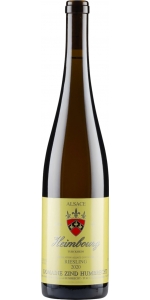
Domaine Zind-Humbrecht Riesling Heimbourg is made from 100 percent Riesling.
Bright yellow color. The nose expresses an immediate sense of strong mineral and limestone influence. After aeration or decanting, it will show eventually bright citrus, bergamot, spices and an expected slight austerity. It is very expressive today, but it is easy to see that this wine still has much more to show in the future. The mouth is tight, dry, showing a bright acidity and elegant finish.
Review:
What a fascinating peachy, flinty and smoky nose this great dry Riesling has. Power, energy and vitality on the generous palate, but also a profoundly chalky and flinty minerality. Long juicy finish that pulls you back for more. From biodynamically grown grapes. Drink or hold.
-James Suckling 95 Points
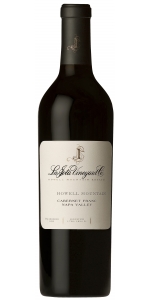
La Jota Howell Mountain Cabernet Franc is made from 100% Cabernet Franc.
The 2019 Cabernet Franc opens with aromas of cassis and graphite when poured in the glass. The firm tannins set the stage on the palate melded with rich flavors of boysenberry and pain de grille with a silky mouthfeel and lingering finish.
Review:
Savory in black pepper, smoked meat and cigar box, this wine is high-toned aromatically, with lovely hints of violet and dried herb, sage and bay leaf. Mountain-sturdy tannins give it structure, power and room to age, with lasting acidity to keep it fresh. Enjoy best from 2029–2039
.-Wine Enthusiast 95 Points
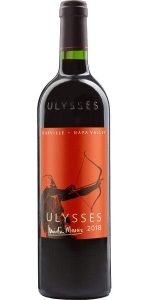
The 2019 Ulysses Cabernet Sauvignon has notes of truffle, blackberries, cassis bud and tobacco with tight polished tannins. A vertical structure and persistent intensity.
Review:
The 2019 Cabernet Sauvignon is mostly Cabernet Sauvignon (90%) with the rest Cabernet Franc and Petit Verdot. Incredible aromatics of red and black currants, spring flowers, graphite, camphor, and cedar define the aromatics, and it's incredibly polished and elegant on the palate, with medium to full body, gorgeous tannins, and a great finish. This is another awesome 2019 that matches ample richness and depth with a terrific sense of finesse.
-Jeb Dunnuck 97 Points
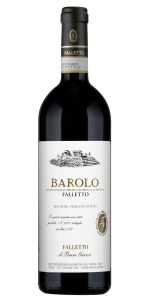
Falletto di Bruno Giacosa Barolo is made from 100 percent Nebbiolo
The 2018 vintage was well received after the turbulent 2017 growing year. A longer winter heralded in heavy rains in May and June, which gave the vines much needed water after the previous year's drought. Throughout the summer, conditions were generally ideal with warm days and cool nights, making harvest an overall success. Early samples of Barbaresco and Barolo are indicating a soft, balanced vintage.
Red garnet in color. Intense and fine aromas of fresh red fruit. The palate presents good freshness, excellent structure and fine, velvety tannins.
Review:
The 2018 Bruno Giacosa Barolo is very rich and hedonistic, with ripe strawberries and rose hip and notes of incense, lilies and violets. It is a lovely nose, persistent, intense and enticing and on the palate it is like falling into a soft velvety bed of rose petals. It already has such beautiful harmony and poise. It has a lush, sensual texture of crushed velvet, and is full-bodied without feeling heavy. There are plenty of dense, savory tannins extending the very long finish, creating a combination of seductive charm and power. This is something special, a great achievement in this vintage. Wait 2-3 years at least but I would not want to miss that young fragrance. (SH)
-Wine Independent 98 Points
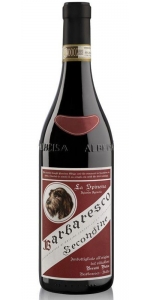
La Spinona Barbaresco Secondine is made from 100 percent Nebbiolo.
This single-vineyard Barbaresco comes from his 3.5 hectares on the cru of Secondine. It is the commune of Barbaresco below the zone of Rabaja Basa and Paje and is where Gaja’s San Lorenzo is located. It is 230 meters above sea level with a southern exposure.
Excellent with game, red meats, truffle dishes and aged cheeses.
Color: Deep ruby red with a hint of garnet in the reflections.
Bouquet: Bright bouquet full of cherries, raspberries, licorice and floral notes.
Taste: Elegant and refined with delicate, soft tannins. It is fresh, velvety and extremely well balanced.
Review:
"The 2019 Barbaresco Secondine is one of the most refined wines I have tasted here. Silky and aromatic, yet also quite deep, the 2019 has much to recommend it. Crushed flowers, sweet red berry fruit, blood orange, mint and cinnamon lend notable aromatic presence to this firm, classically built Barbaresco. There's plenty of tannin and structure, but also an element of pure seduction I am especially drawn to in this vintage."
- Antonio Galloni's Vinous (October 2023), 95 pts
-James Suckling 94 Points
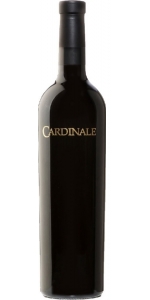
Cardinale Napa Valley Cabernet Sauvignon is made from 91% Cabernet Sauvignon, 9% Merlot.
Super structured and with minerality to spare, this Cabernet Sauvignon offers a real presence on the palate from start to finish. Generous notes of dark chocolate balance beautifully with a blue and black fruit flavor explosion, finishing with a subtle whisper of rose petal.
Reviews:
- James Suckling 98 Points
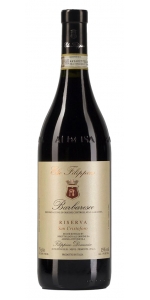
Filippino Elio Barbaresco San Cristoforo Riserva
Made from 100% manual harvest Nebbiolo, the wine comes from the hillsides of San Cristoforo hill in Neive enjoying a south-southwest exposure. The fruity bouquet offers subtle notes of violet and raspberries, combining with spicy hints of cinnamon, cocoa and leather. Full, enchanting and elegant taste, intense with a good body.
The best grapes are delicately pressed and the stalks are removed. The must ferments in stainless steel vats at a controlled temperature of 26°C with a maceration of 20 to 25 days. After racking, the new wine is put into 25 e 30 H Slavonian oak casks for long months. Next, it is bottled and left to age for at least an additional 24 months.
La Spinona Barbaresco Secondine is made from 100 percent Nebbiolo.
This single-vineyard Barbaresco comes from his 3.5 hectares on the cru of Secondine. It is the commune of Barbaresco below the zone of Rabaja Basa and Paje and is where Gaja’s San Lorenzo is located. It is 230 meters above sea level with a southern exposure.
Excellent with game, red meats, truffle dishes and aged cheeses.
Color: Deep ruby red with a hint of garnet in the reflections.
Bouquet: Bright bouquet full of cherries, raspberries, licorice and floral notes.
Taste: Elegant and refined with delicate, soft tannins. It is fresh, velvety and extremely well balanced.
Review:
Aromas of wild red berry, blue flower, crushed mint and oak-driven spice come to the forefront. Reflecting the nose, the full-bodied, polished palate features juicy Morello cherry, crushed raspberry, star anise and spearmint alongside lithe tannins. It's balanced, with bright acidity and closes on a note of bitter almond.
-Wine Enthusiast 93 Points
Pierinvaletta Barbaresco is made from 100% Nebbiolo
Rich, Full bodied, Intense.
Pierin Valetta is one of the ancestor of the Family and these wines are dedicated to him as we would like to thank him for giving us vineyards that reach up to 70 years old.
Made from 70 years old vines planted on clay soils.
Aged 30 months in French and Slovanian Oak barrels.
Wine wasn't filtered before bottling.
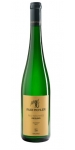
Wachau Riesling is dry and often defined by high levels of dry extract (due to a lengthy ripening period) and a pleasing freshness (due to dramatic temperature swings between day and night). Sedimentary soils of sand and stone give Kirchweg Riesling a dense mineral texture and fine fruity flavors.
Review:
Welcome to the dark side of Wachau dry riesling! Deep and delicately spicy nose that’s full of mystery. Incredible concentration and massive wet stone character on the very precise medium-bodied palate. Radical mineral energy and garden herb freshness at the enormously long and tightly-focused finish.
-James Suckling 98 Points
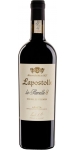
La Parcelle 8 Cabernet Sauvignon presents bold and complex aromas of black fruits, chocolate, and toast alongside earthy, herbal, and floral notes. On the palate, it displays a full body, ripe tannins, and a lasting finish.
La Parcelle 8 Cabernet Sauvignon pairs well with roasted lamb, braised short ribs, mushrooms, or fine cheeses.
Review:
Complex and intense with a rare mineral quality for the hot 2020 vintage. Fresh blueberries, wild herbs, hot stones and graphite. A hint of violet. Tannins are quite chalky and tense on the medium- to full-bodied palate. Extremely long with an ethereal finish. It goes on and on, lasting for two minutes. Effortless intensity and concentration, but almost weightless. This delivers exceptional freshness for this vintage. Harvested from 18th March. Already drinkable now, but it will last. 100% century-old, ungrafted cabernet sauvignon.
-James Suckling 99 Points



