" We don't sell the wine without touching the vine "
| BUY MORE! SAVE MORE! | ||||||||||||||||||||
|
| Country: | Italy |
| Regions: | Piemonte Barbaresco |
| Winery: | La Spinona |
| Grape Type: | Nebbiolo |
| Organic: | Yes |
| Vintage: | 2019 |
| Bottle Size: | 750 ml |
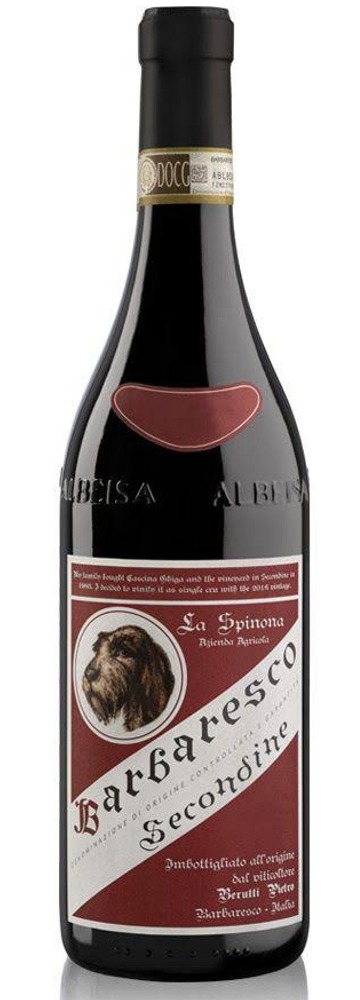
La Spinona Barbaresco Secondine is made from 100 percent Nebbiolo.
This single-vineyard Barbaresco comes from his 3.5 hectares on the cru of Secondine. It is the commune of Barbaresco below the zone of Rabaja Basa and Paje and is where Gaja’s San Lorenzo is located. It is 230 meters above sea level with a southern exposure.
Excellent with game, red meats, truffle dishes and aged cheeses.
Color: Deep ruby red with a hint of garnet in the reflections.
Bouquet: Bright bouquet full of cherries, raspberries, licorice and floral notes.
Taste: Elegant and refined with delicate, soft tannins. It is fresh, velvety and extremely well balanced.
Review:
"The 2019 Barbaresco Secondine is one of the most refined wines I have tasted here. Silky and aromatic, yet also quite deep, the 2019 has much to recommend it. Crushed flowers, sweet red berry fruit, blood orange, mint and cinnamon lend notable aromatic presence to this firm, classically built Barbaresco. There's plenty of tannin and structure, but also an element of pure seduction I am especially drawn to in this vintage."
- Antonio Galloni's Vinous (October 2023), 95 pts
-James Suckling 94 Points
The two Pietro Beruttis, grandfather and grandson, are well known and respected in the Barbaresco area and have received much acclaim both nationally and internationally for their wines. The Berutti’s estate consists of 22 hectares divided between four vineyard sites:
Their best Barbaresco cru comes from the Faset vineyard area, of which Berutti owns the “Bricco” or crest of the vineyard. Only the owner of these coveted hilltop vineyards can use the designations “Bricco”,“Bric” on the label.
La Spinona uses only organic farming practices and is famous for their own production of natural fertilizer. They were one of the first Piedmont estates to obtain organic certification back in the 1980's.
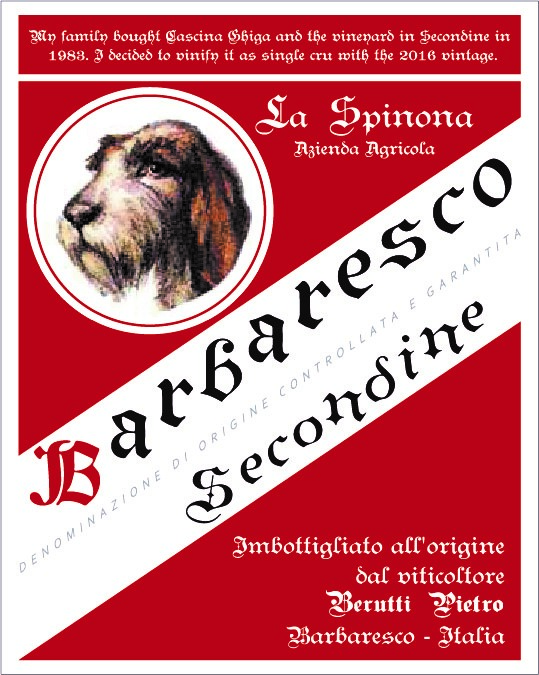
The label of La Spinona is as famous as the wine. The Spinona is a special breed of Piedmontese hunting Dog, which the Berutti’s raise. As the legend goes, this particular dog, Baica, received her place of honor on the label for an act of great heroism. She saved the Berutti’s only son from drowning in the irrigation lake when he was a baby. The son then became a veterinarian to save the dogs and later obtained a degree in agronomy to take care of the vineyards.
The Beruttis produce Barbaresco, Barolo, Dolcetto, Barbera, Chardonnay & Nebbiolo delle Langhe.

La Spinona Barbaresco Secondine is made from 100 percent Nebbiolo.
This single-vineyard Barbaresco comes from his 3.5 hectares on the cru of Secondine. It is the commune of Barbaresco below the zone of Rabaja Basa and Paje and is where Gaja’s San Lorenzo is located. It is 230 meters above sea level with a southern exposure.
Excellent with game, red meats, truffle dishes and aged cheeses.
Color: Deep ruby red with a hint of garnet in the reflections.
Bouquet: Bright bouquet full of cherries, raspberries, licorice and floral notes.
Taste: Elegant and refined with delicate, soft tannins. It is fresh, velvety and extremely well balanced.
Review:
Aromas of wild red berry, blue flower, crushed mint and oak-driven spice come to the forefront. Reflecting the nose, the full-bodied, polished palate features juicy Morello cherry, crushed raspberry, star anise and spearmint alongside lithe tannins. It's balanced, with bright acidity and closes on a note of bitter almond.
-Wine Enthusiast 93 Points

La Spinona Cru Bergera Barolo is made from 100 percent 100% Nebbiolo Lampia
The Beruttis bought 4 hectares in 1994 in the then relatively unknown zone of Novello which lies on the confines of Monforte and Barolo. A Sorì is an entirely south-facing vineyard. This Sori lies at 230 meters. It is named for the great grandfather that started the Barbaresco vineyards. The vines are an average of 40 years old. Bergera comes from the mid part of the vineyard and is dedicated to Pietro's grandfather who started the estate.
Brilliant deep ruby red with garnet reflections. Rich fruity bouquet with hints of cherries, violets liquorice and mint. Good structure with full, cherry-ripe flavors. The tannins are gentle and the spice subtle. It is an elegant wine of great finesse and drinkability. Excellent with wild game, roast, braised or stewed red meats, truffle dishes and aged cheeses.

Spinona Bricco Faset Barbaresco is made from 100 percent Nebbiolo.
This single-vineyard Barbaresco comes from Pietro Berutti's 8 hectares of coveted vineyards on the top of the historic hill, Faset. It is 270 meters above sea level with a south, south-east exposure. The vines are an average of 35 years old. Only organic farming practices are used. The natural fertilizer comes from the 100 head of cattle that they have and no herbicides or pesticides are used.
Barbaresco shows a deep ruby red color with garnet reflections. An intense bouquet with hints of ripe cherries, wild berries and spice. White pepper, licorice and mint blend with enticing floral notes. Mouth-filling and well-structured with a full, velvety body and an austere and long finish.
HARVEST: late October. The grapes are harvested by hand in perforated baskets to allow air to pass through the bunches. The pressing is soft. Cold maceration for 24 hours at 12°C (for certain years).
WINEMAKING: Soft pressing with an initial cold maceration on the skins for 24 hours at 12C. Specially selected yeasts are used. Fermentation takes place for 12 to 14 days in stainless steel at 28-29 °C under temperature controlled conditions. There is a pumping over on the skins. After malolactic fermentation, the wine is racked and goes through a delicate pressing to obtain only the best wine.
AGING : 12-15 months in large 25 hectolitre wooden barrels of Allier and Slavonian oak.
REFINING: in the bottle for 12-15 months in a temperature-controlled environment.
Excellent with game, red meats, truffle dishes and aged cheeses.
This single-vineyard Barbaresco comes from Pietro Berutti's 8 hectares of coveted vineyards on the top of the historic hill, Faset. It is 270 meters above sea level with a south, south-east exposure. The vines are an average of 35 years old. Only organic farming practices are used. The natural fertilizer comes from the 100 head of cattle that they have and no herbicides or pesticides are used.
Barbaresco shows a deep ruby red color with garnet reflections. An intense bouquet with hints of ripe cherries, wild berries and spice. White pepper, licorice and mint blend with enticing floral notes. Mouth-filling and well-structured with a full, velvety body and an austere and long finish.
Review:

Louis Jadot Montrachet Grand Cru is made from 100 percent Chardonnay.
Le Montrachet is situated to the south of the Côte de Beaune, on both villages of Puligny Montrachet and Chassagne Montrachet (like the Batard Montrachet Grand Cru).
The terroir is extremely chalky with a lot of stones, perfectly drained and easy to overheat with south-south-eastern exposition.
The Montrachet is produced with Chardonnay
Grapes are harvested by hand and put in small cases in order not to damage the fruits. Grapes are pressed softly, they ferment in oak barrels produced by our cooperage. 1/3 are new barrels. Aging usually lasts 15 months on fine lies before bottling.
Review:
Aromas of buttered toast, honeyed peaches, white flowers and mint introduce the 2019 Montrachet Grand Cru (Maison Louis Jadot), a full-bodied, layered and enveloping wine that's satiny and sumptuous, with lively acids and fine depth at the core. While I'd give the nod to the stunning Demoiselles as Jadot's best white wine this year, this Montrachet—purchased from the Chassagne-Montrachet side, from the house's usual source—is undeniably promising.
-Wine Advocate 94-96 Points

Boussey Monthelie Blanc Premier Cru Sur La Velle is made from 100 percent Chardonnay.
The name Monthelie comes from Mont Lyoei, mountain of Bacchus. The "Sur la Velle" plot is located on the eastern edge of Monthélie. It borders the Volnay Clos des Chênes Premier Cru to the east. The vineyards here lie on broadly southeast facing slopes with just enough gradient to achieve good drainage.
The Monthelie Blanc Premier Cru Sur La Velle has a beautiful pale yellow color with green reflections.
It is complex and rich with delicious aromas of white flowers, fresh almonds, lemon and minerality.
The finish is long with a very good balance between the excellent ripeness and the perfect amount of acidity.
We recommend this wine with white meat, fish and seafood.

Chateau Talbot Saint-Julien Grand Cru Classe is made from 69 % Cabernet Sauvignon, 26 % Merlot, 5 % Petit Verdot.
The wine presents a delicate and captivating nose of black fruits, fresh tobacco, peppermint and floral nuances. Ripe and juicy fruit flavors of black currants on the palate with well integrated velvety tannins and a beautiful refreshing acidity to the long finish.
For the 2018 vintage, a special packaging with a unique silkscreen printing bottle was created to mark the 100th anniversary of the Cordier Family's acquisition of Chateau Talbot
Pair with red meat, roast pork, game meat, poultry, hard cheeses, poached pear.
"Well-built and rather refined for the vintage, with a deep well of red and black currant paste and plum reduction flavors supported by a deeply inlaid iron note, all of which run the length of the wine. Offers subtle savory, tobacco and singed cedar notes that add range, with a savory echo that leaves a mouthwatering feel in the end. Built to cellar. Cabernet Sauvignon, Merlot and Petit Verdot. Best from 2025 through 2040. - James Molesworth"
- Wine Spectator (March 2022), 95 pts

Quintessa Red 2022 is made from 93% Cabernet Sauvignon, 4% Cabernet Franc, 1% Carménère, 1% Merlot, 1% Petit Verdot.
The 2022 Quintessa is a charming wine, opening with intense aromas of black cherry and cassis that are complemented by notes of tobacco, bay laurel, cedar, and dark chocolate. Plush and inviting on entry, this wine’s flavors align with its aromas. The palate reveals dark fruits and an undertone of crushed rocks, tar, and graphite. On the finish, this vintage displays the signature fine-grained tannin of their Quintessa terroir, backed by voluminous texture and fruit.
Review:
Such an incredible wine here - one of the stars of the September releases. Smells amazing, cooling blueberries with fragrant blackcurrants, edges of florality - totally inviting scents. Full and filling in the mouth, this is ample with such a layered effect, super vertical and elongated. Tight and a little tense but it really works - such balance between black fruit, dried herbs, high acidity and a profound structure. Refined and beautifully presented. So much life, so much energy - this is pure class. A wine you don't want to put down. Feels hands off despite such concentration and power. Ends salty with sticky liquorice, mint and cooling wet stones. You could definitely drink this now but it will age too! 1% Merlot and 1% Petit Verdot complete the blend. One of the final few vintages with Rodrigo Soto at the helm - he stepped down last year to concentrate on his family project Far Mountain in Sonoma Valley which is worth following. Winemaker Rebekah Wineburg.
-Decanter 99 Points

Maionnette Mediterranee Blanc is made from 30% Rolle, 30% Viognier, 20% Semillon and 20% Sauvignon Blanc.
Domaine de la Maïonnette is produced from grapes benefiting from an ideal location next to the river and planted on a clay-limestone based soil with a silty character, which brings suppleness, roundness and lightness to the wines.
La Maionnette is a brilliant straw yellow colored white offering delicate aromas of citrus fruits, and fresh notes of pear and apricot. Rich and round on the palate, and a good balance.