" We don't sell the wine without touching the vine "
Renato Ratti Rocche dell'Annunziata Barolo is made from 100 percent Nebbiolo. Grapes handpicked in the month of October, de-stemmed and pressed. The alcoholic fermentation takes place in temperature-controlled stainless steel containers. Contact with the skins lasts approximately three to four weeks and includes fermentation and subsequent post-fermentation maceration with the traditional submerged cap system. The malolactic fermentation takes place in steel containers.
The Rocche dell'Annunziata vineyard is historically known as one of the most important in the Barolo zone. In his Barolo Chart, Renato Ratti had already underscored this by entering it in the 1st Category class. Situated at about 300 meters above sea level and with a south-east exposure, it extends over approximately 1 hectare. Rich with typical blue marl interspersed between veins of sand, the earth confers an extraordinary elegance and depth, combined with fine and persistent scents of roses and licorice. A prestigious subzone engenders a Barolo that holds within it suggestions of a radiant future. Warm, persistent, rich: in a word, sumptuous.
The label bears the coat of arms of the local noble family, with a black hawk against a gilt backdrop. The Latin inscription “Probasti me et cogniusti me” means “You tried me, you knew me.”
The Bottle: The Albeisa – named after the city of Alba – is the iconic bottle created by Renato Ratti in 1973, desired as a way of identifying the uniqueness of a territory and its wines.
A garnet red. Delicate and persistent fragrance with trace scents of licorice, rose and violet. Full-flavored, warm, with extremely elegant tannins offering long persistence. A great wine for important dishes, red meats roasted on a spit or grilled, game, dishes of gourmet white and red meats and ripe cheeses.
Review:
Lots of dried flowers here give a perfumed nature to it with berries and citrus. Hibiscus water, too. Full-bodied and chewy with lots of tannins and vivid acidity. Subtle plum and strawberry character. Muscular and formed..
-James Suckling 97 Points
Gagliasso Barolo Riserva Oak Box is made from 100% Nebbiolo
Complex and intense aromas of red fruits intermixed with licorice, prune, leather, smoke and notes of toasty oak and vanilla. Full-bodied on the palate with loads of ripe dried and candied fruits, pepper and mocha.
After malolattic fermentation the wine stays for 10 months in French barrels, 10% new oak and 90% different years; after this period all barrels are blended ( 50% Torriglione and 50% Rocche dell’Annunziata) in old barrels for 48 months again. The wine is bottled and refined for 24 months.
There's a gritty, sandy quality to the tannins that would cut through roast pork stuffed with prunes.
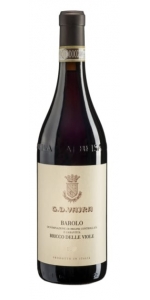
G.D. Vajra Bricco Delle Viole Barolo is made from 100 percent Nebbiolo.
The Barolo Bricco delle Viole shows the signature verticality of its vineyard. The wine is beautifully layered and - while restrained as it’s always the case in the youth of Bricco delle Viole - it also shows a complexity of layers with purple flowers, sweet spices and mineral tones. The palate is noble, with a refined acid spine and profound tannins that promise a long aging potential.
Among the historical vineyards of Barolo, Bricco delle Viole is the highest and the closest to the Alps. It rises from 400 to 480 meters above sea level, on the Western ridge of the village. Its name, “Hill of Violets”, originates from the flowers that blossom early here due to the perfect south exposure. Up above the fogs, Bricco delle Viole enjoys the earliest sunrise and the last sunset every day. Thanks to its vines dating back to 1949 and -now- 1931, a dramatic diuturnal temperature range and this pure light, Bricco delle Viole generates a sophisticated and profound Barolo DOCG of bright aromatics, chiseled tannins and subtle minerality. 2018 is a vintage that shows many nuances of Bricco delle Viole: beyond the signature verticality of this site, the wine offers high tones laced with mineral nuances and plenty of energy and youth.
Review:
The 2018 Barolo Bricco delle Viole is not super intense, but it is balanced in its own way. The wine is subdued but complete with softly yielding tannins to support an elegantly streamlined mouthfeel. Bricco delle Viole is a high and cool growing site in Barolo at 400 to 480 meters in elevation with characteristic Sant'Agata marl soils with fossils. The wine represents a selection of fruit from over seven hectares. With fermentation in steel tank and aging in large Slavonian oak, you are invited to a silky, lifted and beautifully delicate experience with an accessible personality.
-Wine Advocate 95 Points
An elegant version, this red features rose, black currant, cherry, mineral and a hint of eucalyptus aromas and flavors. Linear in profile, this is solidly built on a graceful frame, with finely woven tannins and vibrant acidity.
- Wine Spectator 95 Points
Antica Vigna Amarone della Valpolicella Riserva is made from 65% Corvina, 20% Rondinella, 10% Corvinone, 5% Merlot.
Amarone DOCG has maintained unchanged its typicality, so that “the essence of the territory” of Valle di Mezzane and Cazzano di Tramigna powerfully emerges. Rich in color, firmly structured but with fresh notes.
WINEMAKING AND AGING:
Manual harvest early October with selection of the best bunches.
Drying: natural drying in fruit cellar for 3/4 months with a sharp drop in weight of around 30%.
Vinification: soft crushing of destemmed grapes in the months of January and February.
Fermentation: at a controlled temperature of 18/21°C. Fermentation time: about 30 days
Aging:· 80% in oak barrels for 30 months of which 2/3 in American and French barriques, half of which are used for the second and third time, 1/3 in large
THE TERRITORY:
Geographical location: Tenuta di Mezzane, Tenuta di Cazzano di Tramigna
Height: 350/400 meters asl
Exposure: south
Soil type: limestone
Vineyard training system: guyot and pergola
Vine planting year: from 1972 to 2009
Vine density: 4,000 to 5,400 vines per hectare Vineyard management: sustainable agriculture and great attention to natural
cycles
Pairs well with grilled and roasted meats, as well as cheese.
Timeless Notes:
Dark cherry in color, firm on the palate with a vibrant acidity underbelly. Thought lush on the palate the flavors are complex and elegant from entry to mid-palate with hints of currant and wild berries. The finish brings in a touch of tobacco and leather notes ,classic examples of this region, with more ripe fruit flavors that linger on long strain tannin finish. Complex with depth and elegance on the palate. This one is drinking now, but can handle more time in the cellar with ease. An excellent value in the Riserva category.
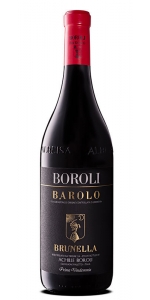
Boroli Barolo Brunella is made from 100 percent Nebbiolo.
A clear ruby red color, with very light orange reflections. A net aroma in which liquorice stands out at first, immediately followed by a fruity scent; the aroma makes you scent it again and again to discover different and pleasant facets. The fruity aroma magnificently prevails after a few minutes in the glass. A very enveloping, fresh and harmonious taste, with a delicate and tasty presence of wood. A long lasting taste that invites to sip it slowly again and again.
Tasting Notes
Brunella is distinguished by a careful selection of grapes, perfect destemming, long macerations with submerged cap. The barrels for Brunella are specifically chosen by the winemaker.
Wine Production
Brunella is one of the most historic single vineyard sites of all of Castiglione Falletto, however it hasn’t ever been bottled singularly under the Menzione Geografica Aggiuntiva BRUNELLA until 2013. The Brunella vineyard occupies the western crest of the Villero hillside and complete surrounds the Boroli winery. The vineyard is a monopole—owned entirely by Boroli and is the most prestigious wine in the lineup. As it occupies the best exposed section of the Villero hillside, La Brunella expresses power, drive, complexity, and extraordinary length and ageability.
About the Vineyard
The Boroli family is a family of entrepreneurs, with roots in Piedmont dating back to 1831. The family started their winemaking business in1997, when Silvano and Elena Boroli felt an ardent desire to step away from the pressures of their publishing business and reconnect to nature. Silvano and Elena grew the company until their son, Achille, stepped in to run the wine-growing and production business in 2012.
With the 2012 grape harvest Achille decided to radically change the methods used in vineyards and wineries, aiming for the highest quality in Barolo and its crus. He cut production levels, updated the winemaking technology, and focused on low intervention methods to raise the quality of the Boroli wines be on par with the finest Barolo wines.
Review:
Ripe red cherries and blood oranges, as well as herbs and roses on the nose, leading to a juicy and flavorful palate that has a swathe of bright, juicy red-fruit flavor. Drinking well now.
-James Suckling 93 Points
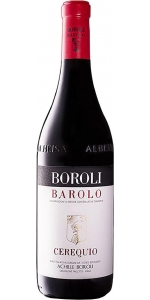
Boroli Cerequio is made from 100 percent Nebbiolo.
The Boroli family is a family of entrepreneurs, with roots in Piedmont dating back to 1831. The family started their winemaking business in1997, when Silvano and Elena Boroli felt an ardent desire to step away from the pressures of their publishing business and reconnect to nature. Silvano and Elena grew the company until their son, Achille, stepped in to run the wine-growing and production business in 2012.
With the 2012 grape harvest Achille decided to radically change the methods used in vineyards and wineries, aiming for the highest quality in Barolo and its crus. He cut production levels, updated the winemaking technology, and focused on low intervention methods to raise the quality of the Boroli wines be on par with the finest Barolo wines.
About the Vineyard
The Cerequio cru lies just across the valley from the Boroli winery in the commune of La Morra and is considered one of the most prestigious sites in the Barolo DOCG zone. It is known to produce Nebbiolo wine of enormous elegance and finesse.
Wine Production
Cerequio is distinguished by a careful selection of grapes, precise destemming, and a long maceration with submerged cap.
Tasting Notes
A clear bright ruby color with very light garnet red reflections; intense and persistent aroma of red fruit with notes of plum and cherry. A pleasant aroma of wood is noticeable after the fruity aroma, anticipating the full taste of a great wine suitable for long lasting life. A succulent, rich, full-bodied and pleasant taste emerges after the woody one, with the presence of slightly ripe red fruit.
Food Pairing
Thanks to its viscosity and body, Barolo is the ideal wine to pair with elaborate dishes and dishes like truffle dishes, meat dishes, pasta with porcini mushrooms, game, and aged cheeses. Cerequio is also perfect with dry pastries or chocolate.
Review:
Elegant bright ruby red. Fragrant and inviting nose of strawberries with whipped cream, icing sugar, elderflower and roses. Flattering palate with clear fruit and appealing acidity, unfolds into a complex style, punchy on the palate with a clear, slightly salty finish.
-Falstaff 95 Points
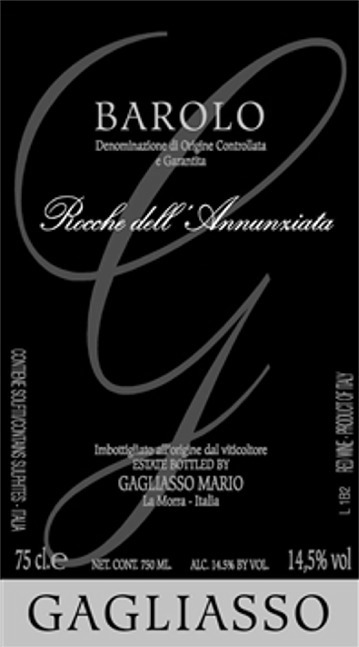
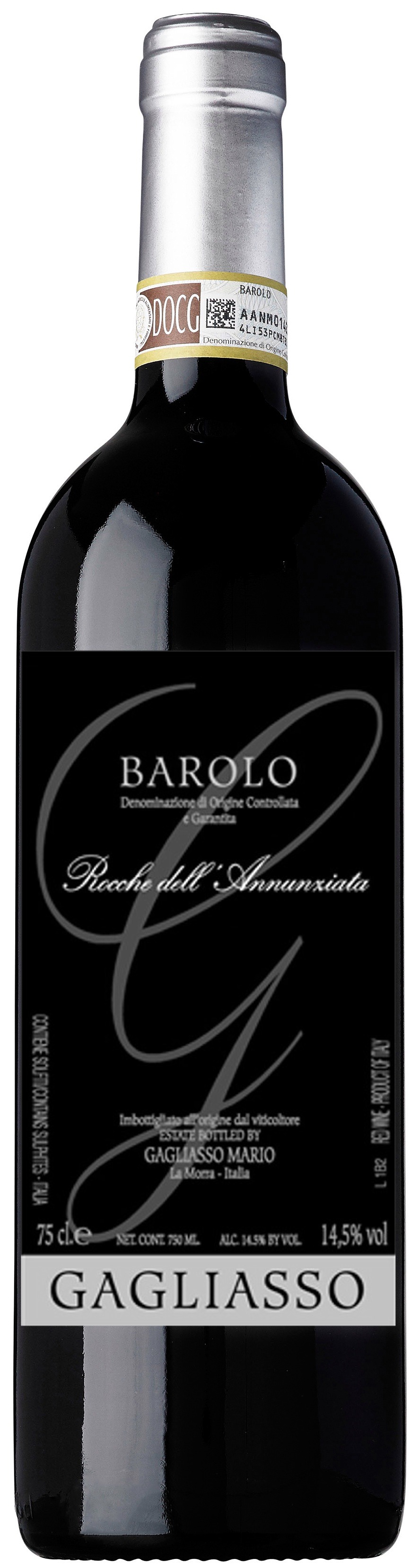
Gagliasso Rocche dell Annunziata Barolo is made from 100% Nebbiolo.
This is a gorgeous wine on many fronts. Firstly, its aromas of wild berry, smoke and cedar are focused and pristine. Secondly, the texture it imparts in the mouth is dense, firm but ultimately yielding and plush. Lastly, the wine's fresh flavors endure for many minutes.
Average density of vines: 5500 vines per hectare Method of cultivation: classical Guyot method with medium-short pruning; the vineyard are three, two with west exposure and one south with medium slope. Green harvest in two different times with reduction of grapes with a production per hectare around 5500 kg . Rocche dell’Annunziata grape are harvested very ripe with a meticulous selection; the fermentation took place in stainless steel vats with temperature controlled. The fermentation is around 33-34°C with 15-17 days of maceration ; malolattic fermentation took place spontaneously in stainless steel vats. After malolattic fermentation the wine stay for 12 month in French barrels, 50% new oak and 50% 2 years; after this period the barrels are blended in big barrels of 2500 liters for 18 month. The wine is bottled and refined for 10-12 month.
Review:
intense on the nose thanks to pressed red flowers, raspberries, cherries and orange. Medium body, velvety tannins and a warm and harmonious finish, slightly voluminous throughout the progression. Delicious now but better from 2021. - Wineritics.com 93 Points
The Gagliasso Estate
The Azienda Agricola Mario Gagliasso is located in the town of La Morra, south of Piedmont, in the province of Cuneo, in the Langhe area.
The winery offers one of the most beautiful views over the Langhe area.
La Morra is located at 513 meters above sea-level, 13 km from Alba, on the top of an imposing hill with the Alps and the Monviso as a background. The hill is planted with vines, for ming huge waves and creating an amphitheatre of rare beauty.
Luca Gagliasso’s family has a long history of winemaking. Luca's grandfather began 50 years ago, at which time he bottled the first Barolo from their historic vineyard, Rocche dell'Annunziata. Around 1987, Lucas's father took over the family tradition of producing wine and brought forth a few changes: he started by using barriques from France, together with large barrels and temperature controlled steel vats. He also purchased a new vineyard. Luca began working with his father during the 2000 vintage, only part time for the first 3 years. He also worked for 3 years with their wine consultant in an analysis laboratory, and worked as a consultant for other wineries.
Luca now works alongside his father, mother, and sister on their 12 hectares of vineyards. On the weekends, Luca's sister and mother work in their restaurant as cooks – only the Gagliasso wines are served. They are currently extending their facility and in the future they plan to incorporate some guest rooms to the restaurant.
The Gagliasso family produces around 60,000 bottles: 40% Barolo, 30% Barbera, 20% Dolcetto and 10% Chardonnay. They have around 250 barriques and 6 large barrels.
Dolcetto is very fruity, aged for a small period in big cask. They produce 3 Barolos and 2 Barberas, one aged 18 months in new oak and the other one only in steel vats. They age the Barolo for 18 months in new barriques, then 12 months in a large cask. Chardonnay is cold macerated, then fermented and aged in French oak for 9 months.
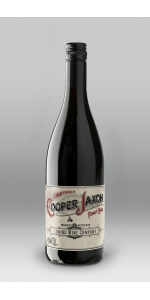
Loring Cooper Jaxon Pinot Noir is made from 100% Pinot Noir
Aged 10 Months in French Oak (15% New)
A special blend in honor of Cooper Jaxon Loring - the next generation of Loring. We don't limit the wine to any
specific AVA, but rather look for a blend that is big, bold, and super tasty!
Juicy and vibrant, with aromas of raspberry puree, blackberry and spring flowers.
Vines are planted on Arroyo Seco Sandy Loam soils on the following vineyard sites: Rancho La Viña, Kessler-Haak, Clos Pepe, John Sebastiano, Aubaine, Rosella's and Sierra Mar.
Vinification is traditionnal with minimal intervention.
Wine went thought Malo-Lactic fermentation and was bottled without filtration.
pH 3.61
Clones: Pisoni, 113, 115, 667, 777, 23
Pairs well with steak and lamb, spicy foods & mild cheeses.
Review:
"This fun and whimsical label from Brian Loring delivers his rich style of Pinot Noir at an affordable price, offering aromas of black cherry, forest herbs, damp sage and crushed slate. The palate is earthy, offering flavors of dark berry, fennel frond, roasted meat and clove. Matt Kettmann"
- Wine Enthusiast (June 2019), 92 pts - Editors' Choice
James Goddard was an ancestor of the Clarke family. Born in West Sussex, England in 1823, James spent his 74 years as a sailor, a whaler, a bullock driver, farmer, prospector, miner and hotel keeper. From an illiterate runaway living rough on the streets of London, he became a rich, successful and admired pillar of South Australian society.
James arrived in Adelaide in 1839 as a 16-year-old sailor. Twelve years later, his life changed forever with the news of gold findings. For the next 20 years, James roamed the country learning the geology that improved his chances of prospecting.
James Goddard Shiraz is made from 100 percent Shiraz.
In 1870, he tried his luck near his farm in the Barossa Valley and discovered the region’s first gold deposits, creating the prosperous Lady Alice Mine. The Lady Alice Mine, though it is no longer operational, was & still is the most successful gold mine in South Australia. From these roots, the Thorn-Clarke family has been connected to the region for the last 150 years.
James Goddard Shiraz is a blend Shiraz sourced from the Milton Park vineyard in the north of Eden Valley, and the St Kitts vineyard in the far northern area of the Barossa. Fruit is harvested in the cool of the night to maintain maximum flavour and freshness and it is fermented for 8 days. The ferment is pumped over twice daily to extract the colour and flavour from the fruit. Once finished fermentation the wine was then matured in a blend of French and American oak for a period of 10 to 12 months depending on the vintage.
Deep vibrant red with purple hues to the rim. The nose shows lifted plums, vibrant purple berries and a delicate spice note. The palate has concentrated satsuma plum, blackberry with lovely charry oak in the background. Long, juicy and even with plush fruit on the finish.
Review:
“Blended from two estate vineyards, St. Kitts and Milton Park, this shiraz offers its richness without any aggression or overt perfume. It’s just lush and delicious, a friendly embrace of firm tannins and purple-red fruit. The texture and flavor combine in a saturated meatiness, for Korean barbecue.”
- Wine & Spirits Magazine, 92 points
Ottella Lugana DOC Le Creete is made from 100% Turbiano (clonal type of Trebbiano di Lugana)
PRODUCTION AREA: S. Benedetto di Lugana. The grapes are harvested exclusively from our own vineyards; harvesting is strictly manual in small 17kg-crates
TRAINING METHOD: Guyot, double arc
Golden, warm, intense straw yellow. Immediate exotic notes.
It develops in a very pleasant fashion, good mineral impression Rich, succulent and well balanced for a truly
satisfactory mouthfeel. Mineral on the finish with just enough acidity to
provide lift and depth.
FOOD: Sea or lake fish to bring out its outstanding features; goes well with white meat and soup, and has quite a surprising affinity with tasty cheese
ALCOHOL BY VOLUME: 13% vol
SERVING TEMPERATURE: 10-12 degrees Celcius
El Cortijillo Tempranillo La Mancha is made from 100% Tempranillo
Up front aromas of raspberry and cherry fruit, medium to light weight, Rhône wine in character, cherry fruit flavors, followed by bright acidity. Reminds of a mythical cross between a Pinot Noir and a Côtes-du-Rhône. Pleasant and fun, bistro red.
Made from 30 year old vine.
Delicious with Paella, hamburger or pasta. But also great with grilled vegetables. (bell pepper, eggplant, etc)