" We don't sell the wine without touching the vine "
| BUY MORE! SAVE MORE! | ||||||||||||||||||||
|
| Country: | France |
| Regions: | Rhone Chateauneuf du Pape |
| Winery: | Grand Veneur |
| Grape Type: | Roussanne |
| Organic: | Yes |
| Vintage: | 2024 |
| Bottle Size: | 750 ml |
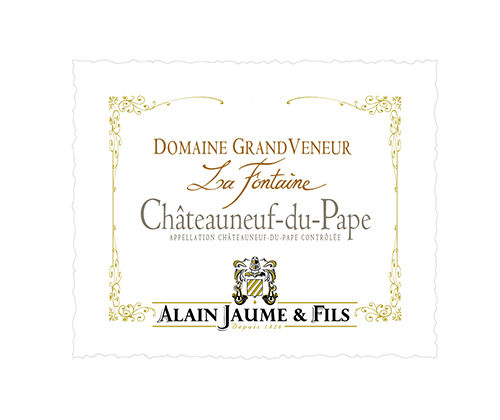
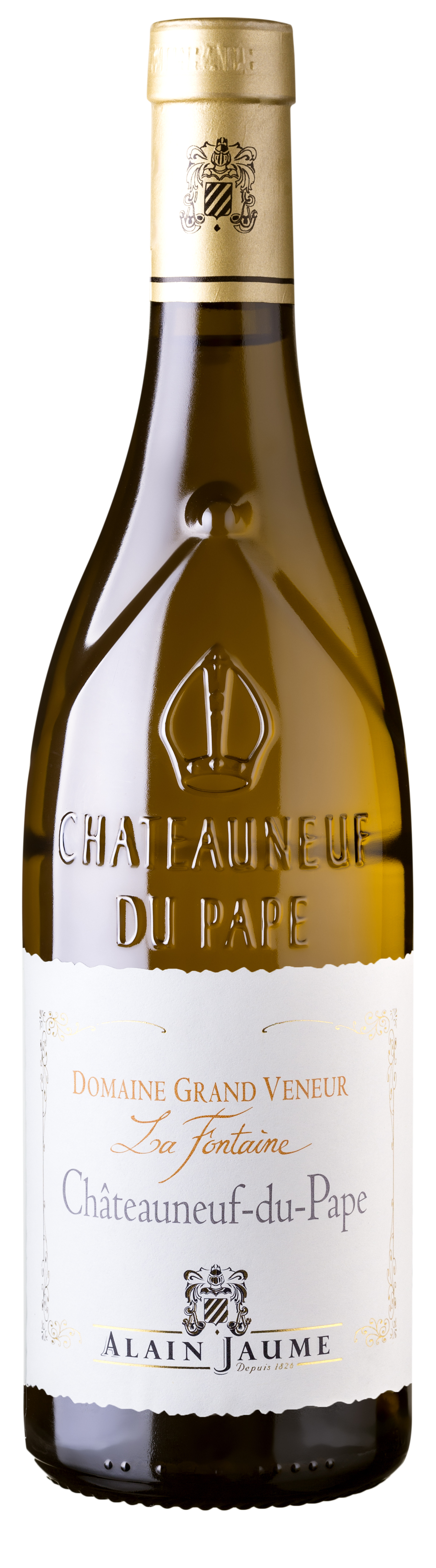
Grand Veneur Chateauneuf Du Pape Blanc La Fontaine is made from 100% Roussane.
Yellow-gold color. The nose is rich in aromas of citrus fruit, tropical fruit, quince and honey, with a touch of vanilla. On the palate, the same aromas appear together with a fatness combining exotic fruit and vanilla : the wine is rich, generous and elegant, with extraordinary length. "La Fontaine" is often considered to be one of the best Châteauneuf du Pape white, and it is by definition a superb gastronomy wine.
Best between 1 and 8 years.
Review:
-Jeb Dunnuck 98 Points
-Decanter 95 Points
The Grand Veneur Estate
In 1320 Pope Jean XXII planted the first vines of Chateauneuf-du-Pape, but it was only in 1360 that the wines of the region first gained fame. Oddly, the wine that gave Chateauneuf-du-Pape its original reputation was the Blanc and not the Rouge. The white wine was a favorite of Pope Innocent VI. The Domaine dates back to 1826, having been founded at that time by Mathieu Jaume. Since 1979, Alain Jaume has run the Domaine and now has the help of his two sons: Sebastien and Christophe.
"Popes throughout history have liked their juice, and when the papal see moved to Avignon in the 13th century, that juice was Chateauneuf-du-Pape ("the pope's new castle") made from grapes grown nearby in the Southern Rhone. The castle is a ruin now, the papal court long gone back to Rome, but the wines that bear the pope's coat of arms emblazoned on the bottle are still produced more or less according to the long-standing recipe. Not every winemaker uses all 13 of the grapes in the proscribed blend, though. At Domaine Grand Veneur, an estate that dates to 1826, Alain Jaume and his sons Sebastien and Christophe emphasize Grenache blended with Syrah and Mourvedre."
- Los Angeles Times
"Improved Chateauneuf with very accomplished, stylish reds since the late 1990s; also very good Vacqueyras and Cotes-du-Rhone Villages." - Anthony Dias Blue's pocket guide to wine 2006
"Grand Veneur is one of the most brilliant estates in Chateauneuf du Pape as well as the force behind the negociant wines sold under the Alain Jaume label. Virtually everything they produce has merit. Some of this estate’s 2009 red wines are just hitting the market as they are bottled early to preserve their fruit and freshness. I can’t say enough about the job Alain Jaume’s two sons, Sebastian and Christophe, have done with this estate. The impeccable attention to detail in the vineyards, the meticulous vinification, and the careful bottling benefit every consumer." - Wine Advocate (#190, August 2010)
"Great bargains continue to emerge from Domaine Grand Veneur as well as from their negociant arm of the business, labeled Alain Jaume" - Wine Advocate (#195, June 2011)
"Don't miss the following "Best Buys" reviewed in several previous issues: Alain Jaume 2010 Cotes du Rhone Haut de Brune (87), Grand Veneur 2010 Cotes du Rhone Blanc (88), Grand Veneur 2009 Cotes du Rhone Les Champauvins (89), Grand Veneur 2009 Cotes du Rhone Reserve Blanc (89), Grand Veneur 2010 Cotes du Rhone Blanc (91), Grand Veneur 2010 Cotes du Rhone Rose (86), Grand Veneur 2009 Lirac Clos de Sixte (91), and Grand Veneur 2010 Cotes du Rhone Blanc de Viognier (89). Credit Christophe and Sebastian Jaume for making this one of the most impeccably run estates in the Rhone Valley. To reiterate, this is an estate at the top of its game and the wines remain fairly priced as well. The 2010 Grand Veneur Chateauneuf du Papes reveal youthful, crisper, more focused styles than their 2009 counterparts. I suspect their pHs are lower, the total acids slightly higher, and the alcohols perhaps .5 to 1% lower across the board." - Wine Advocate (issue197, October 2011)"
The Grand Veneur Vineyard
The estate is located in the commune of Orange and consists of 50 hectares (123 acres). It covers four different appellations: Chateauneuf-du-Pape, Cotes-du-Rhone Villages, Cotes-du-Rhone and Lirac.
The family produces wines under two labels:
- Domaine Grand Veneur – Estate
- Alain Jaume – Negociant
Some wine by Grand Veneur:
Annual production:
- Cotes du Rhone Villages CHAMPAUVINS : +/- 9,000 cases
- Lirac Rouge CLOS DE SIXTE : +/- 5,000 cases
- Chateauneuf du Pape Rouge Grand veneur : 3,300 cases
- Chateauneuf du Pape Blanc Grand veneur : 400 cases
- Chateauneuf du Pape LES ORIGINES red : 1,700 cases
- Chateauneuf du Pape LA FONTAINE white : 300 cases
- Chateauneuf du Pape VIEILLES VIGNES : 530 cases

Argot Bastard Tongue Pinot Noir is made from 100 percent Sonoma Pinot Noir.
Inheriting an unbroken string of success, the "Bastard Tongue" arrives fully-formed and ready to impress. Always a blend from multiple Pinot Noir vineyards, this iteration of "BT" was selected from three distinct sites, each making their own unique contribution of Sonoma County terroir to the wine's character.
Exploding forth on a tidal wave of high-toned, intense red and black fruits, this is a Pinot Noir that no stemware can contain. The palate's profound depth is balanced by an inherent freshness, allowing the wine to crackle with brambly energy, while sustained by bass notes of underbrush, black tea, pie spice and baker's chocolate. A formidable rendition of "Bastard Tongue", and a deserving successor to its line.
Night harvested by hand throughout September, cluster and berry sorted by hand, de-stemmed, no crushing. 7-day cold soaks, followed by native fermentation in open-top bins. Average time on the skins, 14 days. Aging 22 months in French oak barriques (95% new). Never racked prior to bottling. Bottled unfined, unfiltered.
Very versatile for pairing. Goes well with grilled meat, vegetable, fish, poultry and cheese.
Review:
"The 2023 'Bastard Tongue' is an utterly delicious Pinot Noir from Argot. It is both vibrant and expressive, with lifted aromas of raspberries, dark cherries and sweet cranberries woven together with notes of lavender, dried violets, baking spices, tea leaf, and mossy notes that remain persistent throughout. On the palate, it reveals a mouthwatering core of juicy red/dark fruit wrapped in supple tannins, with a gorgeous silky texture that speaks to its finesse. What sets this wine apart is its freshness—bright acidity energizes the layers of flavor, giving the wine a lively structure and a clean, extended finish. It's a Pinot Noir that balances depth and elegance with remarkable complexity." - 97 Points, International Wine Report
"Explosive red fruits, cool pine forest, loamy underbrush, five-spice and bakers chocolate. This wine marches down the palate with red-fleshed strawberries, Luxardo cherries and a hint of blood orange. As the finish spins into infinity, the fruit profile evolves from red to black, crescendoing on the palate's persistent lift of sweet and floral spice notes. Magnificent." - 96 Points, Jeb Dunnuck

The DAOU Cabernet Sauvignon presents a deep ruby-purple color, foreshadowing intense aromas of cherry and blackberry jam complemented by dark chocolate, tobacco leaf and desert sage. The nose also reveals secondary nuances of wet gravel, sandalwood and plum pudding with subtle notes of fennel, black olive and eucalyptus. On the palate, a swirl of black raspberry, pomegranate, cherry preserve and Zante currant melds seamlessly with crushed herbs, fig and cranberry. An impeccably balanced finish flows effortlessly from the juicy mid palate, leaving lovely notes of boysenberry, rhubarb, graphite and dried thyme.
Review:
-Ryan Montgomery (Staff Writer & Critic) 93 Points
-Wine Enthusiast 91 Points
-Decanter World Wine Awards 90 Points

DAOU Vineyards Reserve Cabernet Sauvignon is made from 77% Cabernet Sauvignon, 23% Petit Verdot.
A heady nose delivers fruit-forward aromas of blackberry, raspberry and plum with traces of licorice, thyme, vanilla and cherry. The palate is beautifully balanced, showing layers of black fruit and chocolate-covered blueberry with underlying herbal, cedar and mineral complexity. Exquisitely rounded tannins imbue the finish with stature and length.
Review:
-Wine Enthusiast 93 Points
-James Suckling 95 Points

Reynvaan Family Vineyards is a cult Walla Walla estate whose vines in the cobblestone-strewn Rocks District produce some of Washington's most sought-after Syrah. Stonessence draws on the estate's In the Rocks fruit for a wild, perfumed, savory style that rivals the great Syrahs of the Northern Rhône.
Review:
Sourced from the estate's In the Rocks vineyard, this penetrating Syrah displays the haunting perfume of the Rocks District. Undulating blackberry and blueberry flavours are tinged with blood, iodine and ash. Powerful yet focused, freshly balanced with a finish that lingers on the bitter edges of quinine and olive pit. Made with 15% whole clusters vinified in stainless steel and matured for 18 months in both new puncheons and neutral oak.
Decanter World Wine Awards 98 Points

Reynvaan Foothills Reserve Estate Syrah 2021 is made from 100% Syrah.
Reynvaan Family Vineyards was founded in 2004 by Mike and Gale Reynvaan in Washington’s Walla Walla Valley, with son Matt Reynvaan as winemaker, and has become one of the most sought-after names in the state for its Rhône-inspired, estate-grown reds. The Foothills Reserve is a barrel selection from the family’s high-elevation Foothills in the Sun Vineyard, planted in 2008 on loess soils over deep basalt in the foothills of the Blue Mountains.
Walla Walla Valley Syrah is prized for two very different terroirs: the basalt-cobblestone Rocks District, known for savory, meaty, olive-and-mineral character, and the wind-swept loess hillsides that lend structure, freshness and lift. The Foothills site sits among the latter, giving a Syrah of both power and energy.
Review:
A total masterclass, the 2021 ‘Foothills Reserve’ is a barrel selection wine that comes from the Reynvaan’s high elevation estate Foothills In The Sun Vineyard. The site is set on Loess soils with deep basalt deposits and I have been writing about the potential of this site for more than a decade. Today, wines from this high-elevation location are every bit as good as those from their Rocks District vineyard. Hoisin sauce, beef drippings, menthol, and shades of wild blackberry all combine on the nose. The palate is utterly seamless with serious tension, weight and mouth-watering acidity. It offers La Landonne levels of flavor complexity, yielding blood orange zest notes alongside red cherry candy, cigar ash, wet stone and pipe tobacco that all brilliantly meld together on the palate. Showing seriously good flavor and aromatic range, enjoy this simply stunning Syrah now and over the next ten plus years to come. Drink 2023-2037.
Owen Bargreen, 99 points
Review:
-Jeb Dunnuck 98 Points
-Wine Enthusiast 97 Points
-Eric Guido (Vinous) 96 Points
-James Suckling 95 Points

Sainte-Marie Bourgogne Blanc Vieilles Vignes is made from 100 percent Chardonnay.
The wine has a perfect light yellow color with green hues. Nose of white flower, sweet spice and bitter orange. Fresh and delicious attack. It shows roundness and a slight buttery note with a very saline finish that makes you slightly salivate.
Excellent with Seafood, grilled fish, clams and oysters of course. Also great with goat cheese or Comté cheese.
Aged on lees for 6 months in stainless steel vats. Adjustment of sulphites at the end of MLF and before bottling. Filtration on earth then on 1.2µ cartridge after bonding with bentonite.Machine harvest, and direct pressing with a pneumatic horizontal press. Static settling. Alcoholic and malolactic fermentation in stainless steel vats with native yeast and bacteria.
This wine is declassified Chablis, due to exceeding the volume limit per hectare it could not be labeled Chablis. They call it “over-production” Burgundy, but we call it an outstanding value. This exact same juice is selling for three times as much under the Chablis AOC label!

Grand Veneur Chateauneuf du Pape Blanc Le Miocene is made from 60% Clairette, 40% Roussanne
Pale yellow colour with hints of green, aromas of white flowers (may blossom, honeysuckle).
The palate is pleasantly balanced between liveliness and roundness, which brings out characteristics of dried apricot, honey and elderberry. A Châteauneuf du Pape white displaying a great finesse.
Best between 1 and 8 years.
Soil type Coming from the single vineyard named “La Fontaine”, the plot is facing north.It is made of clay-sand and limestone. Thanks to the northern orientation, it is always very well aired. This sector allow the Roussane and Clairette to mature in great conditions without losing freshness, which we believe is key point. Winemaking & ageing Whole-bunch pressing. Vinification in stainless-steel tanks. Fermentation temperature controlled at 15°C.
Review:
-Yohan Castaing (Robert Parker) 92 Points
Grand Veneur Chateauneuf du Pape Blanc Le Miocene is made from 60% Clairette, 40% Roussanne
Pale yellow colour with hints of green, aromas of white flowers (may blossom, honeysuckle).
The palate is pleasantly balanced between liveliness and roundness, which brings out characteristics of dried apricot, honey and elderberry. A Châteauneuf du Pape white displaying a great finesse.
Best between 1 and 8 years.
Soil type Coming from the single vineyard named “La Fontaine”, the plot is facing north.It is made of clay-sand and limestone. Thanks to the northern orientation, it is always very well aired. This sector allow the Roussane and Clairette to mature in great conditions without losing freshness, which we believe is key point. Winemaking & ageing Whole-bunch pressing. Vinification in stainless-steel tanks. Fermentation temperature controlled at 15°C.
Review:
-Nicolas Greinacher (Vinous) 92 Points

Grand Veneur Chateauneuf du Pape Rouge Le Miocene is made from 70% Grenache, 20% Syrah, 10% Mourvèdre .
An intense dark-ruby color. The nose develop aromas of ripe black fruit (such as blackberry), cherry and spice box. The palate reveals the presence of tannins, in high quantity and elegant. The finish is long and luxurious. This is the Châteauneuf du Pape expression, displaying all the characteristics of the terroir.
Soil type: Plots are located northern part of Châteauneuf du Pape and the vines are grown under organic process.The soil is marked by the violence wrought by the Rhone river. It consists of a layer of marine molasses of the Miocene period covered by alpine alluvium. The presence of a great number of rounded stones known as "galets" in the earth is evidence of the time when the Rhone, then a torrent, tore fragments of rock from the Alps and deposited them on the plain. The GRAND VENEUR cuvee will express year after year a great power and aromatic complexity.
Winemaking & ageing: Harvest is sorted by hand, destemmed and crushed. Fermentation temperature is controlled at 30°C. Vatting period of 18 to 20 days. Matured in vats and oak casks.
Review:
-Jeb Dunnuck 93 Points
Grand Veneur Chateauneuf du Pape Rouge Le Miocene is made from 70% Grenache, 20% Syrah, 10% Mourvèdre .
An intense dark-ruby color. The nose develop aromas of ripe black fruit (such as blackberry), cherry and spice box. The palate reveals the presence of tannins, in high quantity and elegant. The finish is long and luxurious. This is the Châteauneuf du Pape expression, displaying all the characteristics of the terroir.
Soil type: Plots are located northern part of Châteauneuf du Pape and the vines are grown under organic process.The soil is marked by the violence wrought by the Rhone river. It consists of a layer of marine molasses of the Miocene period covered by alpine alluvium. The presence of a great number of rounded stones known as "galets" in the earth is evidence of the time when the Rhone, then a torrent, tore fragments of rock from the Alps and deposited them on the plain. The GRAND VENEUR cuvee will express year after year a great power and aromatic complexity.
Winemaking & ageing: Harvest is sorted by hand, destemmed and crushed. Fermentation temperature is controlled at 30°C. Vatting period of 18 to 20 days. Matured in vats and oak casks.
Review:
-Wine Enthusiast 94 Points
-Joe Czerwinski (Robert Parker) 94 Points
-Jeb Dunnuck 92 Points
-James Suckling 92 Points
Grand Veneur Chateauneuf du Pape Rouge Le Miocene is made from 70% Grenache, 20% Syrah, 10% Mourvèdre .
An intense dark-ruby color. The nose develop aromas of ripe black fruit (such as blackberry), cherry and spice box. The palate reveals the presence of tannins, in high quantity and elegant. The finish is long and luxurious. This is the Châteauneuf du Pape expression, displaying all the characteristics of the terroir.
Soil type: Plots are located northern part of Châteauneuf du Pape and the vines are grown under organic process.The soil is marked by the violence wrought by the Rhone river. It consists of a layer of marine molasses of the Miocene period covered by alpine alluvium. The presence of a great number of rounded stones known as "galets" in the earth is evidence of the time when the Rhone, then a torrent, tore fragments of rock from the Alps and deposited them on the plain. The GRAND VENEUR cuvee will express year after year a great power and aromatic complexity.
Winemaking & ageing: Harvest is sorted by hand, destemmed and crushed. Fermentation temperature is controlled at 30°C. Vatting period of 18 to 20 days. Matured in vats and oak casks.
Review:
-Yohan Castaing (Robert Parker) 94 Points
-Jeb Dunnuck 93 Points
-Decanter World Wine Awards 93 Points
-James Suckling 92 Points

Chappellet Pritchard Hill Estate Vineyard Cabernet Sauvignon is made from 94% Cabernet Sauvignon & 6% Petit Verdot.
Chappellet's Pritchard Hill Cabernet Sauvignon has been, since the beginning of their winemaking career, the most sought after wine of their portfolio. The wine is truly a love letter to the winegrowing potential of Pritchard Hill. The wine was inspired by Bordeaux, and like most left bank Bordeaux, the wine is a blend of predominately Cabernet Sauvignon with remaining amounts other classic Bordeaux blend varieties. The vines grow upon rocky, mountainside vineyards. After harvest and fermentation, the wine was aged for 22 months in 100% new French oak barrels.
Review:

Antonio Camillo Vermentino 2025 is made from Vermentino. It is the sea-breeze white from Antonio Camillo, best known for his Ciliegiolo but equally at home with the Maremma's signature coastal white grape. The estate sits near Capalbio in southern Tuscany, where Camillo has farmed his own old vines with a low-intervention hand since 2006.
Fermented in steel to keep it fresh and precise, this Vermentino is crisp and saline, with citrus, green apple and white flowers over a stony, almost briny finish. Pour it cold alongside seafood, fried vegetables or a sunny afternoon.