
" We don't sell the wine without touching the vine "
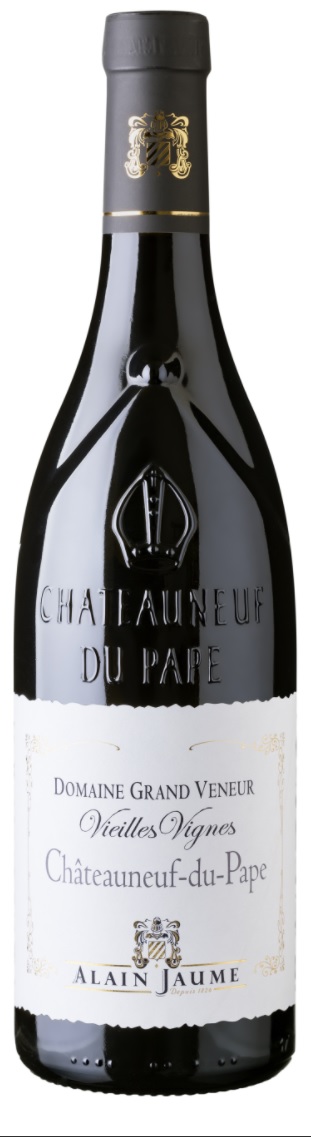
| Country: | France |
| Regions: | Rhone Chateauneuf du Pape |
| Winery: | Grand Veneur |
| Grape Type: | Grenache |
| Organic: | Yes |
| Vintage: | 2019 |
| Bottle Size: | 750 ml |

Grand Veneur Chateauneuf Du Pape Vieilles Vignes is made from 50% Grenache, 40% Mourvedre, 10% Syrah
Matured in concrete vats (40%) and oak casks (60%)
It boasts an inky/purple color in addition to a gorgeous perfume of crushed rocks, jammy black fruits, charcoal and graphite. Blackberry aroma with an air of dates pressed in alongside – this is sweet-noted. It is easy to appreciate, a sleek and stylish start. The palate holds excellent fruit that runs well and has kick. Its tannins move round freely and a minted finale comes forward. Its dark fruit is tasty, darkens on the finish, where tar and char from its oak enter. It is all very much together, a bundle of harmony, and will gain local attributes as it ages.
An outstanding Chateauneuf du Pape which display the best of its terroir.
The vines are 50 to 100+ year old. They are planted on red clay soils covered with pebble stones.
Harvest is destemmed and crushed. Fermentation temperature is controlled at 30°C. Vatting period of 18 to 20 days. Matured in concrete vats (40%) and oak casks (60%).
The vineyards are located in the north of Châteauneuf du Pape. GRAND VENEUR «Vieilles Vignes» cuvee is produced from the older vines. Thanks to time and an organic growing, roots go very deep in the soil. Yields are naturally low and grapes highly concentrated.
The
Winemaking and aging
HarvePair with venisson, duck, braised lamb or strong cheese.
Review:
-Joe Czerwinski (Robert Parker) 95 Points
-Jeb Dunnuck 94 Points
-James Suckling 93 Points
Grand Veneur Chateauneuf Du Pape Vieilles Vignes is made from 50% Grenache, 40% Mourvedre, 10% Syrah
Matured in concrete vats (40%) and oak casks (60%)
It boasts an inky/purple color in addition to a gorgeous perfume of crushed rocks, jammy black fruits, charcoal and graphite. Blackberry aroma with an air of dates pressed in alongside – this is sweet-noted. It is easy to appreciate, a sleek and stylish start. The palate holds excellent fruit that runs well and has kick. Its tannins move round freely and a minted finale comes forward. Its dark fruit is tasty, darkens on the finish, where tar and char from its oak enter. It is all very much together, a bundle of harmony, and will gain local attributes as it ages.
An outstanding Chateauneuf du Pape which display the best of its terroir.
The vines are 50 to 100+ year old. They are planted on red clay soils covered with pebble stones.
Harvest is destemmed and crushed. Fermentation temperature is controlled at 30°C. Vatting period of 18 to 20 days. Matured in concrete vats (40%) and oak casks (60%).
The vineyards are located in the north of Châteauneuf du Pape. GRAND VENEUR «Vieilles Vignes» cuvee is produced from the older vines. Thanks to time and an organic growing, roots go very deep in the soil. Yields are naturally low and grapes highly concentrated.
The vines are 50 to 100+ year old. They are planted on red clay soils covered with pebble stones.
Winemaking and aging
Harvest is destemmed and crushed. Fermentation temperature is controlled at 30°C. Vatting period of 18 to 20 days. Matured in concrete vats (40%) and oak casks (60%).
Pair with venisson, duck, braised lamb or strong cheese.
Review:
"Up with the crème de la crème of the vintage, the 2018 Châteauneuf Du Pape Vieilles Vignes is a bigger, richer wine than the Les Origines cuvée and has a beautiful core of smoked black fruits, candied violets, peppery garrigue, and scorched earth-like aromas and flavors. Playing in the medium to full-bodied end of the spectrum, it’s flawlessly balanced and has terrific tannins, a stacked mid-palate, and a great finish. It certainly shows the more front end-loaded, fleshy, mildly concentrated style of the 2018 vintage, yet the balance is top-notch, and it’s just a thrill to drink today. It should evolve nicely for 10-15 years."
- Jeb Dunnuck (October 2020),96 pts
-Joe Czerwinski (Robert Parker) 95 Points
-Josh Raynolds (Vinous) 94 Points

Grand Veneur Chateauneuf du Pape Rouge Le Miocene is made from 70% Grenache, 20% Syrah, 10% Mourvèdre .
An intense dark-ruby color. The nose develop aromas of ripe black fruit (such as blackberry), cherry and spice box. The palate reveals the presence of tannins, in high quantity and elegant. The finish is long and luxurious. This is the Châteauneuf du Pape expression, displaying all the characteristics of the terroir.
Soil type: Plots are located northern part of Châteauneuf du Pape and the vines are grown under organic process.The soil is marked by the violence wrought by the Rhone river. It consists of a layer of marine molasses of the Miocene period covered by alpine alluvium. The presence of a great number of rounded stones known as "galets" in the earth is evidence of the time when the Rhone, then a torrent, tore fragments of rock from the Alps and deposited them on the plain. The GRAND VENEUR cuvee will express year after year a great power and aromatic complexity.
Winemaking & ageing: Harvest is sorted by hand, destemmed and crushed. Fermentation temperature is controlled at 30°C. Vatting period of 18 to 20 days. Matured in vats and oak casks.
Review:
-Wine Enthusiast 94 Points
-Joe Czerwinski (Robert Parker) 94 Points
-Jeb Dunnuck 92 Points
-James Suckling 92 Points

Grand Veneur Chateauneuf du Pape Rouge Le Miocene is made from 70% Grenache, 20% Syrah, 10% Mourvèdre .
An intense dark-ruby color. The nose develop aromas of ripe black fruit (such as blackberry), cherry and spice box. The palate reveals the presence of tannins, in high quantity and elegant. The finish is long and luxurious. This is the Châteauneuf du Pape expression, displaying all the characteristics of the terroir.
Soil type: Plots are located northern part of Châteauneuf du Pape and the vines are grown under organic process.The soil is marked by the violence wrought by the Rhone river. It consists of a layer of marine molasses of the Miocene period covered by alpine alluvium. The presence of a great number of rounded stones known as "galets" in the earth is evidence of the time when the Rhone, then a torrent, tore fragments of rock from the Alps and deposited them on the plain. The GRAND VENEUR cuvee will express year after year a great power and aromatic complexity.
Winemaking & ageing: Harvest is sorted by hand, destemmed and crushed. Fermentation temperature is controlled at 30°C. Vatting period of 18 to 20 days. Matured in vats and oak casks.
Review:
-Jeb Dunnuck 93 Points

Grand Veneur Chateauneuf Du Pape Blanc La Fontaine is made from 100% Roussane.
Yellow-gold color. The nose is rich in aromas of citrus fruit, tropical fruit, quince and honey, with a touch of vanilla. On the palate, the same aromas appear together with a fatness combining exotic fruit and vanilla : the wine is rich, generous and elegant, with extraordinary length. "La Fontaine" is often considered to be one of the best Châteauneuf du Pape white, and it is by definition a superb gastronomy wine.
Best between 1 and 8 years.
Review:
-Jeb Dunnuck 98 Points
-Decanter 95 Points
Grand Veneur Chateauneuf Du Pape Vieilles Vignes is made from 50% Grenache, 40% Mourvedre, 10% Syrah
Matured in concrete vats (40%) and oak casks (60%)
It boasts an inky/purple color in addition to a gorgeous perfume of crushed rocks, jammy black fruits, charcoal and graphite. Blackberry aroma with an air of dates pressed in alongside – this is sweet-noted. It is easy to appreciate, a sleek and stylish start. The palate holds excellent fruit that runs well and has kick. Its tannins move round freely and a minted finale comes forward. Its dark fruit is tasty, darkens on the finish, where tar and char from its oak enter. It is all very much together, a bundle of harmony, and will gain local attributes as it ages.
An outstanding Chateauneuf du Pape which display the best of its terroir.
The vines are 50 to 100+ year old. They are planted on red clay soils covered with pebble stones.
Harvest is destemmed and crushed. Fermentation temperature is controlled at 30°C. Vatting period of 18 to 20 days. Matured in concrete vats (40%) and oak casks (60%).
T/p>
Hap style="word-wrap: break-word;">The vineyards are located in the north of Châteauneuf du Pape. GRAND VENEUR «Vieilles Vignes» cuvee is produced from the older vines. Thanks to time and an organic growing, roots go very deep in the soil. Yields are naturally low and grapes highly concentrated.
Winemaking and aging
Pair with venisson, duck, braised lamb or strong cheese.
Review:
"The 2019 Châteauneuf Du Pape Vieilles Vignes is based on 45% each of Grenache and Mourvèdre, with the balance Syrah, all destemmed and raised in 55% new French oak. Gorgeous cassis, violet, graphite, fruitcake, and peppery herbs define this brilliant effort, and it's full-bodied, with a pure, seamless texture, wonderful tannins, and one heck of a great finish. This magical 2019 is going to benefit from 4-5 years of bottle age (it's brilliant even today) yet keep for 20 years or more. Châteauneuf du Pape lovers need to have this in their cellar!"
- Jeb Dunnuck (November 2021),99 pts
The Grand Veneur Estate
In 1320 Pope Jean XXII planted the first vines of Chateauneuf-du-Pape, but it was only in 1360 that the wines of the region first gained fame. Oddly, the wine that gave Chateauneuf-du-Pape its original reputation was the Blanc and not the Rouge. The white wine was a favorite of Pope Innocent VI. The Domaine dates back to 1826, having been founded at that time by Mathieu Jaume. Since 1979, Alain Jaume has run the Domaine and now has the help of his two sons: Sebastien and Christophe.
"Popes throughout history have liked their juice, and when the papal see moved to Avignon in the 13th century, that juice was Chateauneuf-du-Pape ("the pope's new castle") made from grapes grown nearby in the Southern Rhone. The castle is a ruin now, the papal court long gone back to Rome, but the wines that bear the pope's coat of arms emblazoned on the bottle are still produced more or less according to the long-standing recipe. Not every winemaker uses all 13 of the grapes in the proscribed blend, though. At Domaine Grand Veneur, an estate that dates to 1826, Alain Jaume and his sons Sebastien and Christophe emphasize Grenache blended with Syrah and Mourvedre."
- Los Angeles Times
"Improved Chateauneuf with very accomplished, stylish reds since the late 1990s; also very good Vacqueyras and Cotes-du-Rhone Villages." - Anthony Dias Blue's pocket guide to wine 2006
"Grand Veneur is one of the most brilliant estates in Chateauneuf du Pape as well as the force behind the negociant wines sold under the Alain Jaume label. Virtually everything they produce has merit. Some of this estate’s 2009 red wines are just hitting the market as they are bottled early to preserve their fruit and freshness. I can’t say enough about the job Alain Jaume’s two sons, Sebastian and Christophe, have done with this estate. The impeccable attention to detail in the vineyards, the meticulous vinification, and the careful bottling benefit every consumer." - Wine Advocate (#190, August 2010)
"Great bargains continue to emerge from Domaine Grand Veneur as well as from their negociant arm of the business, labeled Alain Jaume" - Wine Advocate (#195, June 2011)
"Don't miss the following "Best Buys" reviewed in several previous issues: Alain Jaume 2010 Cotes du Rhone Haut de Brune (87), Grand Veneur 2010 Cotes du Rhone Blanc (88), Grand Veneur 2009 Cotes du Rhone Les Champauvins (89), Grand Veneur 2009 Cotes du Rhone Reserve Blanc (89), Grand Veneur 2010 Cotes du Rhone Blanc (91), Grand Veneur 2010 Cotes du Rhone Rose (86), Grand Veneur 2009 Lirac Clos de Sixte (91), and Grand Veneur 2010 Cotes du Rhone Blanc de Viognier (89). Credit Christophe and Sebastian Jaume for making this one of the most impeccably run estates in the Rhone Valley. To reiterate, this is an estate at the top of its game and the wines remain fairly priced as well. The 2010 Grand Veneur Chateauneuf du Papes reveal youthful, crisper, more focused styles than their 2009 counterparts. I suspect their pHs are lower, the total acids slightly higher, and the alcohols perhaps .5 to 1% lower across the board." - Wine Advocate (issue197, October 2011)"
The Grand Veneur Vineyard
The estate is located in the commune of Orange and consists of 50 hectares (123 acres). It covers four different appellations: Chateauneuf-du-Pape, Cotes-du-Rhone Villages, Cotes-du-Rhone and Lirac.
The family produces wines under two labels:
- Domaine Grand Veneur – Estate
- Alain Jaume – Negociant
Some wine by Grand Veneur:
Annual production:
- Cotes du Rhone Villages CHAMPAUVINS : +/- 9,000 cases
- Lirac Rouge CLOS DE SIXTE : +/- 5,000 cases
- Chateauneuf du Pape Rouge Grand veneur : 3,300 cases
- Chateauneuf du Pape Blanc Grand veneur : 400 cases
- Chateauneuf du Pape LES ORIGINES red : 1,700 cases
- Chateauneuf du Pape LA FONTAINE white : 300 cases
- Chateauneuf du Pape VIEILLES VIGNES : 530 cases

A very deep purple, red in color. This wine showcases Shiraz with its depth of Barossa Valley and the alluring, aromatic freshness of Eden Valley. Vibrant aromas of dark cherries, anise and red raspberry. A distinctive wine with richness and dark berry, fruit compote palate. Perfectly balanced, elegant and refined.
Enjoy with beef filet, roast beetroot and horseradish, or Korean fried cauliflower.
This blend of Barossa Valley (67%) and Eden Valley fruit hails from five parcels averaging 80 years old, the oldest planted in 1854. Intensely concentrated in hue and muscular flavour. Spicy and mineral to the nose and palate, with glimpses of violets. Its iodine and liquorice-edged black cherry and blueberry flavour is succulent, but still in the grip of the sinewy, charry oak, making for an imposing, slightly austere finish. A powerhouse.
Saturated ruby. Heady aromas of ripe dark berries, cherry liqueur, vanilla and incense, with smoky mineral and exotic spice accents building in the glass. Seamless in texture and deeply concentrated, offering palate-staining black and blue fruit, floral pastille and mocha flavors that turn sweeter with air. At once plush and lively, finishing extremely long and smoky, with repeating dark berry and floral notes and velvety tannins.
-Vinous 96 Points

Milsetentayseis 1076 Ribera del Duero Tinto is made with 95% Tempranillo and 5% other native varieties.
TASTING NOTES: A product of its unique landscape, extreme altitude and mineral-rich soil, 1076 Tinto is a bold wine with a distinct character designed to evolve over time. Its freshness and intensely fruity expression are representative of a modern style, moving away from excess, in search of the elegance, smoothness and balance found in the great wines of the world.
TERROIR: A recently restored vineyard situated at over 3,280 feet of altitude where ancestral vines over 100 years old grow harmoniously together with new, indigenous plantings in varied soil comprised of red clay, sand and mineral deposits of quartz, mica, and feldspar.
WINEMAKING: Hand-harvested from a selection of the best plots in the vineyard then separated into concrete, oak or stainless steel fermentation vats depending on the characteristics of the grape and the soil where it was grown. Its production is defined by the team´s constant vigilance throughout the process and their in-depth knowledge of the region, the soil and the native varieties that thrive there.
AGEING: Aged for 18 months in French oak of various sizes and according to the needs of each plot. Bottled in June 2020.
VINTAGE: The 2018 vintage began with abundant rainfall that lasted until late spring. Budding had already begun by the end of April, and as is usual in the Ribera del Duero, mid-May posed great risk of frost. Thankfully, consistent high winds in the area kept it at bay allowing the vineyards to remain unaffected. Spring extended into June with rain and cool temperatures, unusual for this time of year, while summer did not arrive until July bringing with it dry, hot conditions that allowed for the fruit to reach optimal ripeness. The harvest ran from October 5th-October 13th.
Pair with spit-Fire Roasted Suckling Pig.
Reviews:
"Inky violet. Potent aromas of cassis, cherry preserves, incense and potpourri, plus oak spice and mineral topnotes. Alluringly sweet and concentrated, with a spine of smoky minerality supporting intense flavors of dark berry liqueur, bitter chocolate, cola and candied lavender. Youthful, slow-building tannins add shape and grip to an impressively long, juicy finish that echoes the dark berry and floral notes. - Josh Raynolds."
- Vinous (February 2021), 95 pts
"The wine is deep cherry in color exhibiting complex, expressive aromas. Its minerality comes from the soil, the black fruit from the Tempranillo and the spice from a sometime in oak. The combination leads to a full body that finishes with great length.
- Guia Penin, 95 pts
"Very fine-tannined Duero with berry, chocolate and walnut character. Medium body. Solid core of fruit. Linear and very long. Polished and thought-provoking. Drinkable now, but better in 2023."
- James Suckling (November 2021), 94 pts

J Lohr Signature Paso Robles Cabernet Sauvignon is made from 80% Cabernet Sauvignon 6% Cabernet Franc 6% Saint Macaire 4% Petit Verdot 4% Malbec.
J. Lohr Signature Cabernet Sauvignon was first produced to honor the 80th birthday of founder Jerry Lohr. This limited release was specially selected and blended from the exceptional 2016 vintage in Paso Robles. It is both a tribute to Jerry's pioneering efforts in the region and our red wine portfolio's ultimate expression of Cabernet Sauvignon. VINEYARDS & CELLAR Beck Vineyard, in the Creston District of Paso Robles, is a unique, high elevation site that sits at 1,700 feet above the early morning fog line. Its calcareous soils and cooling afternoon winds are perfect for growing Cabernet Sauvignon. The Cabernet from this vineyard ripens early with excellent color, purity of fruit, and phenolic maturity. Incorporation of Cabernet Franc brings freshness to the blend, while the rare Bordeaux variety, Saint Macaire, brings density and a savory character. Petit Verdot and Malbec add structure, color, and a component of bright fruit. The hand-harvested grapes were held separate at harvest and berry-sorted into six-ton open top tanks for fermentation. Maceration took place on the skins for five days, before early pressing to achieve ideal tannin extraction. Aged 19 months in 100% new French oak from coopers Nadalie and Sylvain.
Review:
-Wine Enthusiast 95 Points

Schwarz The Schiller Shiraz is made from 100 percent Shiraz.
The Schiller Shiraz is a wine rich in both flavor and history. The 400 Shiraz vines planted by Carl August Otto Schiller in 1881 are something to be treasured. Earmarked for bulldozers in 2006, a last minute reprieve would see these Ancestor vines remain in the ground. The grapes are hand-picked from the sixth generation Schiller family vineyard at Hallett Valley in the Barossa. Jason first made this wine in 2008, and since then it has been his flagship wine.
Opens quickly to luxe fruits, black plum & fruits of the forest, building in layers of toasty smoked bacon, tobacco leaf and Mediterranean herbs with nuances of spice and earthy tones. A luxurious palate of old vine fruits, savory overtones and fine slippery tannins. A long harmonious finish.
Review:
-James Suckling 92 Points
-Wine Enthusiast Magazine 90 Points

Fullerton Three Otters Pinot Noir is made from 100% Pinot Noir - 40 years old
11 months in 25% new Oak and 75% neutral
Bella Vida Vineyard is perched high in the heart of the Dundee Hills. This picturesque site provides elegant fruit from the storied Jory soils of the AVA. LIVE certified.
Aromas of cherry and raspberry flow into finely-tuned layers of cedar, cocoa, licorice, and baking spices. The palate pulses with energy as the silky tannins and gorgeous mid-palate captivate your senses. A radiant and profound experience.
A co-fermentation of Dijon clones 113, 667, and 777, this wine expresses the volcanic soils of the Dundee Hills elegantly, yet powerfully. Upon arrival, the grapes were immediately de-stemmed into an open-top two-ton fermenter. Following a seven day cold soak, the wine started fermenting slowly at a cool temperature. To manage extraction, we utilized one to two punch-downs and one pump-over per day, with two rack-and-returns at the beginning and middle of fermentation. As fermentation neared the end, the must was heated to achieve a peak temperature of 94° F resulting in optimum extraction, and then we immediately chilled the wine to extend the time on the skins, while switching to one pump-over per day to limit harsh, seed-tannin extraction. After a total of 19 days on the skins, we drained and pressed the wine, keeping the free-run and press fractions separate. This bottling contains only the free run fraction. Following two days of settling, the wine was racked to barrel and aged for 11 months in 25% new French oak and one month in tank prior to being bottled unfined and unfiltered.
Review:
Vivid red. Displays fresh red/dark berry and pungent floral aromas, along with suggestions of cola, mocha and five-spice powder. Appealingly sweet and energetic on the palate, offering intense black raspberry, cherry-cola, spicecake and rose pastille flavors that tighten up slowly on the back half. Fine-grained tannins frame the well-defined finish, which lingers with impressive, red fruit liqueur-driven persistence. (all de-stemmed fruit and 25% new French oak). - Josh Raynolds" - Antonio Galloni's Vinous (June 2019), 93 pts
"Once again the Bella Vida rings the bell as the best of a fine lineup of Pinots from Fullerton. Rich, ripe, powerful fruit flavors mix strawberry jam, black cherry syrup, coffee, cola and brown spices. It's not a wine you have to wait on; enjoy it now through the early 2020s. - PAUL GREGUTT" - Wine Enthusiast (December 2018), 92 pts-James Suckling 93 Points
-Wine Enthusiast 92 Points

The Grade Napa Cabernet Sauvignon Winfield Vineyard is made from Napa Valley Cabernet Sauvignon.
“2016 produced wines that are very giving, round, coating and streamlined. Year after this year, this bottling aims to highlight the best attributes of the Winfield Vineyard, and also creates a wine that possesses qualities that allow it to age well in the cellar and evolve over many years.
“This wine expresses a focused balancing act of dark, rich black fruit, and a fine tannin structure, illuminated through the core with a laser-like acidity. The wine displays a deep purple-red hue with a cranberry halo. Aromas of cassis, cinnamon, citrus oil, roasted meat, and lilac swell from the glass.
“The palate is marked by a wave of jet-black brambly fruit up front, followed by an exotic spice mid-palate and a long, complex finish that lasts and lasts expressing notes of flowering jasmine, and oolong tea. The silky tannins hold everything together and will certainly allow this wine to evolve in the cellar for at least 7-10 years.” - Thomas River Brown
Review:
-Jeb Dunnuck 94 Points

The Peumo Vineyard is located 170 m above sea level and extended along the Cachapoal River, on terraces of hills of the Coastal Mountains. The vines come from pre-phylloxera cuttings and are trellised to vertical shoot position and cordon pruned. The soils are deep with an upper layer of clay that retains moisture, which controls the vines’ vigor and growth and allows them to remain active through late May, when the Carmenere is picked.
Deep, dark red with hints of violet. Elegant and mineral on the nose, with notes of blackberry and a touch of blackcurrant. It fills the palate with underlying mature tannins. Deep, concentrated, with a long aftertaste and distinctive hints of the Peumo terroir. This 2018 vintage is characterized by its elegance and freshness; it is a wine with a lot of Carmenere character. Pairs best with elegant but simply prepared dishes such as juicy, rare roast beef, veal, pork tenderloin with roasted beets and cranberries, duck (con t or magret). Also delightful with squash-stuffed pasta with morel mushrooms or aged goat cheese with figs.
Review:
-Descorchados 98 Points

On the palate, it reveals a fresh attack followed by an ample, structured, long-lasting finish. The wine unfurls in successive stages and ends with top-quality tannins produced by whole cluster fermentation. It features aromas and flavors of smoked ham, violet, graphite, graphite, and licorice.
Syrah, with its deep flavors and firm tannins, is a natural match for grilled or smoked meat and dishes featuring herbs, roasted mushrooms, and onions. Seared venison or beef with black pepper and thyme or a Moroccan tagine of pigeon or chicken are complimented by the spicy characteristic of Syrah.
Review:
This refined, graceful version is winey, offering steeped currant flecked with bacon fat, dried leaves, white pepper and mocha. Streaming and fluid in feel, with salty, mineral intensity building toward the long, elegant finish, which shows polished tannins. Though drinking beautifully now, this will benefit from time in bottle. Best from 2026 through 2038.
-Wine Spectator 94 Points



