
" We don't sell the wine without touching the vine "
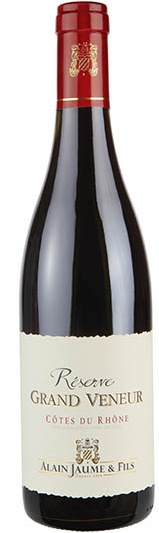
| Country: | France |
| Region: | Rhone |
| Winery: | Alain Jaume |
| Grape Type: | Grenache |
| Vintage: | 2019 |
| Bottle Size: | 375 ml |
SALE
Grand Veneur Cotes du Rhone Rouge Reserve is made from 60% Grenache Noir, 35% Syrah and 5% Cinsault.
The colour is purple-tinged garnet.The aromatic range of the nose goes from fresh berries (wild raspberry, blackcurrant, blackberry) to spices.The palate is big and full-flavoured, with silky-smooth tannins and aromas of the fruit already mentioned. The finish introduces touches of liquorice and pepper. A Côtes du Rhône with great complexity for an every day drinking.
A classic Rhône to drink between 1 and 4 years.
Grand Veneur Cotes du Rhone Rouge Reserve is made from 60% Grenache Noir, 35% Syrah and 5% Cinsault.
The colour is purple-tinged garnet.The aromatic range of the nose goes from fresh berries (wild raspberry, blackcurrant, blackberry) to spices.The palate is big and full-flavoured, with silky-smooth tannins and aromas of the fruit already mentioned. The finish introduces touches of liquorice and pepper. A Côtes du Rhône with great complexity for an every day drinking.
A classic Rhône to drink between 1 and 4 years.
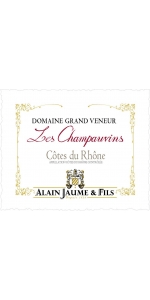
Intense, brilliant garnet-red colour. It reveals lovely fruit, loads of body and a heady bouquet of ground peppers, raspberries cherry liqueur, currants, and spice box. Full-bodied and dense, it tastes more like a "baby Châteauneuf" than a Côtes du Rhône.
A complete wine, rich and elegant, thanks to the harmony of all the elements which make it up.
Drink between 1 and 6 years.
Soil type DOMAINE GRAND VENEUR “Les Champauvins” stretches on 34 ha classified in Côtes du Rhône. The plots are located in the northern border of Châteauneuf du Pape, exactly from 3 meters outside the appellation. A small lane of rocks going through the rocky plateaux has been decided to be the AOC limit in 1936. Here, soils are made of red clay and rocks (pebbled stones of quartz). The quantity of rocks can be amazing as they can completely cover the soil (see picture). In summer and during the day, the rocks temperature will increase to 55°C. This accumulated heat will be get back to the vines during nights . Day after day, this unique phenomenon allow the grapes to reach a perfect maturity and produce a unique wine. Winemaking & Ageing Traditional, in stainless steel vats. Harvest crushed and destemmed. Fermentation in temperature controlled vats at 28°C. Eighteen-day vating period with “pigeage”. Grenache is aged in concrete vats, Syrah and mourvèdre in 4 year old barrels. Intense, brilliant garnet-red colour. It reveals lovely fruit, loads of body and a heady bouquet of ground peppers, raspberries cherry liqueur, currants, and spice box. Full-bodied and dense, it tastes more like a “baby Châteauneuf” than a Côtes du Rhône. A complete wine, rich and elegant, thanks to the harmony of all the elements which make it up.
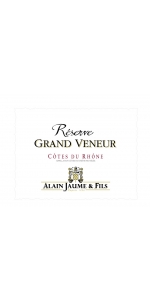
Grand Veneur Cotes Du Rhone Blanc is made from 50% Viognier, 30% Clairette, 20% Roussanne.
Pale yellow colour, brilliant with a gold tinge. Primary aroma of flowers and stone fruit. On the palate, the fruit is immediately present with touches of almond and white peach. A slight liveliness appears in the finish, which creates a perfect balance for the natural generosity of this wine.
To consume young in order to preserve the fruitness typicity. Could age 2-3 years
Direct press, fermentation in temperature controlled stainless-steel vats. Early bottling 6 months after harvest.
Excellent with fish, seafood.
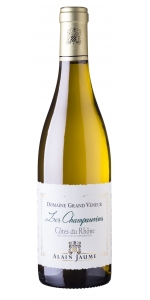
Grand Veneur Cotes Du Rhone Les Champauvins Blanc is made 100% Viognier. Located in the area known as "Les Champauvins", close to Domaine Grand Veneur. The soils are clay-sand and limestone. They enable the white grape varieties to ripen slowly, thus preserving their excellent aromatic finesse.
A great Viognier, conceived and produced with finesse and freshness in mind. Bright, limpid pale yellow color. Intense, delicate nose of floral and white-fleshed fruit aromas. Fresh, mineral and airy on the palate. White peach and pear aromas are the most expressive. The fruity characters are long-lasting, evolving into notes of apricot after a few hours' aeration.

All older vintage wines have been purchased from a single collectors cellar. Pictures can be requested before shipment.
SALE
Grand Veneur Cotes du Rhone Rouge Reserve is made from 60% Grenache Noir, 35% Syrah and 5% Cinsault.
The colour is purple-tinged garnet.The aromatic range of the nose goes from fresh berries (wild raspberry, blackcurrant, blackberry) to spices.The palate is big and full-flavoured, with silky-smooth tannins and aromas of the fruit already mentioned. The finish introduces touches of liquorice and pepper. A Côtes du Rhône with great complexity for an every day drinking.
A classic Rhône to drink between 1 and 4 years.
The Alain Jaume Winery
Established in 1826 in the Northern part of Chateauneuf du Pape, the Alain Jaume Winery boasts both the exceptional terroir of the Southern Rhone Valley and a long line of dedicated winemakers. Alain Jaume works in accordance with certified organic agricultural practices for both the Grand Veneur and Clos de Sixte vineyards. They strive to let the true terrior be expressed in their wines.
The principal winemaker is Alain Jaume. His sons Sebastien and Christophe are both heavily involved with the winery in sales and marketing and winemaking respectively. The Alain Jaume winery consists of 40 acres in Chateauneuf du Pape, 50 acres in Lirac, and 75 acres of Cotes du Rhone vines. The family produces wines under two labels: Domaine Grand Veneur and Alain Jaume.
In 1320 Pope Jean XXII planted the first vines of Chateauneuf-du-Pape, but it was only in 1360 that the wines of the region first gained fame. Oddly, the wine that gave Chateauneuf-du-Pape its original reputation was the White and not the Red. The white wine was a favorite of Pope Innocent VI. The Domaine dates back to 1826, having been founded at that time by Mathieu Jaume. Since 1979, Alain Jaume has run the Domaine and now has the help of his two sons: Sebastien and Christophe.
"Popes throughout history have liked their juice, and when the papal see moved to Avignon in the 13th century, that juice was Chateauneuf-du-Pape ("the pope's new castle") made from grapes grown nearby in the Southern Rhône. The castle is a ruin now, the papal court long gone back to Rome, but the wines that bear the pope's coat of arms emblazoned on the bottle are still produced more or less according to the long-standing recipe. Not every winemaker uses all 13 of the grapes in the proscribed blend, though. At Domaine Grand Veneur, an estate that dates to 1826, Alain Jaume and his sons Sebastien and Christophe emphasize Grenache blended with Syrah and Mourvèdre."
- Los Angeles Times
"Improved Chateauneuf with very accomplished, stylish reds since the late 1990s; also very good Vacqueyras and Cotes-du-Rhône Villages." - Anthony Dias Blue's pocket guide to wine 2006
"Grand Veneur is one of the most brilliant estates in Chateauneuf du Pape as well as the force behind the negociant wines sold under the Alain Jaume label. Virtually everything they produce has merit. Some of this estate’s 2009 red wines are just hitting the market as they are bottled early to preserve their fruit and freshness. I can’t say enough about the job Alain Jaume’s two sons, Sebastian and Christophe, have done with this estate. The impeccable attention to detail in the vineyards, the meticulous vinification, and the careful bottling benefit every consumer." - Wine Advocate (#190, August 2010)
"Great bargains continue to emerge from Domaine Grand Veneur as well as from their negociant arm of the business, labeled Alain Jaume" - Wine Advocate (#195, June 2011)
"One of the best-run and highest quality estates of the Southern Rhone is Domaine Grand Veneur, now run by the younger generation of the Jaume family, Sebastien and Christophe. The brothers have done a fabulous job taking over for their quality-oriented father, Alain. These are their less expensive wines, but I will follow up later this year with my reviews of their 2010 Chateauneuf du Papes as well as the 2011s, which I have not yet tasted. They have certainly gotten a good start on their 2011 less expensive Cotes du Rhone selections. The Jaumes are some of the finest practitioners of white winemaking in the Southern Rhone and showcase that with their least expensive offerings, which are creative blends that over-deliver." - Wine Advocate (Issue #201, June 2012)
Some wines by Alain Jaume Winery:
Any Alain Jaume wines we have in stock are listed below, if you don’t see the wine you are looking for please don’t hesitate to ask for it.
Crown Point Estate Selection is made from 75% Cabernet Sauvignon, 10% Merlot, 6% Petit Verdot, 6% Cabernet Franc, 3% Malbec.
The 2016 Crown Point Estate Selection exhibits a heady aromatic array of baking spices, ripe red and black fruits, with deep intonations of earth and minerals. The palate is elegant and bright, with appealing acids and nuanced notes of savory mocha and dried herbs. Polished and seamless, the tannins finish with a comet-like trail of textural opulence highlighted by glossy flavors of baked berry pie and warm toast. Recommended drinking window: now through 2030s.The 2016 Estate Selection is representative of all five red Bordeaux varieties. The selection process starts in the vineyard and continues on through the winemaking process: only the best lots make the final blend. All blocks were harvested & fermented separately. The individual components were blended after 12 months in barrel. Total time in 225 liter French oak barrels was 26 months.
Review:
Deeply colored, the 2016 Estate Selection checks in as 75% Cabernet Sauvignon, 10% Merlot, 6% Petit Verdot, 6% Cabernet Franc, 3% Malbec that was brought up 26 months in 75% new French oak. Deeply colored, it has a smoking good bouquet of crème de cassis, smoke tobacco, lead pencil, camphor, and hints of chocolate. This gives way to a powerful, opulent Cabernet Sauvignon that has plenty of sweet tannins, a layered, multi-dimensional texture, no hard edges, and an awesome finish. I’d happily put this beauty in a lineup of top Napa Valley Cabernet Sauvignon and blends.
-Wine Enthusiast 97 Points
There’s an impressive amount of complexity on the nose of this bottling by winemaker Adam Henkel, from crushed graphite and concentrated black strawberry to cinnamon pastry, licorice and a brush of herbs. The sip is intense, with leathery but chiseled tannins presenting flavors of charred black currant, licorice, black olive, dried flower and white pepper
-Jeb Dunnuck 97 Points
Enemigo El Enemigo Gran Enemigo is made from Cabernet Franc.
Gran Enemigo Agrelo is intense, balanced, and elegant. Cabernet Franc brings light notes of eucalyptus and thyme, Malbec provides ripe black fruits, and oak provides a touch of chocolate and vanilla. Certified Sustainable by Bodegas de Argentina.
Gran Enemigo Agrelo pairs beautifully with steak, veal, and roasted game birds such as chicken, turkey, and duck.
Reviews:
The 2019 Gran Enemigo Agrelo Single Vineyard shows the completeness of the vintage, a year with good yields and a cooler winter and summer. The result is a very balanced wine with full development of aromas and flavors, moderate ripeness and good freshness and balance. It has a fine texture, some chalky sensations and a dry finish, despite the fact that the soils have no limestone. The vines here are over 40 years of age.
-Robert Parker's Wine Advocate 97 Points
#73 Wine Spectator Top 100 of 2023
The 2019 Cabernet Franc Gran Enemigo Single Vineyard Agrelo also includes 15% Malbec from the clayish soils of Luján de Cuyo. Aged for 15 months in foudres, this purplish wine reveals enticing cigar ash notes alongside blueberry and plum aromas, with a subtle cedar backdrop. Dry, rich and plush on the palate, it quickly tightens due to its fine-grained, reactive, clay-like tannins. This long-lasting red lingers on the ashy notes, beautifully layered and crafted with a modernist touch in a slightly cool vintage.
- Vinous 97 Points



