
" We don't sell the wine without touching the vine "
| Country: | United States |
| Region: | California |
| Winery: | I. Brand and Family |
| Grape Type: | Sauvignon Blanc |
| Organic: | Yes |
| Vintage: | 2023 |
| Bottle Size: | 750 ml |

Ptit Paysan Cabernet Sauvignon is made from 91% Cabernet Sauvignon, 6% Petite Verdot, 3% Cabernet Pfeffer.
Oak: 11 months on lees in neutral barrels
The Cabernet Sauvignon is sourced from a vineyard at the foot of the Santa Cruz Mountains west of Morgan Hill, which grows in a mix of granitic and volcanic soils, and a 25-year-old vineyard east of Gilroy, which grows in deep, extremely sandy soils against the foothills of the Diablo Range. The Petite Verdot is sourced from the Paicines AVA and grows in rocky alluvial deposits above the Tres Piños Arroyo. All three vineyards experience the warm days and cold nights typical of the Central Coast, allowing these late ripening Bordeaux varieties to be picked at high acidity and moderate sugars.
Le P'tit Paysan offers intense blackberry, dark cherry aromas, chocolate, herbaceous and toasty notes on the palate. Medium-bodied, well-balanced with moderate and integrated tannins that give structure and liveliness to the wine.
Pairs well with steak, duck, game, hearty stews, ribs, and dark, rich sauces.

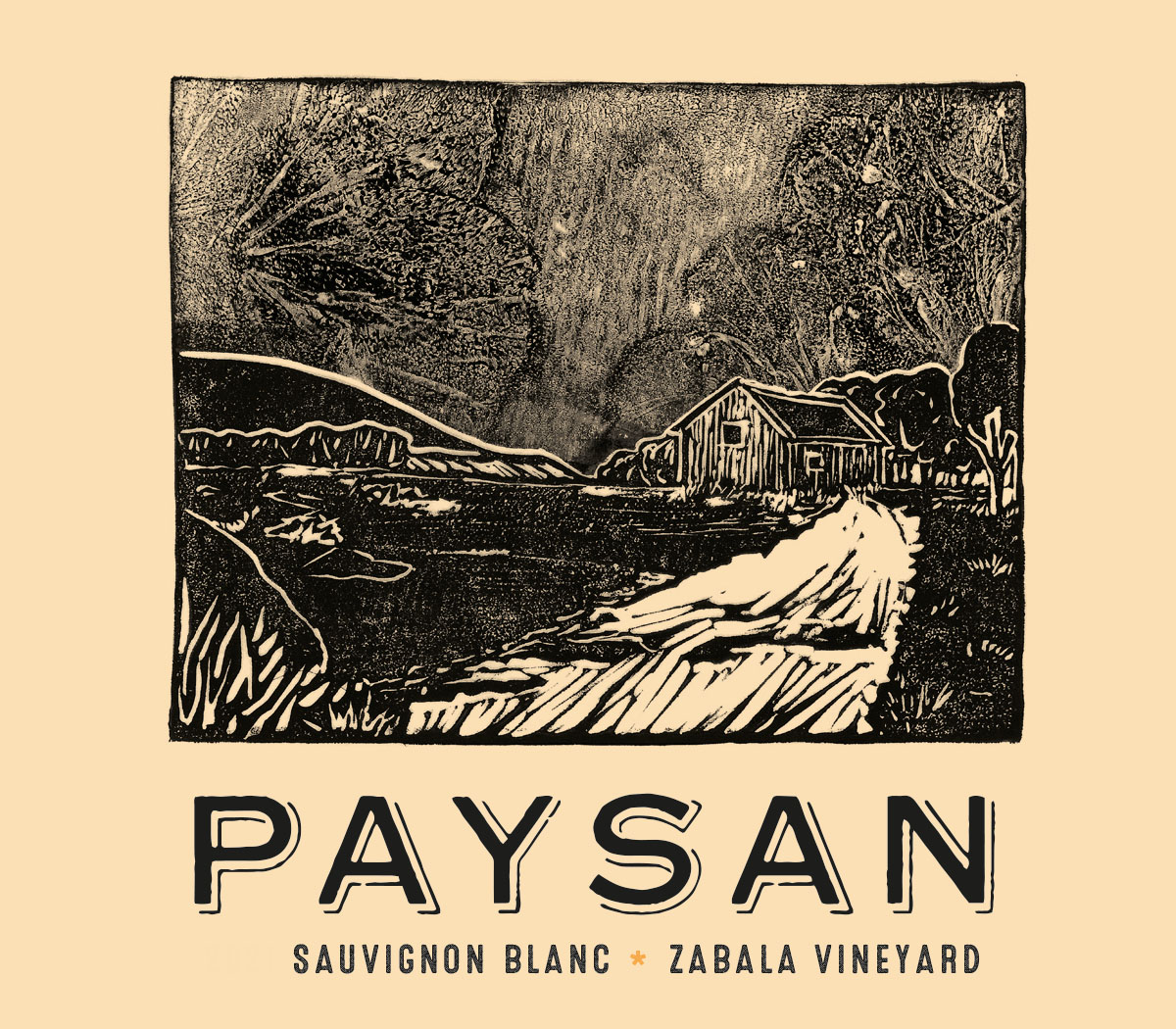
Paysan Sauvignon Blanc Zabala Vineyard is made from 100% Sauvignon Blanc.
Paysan Sauvignon Blanc comes from Zabala Vineyard - located on a large holding on the Arroyo Seco floodplains that was part of land granted to the Zabala family before California’s statehood. It was first planted in the 1970s and has grown to encompass over 1000 acres. Zabala Vineyard is one of the rockiest vineyard I Brand works with, full of what is locally known as ‘Greenfield Potatoes’, which are the rather inedible round river stones that dominate the soil and have been collected into piles and walls at every property in the basin. This vineyard is located directly in the path of the daily Salinas Valley winds, which control sugar development and retain natural acidity. Certified organic grapes.
Tasting Notes: Light-bodied. Aromatic explosion on the nose. Lime, gooseberry, green melon, grapefruit, white peach, passion fruit. Crisp, tart, clean with bright acidity on the palate. Neutral oak ageing provides subtle creaminess, while still exhibiting trademark green notes.

Marea Albarino is made from 100% Albariño
This 100% Albarino is produced from fruits grown in Kristy Vineyard, on the western bench overlooking the Salinas River on broken sediment of ancient sea beds. Kristy is special because Albarino in the vineyard reaches full phenological ripeness at low potential alcohol and natural, bright acidity. Cold fermented in stainless steel for aromatic intensity.
Bright, fresh and crisp with notes of lemon curd and tangerine. On the palate it shows elegant texture and bright acidity on the finish.
Picked under 22 brix, 2/3 whole cluster pressed, 1/3 destemmed and left on skins for two days. Aged on the lees for four months and then sterile filtered.
Pairs with oysters, grilled fish, spicy cuisines.

Le P'tit Paysan Le Ptit Pape is made from 62% Grenache, 19% Syrah, 14% Mourvedre, 3% Counoise, 2% Cinsault
Oak: Mixture of one and twice used barrels for 11 months and puncheons
Playful interpretaion of a domestic, baby, Chateauneuf-du-Pape.
Cherry blossoms, dusty road, red plums, herb de Provence. Rosewater and red cherry on the palate, nimble with medium body. Grippy finish with firm Grenache tannins and hints of olive and sagebrush.
Fermented in several lots ranging from 0-50% whole cluster. Fermeted to dryness on skins.
Aged in neutral barrels for 11 months. From limestone rich soils

I Brand Cabernet Franc Bayly Ranch is made from 100% Cabernet Franc.
This 100% Cabernet Franc is produced from vineyards located in Tres Pinot Creek, (along San Andreas Fault Line), at only 800 foot elevation. A great locale for Cabernet Franc to exhibit Loire-like structure overlaid with the bright fruit befitting California sunshine.
Review:
"This is a sprightly, textural, mineral-driven bottling that's immediately fascinating yet will be a joy to watch evolve. Light in the glass, it begins with aromas of cranberry, nori wrap, herb-dusted strawberry and a hint of dried blood. The palate shows a rusty edge, offering dried strawberry, crumpled oregano and a hint of green peppercorn. Drink now through 2034. - Matt KETTMANN"
- Wine Enthusiast (Septmember 1st 2021), 94 pts

I Brand Melon de Bourgogne Chalone is made from Melon de Bourgogne.
The Graff Family began working in Chalone in the early 60s, with Dick Graff as the driving force behind the Chalone Vineyard, building, with the support of his brothers and a gaggle of stockholders, the original 1919 planting to international fame. After selling the Chalone group and Dick’s untimely death in a plane crash, the family’s land holdings have shrunk progressively to just this 160 acre parcel, owned by Dave Graff and his children. On those 160 acres is a small 3 acre vineyard planted in 1989 to Syrah, Mourvédre and Melon de Bourgogne. The site has depleted, granitic soils. The Melon de Bourgogne in Chalone was originally thought to be Pinot Blanc. Dick Graff distributed cuttings of these vines as far as Oregon. In the 1970s, a visiting ampelographer correctly identified the vines as Melon de Bourgogne. These vines were selected from the older ‘Pinot Blanc’ planting and can legally be labeled as either (but we like accuracy).
The wine comes from a tiny parcel of 30+ year old Melon planted on depleted granitic soils. The warm days and cold nights of the Chalone AVA produce a perfect balance of concentration and acidity, which Ian Brand amplifies with a few days of skin contact. The pure aromas of light peach, pear and gardenia are slightly toasty on the nose. The palate is defined by lemon-skin and grapefruit-pith grip, with a touch of baked apple in the midpalate.
Paysan Sauvignon Blanc Zabala Vineyard is made from 100% Sauvignon Blanc.
Paysan Sauvignon Blanc comes from Zabala Vineyard - located on a large holding on the Arroyo Seco floodplains that was part of land granted to the Zabala family before California’s statehood. It was first planted in the 1970s and has grown to encompass over 1000 acres. Zabala Vineyard is one of the rockiest vineyard I Brand works with, full of what is locally known as ‘Greenfield Potatoes’, which are the rather inedible round river stones that dominate the soil and have been collected into piles and walls at every property in the basin. This vineyard is located directly in the path of the daily Salinas Valley winds, which control sugar development and retain natural acidity. Certified organic grapes.
Tasting Notes: Light-bodied. Aromatic explosion on the nose. Lime, gooseberry, green melon, grapefruit, white peach, passion fruit. Crisp, tart, clean with bright acidity on the palate. Neutral oak ageing provides subtle creaminess, while still exhibiting trademark green notes.
They did not set out to make these wines. They discovered great vineyards at the edge of sensible farming and decided to bring them to light.
The farther they looked, the more they found – remote, challenging vineyards, with hard depleted soils, and intense sunlight tempered only by the coastal breeze. Vineyards capable of producing only the most idiosyncratic wines. Their goal as winemakers is to lightly polish the roughest edges and leave the idiosyncrasy intact. It is here in the back country, filled with individual character, where Le P’tit Paysan comes to life.
Ian Brand's first winery job was in the lab and cellar at Bonny Doon Winery in Santa Cruz. Ian was Vineyard Manager and Assistant Winemaker at Big Basin Vineyards in the Santa Cruz Mountains for four years before he and Heather began their own project.
In the growing sites I Brand Family Winery looks for shallow, rocky soils, good site selection and proper varietal match with the soil and climate. The often overlooked greater Monterey Bay Area has a plethora of underappreciated, rocky vineyards.
Vineyard names:
Fellom Ranch, Bates Ranch, Besson, Summers, Wheeler, Brigantino, Bayly Ranch, Enz, Brosseau, Spur Ranch, Kristy, Quail Run, La Belle Rose, Cedar Lane, Mission Ranch, Escolle, Arroyo Seco Canyon, Los Ositos.
Farming:
Brosseau (cert organic)
Enz (practicing organic, dry farmed)
Besson (dry farmed)
Bates (dry farmed)
Sustainable: Kristy, Bayly, Quail Run, Los Ositos.

All older vintage wines have been purchased from a single collectors cellar. Pictures can be requested before shipment.

Mortet Bourgogne Cote d'Or Rouge is made from 100 percent Pinot Noir.
A parcel of 90 ares, one part is 20 years old and the other part is 55 years old. Its is called Les Pressonniers, in Gevrey-Chambertin.
Bourgogne Rouge Côte d’Or comes from a plot of Gevrey-Chambertin vines, giving delicate fruit and body, as well as the character and complexity of the Gevrey-Chambertin terro



