" We don't sell the wine without touching the vine "
| Country: | South Africa |
| Region: | Western Cape |
| Winery: | Kershaw |
| Grape Type: | Pinot Noir |
| Vintage: | 2018 |
| Bottle Size: | 750 ml |

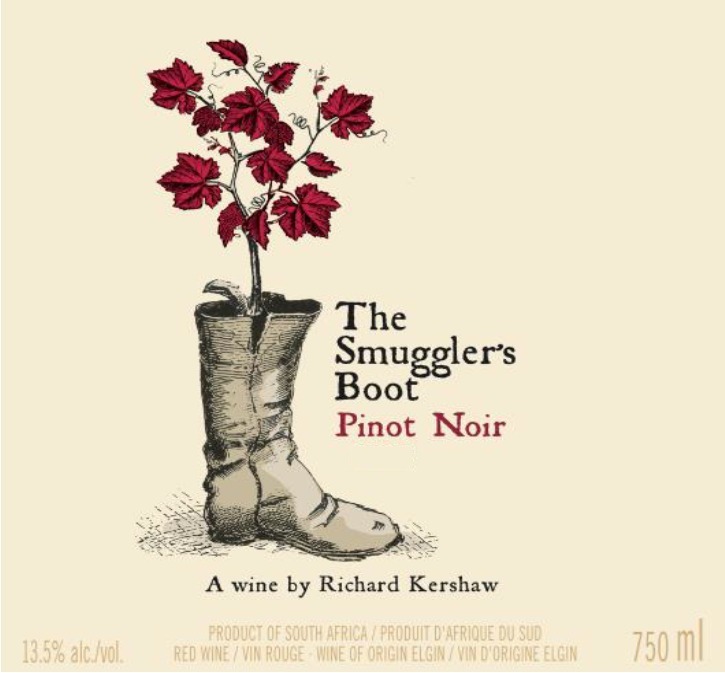
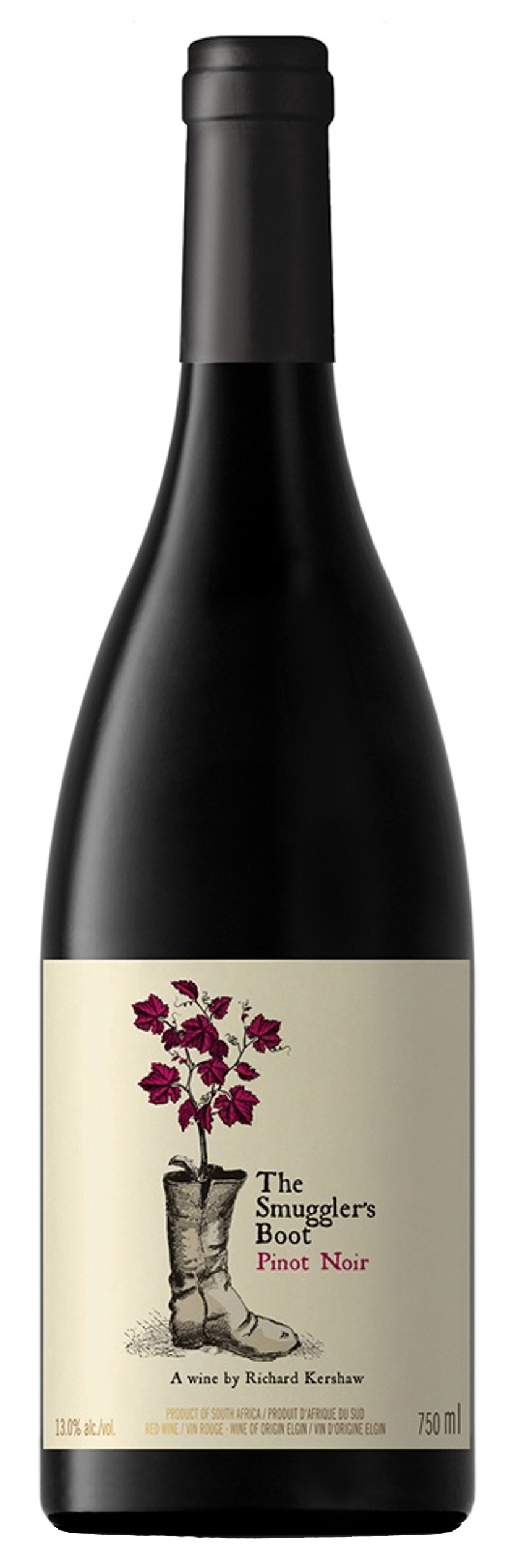
Kershaw Smugglers Boot Pinot Noir is made from 100% Pinot Noir made from French clones PN667, PN115 and PN113.
The name derives from the time of trade embargoes in South Africa when growers & winemakers smuggled grapevine material into the country by hiding the cuttings in Wellington boots. The Smuggler’s Boot range celebrates that ingenuity.
Attractive strawberry, savory and star anise spice linger on the nose. Juicy and sumptuous on the mid palate with breadth of flavor offset by a nimbleness of fresh acidity, friable tannins and sinuous mouthfeel, this Pinot unwraps to earthy, fennel, chocolate and a hint of incense to a long supple finish.
Handpicked grapes were first bunch sorted on a conveyor before the stems were removed and the destemmed berries sorted to remove jacks and substandard berries. After a 3-day maceration in 500kg open-topped fermenters, the uncrushed grapes began a spontaneous fermentation. A gentle pigeage program was charted and the grapes remained on skins for 10-16 days.
The free-run wine was racked to a combination of 50% French oak barrels (10% new) and 50% breathable plastic eggs with the remaining pomace basket-pressed. Malolactic then proceeded followed by a light sulphuring after which the wine was racked off Malolactic lees and returned to cleaned barrels for an 11-month maturation. No finings, simply racked and light filtration prior to bottling.
Richard Kershaw’s personal suggestions for dishes include charcuterie, its salt and fat being complemented by the delicate spicy notes and fruit; Pork loin with honey, pepper, and lemon-zest glaze; Carpaccio; duck cassoulet; ovenroasted monkfish with garlic mashed potatoes; seared tuna; wild mushroom risotto; a simple beet salad with some hazelnuts and ricotta cheese; a slice of Brie or Gorgonzola dolce.
Kershaw Smugglers Boot Pinot Noir is made from 100% Pinot Noir made from French clones PN667, PN115 and PN113.
The name derives from the time of trade embargoes in South Africa when growers & winemakers smuggled grapevine material into the country by hiding the cuttings in Wellington boots. The Smuggler’s Boot range celebrates that ingenuity.
Attractive strawberry, savory and star anise spice linger on the nose. Juicy and sumptuous on the mid palate with breadth of flavor offset by a nimbleness of fresh acidity, friable tannins and sinuous mouthfeel, this Pinot unwraps to earthy, fennel, chocolate and a hint of incense to a long supple finish.
Handpicked grapes were first bunch sorted on a conveyor before the stems were removed and the destemmed berries sorted to remove jacks and substandard berries. After a 3-day maceration in 500kg open-topped fermenters, the uncrushed grapes began a spontaneous fermentation. A gentle pigeage program was charted and the grapes remained on skins for 10-16 days.
The free-run wine was racked to a combination of 50% French oak barrels (10% new) and 50% breathable plastic eggs with the remaining pomace basket-pressed. Malolactic then proceeded followed by a light sulphuring after which the wine was racked off Malolactic lees and returned to cleaned barrels for an 11-month maturation. No finings, simply racked and light filtration prior to bottling.
Richard Kershaw’s personal suggestions for dishes include charcuterie, its salt and fat being complemented by the delicate spicy notes and fruit; Pork loin with honey, pepper, and lemon-zest glaze; Carpaccio; duck cassoulet; ovenroasted monkfish with garlic mashed potatoes; seared tuna; wild mushroom risotto; a simple beet salad with some hazelnuts and ricotta cheese; a slice of Brie or Gorgonzola dolce.

Kershaw Pinot Noir Deconstructed Kogelberg Sandstone PN115 is made from 100 percent Pinot Noir.
Only two barrels made. The inspiration for these Deconstructed Pinot Noir’s stems from my belief that the Elgin region boasts credentials that make it world-class. My mandate has been to prove that Elgin has a signature grape synonymous with the area and exhibits specific ‘terroirs’ (mesoclimates) within its demarcated boundary, reflecting regional distinctions. To fully comprehend this, it is necessary to dig deeper into the DNA that makes up our region. As such, I split Elgin into seven different sub-regions or zones whereby each zone identifies with a particular topographical or climatic nuance. Within these zones, I then selected specific vineyards and further an individual clone. This wine is from the South Western part of Elgin, in the Kogelberg biosphere. The Sandstone soils lend lightness, elegance and lift in the mid-palate, very subtle. PN115 tends to be more broad and structured but on these soils still has a lovely lift.
Tasting Notes : Light to medium cerise; intense and attractive aromas of strawberry, Bing cherry, orange peel and dark chocolate. The perfume lingers into the palate as the entry is medium-bodied, juicy, ripe and silky-textured. A pulsating acidity coated by fleshy red plums, cherry compote and tinned strawberry. Intermingled are wisps of incense, almost peat notes from an earthier wood content giving a beguiling interplay of wood and fruit. Complex with excellent concentration, the wine has a crushed velvet tannin and persistency that lingers on for many minutes.
Pair with roast duck breast with a raspberry glaze.

Argot Pinot Noir Sonoma County is made from 100 percent Pinot Noir.
Everything you have come to expect from an Argot Pinot Noir, shone through the filter of a textbook-perfect vintage. We simply can not get over the quality of fruit this wine displays! Intense, yet fresh; fruity, yet spicy; brambly, yet juicy; immediate, yet lingering. A Pinot Noir that displays the variety’s natural come-hither attitude, while succinctly capturing its intriguing nature. There are not enough superlatives to describe this wine. Almost too easy to love!
VINEYARD Multiple vineyards throughout Sonoma County, including both valley floor and high-elevation hillside sites
PRODUCTION 600 cases
VARIETAL 100% Pinot Noir
CRUSH Night harvested by hand beginning in mid-September, concluding at our coolest sit on October 13. Cluster and berry sorted by hand, de-stemmed, no crushing
FERMENT 7-day cold soaks, followed by native fermentation in open-top containers, with the grapes fermenting on their skins for an average time of 14 days.
AGING 16 months, French oak barrels, 7% new, remainder once-used. Never racked prior to bottling. Bottled un-fined, unfiltered.
NOTES Singularly great. 2018 was an all-time vintage for California’s North Coast, achieving rarely before experienced heights. A mild summer gave way to Autumnal perfection, allowing cooler areas the opportunity to ripen their crop while chemistries remained perfect. What arrives in bottle is nothing short of a pinnacle representation of Sonoma County Pinot Noir — profound depth of pure, red Pinot Noir fruits, caressing textures balanced by deep minerality and a quenching acidity.

Lismore Pinot Noir is made from 100 percent Pinot Noir
Complex bouquet of crushed rose petals, wild jasmine and fresh French herbs followed by a palate full of cranberry, raspberry and a long savory finish.
The grapes were picked at optimal ripeness. 30% whole bunch fermented in large 5000 liter vats with gentle pump-overs twice a day. The process allowed for a long extraction period which lends to the fruit expression and structure of this wine. The free run wine was drained off and the fermented grapes were then pressed in a traditional wooden basket press. The wine was racked into 225, 300 and 500 liter barrels where malolactic fermentation took place and the wine was aged for 10 months. 35% new French oak was used.
Review:
"The 2018 Pinot Noir comes from Walker Bay and Kaaimansgat and includes 30% whole-bunch fruit, aged for 11 months in 25% new oak. The bouquet sports vivid red cherry and raspberry fruit that is exceptionally well defined and beautifully integrated with the oak. The palate is medium-bodied with supple tannins, well-judged acidity and a slightly fleshy texture. There is just the right amount of salinity here, and the finish is kept on a tight leash, allowing the detail and precision to be fully expressed. A slight sour edge on the finish keeps you coming back for another sip. Excellent and reassuringly classy. - Neal Martin" - Antonio Galloni's Vinous (November 2019), 92 pts
"Walker Bay and Elandskloof are the twin sources of 30% whole bunch-fermented Pinot from Sam O'Keefe. Juicy, floral and charming, it's a graceful, fruit forward style with some clove and tobacco spice and refreshing acidity. The finish is a little firmer than I remember. 2020-24"- Tim Atkin (South Africa 2020 Special Report), 92 pts

Bydand Pinot Noir Umino Vineyard is made from 100 percent Pinot Noir.
This small, sustainably farmed vineyard perches on a south-facing ridge in the Sebastopol Hills area of the esteemed Russian River Valley AVA, and has produced exceptional Pinot Noir for Bydand since their first vintage. Third-generation farmer David Umino rejected early assessments that the site was too cool for viticulture, and planted Pinot Noir there in 1996. The cold maritime winds in fact help to modulate ripening, and protect the grape’s natural purity and balance - resulting in fruit-driven wines with expressive red fruit and dark berry flavors, balanced with crushed rock and mouth-watering freshness. Velvety tannins coat the palate, providing an alluring and persistent finish.
This site combines the best of the earthy west Sonoma Coast and well-fruited Russian River.
Kershaw Smugglers Boot Pinot Noir is made from 100% Pinot Noir made from French clones PN667, PN115 and PN113.
The name derives from the time of trade embargoes in South Africa when growers & winemakers smuggled grapevine material into the country by hiding the cuttings in Wellington boots. The Smuggler’s Boot range celebrates that ingenuity.
Attractive strawberry, savory and star anise spice linger on the nose. Juicy and sumptuous on the mid palate with breadth of flavor offset by a nimbleness of fresh acidity, friable tannins and sinuous mouthfeel, this Pinot unwraps to earthy, fennel, chocolate and a hint of incense to a long supple finish.
Handpicked grapes were first bunch sorted on a conveyor before the stems were removed and the destemmed berries sorted to remove jacks and substandard berries. After a 3-day maceration in 500kg open-topped fermenters, the uncrushed grapes began a spontaneous fermentation. A gentle pigeage program was charted and the grapes remained on skins for 10-16 days.
The free-run wine was racked to a combination of 50% French oak barrels (10% new) and 50% breathable plastic eggs with the remaining pomace basket-pressed. Malolactic then proceeded followed by a light sulphuring after which the wine was racked off Malolactic lees and returned to cleaned barrels for an 11-month maturation. No finings, simply racked and light filtration prior to bottling.
Richard Kershaw’s personal suggestions for dishes include charcuterie, its salt and fat being complemented by the delicate spicy notes and fruit; Pork loin with honey, pepper, and lemon-zest glaze; Carpaccio; duck cassoulet; ovenroasted monkfish with garlic mashed potatoes; seared tuna; wild mushroom risotto; a simple beet salad with some hazelnuts and ricotta cheese; a slice of Brie or Gorgonzola dolce.
Surrounded by mountains, the Elgin district sits in the Western Cape of South Africa. The year-round cool climate is perfect for producing grapes with rich, subtle flavors.
Focusing on apposite noble grapes, i.e. ones with the ability to produce world-class examples, our Kershaw Elgin Chardonnay, Syrah and Pinot Noir and Kershaw Deconstructed Chardonnay and Syrah are made by South Africa’s only winemaking Master of Wine, Richard Kershaw.
Richard Kershaw Wines was established in January 2012 to create clonally selected, site-specific, cool climate wines in the Elgin Valley, South Africa’s coolest wine region. Focusing on apposite noble grapes, i.e. ones with the ability to produce world-class examples, our Kershaw Elgin Chardonnay, Syrah and Pinot Noir and Kershaw Deconstructed Chardonnay and Syrah are made by South Africa’s only winemaking Master of Wine, Richard Kershaw.
Winery Philosophy: Our commitment is to make the best wines possible from the vine clones best suited to our unique terroir. Our grapes are grown in the cool climate vineyards of Elgin in the Western Cape of South Africa. We produce only a very limited number of cases of Kershaw Elgin Chardonnay and Kershaw Elgin Syrah each vintage. Our aim always is to produce some of the best wines of their style in South Africa.
Owner: Richard Kershaw MW
Date Founded: January 2012
Born and raised in the UK, Richard travelled extensively before settling in South Africa in 1999 to make wine full time. He established Richard Kershaw Wines in January 2012 to create clonally selected, site-specific, cool climate wines in the Elgin Valley, the country’s coolest wine region, choosing to focus on apposite noble grapes (ones with the ability to produce world-class examples) and now has a stable of award-winning, much in demand wines including Kershaw Elgin Chardonnay, Syrah and Pinot Noir and Kershaw Deconstructed Chardonnay and Syrah.
One of only 10 Masters of Wine who actively make their own wines and South Africa’s only winemaking Master of Wine, Richard is much in demand when not in the vineyard or cellar. A wine show judge for many prestigious competitions around the globe, he is also part of the educational panel for the Institute of Masters of Wine, lectures for the WSET (Wine & Spirit Education Trust) in South Africa, and shares the breadth of his knowledge with students and consumers via talks, tastings and blogs.
Our grapes are grown in the cool climate vineyards of Elgin in the Western Cape of South Africa. We produce a limited number of cases of Kershaw Elgin Chardonnay, Syrah and Pinot Noir each vintage under our Clonal Selection range, and site- soil- and clone- specific Elgin Chardonnay and Syrah in our Deconstructed range. We have recently introduced our GPS Series range which explores unusual sites from outside the Elgin region, and our Smuggler's Boot range in which Richard uses a variety of winemaking techniques to produce easy drinking wines. Our aim always is to produce some of the best wines of their style in South Africa.
The Elgin Valley benefits from higher altitude, ocean proximity, specific cloud cover sequencing, high cold units and a large diurnal range, similar to Southern Burgundy and the Northern Rhône, which enables the germane grapes, Chardonnay and Syrah, to show a sense of place.
Kershaw Elgin Chardonnay makes use of the lower-yielding Dijon clones, namely 76, 95 & 96 (developed at the University of Burgundy in Dijon, France), offering a restrained, mineral style focused on elegance with a white, fruit character, some oatmeal, and complexity gained from percipient wood.
Kershaw Elgin Syrah makes use of local clones 9c and 22 giving subtlety and precision built on fine tannins that educe harmony, freshness and flavours of black fruit, iodine, medicinal notes and black pepper.
Kershaw Elgin Pinot Noir makes use of French clones PN667, PN115 and PN113 giving floral attributes underscored by purity, focus and freshness framed by fine powder tannins yet cushioned by a succulent texture and flavours of black cherry, pomegranate, rose petal and raspberry.
Each Clonal Selection wine is made from 3-4 small parcels on terroir-specific plots with particular soils types. Each Deconstructed wine is made from clone specific, soil specific site in Elgin. They are all handpicked into small lugs and vinified in Elgin travelling no more than 10-15 minutes between vineyard and cellar, avoiding unnecessary crushing and premature juice oxidation. In the cellar, they are handled minimally using a gravity-fed system that avoids pumping and no products are added to the wine.
Winemaker: Richard Kershaw MW
Lismore Pinot Noir is made from 100 percent Pinot Noir
Complex bouquet of crushed rose petals, wild jasmine and fresh French herbs followed by a palate full of cranberry, raspberry and a long savory finish.
The grapes were picked at optimal ripeness. 30% whole bunch fermented in large 5000 liter vats with gentle pump-overs twice a day. The process allowed for a long extraction period which lends to the fruit expression and structure of this wine. The free run wine was drained off and the fermented grapes were then pressed in a traditional wooden basket press. The wine was racked into 225, 300 and 500 liter barrels where malolactic fermentation took place and the wine was aged for 10 months. 35% new French oak was used.
Review:
"The 2018 Pinot Noir comes from Walker Bay and Kaaimansgat and includes 30% whole-bunch fruit, aged for 11 months in 25% new oak. The bouquet sports vivid red cherry and raspberry fruit that is exceptionally well defined and beautifully integrated with the oak. The palate is medium-bodied with supple tannins, well-judged acidity and a slightly fleshy texture. There is just the right amount of salinity here, and the finish is kept on a tight leash, allowing the detail and precision to be fully expressed. A slight sour edge on the finish keeps you coming back for another sip. Excellent and reassuringly classy. - Neal Martin" - Antonio Galloni's Vinous (November 2019), 92 pts
"Walker Bay and Elandskloof are the twin sources of 30% whole bunch-fermented Pinot from Sam O'Keefe. Juicy, floral and charming, it's a graceful, fruit forward style with some clove and tobacco spice and refreshing acidity. The finish is a little firmer than I remember. 2020-24"- Tim Atkin (South Africa 2020 Special Report), 92 pts

Viejo Isaias Juana Cabernet Franc is made from 100 percent Cabernet Franc.
Cabernet Franc has an intense bright velvety red color. In the nose this wine reveals a complex expression marked by fresh berries followed by hints of floral aromas. It also displays some smoke and vanilla from the oak barrels. It is rich and balanced in the mouth with an elegant tannic structure and long fresh fruit end.
Vineyard information:
Location: Perdriel, Luján de Cuyo, on the highest area of the Mendoza river - Mendoza.
Altitude: 950m above sea level.
Soil: Stony, from Alluvial origins
Coming from our estate vineyards in Perdriel and Lujan de Cuyo.
Aged in 50% French and 50% American Oak barrels for 12 months. First and second use only.
Wine was slightly filtered before bottling.
Excellent when paired with red meats, pasta with spicy sauces, matured cheeses.
Review:
"Hints of plums and dark berries with some dried flowers, following through to a medium body with round tannins and a juicy finish. Bigger in nature. Drink or hold."
- James Suckling (March 2022), 92 pts

A deep powerful Gran Reserva from one of Rioja Alavesa’s most enduring family run wineries. The hillside terraced vineyards are sheltered by the Sierra Cantabria Mountains to the north from harsh weather extremes. Small plot production is utilized in this region of infertile chalky clay soil to produce clusters of excellent quality. Almost 900 plots are needed to complete the approximately 400 hectares of estate-owned or cellar-controlled vineyards, some with vines more than 100 years in age.
Tasting notes
Ruby red color with earthy tones. The wine shows finesse, elegance and complexity with good concentration of black fruit, thyme and rosemary with secondary aromas of leather and tobacco leaves. In the palate it is polished and rounded, making it pleasant and easy to drink. Fleshy with both elegance and power. It has touches of black fruit jam and liquorice. A long, delicious and persistent finish.
Suitable for pairing with a long, copious meal where it can accommodate braised vegetables, cold cuts, peppers stuffed with hake and shrimp, mushroom omelettes, cod Rioja style, both red and white meat... and so on.