
" We don't sell the wine without touching the vine "
| Country: | France |
| Region: | Bordeaux |
| Winery: | Chateau des Landes |
| Grape Type: | Cabernet Franc |
| Organic: | Yes |
| Vintage: | 2018 |
| Bottle Size: | 750 ml |

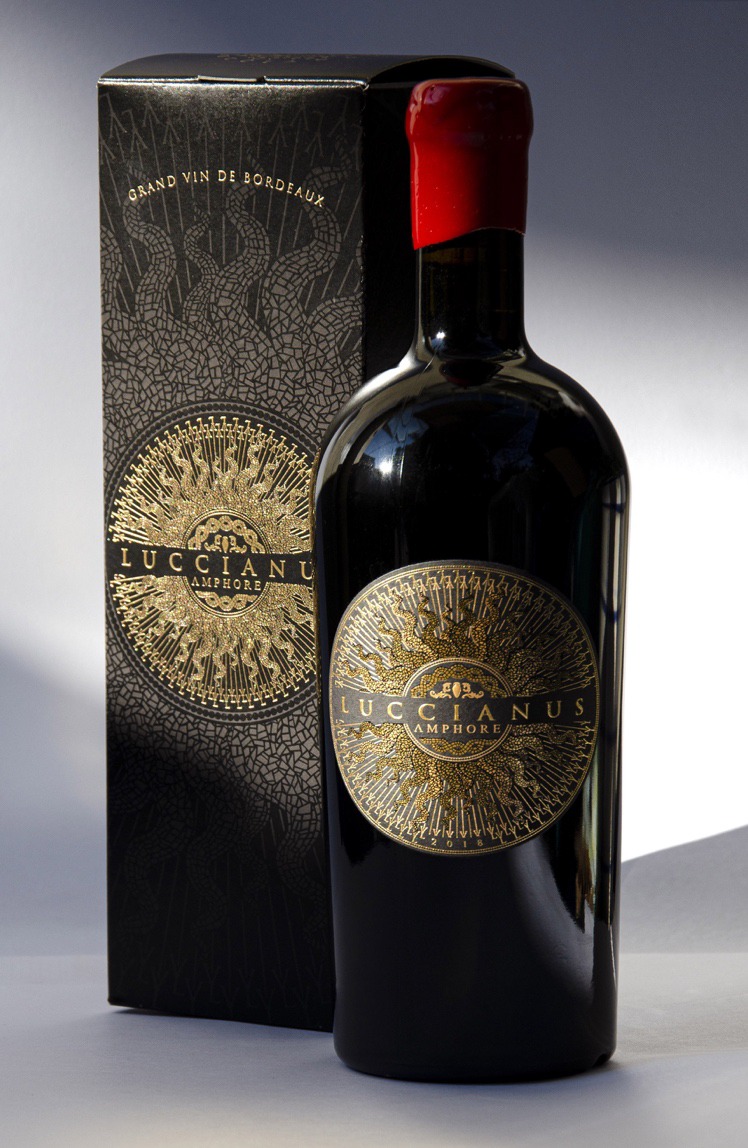
Luccianus Amphore Lussac St. Emilion is made from 100% Cabernet Franc.
Luccianus is the name of Gallo-Roman origin designating the town of Lussac and its vineyard dating from the 4th century. This 100% Cabernet Franc is produced from the estate oldest vines of 100 years of age and is a return to ancestral aging techniques. The amphora aging gives out a very expressive wine with a superb aromatic radiance and very silky tannins all without a woody note.
The wine shows a beautiful deep purple color. The nose is complex and rich with intense notes of fruits and spices. The palate is round and powerful with silky tannins.
Review:
-James Suckling 93 Points
-Jane Anson - Inside Bordeaux 92 Points

Landes Cuvee Prestige Lussac Saint Emilion is made from 80% Merlot, 15% Cabernet Sauvignon and 5% Cabernet Franc
Color: deep dark ruby intense color
Aroma: racy and aromatic nose with aromas of ripe red fruit, floral notes, wood and spice with a touch of vanilla.
Taste: this wine has a good structure and some powerful aromas of raspberries, blackcurrant, vanilla and it is powerful with a complex finish. The oak is present but not dominant. The tannins are quite well integrated already.
Average age of the Vines: 60 years Yield : 50 hectoliters / hectare. Grape picking: harvest by machine. Vats: Stainless steel thermoregulated and computerized. Fermentation: 45 to 50 days with a final 35°C warm steeping. Winemaking: Malolactic fermentation in new oak barrel. Ageing: 16 months in new French Oak barrels from Allier and Limousin. Annual production: 10,000 bottles. (833 cases)
Review:
-James Suckling 92 Points

Landes Cuvee Tradition Lussac Saint Emilion is made from 80% Merlot, 15% Cabernet Sauvignon and 5% Cabernet Franc
Color: deep ruby intense color.
Aroma: racy and aromatic nose with aromas of ripe red fruit.
Taste: this wine is silky, round and smooth first taste, with aromas of raspberries, and blackcurrant, powerful and complex finish.

From the volcanic soils in the blocks residing at the summit of Stony Hill's vineyard, their 2019 Cabernet Sauvignon is showing beautifully. 2019 was a warm year with late spring rains and a true, dry fall finish. e late spring rains imbued wines with a characteristic freshness and tension, balanced by a generous fruit profile. Bing cherry, cassis, pomegranate seed, singed bay leaf, and cacao sings from the glass. The palate receives a structure showing breadth and presence with lacey tannins and a delicate, persistent finish.
Review:
-Decanter World Wine Awards 94 Points
Landes Cuvee Tradition Lussac Saint Emilion is made from 80% Merlot, 15% Cabernet Sauvignon and 5% Cabernet Franc
Color: deep ruby intense color.
Aroma: racy and aromatic nose with aromas of ripe red fruit.
Taste: this wine is silky, round and smooth first taste, with aromas of raspberries, and blackcurrant, powerful and complex finish.
Luccianus Amphore Lussac St. Emilion is made from 100% Cabernet Franc.
Luccianus is the name of Gallo-Roman origin designating the town of Lussac and its vineyard dating from the 4th century. This 100% Cabernet Franc is produced from the estate oldest vines of 100 years of age and is a return to ancestral aging techniques. The amphora aging gives out a very expressive wine with a superb aromatic radiance and very silky tannins all without a woody note.
The wine shows a beautiful deep purple color. The nose is complex and rich with intense notes of fruits and spices. The palate is round and powerful with silky tannins.
Reviews:
"Centenarian vine Cabernet Franc aged for a year in an amphora has yielded a well-structured wine. Dense tannins are no impediment to the wine's black fruits and spicy, open character. Rich and concentrated, the wine will age and be best from 2024. - ROGER VOSS"
- Wine Enthusiast (May 2021), 93 pts
"Plums, berries and orange peel on the nose. It’s full-bodied and round-tannined with a lovely, juicy texture and a flavorful finish. Delicious and attractive. Made in amphora. Can age, but will intrigue now. Drink or hold."
- James Suckling (February 2021), 93 pts
Chateau des Lande Estate
Château des Landes was created in 1952 by Paul Lassagne, Nicolas' grandfather. He started with only 2 hectares and grew to 7 hectares in 1979.
His son, Daniel, came along and bought more vineyards surrounding the cellar and he managed to grow to 27 hectares in almost 20 years.
In 2001, Nicolas, came aboard and decided to continue on the family tradition bringing his expertise and his knowledge.
Nicolas is now in charge of the Estate and he manage 27.2 hecatres of vineyards (68 hectares).
27.2 hectares (68 acres) of vineyard with a density of 5,500 vineplants per hecatres ( 2,217 vineplants per acre).
The average age of the vine is 30 years.
The soil is mostly a mix of Clay and limestone, while the subsoil is white clay.

Every now and then, in life and in wine, we are presented with unique opportunities to express ourselves and create something truly remarkable.
When rare opportunities arise, we need to capture, nurture and develop them so that their potential is fulfilled. So when Torbreck was given the opportunity to work with one of the most famous vineyards in the Barossa Valley, it became almost inevitable that the resulting wine would be truly remarkable.
In 2003, Torbreck growers and fourth generation descendants of the Seppelt family, Malcolm and Joylene Seppelt, asked our winemakers to create for them a small batch of Shiraz from their old Gnadenfrei vineyard in the sub-region of Marananga.
Planted in 1958, the five acre vineyard is traditionally dry grown and comes from an original Barossa clonal source. South facing, on the eastern side of a ridge separating the Seppeltsfield and Marananga appellations, these aged vines have been meticulously hand tended, traditionally farmed and pruned by a grower with a lifetime’s experience on Western Barossa soils of very dark, heavy clay loam over red friable clay. The resulting low yields of small, concentrated Shiraz berries make the vineyard the envy of all winemakers in the Barossa.
We looked longingly at the wine when it was returned to the Seppelts, knowing that it was the best we had ever made. In 2005 we convinced the Seppelts to sell Torbreck the fruit and The Laird was born. In 2013 Torbreck purchased the Gnadenfrei vineyard, securing The Laird’s reputation as one of the world’s great single vineyard Shiraz wines.
Torbreck is the name of a forest near Inverness, Scotland and you’ll find more than a passing nod to the Celts in our wine naming conventions. The Laird of the Estate in Scotland is the Lord of the Manor and master of all he surveys.
Review:
I poured the 2017 The Laird, set it aside and got about doing other jobs for 45 minutes or so, to give it some room to breathe. And it does breathe. It has its own pulse and beat and life, and it flexes and moves in the mouth. This is incredibly enveloping, with aromas reminiscent of campfire coals, charred eucalyptus, lamb fat, roasted beetroot, black tea and a prowling sort of countenance. In the mouth, the wine is bonded and cohesive and seamless, there are no gaps between anything, no space between fruit, oak and tannin; it all comes as one. While this is a singular wine, it is so big and concentrated that it needs no accompaniment other than some fresh air and a good mate. It's denser than osmium and is impenetrable at this stage.

Pearmund Cellars Petit Verdot 2022 is made from Petit Verdot.
Blackberry aromas with rich plum flavors, well-rounded tannins and a smooth finish. Earthy, rustic and warm. Limited production.



