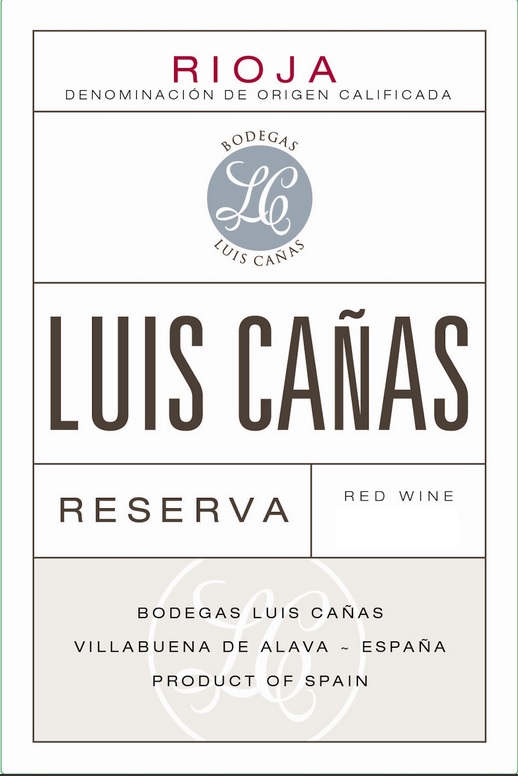
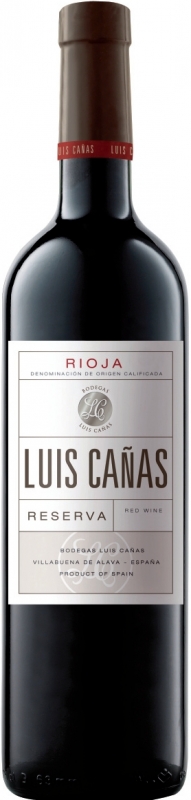
" We don't sell the wine without touching the vine "
| Country: | Spain |
| Region: | Rioja |
| Winery: | Luis Canas |
| Grape Types: | Tempranillo Graciano |
| Vintage: | 2010 |
| Bottle Size: | 750 ml |

Luis Canas Rioja Gran Reserva is made from 95% Tempranillo and 5% Graciano.
A deep, powerful Gran Reserva from one of Rioja Alavesa's most enduring family-run wineries. The hillside terraced vineyards are sheltered from weather extremes by the Sierra Cantabria Mountains to the north, and small-plot farming on infertile chalky-clay soils yields clusters of excellent quality, some vines more than 100 years old.
Ruby red with earthy tones. Fine, elegant and complex, with good concentration of black fruit, thyme and rosemary and secondary aromas of leather and tobacco leaf. On the palate it is polished and rounded, fleshy yet elegant, with touches of black-fruit jam and liquorice and a long, persistent finish.
Made for a long, generous meal — braised vegetables, cold cuts, stuffed peppers, mushroom omelettes, cod Rioja-style, and both red and white meats.
Review:
-Joaquín Hidalgo (Vinous) 93 Points

Luis Canas Rioja Reserva is made from 100 percent 95% Tempranillo and 5% Graciano
A classic style Rioja Reserva from one of the regions most enduring family run wineries. The hillside terraced vineyards are sheltered by the Sierra Cantabria Mountains to the north from harsh weather extremes. Small plot production is utilized in this region of infertile chalky clay soil to produce clusters of excellent quality. Almost 900 plots are needed to complete the approximately 400 hectares of estate-owned or cellar-controlled vineyards, some with vines more than 100 years in age.
Tasting notes
Rich color. Very pleasant on the nose, subtle and elegant, complex, with aromas of fine wood, ripe fruit, coffee. Thick, unctuous and round on the palate with solid structure and juicy tannins. The second nose shows spiced nuances and black ripe fruit aromas.
Winemaking and aging
Upon entering the bodega, bunches undergo a manual selection and then individual grapes are sorted based on their weight. Following this double selection process, they are de-stemmed and crushed before undergoing fermentation and then aceration in stainless steel tanks for a total of 8 days, obtaining better color extraction as well as much more complex and tannic wines, suitable for prolonged aging.
After its primary fermentation, the wine is placed in barrels where it undergoes malolactic fermentation and is aged for 18 months in French (70%) and American (30%) oak barrels, then aged minimum 18 months in bottle before release.
Total acidity: 5 g./l. Volatile acidity: 0,6 g./l. PH: 3,59 Free SO2: 25 mg./l. Residual sugar: 1,9 g./l.
Excellent with red or white meats, all types of game, roasts, oily fish, rice with meat and cheese. Within Rioja cuisine it is perfection accompanying peppers stuffed with cod, artichokes with ham, migas pastoriles and trotters
Review:
Elegant and driven, pairing muscularity with drive and nuance. Fresh pink citrus, pomegranate and cranberry dominate the palate, with energy and detail. The tannins are at once savoury and zesty and the wine lingers forever with detailed notes of oregano, thyme, tarragon and curry leaf.
-Decanter 95 Points
Luis Canas Rioja Reserva is made from 100 percent 95% Tempranillo and 5% Graciano
A classic style Rioja Reserva from one of the regions most enduring family run wineries. The hillside terraced vineyards are sheltered by the Sierra Cantabria Mountains to the north from harsh weather extremes. Small plot production is utilized in this region of infertile chalky clay soil to produce clusters of excellent quality. Almost 900 plots are needed to complete the approximately 400 hectares of estate-owned or cellar-controlled vineyards, some with vines more than 100 years in age.
Tasting notes
Rich color. Very pleasant on the nose, subtle and elegant, complex, with aromas of fine wood, ripe fruit, coffee. Thick, unctuous and round on the palate with solid structure and juicy tannins. The second nose shows spiced nuances and black ripe fruit aromas.
Winemaking and aging
Upon entering the bodega, bunches undergo a manual selection and then individual grapes are sorted based on their weight. Following this double selection process, they are de-stemmed and crushed before undergoing fermentation and then aceration in stainless steel tanks for a total of 8 days, obtaining better color extraction as well as much more complex and tannic wines, suitable for prolonged aging.
After its primary fermentation, the wine is placed in barrels where it undergoes malolactic fermentation and is aged for 18 months in French (70%) and American (30%) oak barrels, then aged minimum 18 months in bottle before release.
Total acidity: 5 g./l. Volatile acidity: 0,6 g./l. PH: 3,59 Free SO2: 25 mg./l. Residual sugar: 1,9 g./l.
Excellent with red or white meats, all types of game, roasts, oily fish, rice with meat and cheese. Within Rioja cuisine it is perfection accompanying peppers stuffed with cod, artichokes with ham, migas pastoriles and trotters
Review:
-Jeb Dunnuck 92 Points
-Tim Atkin 91 Points
-James Suckling 91 Points

Luis Canas Rioja Crianza is made from 95% Tempranillo and 5% Garnacha
A classic style Rioja from one of the regions most enduring family run wineries.. The hillside terraced vineyards are sheltered by the Sierra Cantabria Mountains to the north from harsh weather extremes. Small plot production is utilized in this region of infertile chalky clay soil to produce clusters of excellent quality. Almost 900 plots are needed to complete the approximately 400 hectares of estate-owned or cellar-controlled vineyards, some with vines more than 100 years in age.
Tasting notes
Made from 95% Tempranillo, 5% Garnacha of 30 years of age, the wine shows a ruby red color, a clean nose with nuances of balsamic, plum and cedar. The palate is smooth and velvety, complex and structured, with fruit, spice flavors with toasted oak. A pleasant finish with red fruits and hints of eucalyptus.
The harvest
This year in Rioja Alavesa the weather has been especially cold, the summer short and dry, and there has been plenty of rain in early September. This has produced wines with great aromatic notes, particularly those coming from high altitude areas, very fragrant and with great structure.
Winemaking and aging
Upon entering the bodega and passing the selection table, the grapes are de-stemmed and crushed before undergoing fermentation and then maceration in stainless steel tanks for a total of 8 days, obtaining better color extraction as well as much more complex wines, suitable for prolonged aging. The wine is clarified with vegetable gelatines and follows anicrobic filtration.
It is ideal to pair with meats; red meat, poultry, small game, oily fish, semi-cured cheeses, spicy dishes and hot dishes such as beans or potatoes Rioja style.
After its primary fermentation, the wine is placed in barrels where it undergoes malolactic fermentation and is aged for a minimum of 12 months. It is then bottled for at least another 12 months.
Review:
"Juicy Bing cherries, peppery herbs, leather, and cedarwood notes all emerge from the 2021 Rioja Crianza, a medium-bodied, concentrated, round, layered red that has supple tannins, beautiful fruit, and a great finish. This classic Rioja has tons to love."
- Jeb Dunnuck (Importer Highlight: Fran Kysela ; July 2024), 91 pts
-Decanter 93 Points
Luis Canas Rioja Crianza is made from 95% Tempranillo and 5% Garnacha
A classic style Rioja from one of the regions most enduring family run wineries.. The hillside terraced vineyards are sheltered by the Sierra Cantabria Mountains to the north from harsh weather extremes. Small plot production is utilized in this region of infertile chalky clay soil to produce clusters of excellent quality. Almost 900 plots are needed to complete the approximately 400 hectares of estate-owned or cellar-controlled vineyards, some with vines more than 100 years in age.
Tasting notes
Made from 95% Tempranillo, 5% Garnacha of 30 years of age, the wine shows a ruby red color, a clean nose with nuances of balsamic, plum and cedar. The palate is smooth and velvety, complex and structured, with fruit, spice flavors with toasted oak. A pleasant finish with red fruits and hints of eucalyptus.
The harvest
This year in Rioja Alavesa the weather has been especially cold, the summer short and dry, and there has been plenty of rain in early September. This has produced wines with great aromatic notes, particularly those coming from high altitude areas, very fragrant and with great structure.
Winemaking and aging
Upon entering the bodega and passing the selection table, the grapes are de-stemmed and crushed before undergoing fermentation and then maceration in stainless steel tanks for a total of 8 days, obtaining better color extraction as well as much more complex wines, suitable for prolonged aging. The wine is clarified with vegetable gelatines and follows anicrobic filtration.
It is ideal to pair with meats; red meat, poultry, small game, oily fish, semi-cured cheeses, spicy dishes and hot dishes such as beans or potatoes Rioja style.
After its primary fermentation, the wine is placed in barrels where it undergoes malolactic fermentation and is aged for a minimum of 12 months. It is then bottled for at least another 12 months.
Review:
-Jeb Dunnuck 91 Points
-Joaquín Hidalgo (Vinous) 90 Points

Luis Canas Rioja Blanco Vina Viejas is made from 90% Viura and 10% Malvasia from 60+ year-old vines, barrel-fermented for three and a half months in new French oak.
Grapes are harvested into small crates and sorted by hand, bunch by bunch. Beautiful golden yellow with bright, luminous highlights; the nose is fine and elegant, weaving floral and fruity tones. The palate is dry, with crisp acidity that lends freshness and vivacity and a structured, tasty finish of ripe fruit. Best served at 8°C.
Pairs with shellfish, crustaceans and grilled white fish or fish stews, and also with rice dishes, soft and blue cheeses, all kinds of mushrooms, and fresh fruit.
Review:
-James Suckling 93 Points
A deep powerful Gran Reserva from one of Rioja Alavesa’s most enduring family run wineries. The hillside terraced vineyards are sheltered by the Sierra Cantabria Mountains to the north from harsh weather extremes. Small plot production is utilized in this region of infertile chalky clay soil to produce clusters of excellent quality. Almost 900 plots are needed to complete the approximately 400 hectares of estate-owned or cellar-controlled vineyards, some with vines more than 100 years in age.
Tasting notes
Rich ruby red color. Intense and concentrated on the nose with warm, fresh notes of chocolate and cocoa. The barrel is present with notes of toasted wood, peat and smoke with spicy and black fruit touches. It is potent on the palate and shows nerve and good structure, an expression of wines from great vintages.
"On the contrary, the 2010 Gran Reserva feels quite integrated and polished, with classical aromas of forest floor, mushrooms, tobacco and red and black berry fruit, all of it in a subtle and harmonious way. The palate feels quite compact, balanced and polished, with fine tannins and very tasty flavors. This is a great Gran Reserva. 20,000 bottles produced."
- Robert Parker's Wine Advocate (Issue #226, August 2016), 92 pts
"Dark plum cake and earthy aromas. A full body, moderately dry tannins and quite fresh acidity make this a Rioja classic. Drink now."
- James Suckling (Span Tasting Report 2017), 92 pts
The Luis Canas & Amaren Estate
Bodega Luis Cañas is a family winery which for more than two centuries has devoted itself to viticulture and winemaking. However, it was not until 1970 when Luis Cañas first hit the market selling its young bottled wine which until then it had sold only in bulk. From this date onwards, it begins to experience a rise in sales and what is today one of the leading wineries in the Rioja Alavesa begins to take shape.
1989 marks a new milestone in the winery’s transformation when Juan Luis Cañas, the only son of Mr Luis Cañas takes charge of the same. Aged 33 , he brings fresh ideas to the table and begins to develop new wines at the same time as he promotes increasingly aged wines, beginning to lay the foundations of what would later become the new winery.
The Region
-The Climate: Fundamentally Atlantic, which thanks to the protection that the Sierra Cantabria provides from the coldest northern winds as well as Continental and Mediterranean influence.
The average annual temperature oscillates between 12.6º and the 13.2º. There are large fluctuations in the temperature between the morning and the night at harvest time, which is very positive for the quality of the grapes.
Average rainfall is around 400 mm. and 600 mm
- The Soil: The soil is poor and of a clay loam or chalky clay type, ideal for obtaining grapes of an extraordinary quality.
- Altitude: Our vineyards are located between 450 and 600 meters in altitude.
- Grape Varietals:
TEMPRANILLO: The most important indigenous red variety in the D.O. RIOJA. And one of the biggest varieties in the world. It produces wines for length ageing, very balanced in their alcoholic degrees, color and acidity.
GRACIANO: An indigenous red variety with a great future in Rioja and so its surface area is increasing. It produces wines with considerable acidity and polyphonelic content, ideal for growing, whose aroma is superior in intensity to the rest of the Rioja verities. A perfect complement to the Tempranillo for ageing.
VIURA: The most extensive white variety in Rioja. It produces fruity wines, with a floral aroma and a notable degree of acidity, ideal for preparing both young white and vintage wines.
MALVASÍA: A White variety that produces wines of great oiliness and aromatic intensity.
The Luis Canas & Amaren Vineyards
The vineyard is the star of a landscape where the plots of land, mainly located on slopes and terraces, being protected to the north by the imposing presence of the Sierra Cantabria.
Villabuena is a town located to the south of the province of Álava, where the city of the vineyard and the preparation of wines is practically the sole activity that is carried on.
It is in this region of Rioja Alavesa where the most suitable conditions arise for obtaining large vineyards of a superior quality.
22 hectares of vines of over 60 years of age and 30 hectares of between 30 and 60 years make up a vineyard which is the strongest indication of the wine cellar.
The old vineyards achieve a perfect balance given their low production level, having very deep roots that offer the wines complexity, minerality and personality as well as making them more resistant to drought.
Vines that are checked and run by the agronomic engineers from our field department in which rational wine-growing that is respectful of the environment.
All of the forms of treatment that are carried on at the vineyard are restricted to minimally aggressive products and methods which include amongst others, the prohibition against the use of herbicides and the use of fertilizers that are always organic.
The purpose is to make use of a vineyard with a powerful defensive system that is capable of being defended from external threats with no need for artificial assistance. In this way we achieve complete respect for the land. The native soil is a fundamental part of the distinguishing personality of each region. We also manage to make the vines healthier.

Roland Champion Champagne Brut Rose Grand Cru NV is the blend of 33% Chardonnay, 33% Pinot Meunier and 33% Pinot Noir.
The Champagne rose shows an orange salmon color coming from the red wine base. The pinot meunier brings red fruit aromas of strawberry and raspberry with hints of spices. The palate is juicy and harmonious with good depth and minerality. A delicate balance between Chardonnay, Pinot Meunier and Pinot Noir.
It is a blend of 93% White juice (made from 33% Chardonnay, 33% Pinot Meunier and 33% Pinot Noir) and 7% Pinot Noir red wine. The grapes used to produce the Coteaux Champenois red wine are coming from their vineyards near the Village of Verneuil.

Setriolo Chianti Classico 2024 is made predominantly from Sangiovese, with a touch of Merlot. Setriolo is a tiny family estate at Castellina in Chianti, where the Soderi family have grown grapes since the early nineteenth century; after decades of selling their fruit, they bottled their first estate wine in 2005 and today farm just over three and a half hectares organically.
Hand-harvested and fermented in stainless steel with a two-week maceration, a portion aged a year in French oak, this is a classic, honest Chianti Classico: ruby red with aromas of fresh cherry and raspberry lifted by a note of licorice, with good tannic structure, softness and a savory Tuscan finish.