
" We don't sell the wine without touching the vine "
| BUY MORE! SAVE MORE! | ||||||||||||||||||||
|
| Country: | France |
| Region: | Loire |
| Winery: | Marie Baron |
| Grape Type: | Sauvignon Blanc |
| Vintage: | 2024 |
| Bottle Size: | 750 ml |
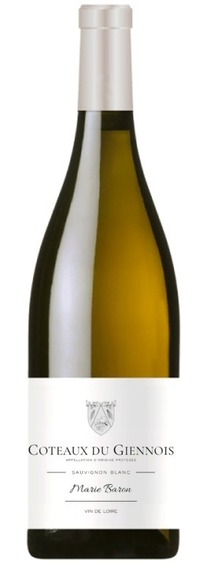
Marie Baron Coteaux du Giennois Blanc is made from 100 percent Sauvignon Blanc.
Coteaux du Giennois is an appellation in the upper Loire Valley, near Sancerre and Pouilly-Fumé. These hillside vineyards benefit from a continental climate with flint and limestone soils that give the wines their distinctive mineral character.
This wine presents a bright pale yellow color with aromas of citrus, white flowers, and flinty minerality. On the palate, it is crisp and vibrant with lively acidity, flavors of grapefruit and lemon, and a refreshing mineral finish.
Excellent with goat cheese, oysters, grilled fish, or fresh salads.
Marie Baron is a Loire Valley producer offering wines from some of the region's most celebrated appellations, including Sancerre, Pouilly-Fumé, Bourgueil, and Coteaux du Giennois. Imported to the United States by Kysela Père et Fils, these wines represent excellent value from classic Loire terroirs.
The white wines — Sancerre, Pouilly-Fumé, and Coteaux du Giennois Blanc — showcase the purity and precision of Sauvignon Blanc grown on the limestone and flint soils of the central Loire. Crisp, mineral-driven, and aromatic, they deliver the hallmark freshness and elegance that have made this region world-famous for Sauvignon Blanc.
From Bourgueil in the western Loire, Marie Baron produces a Cabernet Franc-based red that captures the appellation's signature combination of bright red fruit, earthy depth, and silky tannins. These are versatile, food-friendly wines that offer genuine terroir expression at accessible prices.

Marie Baron Sancerre Blanc is made from 100 percent Sauvignon Blanc.
Sancerre is one of the most iconic white wine appellations in the world, located in the eastern Loire Valley on steep hillsides overlooking the Loire River. The appellation's Kimmeridgian marl, limestone, and flint soils produce Sauvignon Blanc of exceptional minerality and elegance.
This wine shows a bright, pale straw color with aromas of gooseberry, citrus, and white flowers, underscored by a characteristic chalky minerality. On the palate, it is vibrant and refreshing with crisp acidity, flavors of lime and green apple, and a clean, lingering finish.
Classic pairing with fresh goat cheese (especially Crottin de Chavignol), oysters, grilled fish, or asparagus.

Marie Baron Bourgueil Rouge is made from 100 percent Cabernet Franc.
Bourgueil is a renowned red wine appellation in the Loire Valley, situated on the north bank of the Loire River in Touraine. The appellation is known for producing expressive Cabernet Franc wines that range from light and fruity to structured and age-worthy.
This wine displays a beautiful ruby color with aromas of red fruits, violets, and a characteristic hint of green pepper. On the palate, it is medium-bodied with supple tannins, bright acidity, and flavors of raspberry and blackcurrant with a touch of graphite.
Pairs wonderfully with charcuterie, grilled meats, goat cheese, or rillettes.

Marie Baron Pouilly Fume is made from 100 percent Sauvignon Blanc.
Pouilly-Fumé is one of the Loire Valley's most prestigious white wine appellations, located on the right bank of the Loire River across from Sancerre. The 'Fumé' in the name refers to the smoky, flinty character imparted by the Kimmeridgian clay and silex (flint) soils.
This wine displays a brilliant pale gold color with intense aromas of citrus, white peach, and the signature gunflint smokiness. On the palate, it is elegant and focused with mineral-driven acidity, flavors of green apple and grapefruit, and a long, precise finish.
Pairs beautifully with shellfish, sushi, grilled fish, or fresh goat cheese like Crottin de Chavignol.

Domaine de la Janasse has been in the Sabon family since 1967, today run by siblings Christophe and Isabelle. Their Châteauneuf-du-Pape Blanc — Roussanne-led, with Grenache Blanc and Clairette — is consistently one of the finest whites in the appellation, combining richness with purity and the ability to age for two decades.
Review:
Based on 70% Roussanne and 15% each Grenache Blanc and Clairette and aged 12 months in 20% new French oak with the balance in used barrels and concrete. It has a medium gold hue and delivers remarkable intensity in its ripe stone fruits, fresh croissant, honeyed flowers, and orange blossom nuances. It's medium to full-bodied, has a pure, seamless, layered mouthfeel, beautiful balance, and a fabulous finish that will evolve for 20+ years if well stored. Drink 2025-2045.
Jeb Dunnuck 98 Points
-Jeb Dunnuck 91 Points

Grand Veneur Chateauneuf Du Pape Blanc La Fontaine is made from 100% Roussane.
Yellow-gold color. The nose is rich in aromas of citrus fruit, tropical fruit, quince and honey, with a touch of vanilla. On the palate, the same aromas appear together with a fatness combining exotic fruit and vanilla : the wine is rich, generous and elegant, with extraordinary length. "La Fontaine" is often considered to be one of the best Châteauneuf du Pape white, and it is by definition a superb gastronomy wine.
Best between 1 and 8 years.
Review:
-Jeb Dunnuck 98 Points
-Decanter 95 Points

Grand Veneur Chateauneuf du Pape Blanc Le Miocene is made from 60% Clairette, 40% Roussanne
Pale yellow colour with hints of green, aromas of white flowers (may blossom, honeysuckle).
The palate is pleasantly balanced between liveliness and roundness, which brings out characteristics of dried apricot, honey and elderberry. A Châteauneuf du Pape white displaying a great finesse.
Best between 1 and 8 years.
Soil type Coming from the single vineyard named “La Fontaine”, the plot is facing north.It is made of clay-sand and limestone. Thanks to the northern orientation, it is always very well aired. This sector allow the Roussane and Clairette to mature in great conditions without losing freshness, which we believe is key point. Winemaking & ageing Whole-bunch pressing. Vinification in stainless-steel tanks. Fermentation temperature controlled at 15°C.
Review:
-Yohan Castaing (Robert Parker) 92 Points

Every now and then, in life and in wine, we are presented with unique opportunities to express ourselves and create something truly remarkable.
When rare opportunities arise, we need to capture, nurture and develop them so that their potential is fulfilled. So when Torbreck was given the opportunity to work with one of the most famous vineyards in the Barossa Valley, it became almost inevitable that the resulting wine would be truly remarkable.
In 2003, Torbreck growers and fourth generation descendants of the Seppelt family, Malcolm and Joylene Seppelt, asked our winemakers to create for them a small batch of Shiraz from their old Gnadenfrei vineyard in the sub-region of Marananga.
Planted in 1958, the five acre vineyard is traditionally dry grown and comes from an original Barossa clonal source. South facing, on the eastern side of a ridge separating the Seppeltsfield and Marananga appellations, these aged vines have been meticulously hand tended, traditionally farmed and pruned by a grower with a lifetime’s experience on Western Barossa soils of very dark, heavy clay loam over red friable clay. The resulting low yields of small, concentrated Shiraz berries make the vineyard the envy of all winemakers in the Barossa.
We looked longingly at the wine when it was returned to the Seppelts, knowing that it was the best we had ever made. In 2005 we convinced the Seppelts to sell Torbreck the fruit and The Laird was born. In 2013 Torbreck purchased the Gnadenfrei vineyard, securing The Laird’s reputation as one of the world’s great single vineyard Shiraz wines.
Torbreck is the name of a forest near Inverness, Scotland and you’ll find more than a passing nod to the Celts in our wine naming conventions. The Laird of the Estate in Scotland is the Lord of the Manor and master of all he surveys.
Review:
I poured the 2017 The Laird, set it aside and got about doing other jobs for 45 minutes or so, to give it some room to breathe. And it does breathe. It has its own pulse and beat and life, and it flexes and moves in the mouth. This is incredibly enveloping, with aromas reminiscent of campfire coals, charred eucalyptus, lamb fat, roasted beetroot, black tea and a prowling sort of countenance. In the mouth, the wine is bonded and cohesive and seamless, there are no gaps between anything, no space between fruit, oak and tannin; it all comes as one. While this is a singular wine, it is so big and concentrated that it needs no accompaniment other than some fresh air and a good mate. It's denser than osmium and is impenetrable at this stage.
-Erin Larkin (Robert Parker) 97 Points

Thorn Clarke Terra Barossa Shiraz is made from 100 percent Shiraz
Deep purple red. Aromas of ripe plums, cherries and earth with subtle notes of vanilla and cloves. The aromas follow through onto the palate with a fruit focus, subtle oak notes and soft, rounded tannins. The wine walks the line between medium and full bodied with a plush mouthfeel.
The grapes are crushed and de-stemmed into fermenters. Yeast is added immediately once in fermenter and the ferments are pumped over twice daily to maximise colour, tannin and flavour extraction. Cooling is used to ensure ferment temperatures remain in the 22-25 degree celcius range which will allow the fruit to display maximum fruit expression. Pressing then occurs approximately seven days after crushing and the wine is then put into predominately American oak to mature.



