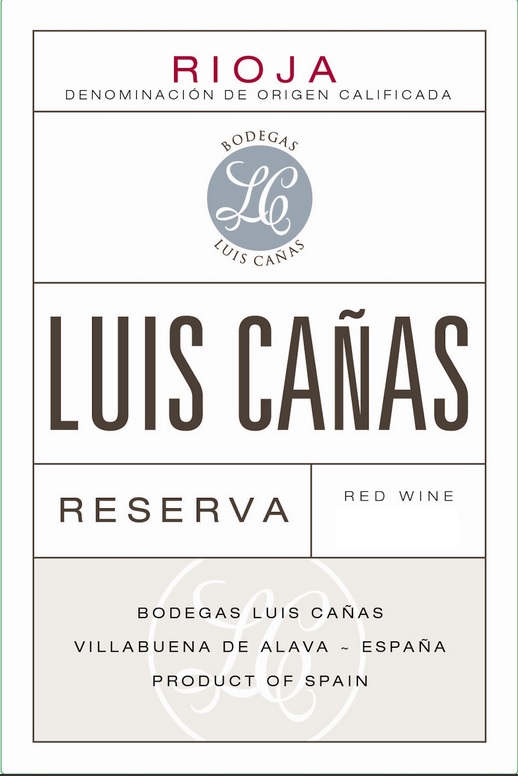
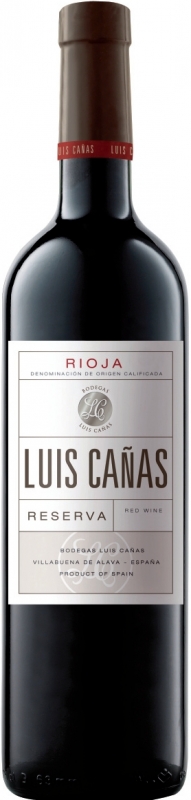
" We don't sell the wine without touching the vine "
| Country: | Spain |
| Region: | Rioja |
| Winery: | Luis Canas |
| Grape Type: | Tempranillo |
| Vintage: | 2017 |
| Bottle Size: | 750 ml |

Luis Canas Rioja Reserva is made from 100 percent 95% Tempranillo and 5% Graciano
A classic style Rioja Reserva from one of the regions most enduring family run wineries. The hillside terraced vineyards are sheltered by the Sierra Cantabria Mountains to the north from harsh weather extremes. Small plot production is utilized in this region of infertile chalky clay soil to produce clusters of excellent quality. Almost 900 plots are needed to complete the approximately 400 hectares of estate-owned or cellar-controlled vineyards, some with vines more than 100 years in age.
Tasting notes
Rich color. Very pleasant on the nose, subtle and elegant, complex, with aromas of fine wood, ripe fruit, coffee. Thick, unctuous and round on the palate with solid structure and juicy tannins. The second nose shows spiced nuances and black ripe fruit aromas.
Winemaking and aging
Upon entering the bodega, bunches undergo a manual selection and then individual grapes are sorted based on their weight. Following this double selection process, they are de-stemmed and crushed before undergoing fermentation and then aceration in stainless steel tanks for a total of 8 days, obtaining better color extraction as well as much more complex and tannic wines, suitable for prolonged aging.
After its primary fermentation, the wine is placed in barrels where it undergoes malolactic fermentation and is aged for 18 months in French (70%) and American (30%) oak barrels, then aged minimum 18 months in bottle before release.
Total acidity: 5 g./l. Volatile acidity: 0,6 g./l. PH: 3,59 Free SO2: 25 mg./l. Residual sugar: 1,9 g./l.
Excellent with red or white meats, all types of game, roasts, oily fish, rice with meat and cheese. Within Rioja cuisine it is perfection accompanying peppers stuffed with cod, artichokes with ham, migas pastoriles and trotters
Review:
-Jeb Dunnuck 92 Points
-Tim Atkin 91 Points
-James Suckling 91 Points

Luis Canas Rioja Gran Reserva is made from 95% Tempranillo and 5% Graciano.
A deep, powerful Gran Reserva from one of Rioja Alavesa's most enduring family-run wineries. The hillside terraced vineyards are sheltered from weather extremes by the Sierra Cantabria Mountains to the north, and small-plot farming on infertile chalky-clay soils yields clusters of excellent quality, some vines more than 100 years old.
Ruby red with earthy tones. Fine, elegant and complex, with good concentration of black fruit, thyme and rosemary and secondary aromas of leather and tobacco leaf. On the palate it is polished and rounded, fleshy yet elegant, with touches of black-fruit jam and liquorice and a long, persistent finish.
Made for a long, generous meal — braised vegetables, cold cuts, stuffed peppers, mushroom omelettes, cod Rioja-style, and both red and white meats.

Luis Canas Rioja Hiru 3 Racimos is 100% Tempranillo
60 years old vines
Alcohol: 14,5º
Total acidity: 6,0 gr/l
Volatile acidity: 0,50 gr/l
PH: 3,47
Free SO2: 25 mg/l
Reducing sugars: 1,8 gr/l
This wine is a response to our quest to find the perfect wine, one that combines structure, complexity and balance. It is the result of a careful selection of grapes not from the vines but from the appropriate clusters, those that naturally produce three or less clusters and which are 60 or more years of age. Vines situated on slopes and terraces of limestone and clay soil, well exposed to the sun. These grapes are harvested in small boxes at the very best moment, then inspected on the selection table and vinified in small groups at a controlled temperature. After alcoholic fermentation they are macerated to extract their full potential. The resulting most is then settled in new French and American oak barrels to undergo malolactic fermentation. This second fermentation ensures the wine gains in complexity and aromatic intensity, it also stabilises its colour.
Fully ripened and concentrated fruit aromas with balsamic and spicy mineral nuances, notes of blackberry and blueberry preserve wrapped in creamy oak, caramel and milky coffee tones. The palate is concentrated, unctuous in the centre, balanced, sweet, with fine tannins. Very long finish, expressive, clearly marked with the character of the soil.
Hiru 3 racimos is a complex wine and so is its pairing with food. We must consider two options, either drink it in light sips so that the wine itself is the star of the feast, or serve with solid dishes that can match its vigour. An Iberian pork loin with roasted peppers, steak with mushrooms and plums, wild boar stew or pheasant in port are dishes that blend incredibly with this characterful wine.

Luis Canas Rioja Blanco Vina Viejas is made from 90% Viura and 10% Malvasia from 60+ year-old vines, barrel-fermented for three and a half months in new French oak.
Grapes are harvested into small crates and sorted by hand, bunch by bunch. Beautiful golden yellow with bright, luminous highlights; the nose is fine and elegant, weaving floral and fruity tones. The palate is dry, with crisp acidity that lends freshness and vivacity and a structured, tasty finish of ripe fruit. Best served at 8°C.
Pairs with shellfish, crustaceans and grilled white fish or fish stews, and also with rice dishes, soft and blue cheeses, all kinds of mushrooms, and fresh fruit.

Luis Canas Rioja Crianza is made from 95% Tempranillo and 5% Garnacha
A classic style Rioja from one of the regions most enduring family run wineries.. The hillside terraced vineyards are sheltered by the Sierra Cantabria Mountains to the north from harsh weather extremes. Small plot production is utilized in this region of infertile chalky clay soil to produce clusters of excellent quality. Almost 900 plots are needed to complete the approximately 400 hectares of estate-owned or cellar-controlled vineyards, some with vines more than 100 years in age.
Tasting notes
Made from 95% Tempranillo, 5% Garnacha of 30 years of age, the wine shows a ruby red color, a clean nose with nuances of balsamic, plum and cedar. The palate is smooth and velvety, complex and structured, with fruit, spice flavors with toasted oak. A pleasant finish with red fruits and hints of eucalyptus.
The harvest
This year in Rioja Alavesa the weather has been especially cold, the summer short and dry, and there has been plenty of rain in early September. This has produced wines with great aromatic notes, particularly those coming from high altitude areas, very fragrant and with great structure.
Winemaking and aging
Upon entering the bodega and passing the selection table, the grapes are de-stemmed and crushed before undergoing fermentation and then maceration in stainless steel tanks for a total of 8 days, obtaining better color extraction as well as much more complex wines, suitable for prolonged aging. The wine is clarified with vegetable gelatines and follows anicrobic filtration.
It is ideal to pair with meats; red meat, poultry, small game, oily fish, semi-cured cheeses, spicy dishes and hot dishes such as beans or potatoes Rioja style.
After its primary fermentation, the wine is placed in barrels where it undergoes malolactic fermentation and is aged for a minimum of 12 months. It is then bottled for at least another 12 months.
Review:
"Juicy Bing cherries, peppery herbs, leather, and cedarwood notes all emerge from the 2021 Rioja Crianza, a medium-bodied, concentrated, round, layered red that has supple tannins, beautiful fruit, and a great finish. This classic Rioja has tons to love."
- Jeb Dunnuck (Importer Highlight: Fran Kysela ; July 2024), 91 pts
-Decanter 93 Points
Luis Canas Rioja Crianza is made from 95% Tempranillo and 5% Garnacha
A classic style Rioja from one of the regions most enduring family run wineries.. The hillside terraced vineyards are sheltered by the Sierra Cantabria Mountains to the north from harsh weather extremes. Small plot production is utilized in this region of infertile chalky clay soil to produce clusters of excellent quality. Almost 900 plots are needed to complete the approximately 400 hectares of estate-owned or cellar-controlled vineyards, some with vines more than 100 years in age.
Tasting notes
Made from 95% Tempranillo, 5% Garnacha of 30 years of age, the wine shows a ruby red color, a clean nose with nuances of balsamic, plum and cedar. The palate is smooth and velvety, complex and structured, with fruit, spice flavors with toasted oak. A pleasant finish with red fruits and hints of eucalyptus.
The harvest
This year in Rioja Alavesa the weather has been especially cold, the summer short and dry, and there has been plenty of rain in early September. This has produced wines with great aromatic notes, particularly those coming from high altitude areas, very fragrant and with great structure.
Winemaking and aging
Upon entering the bodega and passing the selection table, the grapes are de-stemmed and crushed before undergoing fermentation and then maceration in stainless steel tanks for a total of 8 days, obtaining better color extraction as well as much more complex wines, suitable for prolonged aging. The wine is clarified with vegetable gelatines and follows anicrobic filtration.
It is ideal to pair with meats; red meat, poultry, small game, oily fish, semi-cured cheeses, spicy dishes and hot dishes such as beans or potatoes Rioja style.
After its primary fermentation, the wine is placed in barrels where it undergoes malolactic fermentation and is aged for a minimum of 12 months. It is then bottled for at least another 12 months.
Review:
-Jeb Dunnuck 91 Points
-Joaquín Hidalgo (Vinous) 90 Points
Luis Canas Rioja Reserva is made from 100 percent 95% Tempranillo and 5% Graciano
A classic style Rioja Reserva from one of the regions most enduring family run wineries. The hillside terraced vineyards are sheltered by the Sierra Cantabria Mountains to the north from harsh weather extremes. Small plot production is utilized in this region of infertile chalky clay soil to produce clusters of excellent quality. Almost 900 plots are needed to complete the approximately 400 hectares of estate-owned or cellar-controlled vineyards, some with vines more than 100 years in age.
Tasting notes
Rich color. Very pleasant on the nose, subtle and elegant, complex, with aromas of fine wood, ripe fruit, coffee. Thick, unctuous and round on the palate with solid structure and juicy tannins. The second nose shows spiced nuances and black ripe fruit aromas.
Winemaking and aging
Upon entering the bodega, bunches undergo a manual selection and then individual grapes are sorted based on their weight. Following this double selection process, they are de-stemmed and crushed before undergoing fermentation and then aceration in stainless steel tanks for a total of 8 days, obtaining better color extraction as well as much more complex and tannic wines, suitable for prolonged aging.
After its primary fermentation, the wine is placed in barrels where it undergoes malolactic fermentation and is aged for 18 months in French (70%) and American (30%) oak barrels, then aged minimum 18 months in bottle before release.
Total acidity: 5 g./l. Volatile acidity: 0,6 g./l. PH: 3,59 Free SO2: 25 mg./l. Residual sugar: 1,9 g./l.
Excellent with red or white meats, all types of game, roasts, oily fish, rice with meat and cheese. Within Rioja cuisine it is perfection accompanying peppers stuffed with cod, artichokes with ham, migas pastoriles and trotters
The Luis Canas & Amaren Estate
Bodega Luis Cañas is a family winery which for more than two centuries has devoted itself to viticulture and winemaking. However, it was not until 1970 when Luis Cañas first hit the market selling its young bottled wine which until then it had sold only in bulk. From this date onwards, it begins to experience a rise in sales and what is today one of the leading wineries in the Rioja Alavesa begins to take shape.
1989 marks a new milestone in the winery’s transformation when Juan Luis Cañas, the only son of Mr Luis Cañas takes charge of the same. Aged 33 , he brings fresh ideas to the table and begins to develop new wines at the same time as he promotes increasingly aged wines, beginning to lay the foundations of what would later become the new winery.
The Region
-The Climate: Fundamentally Atlantic, which thanks to the protection that the Sierra Cantabria provides from the coldest northern winds as well as Continental and Mediterranean influence.
The average annual temperature oscillates between 12.6º and the 13.2º. There are large fluctuations in the temperature between the morning and the night at harvest time, which is very positive for the quality of the grapes.
Average rainfall is around 400 mm. and 600 mm
- The Soil: The soil is poor and of a clay loam or chalky clay type, ideal for obtaining grapes of an extraordinary quality.
- Altitude: Our vineyards are located between 450 and 600 meters in altitude.
- Grape Varietals:
TEMPRANILLO: The most important indigenous red variety in the D.O. RIOJA. And one of the biggest varieties in the world. It produces wines for length ageing, very balanced in their alcoholic degrees, color and acidity.
GRACIANO: An indigenous red variety with a great future in Rioja and so its surface area is increasing. It produces wines with considerable acidity and polyphonelic content, ideal for growing, whose aroma is superior in intensity to the rest of the Rioja verities. A perfect complement to the Tempranillo for ageing.
VIURA: The most extensive white variety in Rioja. It produces fruity wines, with a floral aroma and a notable degree of acidity, ideal for preparing both young white and vintage wines.
MALVASÍA: A White variety that produces wines of great oiliness and aromatic intensity.
The Luis Canas & Amaren Vineyards
The vineyard is the star of a landscape where the plots of land, mainly located on slopes and terraces, being protected to the north by the imposing presence of the Sierra Cantabria.
Villabuena is a town located to the south of the province of Álava, where the city of the vineyard and the preparation of wines is practically the sole activity that is carried on.
It is in this region of Rioja Alavesa where the most suitable conditions arise for obtaining large vineyards of a superior quality.
22 hectares of vines of over 60 years of age and 30 hectares of between 30 and 60 years make up a vineyard which is the strongest indication of the wine cellar.
The old vineyards achieve a perfect balance given their low production level, having very deep roots that offer the wines complexity, minerality and personality as well as making them more resistant to drought.
Vines that are checked and run by the agronomic engineers from our field department in which rational wine-growing that is respectful of the environment.
All of the forms of treatment that are carried on at the vineyard are restricted to minimally aggressive products and methods which include amongst others, the prohibition against the use of herbicides and the use of fertilizers that are always organic.
The purpose is to make use of a vineyard with a powerful defensive system that is capable of being defended from external threats with no need for artificial assistance. In this way we achieve complete respect for the land. The native soil is a fundamental part of the distinguishing personality of each region. We also manage to make the vines healthier.

Luis Canas Reserva Seleccion de la Familia Rioja is made from 85% Tempranillo and 15% Cabernet Sauvignon
Aged for 20 months in new oak barrels - 50% French 50% American.
45 years old vines
Alcohol: 14,5º
Total acidity: 5,73 g./l.
Volatile acidity: 0,73 g./l.
PH: 3,53
Free SO2: 28 mg./l.
Reducing sugars: 1,3 g./l.
The “family reserve” from one of Rioja Alavesa’s most enduring family-run wineries. Wines destined to be the Reserva de la Familia label are made from a selection of grapes from old vines, those which combine a series of characteristics such as good orientation and exposure to the sun, and a poor soil which ensures low yields.
This wine is one of very few Rioja wines to blend Cabernet Sauvignon with Tempranillo. Bodegas Luis Cañas was granted permission by the D.O.Ca. to plant this variety as an experiment in the early 1980s.
Tasting notes
A brilliant garnet color with cherry hints on the edges.
The nose offers a complex variety of aromas that combine to bring an intense and sophisticated wine. Initially we can find very ripe berry fruits, smoky notes, raisins and liquor. After a certain amount of aeration, the cinnamon and jam notes appear and, with a little more time, the roasted and spiced aromas are noticed more clearly.
The palate is full, with a good presence of tannins, although these are offset by the glycerine like character, resulting in a fleshy sensation. Long lasting and lingering finish.
Winemaking and aging:
The grapes were cold macerated for 72 hours upon arrival at the winery. They underwent fermentation at 26º C in sealed cement tanks under constant thermal control, with the must pumped over daily. With the paste devatted by gravity, spontaneous malolactic fermentation took place after 45 days.
The wine was aged for 20 months in 50% medium toasted American and 50% French oak barrels. The barrel ageing not only adds tannins from the wood, but stabilizes the wine naturally. After the final racking, it was clarified in tanks with a small amount of natural egg white, decanted after 30 days and bottled directly without any type of filtration. Because this wine’s evolutionary cycle is quite slow, only corks of the highest quality available were used to ensure that it could be prolonged for several years.
Review:
-Jeb Dunnuck 95 Points
-International Wine Review 93 Points
-Tim Atkin 92 Points
-Wine Enthusiast 94 Points

Cazaux Gigondas Cuvee Prestige is made from 50% Grenache, 30% Syrah, and 20% Mourvèdre.
A blend of Grenache, Syrah and Mourvedre produced from the oldest vines of the estate and only in the years of highest grape quality. Aromas of prune, chocolate, spices, fruit brandy and plum. Rounded tannins and a long finish.
Red meats aged, venison
Review:
"Not yet bottled, the 2019 Gigondas Cuvée Prestige checks in as 50% Grenache, 30% Syrah, and 20% Mourvèdre, all from the older vines of the estate and vinified and aged in barrel. There are a tiny 700 cases produced. A terrific nose of red and black fruits, Provençal garrigue, and subtle spicy oak is followed by remarkable purity of fruit, silky tannins, and a great finish. it has a touch of modern character which is going to integrate with 2-3 years of bottle age, and it will have 10-15 years or more of prime drinking.."
- Jeb Dunnuck (January 2022), 91-93+ pts

Arzuaga Ribera del Duero Crianza 95% Tempranillo and 5% Cabernet Sauvignon.
Dark cherry color with purple highlights. Powerful nose and high aromatic diversity of ripe red and black fruits, spicy and balsamic notes, and a roasted finish. Soft and mellow in the mouth with a great fruitiness and length.
Review:
-Decanter 95 Points

Lingua Franca The Plow Pinot Noir is made from 100 percent Pinot Noir.
A large proportion of fruit from some of our finest sites, 48% coming from Blocks 1 - 3, planted with PN777 clone. Another 44% is sourced from two blocks of the bold PN 115. The elegant and nuanced PN777 Pinot Noir grown on Gelderman-Jory soils creates the top notes of mineral, rose petal and savory elements while the PN115 provides the fruit, body and weight of the wine.
Loin of lamb, Filet Mignon, veal chop, veal scallopini, pasta with Bolognese sauce, charcuterie, hard cheeses, hamburger, Viennese boiled beef (Tafelspitz), Wienerschnitzel, Kalbi, Bulgogi. Teriyaki, Vietnamese shaking beef, Chinese broccoli beef or Feast of the Immortals? Experimentation is welcome!
Review:
-Jeb Dunnuck 94 Points
-Owen Bargreen 95 Points

Orin Swift Palermo 2021 is made predominantly from Cabernet Sauvignon, with small amounts of Merlot and Malbec.
Palermo is Dave Phinney's Napa Valley Cabernet Sauvignon under the Orin Swift label — sourced across the valley for a plush, dark, and expressive style with the bold personality that made Orin Swift a cult name.
Review:
100% Cabernet Sauvignon aged 11 months in 34% new oak. Alluring aromas of ripe blackberry and black cherry fruit, spiced plums and nuances of clove and tobacco laced with vanilla. Full-bodied with absolutely riveting tannins that take centre stage, fueling a panoply of deep mid-palate dark berry fruits that build in stature and length on the finish, resolving in decadent waves of dark chocolate notes and fragrant red powdery spices.
-Decanter, 94 points