" We don't sell the wine without touching the vine "
| Country: | France |
| Region: | Beaujolais |
| Winery: | Manoir du Carra |
| Grape Type: | Gamay |
| Organic: | Yes |
| Vintage: | 2025 |
| Bottle Size: | 750 ml |

Manoir du Carra Bistrot Beaujolais-Villages is made from 100 percent Gamay.
From Granitic and sandy soils, the Beaujolais-Villages Carra Bistrot exhibits intense color, with hints of cherry and garnet, and to reveal aromas of red fruit dominated by cassis and strawberry. This Cuvée was specially made for the Parisian Bistrots willing to offer easy drinking wines, with enough body to withstand local Cuisine from the Beaujolais region.
Produced from a selection of old vines (50-70 years old). Manual harvest; selection of the best grapes using a sorting table; semi-carbonic maceration for 10-12 days. No filtration. Egg white fining.
Great with coq au vin (Chicken cooked in a red wine sauce) or charcuterie (garlic sausage, dry sausage).

Manoir du Carra Beaujolais Cru Brouilly Terre de Combiaty is 100% Gamay.
Parcels are in the place called “Combiaty”, within the village of St Etienne la Varenne. The soils are dry, made of pink granite, which gives the wine its typicity. Yield is 45-50hl/ha
Nice ruby color, subtle red fruit aromas of raspberry and wild strawberry with floral hints of hyacinth and violet. Full bodied with soft tannins, this Brouilly is best enjoyed young.

Manoir du Carra Beaujolais Cru Fleurie Clos des Deduits is made from 100% Gamay grapes coming from the lieu dit "Montee de la Tonne".
The vineyard measures 1.5 hectare and the average age of the vines is 50 years. Yield: 48 hl/ha
Manual harvest; Semi-carbonic maceration for 10-12 days; Aging in Foudre for 3-4 months; Slight filtration.
Intense red color, subtle fruity and floral aromas of violet, berry and cinnamon. Ample in the mouth, fruit flavors. Even better after a few years of cellaring.
Excellent with red and game meats, and cheeses.
Manoir du Carra Beaujolais Cru Fleurie Clos des Deduits is made from 100% Gamay grapes coming from the lieu dit "Montee de la Tonne".
The vineyard measures 1.5 hectare and the average age of the vines is 50 years. Yield: 48 hl/ha
Manual harvest; Semi-carbonic maceration for 10-12 days; Aging in Foudre for 3-4 months; Slight filtration.
Intense red color, subtle fruity and floral aromas of violet, berry and cinnamon. Ample in the mouth, fruit flavors. Even better after a few years of cellaring.
Excellent with red and game meats, and cheeses.

The 2005 vintage was the Sambardier family's first release of the Juliénas, the oldest Cru of Beaujolais, that was named for the famous Roman Emperor Julius Caesar.
The vineyards are located in the lieu-dit "En bottiere" on granite and schist soil types.
Young and dynamic winemaker Frederic Sambardier only produces 4,800 bottles or 400 cases (12/750ml) from 0.8 hectare (1.97 acre). The vines average over 50 years old. Skin maceration during fermentation for 10-12 days. Finally, the wine has had 4 months of aging in foudre (large barrel). Egg white fined, the wine is bottled unfiltered.
Imported - 150 cases 6/750 ml
Beautiful ruby red color. Pleasing and graceful, this full-bodied Julienas displays spices and ripe red and black fruit aromas (red currant, blackberry). This well balanced wine shows soft tannins and a long lasting finish. Excellent now, it will show even better after a few years of cellaring.
This is a perfect match with game, poultries, white meats and cheeses or even by itself as an aperitif.

Manoir du Carra Beaujolais Cru Moulin a Vent Les Burdelines is made from 100 percent Gamay,
Cru Moulin-à-Vent is called the “King of Beaujolais” and is known to age the longest and be the most tannic. Measuring 660 hectares (1,630 acres) in size, there are 280 examples of this AOC on the market.
The wine is produced in the lieu-dit “Les Burdelines”, which belongs to the 18 'climates' registered by the National Institute for Designations of Origin.
Intense color between garnet and deep ruby. Red fruit nose with floral, smoky and forest notes. The mouth is rich and well structured. In a few years the aromas will evolve towards more spice, musk and venison
Average age of the vines: 30 years old (between 20 and 60 years old). Skin contact maceration: between 2 and 5 days depending on the parcels.
Beaujolais-Nouveau has been very popular with almost every Thanksgiving dish - from turkey to ham, green beans to mashed potatoes, and gravy to cranberry sauce.
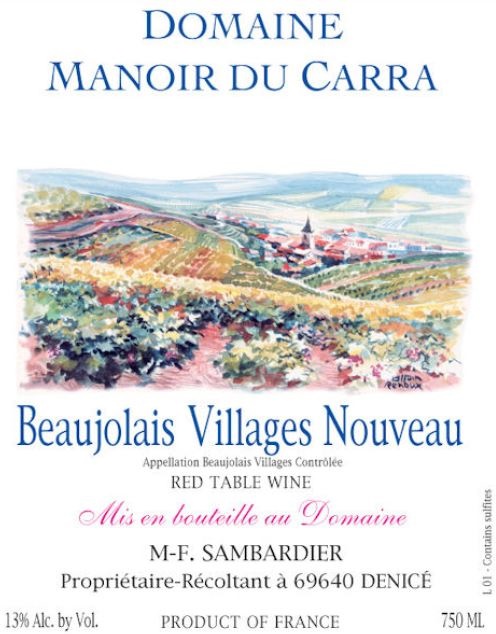
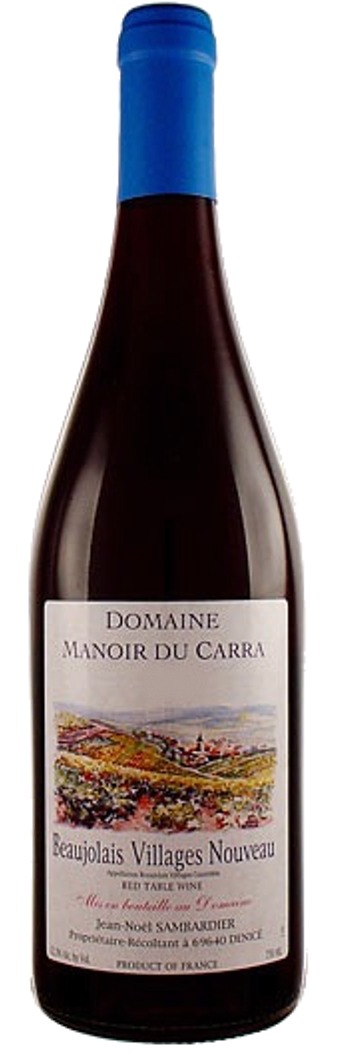
The Beaujolais Villages Nouveau is deeper red, with flavors reminiscent of strawberries and roses, plus a mineral component. Fragrant and medium bodied; refreshing with a tart finish. Beaujolais Villages Nouveau is meant to be consumed young, within 5-7 months.
Beaujolais Nouveau originated about a century ago as a 'vin de l'année' - a cheap and cheerful drink produced by locals to celebrate the end of the harvest season. The Beaujolais AOC was established in 1937, and after WWII, the wine was sold outside of the area. By the 1970's, Beaujolais Nouveau day was a national event.
he region of Beaujolais is 34 miles long from north to south, and 7 to 9 miles wide. There are nearly 4,000 grape growers who make their living in this picturesque region just north of France's third largest city, Lyon.
The Gamay grapes that go into Beaujolais Nouveau are handpicked, as are all the grapes in the Beaujolais. Beaujolais & Champagne are the only vineyards where hand harvesting is mandatory. Gamay (Gamay noir Jus Blanc) is the only grape permitted for Beaujolais.
Beaujolais Nouveau cannot be made from grapes grown in the 10 crus (great growths) of Beaujolais; only from grapes coming from the appellations of Beaujolais and Beaujolais-Villages. Approximately 1/3 of the entire crop of the Beaujolais region is sold as Beaujolais Nouveau.
Nouveau is made with carbonic maceration, or whole-berry fermentation. This technique preserves the fresh, fruity quality of the grapes without extracting bitter tannins from the grape skins.
The Domaine Manoir du Carra Estate
Domaine Manoir du Carra is located in the small town of Denice, 5 km from Villefranche-sur-Saone, 45 km south of Mâcon and 40 km north of Lyon. The property dates back to 1850, and has been bequeathed from father to son for five generations. It is now owned by Jean-Noel Sambardier and his wife. Like many Beaujolais producers, part of their wine is sold to negociant, to which they sell at least 25% of their production each year.
The Domaine Manoir du Carra Vineyard
30 hectares (74.10 acres) total, divided along the North-South axis between Beaujolais A.O.C (10 ha= 24.70 acres) and Beaujolais-Villages A.O.C. (20 ha=49.40 acres). The Sambardiers own 50 vineyard plots. The vines are 50-100 years old. Yields are 55 hl/ha.

My Favorite Neighbor Cabernet Sauvignon is made from 79% Cabernet Sauvignon, 8% Malbec, 6% Syrah, 4% Petite Sirah, 3% Petit Verdot.
A homage to Stephan Asseo of L’Aventure Winery became an obsession. Sourced from exceptional vineyard sites around Paso Robles, San Luis Obispo and south to Edna Valley, this wine is cultivated meticulously by the farmers who have become My Favorite Neighbors. With their dedication to the land, we are able to craft a world class wine without any shortcuts or compromises. Welcome to our Neighborhood.
The 2022 My Favorite Neighbor is everything you’ve come to expect from our flagship Cabernet Sauvignon, sourced from our favorite Paso Robles growers who lend their neighborly spirit to the wine. Effusive aromas of raspberry and currant reveal notes of blue fruit and purple flower. On the palate, juicy red fruits are interwoven with hints of black cherry, cinnamon and toasted oak. Structured tannins carry into a long, chewy finish. Whether it’s a casual backyard barbecue or a fine celebratory meal, this versatile wine has you covered for summer and beyond.

Roland Champion Champagne Blanc de Blancs NV is aged for minimum 30 months (the minimum for NV is 15 months). This cuvee is made from 100% Chardonnay and is produced from the free run juice only. The current release is the result of the blend of the 2005, the 2006 and the 2007 vintage.
Fresh and delicate, its fine bubbles and wide range of aromas will be perfect as an aperitif. This Champagne will also match very well with seafood and shellfish.
dosage : 8 grams per liter
ageing : 30 months on laths
Even if it doesn't say on the label, 100% of the production is RD (Recently Disgorged)
Total Production for this Cuvée : 1,500 cases (9 liter equivalent) per year
Reviews:
"Golden yellow color. Lively, fruity, toasty leesy aromas of honeyed brioche and apple tart with a satiny, tangy, dry-yet-fruity medium body and a sleek, interesting, snappy lemon curd, nougat, and chalk finish with silky, soft, fruit tannins. A classic example of blanc de blanc champagne, delicious."
- Beverage Testing institute , 93 pts
"Spiced with ground anise and ginger accents, this offers notes of poached pear, lemon meringue pie, hazelnut and stony mineral. Very elegant and well-meshed throughout, with a silky finish. Tasted twice, with consistent notes. 1,500 cases made. –AN"
- Wine Spectator 92 pts
"This cuvée made from 100% Chardonnay offers a fresh aromatic nose of light toast, dried yellow fruit and nuances of yeast. On the palate it has a creamy mouth feel of toasted nuts and rich autolytic notes. This is a beautiful wine, rich and complex."
International Wine review 92+ pts
"Small grower. Autumn fruits dominate the aromas of this wine, which is blatantly more like a wine than we normally expect a champagne to be. Some may find that unexpected and even off-putting, while others will find it intriguingly delicious."
- Washington Post - EXCELLENT
"Roland Champion is a small family-owned producer, now with the fourth generation, in the village of Chouilly (”shoo-ee”), which has only Grand Cru vineyards. Made from 100 percent chardonnay grapes, this Champagne offers ethereal grace and poise and harmony; if I were fighting a duel tonight, I would ask for this Champagne as my last beverage. The nose here is about the richness of warm biscuits and hazelnuts, dried fruit and spice, like a Platonic, ineffably light fruitcake; in the mouth, however, it’s about a structure that encompasses an incredible marriage of power and elegance, like the delicacy and strength of the finest bone china. And there’s something porcelain-like about this Champagne, in its notable crisp, lively character, its transparency and its slightly chalky, shale-like mineral elements. Forget the Champagnes that come on with heavy toasty, caramel qualities; here, instead, is a wealth of subtlety and nuance touched with a racy, dynamic edge. Exceptional."
Biggerthanyourhead.net

Alain Jaume Domaine du Clos de Sixte Lirac is made from 50% Grenache, 35% Syrah, 15% Mourvedre
An intense red garnet color. On the nose, aromas of red and black ripe fruit (kirsch and wild blackberry). The mouth is full, with aromas of blackcurrant liqueur and spice. Tannins are both harmonious and elegant thanks to the fleshiness of the wine. Hints of licorice and vanilla on the finish, which gives the wine length and complexity.
Soil type LIRAC vineyard is facing Chateauneuf du Pape, opposite side of the Rhône river. As showed by the picture and following geologist George Truc, soils are almost similar in both side. They are marked by the violence wrought by the Rhone river. It consists of a layer of marine molasses of the Miocene period covered by alpine alluvium. The presence of a great number of rounded stones known as "galets" in the earth is evidence of the time when the Rhone, then a torrent, tore fragments of rock from the Alps and deposited them on the plain. LIRAC is one of the up-coming best area from the southern Rhône valley, as it delivers outstanding wines. Winemaking & ageing Traditional wine-making in stainless still vats. Hand sorted bunches, crushed and destemmed grapes. Fermentation temperature : 30°C. 18 days of vatting with pigeages.

Charles Heidsieck Vintage Brut is made from 57% Pinot Noir, 43% Chardonnay.
A beautiful golden robe offers glints of green accentuated by a delicate, dynamic effervescence. The initial nose introduces intense toasted and smoky notes along with ripe fruit. When swirled in the glass, the nose takes on a heartier dimension with touches of apricot and vineyard peaches. The aromatic concentration, due to a heat wave of several weeks, is reminiscent of the summer sun. The attack is taut and decisive. the creamy texture, the crisp fruitiness and spiced notes of cinnamon, licorice and pepper are the hallmark of the House style.
Review:
Aged for eight years on the lees before disgorgement, the Champagne is deliciously toasty with acidity and fine dryness.
-Wine Enthusiast 96 Points
Disgorged in January of 2023, the 2013 Champagne Millésime Brut was the last vintage from the cellar master for Heidsieck prior to Cyril Brun. The 2013 Champagne Millésime Brut is a bright straw yellow color and is based on the crus of Les Mesnil, Avize, Averney, and Aÿ. It’s fresh with aromas of wet stones, fresh quince, and fresh jasmine flowers. It has a chalky and focused texture, with ripeness to balance it out, and a long, graceful finish. At this stage, it feels more forward with 57% Pinot Noir and the rest Chardonnay. A more mineral-tinged expression, it has a lot of charm and the promise of longevity over the coming two decades. Drink 2024-2044. It will be interesting to see how the Pinot shows itself over time. 8 grams per liter dosage.
-Jeb Dunnuck 95 Points

Marco Capra Langhe Nascetta is made from 100% Nascetta - 15 years old - 1.73 acres
Aged 6 months in stainless steel vats
The name "CONNA" is a sweet nickname after his wife Monica.
Bright straw yellow with greenish hues, with an intense and interesting perfume of grapefruit, apple and aromatic herbs. Floral, fresh, focused, good acidity. Refreshing and bright, full bodied with an aromatic persistence, it is savory and tasty on the palate with a smoothness that enhances the rich character of the wine
Altitude: 400 m above sea level.
Soil composition: lime and sand.
Plant density: 5000 vines / hectare.
Cultivation system: traditional Guyot.
Yield per hectare: 6 tons.
After a short period of maceration on skins, the grapes are soft pressed. The clear must obtained ferments slowly in stainless steel vats at a controlled temperature of 16-17°C. The wine spends a long period of time on the fine lees, with frequent “batonnage”
Ideal with apetizers, shellfish and other fish dishes.