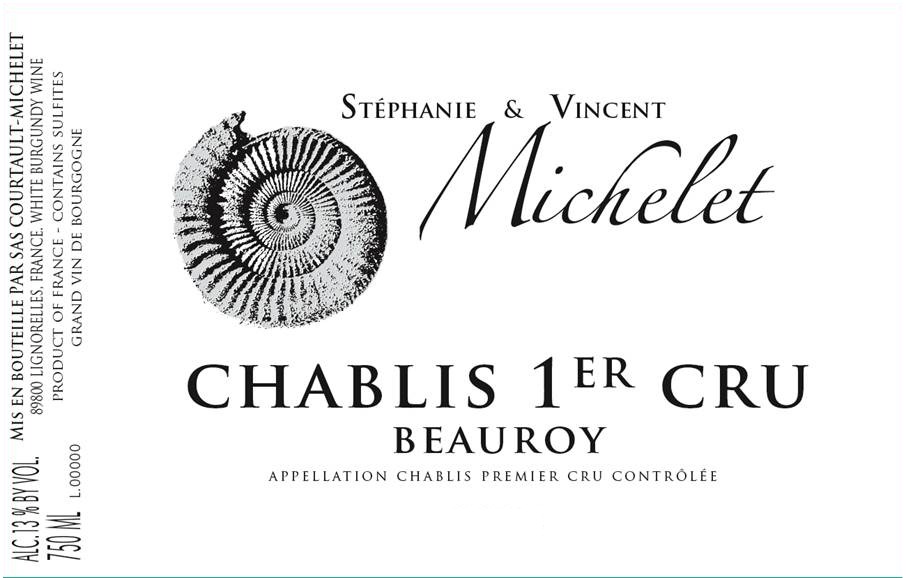
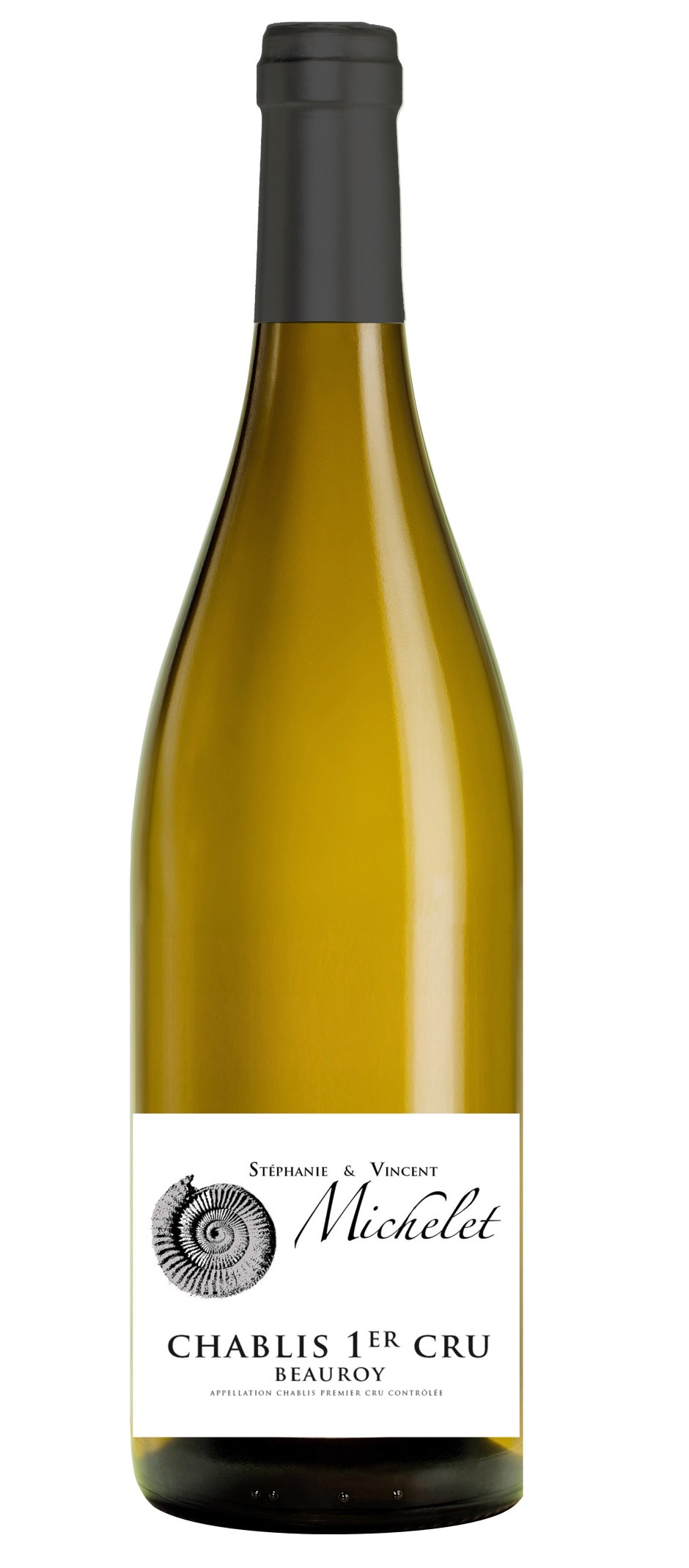
" We don't sell the wine without touching the vine "
| Country: | France |
| Regions: | Burgundy Chablis |
| Winery: | Courtault-Michelet |
| Grape Type: | Chardonnay |
| Organic: | Yes |
| Vintage: | 2015 |
| Bottle Size: | 750 ml |

Michelet Chablis Premier Cru Beauroy is made from 100 percent Chardonnay.
Chablis is the northernmost wine region of Burgundy, renowned for producing some of the world's finest and most mineral-driven Chardonnay. The Premier Cru 'Beauroy' vineyard is located on the right bank of the Serein River on slopes with Kimmeridgian clay and limestone soils rich in fossilized oyster shells.
This wine displays a brilliant pale gold color with green reflections. The nose offers aromas of citrus, white flowers, and characteristic flinty minerality. On the palate, it is precise and elegant with bright acidity, flavors of green apple and lemon, and a long mineral finish.
Pairs excellently with oysters, shellfish, sushi, or simply prepared white fish.

Corinne Perchaud Chablis Premier Cru Fourneaux is made from 100 percent Chardonnay.
This is the south facing portion of the slope and very hot, heavy "Fourneaux" or "oven" effect.
The wine is expressive and vivacious with beautiful aromas.
Well-balanced, round and fruity wine with a fine minerality on the finish.
1er Cru Fourneaux is located on the Fleys village and faces the field. the plots are very steep and exposed full south on soil type Kimmeridgian consists of marl clay-limestone with shallow ground and a very stony ground. After a slight settling, the juice starts its fermentation in tank, then ¼ of juice is racked in barrels. Both wines perform their alcoholic fermentation and malolactic and their aging on the lees, separately. The two cuvées are blended six months after harvesting. The wine is then filtered and is bottled 15 months after harvesting. 2013 Conditions and Harvest The relatively high temperatures at the end of winter allowed an early bud vines in early March. With a hot, dry spring flower took place in good conditions. In July, a hailstorm located did some damage to our Fourchaume plot. July and early August, rainy and stormy brought the water needed by the vineyards. The dry and sunny weather of the second half of August brought the grapes to maturity. The harvest began on September 2 under cloudy skies.
Coquille St. Jacques (scallops) with leeks and cream.

Domaine Louis Moreau Chablis Vaillons Premier Cru is made from 100 percent Chardonnay.
Chablis achieves its highly distinctive mineral character due to its cool northerly climate and its highly calcareous soil. The Domaine Louis Moreau Chablis Vaillons Premier Cru is a generous, fleshy and lively wine that displays a beautiful balance of minerality, fruitiness and elegance.
Chablis, with its steely character and fresh citrus flavor, pairs well with white fish and shellfish and its naturally high acidity can counterbalance cream-based sauces. Unoaked Chablis lends itself well to vegetables, starches, Comté, or fresh goat cheese.

Bachelet Bertrand Chassagne Montrachet Blanc Premier Cru Morgeot is made from 100 percent Chardonnay.
The Chassagne-Montrachet appellation is located in the southern part of the Côte de Beaune and produces mainly white wines. 'Morgeot' is located in the south of the village, characterized by compact limestone soil containing iron oxide, which gives the soil its particular red-brown color.
The wine offers a golden color, a subtle nose of white flowers and honey notes. Full-bodied and well-structured on the palate.
The softness of the Chardonnay on the palate makes an interesting pairing with cooked foie gras; it also sits well with lobster, spiny lobster, or even morel mushroom dumplings or Bresse chicken in a cream sauce.

Bachelet Bertrand Maranges Blanc Premier Cru Fussiere is made from 100 percent Chardonnay.
The Maranges appellation is the youngest of the Côte de Beaune family, making its debut in May 1989. It spans three villages, namely Dezize-lès-Maranges, Cheilly-les-Maranges and Sampigny-les-Maranges. Several hills and slopes make up this appellation, all south/south-east-facing, at an altitude of between 200 and 400 metres. The Maranges 1ers Crus are spread over seven distinct villages.
'La Fussière' is the main village of the Maranges appellation and is located in the Cheilly and Dezize-les-Maranges areas.
This wine has a pale gold robe, with plenty of sparkle. At first, the nose evokes notes of white flowers, like acacias, then the second nose delivers a flinty, slightly buttery aspect. Plenty of versatility and subtlety on the palate, with floral notes.
A good accompaniment to a cold starter or fish. Try with a slightly sharp hard cheese, such as Cantal or Gouda, to draw out its natural vivacity.

Bachelet Bertrand Maranges Rouge Premier Cru Clos Roussots is made from 100 percent Pinot Noir.
The Maranges appellation is the youngest of the Côte de Beaune family, making its debut in May 1989. It spans three villages: Dezize-lès-Maranges, Cheilly-les-Maranges and Sampigny-les-Maranges. Several hills and slopes make up this appellation, that are south/south-east-facing.
'Les Clos Roussots' is a Premier Cru vineyard in Cheilly-les-Maranges, producing wines with depth and structure.
The wine offers deep ruby color with purple highlights. Aromatic nose of dark berries, spice, and a mineral edge. The palate is full-bodied with firm yet silky tannins and a long finish.
Pairs well with roasted meats, game, and aged cheeses.
The nose offers rich and intense aromas of rose petals and litchi. The wine is well-structured and generous in the mouth with subtle notes of dried fruits and honey. A long mineral finish.
Machine harvested at full maturity (around Sept. 25th - lasts 12-18 days); pneumatic press; fermentation in temperature controlled stainless steel tanks for 8-10 days; M.L (2 months after the harvest); aging on the lees until May (3 month extra compared to the Petit Chablis); racking; fining if necessary; cold stabilization; filtration right before bottling in July.
A great match with fine fish in creamy sauce or white meat stuffed with mushrooms. The complex and subtle aromas make this wine and ideal accompaniment to delicate and refined seafood dishes - lobsters and crayfish. Let it age a little and its richness will be appreciated with foie gras.
Review:
"A stony, minerally undercurrent knits the ripe peach, apple and honey flavors together, while the bright structure keeps this focused. Shows fine balance and length. Drink now through 2023. – B.S."
- Wine Spectator (November 30th 2017), 92 pts
Domaine Courtault-Michelet Estate
This is a new Estate, founded by Stephanie Courtault and her husband Vincent Michelet.
Stephany is the daughter of Jean Claude Courtault, who runs a family winery founded in 1984. Jean Claude arrived in Lignorelles in 1974 to work as a vineyard manager for one of the village's wine estates. In 1984, JC Courtault purchased 1.5 hectare of 4 year old vines in the Chablis area. Then, he rented a piece of land in the Chablis appellation area that he planted with the help of his wife, Marie-Chantal. This dynamic estate aims to fuse tradition with modernity.
Date Founded: 1984
A native of Touraine, Jean-Claude Courtault arrived at Lignorelles in 1974 to work as Vineyard Manager for one of the village's wine estates.
In 1984, JC Courtault seized the chance to buy 1.5 hectares of 4 year old vines in the Chablis area. Next, he rented a plot of land in the Chablis appellation area, which he then planted up with the help of his wife, Marie-Chantal. And so the Estate Jean-Claude Courtault came into being.
JC Courtault enlarged and worked his vineyard over time, whilst still fulfilling his duties as Vineyard Manager. He began producing wine, and in 1987, the process of bottling and marketing started. That year's wine was rewarded with a gold medal at the "Concours Général des Vins de Paris" competition. This medal was just the first of many awards and prizes that have punctuated JC Courtault's career, a mark of the quality and consistency of his wines.
The 1994 edition of the Guide Hachette gave something of a commercial boost to the Estate Jean-Claude Courtault, after it awarded the 1992 Chablis a favourite buy distinction.
In 1995, with the estate boasting a dozen hectares of Chablis and Petit Chablis, Jean-Claude Courtault decided to devote himself to wine-growing on a full-time basis. He built a wine storehouse that included all the features necessary for optimal operating efficiency.
The estate has continued to develop its vineyard and now boasts a total of 17.60 hectares in production. This development drive is due to continue, with the arrival of Stéphanie, daughter of JC and MC Courtault, and her husband, Vincent Michelet. From now on it will be up to them to take up the challenge of producing Chablis wines.
The estate produces three of the four appellations found in the Chablis wine-growing region : Petit Chablis, Chablis, Chablis 1er Cru and Chablis Grand Cru Valmur
Some 50,000 bottles are sold in France and abroad.
Domaine Courtault-Michelet Vineyards
The wines of the Estate Jean-Claude Courtault are particularly renowned for their strong fruit character, the wine-grower's signature, if you like. These wines are regularly singled out for their quality, as can be seen in the Guide Hachette and various competitions - concours de Paris, Mâcon, Vignerons Indépendants. The Estate Jean-Claude Courtault sells and produces wines that have come from the estate's own vines.
The estate's vines are planted in accordance with the tradition of the Lignorelles area, in other words, every 5 rows, sufficient space is left for a tractor to pass. Planting density is on average around 6000 to 7000 vines per hectare, roughly equivalent to the mean for the Chablis wine-growing region.
This vineyard is sited on relatively hilly ground. Some plots have required considerable work on them before planting, with gradients of up to 1 in 2.5 (40%) possible. The oldest plots have 35 year-old vines.
Grape Harvest generally begins at the end of September and lasts between 12 to 18 days, depending on the year. Our main aim is to harvest the grapes at their optimal ripeness. This allows us to obtain a higher sugar content in the grapes whilst still maintaining pH and acidity at the levels needed to make a well-balanced wine.

Guillemot-Michel Vire Clesse is made from 100 percent Chardonnay.
Beautifully expressive, with yellow fruits, orange blossom, smoke & flint. Thick and saline on entry, then seriously deep in the mid-palate, with suggestions of exotic fruits perfectly countered by strong minerality. This wine strikes a perfect balance between sweet and salty elements, and it shows vibrant acidity. It boasts a thickness that few other northern Mâconnais can match.
Enjoy with fish (such as sole meuniere), seafood, roasted chicken, goat cheese.
Review:
"The 2018 Viré-Clessé Quintaine is showing beautifully, wafting from the glass with a lovely bouquet of honeyed citrus fruit, fresh pastry and orange blossom. Medium to full-bodied, satiny and supple, it's elegantly textural and refined, with a fragrant core of fruit and a long, penetrating finish. Even though it will reward a bit of bottle age, it's slightly finer-boned than the more concentrated, muscular 2017, so I would opt to drink this immensely charming wine before its older sibling. – William Kelley"
- The Wine Advocate (Issue 249, June 30th 2020), 93 pts

Marie Baron Sancerre Blanc is made from 100 percent Sauvignon Blanc.
Sancerre is one of the most iconic white wine appellations in the world, located in the eastern Loire Valley on steep hillsides overlooking the Loire River. The appellation's Kimmeridgian marl, limestone, and flint soils produce Sauvignon Blanc of exceptional minerality and elegance.
This wine shows a bright, pale straw color with aromas of gooseberry, citrus, and white flowers, underscored by a characteristic chalky minerality. On the palate, it is vibrant and refreshing with crisp acidity, flavors of lime and green apple, and a clean, lingering finish.
Classic pairing with fresh goat cheese (especially Crottin de Chavignol), oysters, grilled fish, or asparagus.