
" We don't sell the wine without touching the vine "
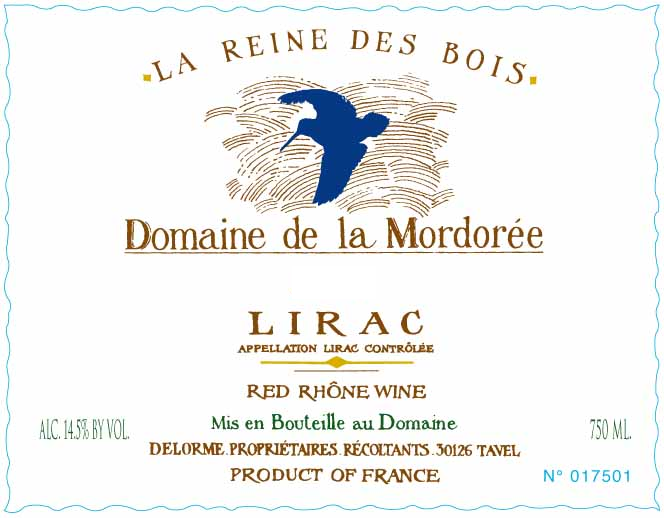

Mordoree Lirac Rouge Reine des Bois equal parts Grenache, Syrah and Mourvedre
Color : deep dark red, with blueish hints.
Aromas : highly fruity ( raspberry, billberry, blackberry ), floral (violet) and intense with a grilled touch ( coffee ).
Palate : melted and concentrated tannins, full bodied, very long fresh finish.
Ageing potential : 8 to 10 years
Grilled meats, sauce meats, game birds, game rabbits and semi-mature cheeses.
- James Suckling (June 2023), 91 pts
Mordoree Lirac Rouge Reine des Bois equal parts Grenache, Syrah and Mourvedre
Color : deep dark red, with blueish hints.
Aromas : highly fruity ( raspberry, billberry, blackberry ), floral (violet) and intense with a grilled touch ( coffee ).
Palate : melted and concentrated tannins, full bodied, very long fresh finish.
Ageing potential : 8 to 10 years
Grilled meats, sauce meats, game birds, game rabbits and semi-mature cheeses.
Review:
"The 2022 Lirac Cuvée De La Reine Des Bois checks in as 40% Syrah and the rest equal parts Grenache and Mourvèdre. It's a killer bottle of wine that has both red and black fruits intermixed with notions of peppery garrigue, flowers, melted licorice, and graphite. With a rare level of purity and precision, it's medium to full-bodied, has a supple, layered mouthfeel, fine tannins, and a great finish."
- Jeb Dunnuck (Import Highlight: Fran Kysela; July 2024), 93 pts

Color: Deep Red
Nose : Red fruits (raspberry, black-current) and flowers (violet).
Palate : Full, rich and ample, long finish, nice concentration.
Aging potential : 7 to 9 years
Surface : 22 Ha. Yield : 40 Hl./Ha. Vineyard age : 40 years Terroir : Clay / chalk, clay / limestone and sandy with pebble stones. Harvest : by hand Vinification : 100% destemmed , long 30 days maceration with a maximum of 34°C temperature
Pairs well with red meats, grilled meats, game and cheeses.
Color: Deep Red
Nose : Red fruits (raspberry, black-current) and flowers (violet).
Palate : Full, rich and ample, long finish, nice concentration.
Aging potential : 7 to 9 years
Surface : 22 Ha. Yield : 40 Hl./Ha. Vineyard age : 40 years Terroir : Clay / chalk, clay / limestone and sandy with pebble stones. Harvest : by hand Vinification : 100% destemmed , long 30 days maceration with a maximum of 34°C temperature
Pairs well with red meats, grilled meats, game and cheeses.
Review:
A blend of Grenache, Syrah, and Mourvèdre brought up in tank, the 2019 Côtes Du Rhône La Dame Rousse is a big, rich, powerful Côtes du Rhône loaded with notions of smoked black cherries, licorice, scorched earth, and ample minerality. These all carry to a medium to full-bodied Southern Rhône that has terrific purity of fruit, ripe, present tannins, and a great finish. I love its balance and it’s going to deliver ample pleasure over the coming 4-6 years.
-Jeb Dunnuck 90-92 Points
"For this appellation this is a remarkably restrained and rather elegant red with complex red-fruit, baking-spice and terra-cotta aromas. The self-confidently dry tannins build gently and keep the alcohol well in check until right at the end, when you do feel a touch of warmth. A blend of grenache and syrah. From organically grown grapes. Drink or hold."
- James Suckling (February 2022), 92 pts
Color: Deep Red
Nose : Red fruits (raspberry, black-current) and flowers (violet).
Palate : Full, rich and ample, long finish, nice concentration.
Aging potential : 7 to 9 years
Surface : 22 Ha. Yield : 40 Hl./Ha. Vineyard age : 40 years Terroir : Clay / chalk, clay / limestone and sandy with pebble stones. Harvest : by hand Vinification : 100% destemmed , long 30 days maceration with a maximum of 34°C temperature
Pairs well with red meats, grilled meats, game and cheeses.
Review:
"Aromas of spiced cherries, forest berries and sweet spices. Medium body with fine tannins. Layered and textured with a velvety mid-palate. Balanced and harmonious with a focused finish and excellent length. From biodynamically grown grapes with Demeter certification. Drink or hold."
- James Suckling (May 2023), 93 pts

Mordoree Lirac Blanc Reine des Bois is made from Grapes : Grenache 35 % Clairette 25 % Viognier 10 % Roussanne 15 % Marsanne 10 % Picpoul 5%>
Color : green gold
Aromas : white fruits, peach, apricot, pear, violet.
Palate : rounded, long finish, highly flavoured.
Ageing Potential : 4-5 years.
Surface : 4 Ha. Yield : 35 Hl./Ha. Vineyard age : 30 years Terroir : Clay / chalk with pebble stones. Harvest : by hand Vinification : skin maceration and direct pressing with temperature control. Fermentation : oak barrel fermentation for 25% of the total volume
Pairs well with appetizers, fish, seafood.
Review:
"Iconic grapes of 35% Grenache, 25% Clairette, 10% Viognier, 15% Roussanne, 10% Marsanne, and 5% Picpoul from 40-year-old vines make up this organic Southern Rhône white. A floral bouquet of white tea and jasmine make their designs on a defined slate mouthfeel. Lime pops with a tart center, along with notes of peach and gingerbread on a keen, edgy finish."
- The Somm Journal (Feb/March 2022), 94 pts
Review:
Moving to the 2011 reds, and showing plenty of aromatic similarity to its big brother, the 2011 Lirac Cuvee de La Reine des Bois is a superb wine in the vintage. Offering up lively and clean notes of black raspberry, licorice, graphite and toasty notes, it is a medium-bodied, supple and beautifully polished Lirac meant for drinking over the coming 4-5 years. Drink now-2018. Wine Advocate #209 92 Points
Mordoree Lirac Rouge Reine des Bois 2011 is made from 1/3 Grenache, 1/3 Mourvèdre, 1/3 Syrah.
Vinification : 100% destemmed, long 30 days maceration with a maximum of 34° C temperature.
Maturing : 30% in oak barrels, 70 % in enameled steel tank.
Estate bottled
Tasting :
Sight: deep dark red, with blueish hints.
Nose: highly fruity ( raspberry, billberry, blackberry ), floral (violet) and intense with a grilled touch ( coffee ).
Palate: melted and concentrated tannins, full bodied, very long fresh finish.
To go with : grilled meats, sauce meats, game birds, game rabbits and semi-mature cheeses.
Service temperature : 18° C
Ageing potential : 8 to 10 years
The Mordoree Estate
This is arguably the top estate in our Portfolio. Domaine de la Mordoree (woodcock), located in the town of Tavel, in the Southern Rhone Valley, is the most consistent producer of top quality wine in my entire selection. In 1986, the brothers Christophe and Fabrice Delorme decided to dedicate themselves to their passion for wine. They started their own estate with the objective to produce the best wines in each appellation while preserving the environment
The Mordoree Vineyard
The vineyard consists of 55 hectares (135 acres), on 38 different parcels, which provide with a rich, wide range of soils and climates. The soil is a mix of clay, chalk and sand with pebble stones. The improvements at the Domaine have been incredible: new pneumatic presses, new stainless steel vats, new destemmer, new vinification and aging plant, and aging in oak barrels for the top wines. All the grapes are raised by culture raisonnée which is very close to organic viticulture (intervention in the vineyard only when necessary). The yield is reduced in the vineyard by ébourgeonnage (de budding in spring) and vendanges vertes in summer (green harvesting). Oak aging for the top wines in special barrels like “jupille” for 10 months. No expense is spared at this Domaine to achieve quality.

Copain Edmeades Pinot Noir is made from 100 percent Pinot Noir.
This wine embodies everything you love about Anderson Valley Pinot; flavors of strawberry, Rainier cherries with hints of spice.
VINTAGE NOTES:
The 2017 vintage began with significant rainfall prior to bloom, refilling the state’s reservoirs and ending California’s five-year drought. We saw a sudden spike in temperatures just prior to harvest, leading fruit to ripen quicker than anticipated. This sped up our harvest schedule, but due to our team’s vigilance, the fruit was still able to be picked at optimal ripeness. Temperatures then cooled back down by mid-September, allowing the remaining vineyards to complete ripening at an ideal pace. The rest of harvest was finished as planned, with yields coming in at their typical levels.
The historical Edmeades Vineyard sits along the western side of the small town of Philo in what’s known as the “deep-end” of Anderson Valley. Flanked by the Navarro River, there is a diversity of sandstone soils throughout the vineyard. The Edmeades vineyard is planted with vines facing southwest, allowing this vineyard to receive warmer afternoon weather. This helps to balance the prolonged cool fog influence this vineyard sees throughout the growing season.
Aromas: Raspberry, dried cherries, pennyroyal, orange zest.
Palate: Medium weight palate with soft tannins. Notes of cherry, pomegranate, and clove with light delicate cola notes on the finish.
Review:
The first vintage for this cuvée from Ryan, the 2017 Pinot Noir Edmeades Vineyard comes from mid-valley and was brought up in 27% new French oak. It's a beautiful wine with blueberry and wild strawberry fruits as well as complex spice, dried flowers, and some loamy soil notes. Medium-bodied, seamless, and silky on the palate, it's a lovely, layered wine that shines for its texture and balanced.

Luis XIV Vino Noble is a naturally sweet red wine, made from very late Monastrell harvests. All of its sugar and alcohol comes from the grape itself and has been subjected to a long aging in semi-new American oak barrels. In the mouth it is very intense, sweet without cloying, with aromas of stewed plums and a very long finish of spicy oak wood. RATING: Noble Alicante sweet wine



