
" We don't sell the wine without touching the vine "
| BUY MORE! SAVE MORE! | ||||||||||||||||||||
|
| Country: | Italy |
| Regions: | Piemonte Barolo |
| Winery: | Pio Cesare |
| Grape Type: | Nebbiolo |
| Organic: | Yes |
| Vintage: | 2018 |
| Bottle Size: | 750 ml |
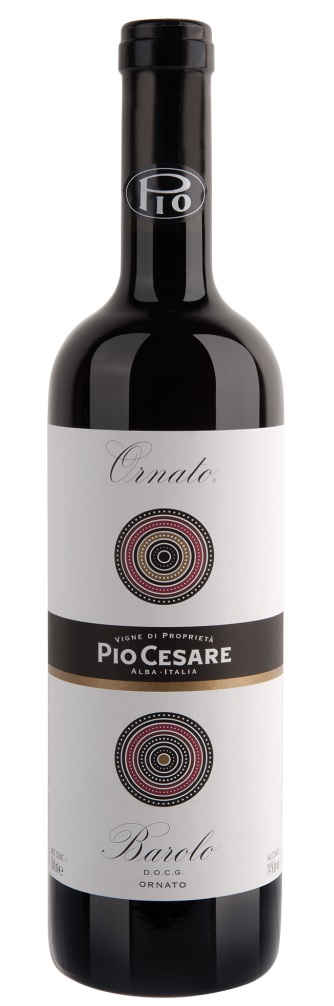
Pio Cesare Ornato Barolo is made from 100 percent Nebbiolo.
Vineyards
The very first Single Vineyard Barolo produced by the Pio Family, for the first time in 1985. Great structure, power, concentration, with a very long life. Produced in small quantities.
Vinification
In stainless steel tanks at high temperatures. Maceration for 30 days. Ageing In large oak “botti” for about 30 months; a small amount in French oak barriques for the first 12 months.
Review:
Complex on the nose, offering a blend of ripe red berries, nutty minerals, orange-peel and spice. Some savory, almost meaty notes, too. Full, compact and intense, yet there’s a graceful feel to the palate, thanks to the really fine web of tannin. Super polish and promise here. Classy. Needs some time.
-James Suckling 96 Points
Pio Cesare has been producing wines for 135 years and through five generations in its ancient cellars in the center of the town of Alba.
The Pio Cesare winery was founded in 1881, by Cesare Pio. He was a very successful entrepreneur and was inspired to produce a small and select quantity of wines from the hills of Barolo and Barbaresco for himself, his family, friends, and customers. Cesare Pio was dedicated to the terroir of the Piedmont region and to producing wines of the highest quality.
Over the years, Cesare Pio built a thriving business.
His entrepreneurial spirit encouraged him to travel throughout Europe in the early 20th century to publicize and promote Pio Cesare’s wines. His passport, which is proudly displayed at the winery in Alba, bears the number 55.
His son, Giuseppe Pio, the second generation, found himself with a thriving winery at the turn of the century. He carried on his father’s passion and invested in expansion of the cellars and the trade, making Pio Cesare a benchmark brand for the wines of the region.
In 1940, Giuseppe Pio’s only child, Rosy, married Giuseppe Boffa, a young and well-known engineer from Alba, who managed a large company in Milan at the time.
Then Italy began to struggle during the Second World War,Giuseppe Boffa decided to leave his job in Milan to dedicate himself to the Pio Cesare winery.
Thanks to his efforts, the Pio Cesare brand gained fame and prominence both domestically and internationally, becoming one of the most respected names among Italian wine producers, with a special focus on its renowned Barolo.
Rosy and Giuseppe Boffa named their youngest son Pio, in honor of his great-grandfather’s surname. Pio Boffa, the fourth generation, leads and directs the company today.In the early 1990’s Pio Boffa asked his cousin Augusto to join him in the company.
His sister’s son, Cesare Benvenuto, has been active since 2000 as the fifth generation and recently Pio Boffa’s daughter, Federica Rosy, joined Pio Cesare, representing the future of the Family.
Today, the family members travel extensively to more than 50 countries around the world, echoing what Cesare Pio himself did at the beginning of our history—promoting the name and reputation of the Pio Cesare winery to restaurants, hotels, wine shops and wine lovers worldwide.

Luigi Baudana Barolo Cerretta is made from 100 percent Nebbiolo.
Austere and very mineral expression of Barolo. Aromas of dark cherries and raspberries jump out vividly from the glass. Hints of iron, menthol, new leather add to the depth and intrigue of this wine. Refined and polished, Cerretta has an extra layer of tannins, important structure and a lively acidity which are nearly buried by its exquisitely lush fruit.
-Wine Independent 95 Points

Falletto di Bruno Giacosa Barolo is made from 100 percent Nebbiolo
The 2018 vintage was well received after the turbulent 2017 growing year. A longer winter heralded in heavy rains in May and June, which gave the vines much needed water after the previous year's drought. Throughout the summer, conditions were generally ideal with warm days and cool nights, making harvest an overall success. Early samples of Barbaresco and Barolo are indicating a soft, balanced vintage.
Red garnet in color. Intense and fine aromas of fresh red fruit. The palate presents good freshness, excellent structure and fine, velvety tannins.
Review:
The 2018 Bruno Giacosa Barolo is very rich and hedonistic, with ripe strawberries and rose hip and notes of incense, lilies and violets. It is a lovely nose, persistent, intense and enticing and on the palate it is like falling into a soft velvety bed of rose petals. It already has such beautiful harmony and poise. It has a lush, sensual texture of crushed velvet, and is full-bodied without feeling heavy. There are plenty of dense, savory tannins extending the very long finish, creating a combination of seductive charm and power. This is something special, a great achievement in this vintage. Wait 2-3 years at least but I would not want to miss that young fragrance. (SH)
-Wine Independent 98 Points

G.D. Vajra Barolo Ravera is made from 100 percent Nebbiolo.
The Barolo Ravera shows a striking balance of all tones. Red and dark fruits on the nose are interlaced with mineral hints and the iron tones which are such a signature of Ravera. The wine has brilliant drinkability, with a layered, ample mid palate and a racy finish.
Review:
Seamlessly stitched together, the G.D. Vajra 2018 Barolo Ravera reveals tight layering and smooth texture. Fruit comes from an amphitheater of vines with Tortoniana epoch sandstone clay that is typical of parts of Barolo and Novello. What stands out here is the mineral character of the wine. It frames a dark core of plum, dark cherry and soft spice.
- Robert Parker's Wine Advocate 94 Points

G.D. Vajra Bricco Delle Viole Barolo is made from 100 percent Nebbiolo.
The Barolo Bricco delle Viole shows the signature verticality of its vineyard. The wine is beautifully layered and - while restrained as it’s always the case in the youth of Bricco delle Viole - it also shows a complexity of layers with purple flowers, sweet spices and mineral tones. The palate is noble, with a refined acid spine and profound tannins that promise a long aging potential.
Among the historical vineyards of Barolo, Bricco delle Viole is the highest and the closest to the Alps. It rises from 400 to 480 meters above sea level, on the Western ridge of the village. Its name, “Hill of Violets”, originates from the flowers that blossom early here due to the perfect south exposure. Up above the fogs, Bricco delle Viole enjoys the earliest sunrise and the last sunset every day. Thanks to its vines dating back to 1949 and -now- 1931, a dramatic diuturnal temperature range and this pure light, Bricco delle Viole generates a sophisticated and profound Barolo DOCG of bright aromatics, chiseled tannins and subtle minerality. 2018 is a vintage that shows many nuances of Bricco delle Viole: beyond the signature verticality of this site, the wine offers high tones laced with mineral nuances and plenty of energy and youth.
Review:
The 2018 Barolo Bricco delle Viole is not super intense, but it is balanced in its own way. The wine is subdued but complete with softly yielding tannins to support an elegantly streamlined mouthfeel. Bricco delle Viole is a high and cool growing site in Barolo at 400 to 480 meters in elevation with characteristic Sant'Agata marl soils with fossils. The wine represents a selection of fruit from over seven hectares. With fermentation in steel tank and aging in large Slavonian oak, you are invited to a silky, lifted and beautifully delicate experience with an accessible personality.
-Wine Advocate 95 Points
An elegant version, this red features rose, black currant, cherry, mineral and a hint of eucalyptus aromas and flavors. Linear in profile, this is solidly built on a graceful frame, with finely woven tannins and vibrant acidity.
- Wine Spectator 95 Points
Luigi Baudana Barolo Cerretta is made from 100 percent Nebbiolo.
Austere and very mineral expression of Barolo. Aromas of dark cherries and raspberries jump out vividly from the glass. Hints of iron, menthol, new leather add to the depth and intrigue of this wine. Refined and polished, Cerretta has an extra layer of tannins, important structure and a lively acidity which are nearly buried by its exquisitely lush fruit.
-Wine Independent 95 Points

This Pinot Grigio is grown at the foot of the remains of what was once the stunning villa of the della Scala family, one of the most influencial families in Verona from the early 1200's to the late 1300's. The much admired ruler of Verona, Cangrande I della Scala, summered at this villa. Cangrande I was a great warrior, diplomatic prince and an important patron of the arts. He championed the works of Dante, Patrarch and Giotto. He created beautiful architecture throughout the city in the ornate, gothic style of his time. This label is a reproduction of the design taken from a fragment of the ornate and intricate art that once covered the ceilings of the villa. In Italian, Ornato means ornate or adorned. This label celebrates the beautiful, complex taste of the Della Scala family and the Gothic art of that period.
Color: Brilliant straw colored wine with golden reflections.
Bouquet: Fresh and floral bouquet with a hint of pears, apricots and bananas blended with the intense aroma of acacia flowers.
Taste: Fresh and inviting with bright fruit and an easy drinking style with a pleasing hint of almonds in the aftertaste.
Vineyard: Rich in limestone the soil is of alluvial origin. The vineyards are located in the province of Verona. The agricultre is sustainable. No chemical fertilizers, herbicides or pesticides are used. The vineyards are South facing at 300 meters above sea level.
Harvest: September – by hand. The grapes are picked as they ripen to keep the acidity high. The grapes are brought to the cellar and refrigerated within a half hour of picking to keep oxidation to a minimum.
The grapes are soft pressed and the juice is placed in stainless steel along with the skins for a brief maceration of 12 hours at 8-10° C. The must is then racked and lightly filtered. Fermentation then takes place with selected indigenous yeast under controlled temperatures. Of 16-18°C. The fermentation is slow and cool to emhance the natural aromas of the grapes. The finished wine is placed in stainless steel holding tanks until bottled.
Aging: 3-4 months in stainless steel.
Alcohol: 12%
Acidity: 5.30
Seafood dishes, risottos with scampi, spaghetti with clams, sole in white wine.
This Pinot Grigio is grown at the foot of the remains of what was once the stunning villa of the della Scala family, one of the most influencial families in Verona from the early 1200's to the late 1300's. The much admired ruler of Verona, Cangrande I della Scala, summered at this villa. Cangrande I was a great warrior, diplomatic prince and an important patron of the arts. He championed the works of Dante, Patrarch and Giotto. He created beautiful architecture throughout the city in the ornate, gothic style of his time. This label is a reproduction of the design taken from a fragment of the ornate and intricate art that once covered the ceilings of the villa. In Italian, Ornato means ornate or adorned. This label celebrates the beautiful, complex taste of the Della Scala family and the Gothic art of that period.
Color: Brilliant straw colored wine with golden reflections.
Bouquet: Fresh and floral bouquet with a hint of pears, apricots and bananas blended with the intense aroma of acacia flowers.
Taste: Fresh and inviting with bright fruit and an easy drinking style with a pleasing hint of almonds in the aftertaste.
Vineyard: Rich in limestone the soil is of alluvial origin. The vineyards are located in the province of Verona. The agricultre is sustainable. No chemical fertilizers, herbicides or pesticides are used. The vineyards are South facing at 300 meters above sea level.
Harvest: September – by hand. The grapes are picked as they ripen to keep the acidity high. The grapes are brought to the cellar and refrigerated within a half hour of picking to keep oxidation to a minimum.
The grapes are soft pressed and the juice is placed in stainless steel along with the skins for a brief maceration of 12 hours at 8-10° C. The must is then racked and lightly filtered. Fermentation then takes place with selected indigenous yeast under controlled temperatures. Of 16-18°C. The fermentation is slow and cool to emhance the natural aromas of the grapes. The finished wine is placed in stainless steel holding tanks until bottled.
Aging: 3-4 months in stainless steel.
Alcohol: 12%
Acidity: 5.30
Seafood dishes, risottos with scampi, spaghetti with clams, sole in white wine.

Colored in pearlescent pale straw tones flecked with gold, our 2022 chardonnay from Russian River Valley’s cool Green Valley opens with a refreshing swirl of clover and fresh-cut alfalfa laced with spring blossoms around hints of white peach and citrus that open to crisp Fuji apple and warm baking spice. Apple notes carry through in the mouth over complex layers of crème caramel and butterscotch, all lifted with the bright energy of juicy acidity and savory oyster shell minerality. The rich, structured finish is touched with sea salt—the briny tension in elegant balance with a touch of new oak.
Green tint to the light yellow color. A very tight 2022 for this hot vintage, showing tension and focus. Medium- to full-bodied with super integrated tannins that show such length and intensity. It gives a beautiful nod to grand cru Burgundies of yesteryear. Love this. Drink or hold.
-James Suckling 97 Points
Technically from Green Valley of the Russian River Valley, the 2022 Chardonnay Ross Station Estate is a bright yellow green hue and comes from the Hudson Vineyard, which sits on pure Goldridge soils and includes some of the later ripening Calera clones. Aged 18 months in barrel, the wine has a Grand Cru-like richness and layered depth. In the glass, it shows off a wonderful bouquet of candied apple, honeysuckle, lemon oils, and almond. The palate is rounded, with a silky texture and great acidity that propels it through the palate to its long finish with notes of almond. This is an exceptional wine to drink over the next 10-12 years. 460 cases were produced. Drink: 2024-2036.
-Jeb Dunnuck 97 Points

Weller-Lehnert Piesporter Michelsberg Riesling is made from 100 percent Riesling.



