" We don't sell the wine without touching the vine "
| Country: | France |
| Region: | Bordeaux |
| Winery: | Suau |
| Grape Types: | Cabernet Franc Cabernet Sauvignon Merlot |
| Organic: | Yes |
| Vintage: | 2010 |
| Bottle Size: | 750 ml |

Chateau Arnauds des Bordeaux Rouge is made from 100% Merlot.
The wine shows a deep red purple color and intense aromas of black fruits (blackcurrant, black cherry) with hints of liquorice. Very fruity and well-balanced. It is powerful and well structured in the mouth with round and silky tannins, ripe flavors of black fruits. Strong and a slightly spicy finish.
Grapes are coming from 30 year old vines planted on gravelly soils.
The land benefits from sun exposure, warmth and humidity that are strong assets for the vine culture.
The wine pairs well with game meat and beef on the grill.

Chateau Brule Secaille Grande Reserve Cotes de Bourg Rouge is made from 55% Merlot, 30% Cabernet sauvignon, 10% Cabernet Franc and 5% Malbec.
The color is deep dark ruby. limpid and brilliant. The nose is intense and complex with hints of blackberries, sweet spicies, noble plain chocolate and Vanilla. The palate is full bodied, very long with well integrated tannins. The finish is very fresh and luscious with toasted notes in the background.
Average age of the vines is 30 years.
Manual harvest from September 21th to October 7th 2015.
Upon arrival at the winery, only the best grapes were selected using a sorting table.
Skin contact maceration during 2 weeks in temperature controlled vats.
Aged 12 months in Oak barrels. (1/3 new oak, 1/3 1 year old and 1/3 two year old barrels). They use 60% French Oak and 40% American Oak.
Served with red meat (beef filet, sirloin), pork tenderloin, roasted duck breast with honey&orange sauce, roasted lamb with thyme, poultry and fine cheese.
Review:
"A purple-colored, young wine dominated by Merlot, this is rich, structured and full of blackberries. With a good balance between the fruit and the tannins already in place, it shows excellent potential. Drink this already delicious but still firm wine from 2022. - ROGER VOSS"
- Wine Enthusiast (December 2018, Best of Year 2018 Issue), 90 pts
Chateau Arnauds des Bordeaux Rouge is made from 100% Merlot.
The wine shows a deep red purple color and intense aromas of black fruits (blackcurrant, black cherry) with hints of liquorice. Very fruity and well-balanced. It is powerful and well structured in the mouth with round and silky tannins, ripe flavors of black fruits. Strong and a slightly spicy finish.
Grapes are coming from 30 year old vines planted on gravelly soils.
The land benefits from sun exposure, warmth and humidity that are strong assets for the vine culture.
The wine pairs well with game meat and beef on the grill.

Alain Jaume Cotes Du Rhone Rouge Haut de Brun is made from 60% Grenache, 30% Syrah, 10% Cinsault
The colour is purple-tinged garnet.The aromatic range of the nose goes from fresh berries (wild raspberry, blackcurrant, blackberry) to spices.The palate is big and full-flavoured, with silky-smooth tannins and aromas of the fruit already mentioned. The finish introduces touches of liquorice and pepper. A Côtes du Rhône with great complexity for an every day drinking.
A classic Rhône to drink between 1 and 4 years. Best poured at 17°C.
Traditional wine making and ageing is performed in vats only. Bottling after 10-12 months.
Ideal throughout the meal, but particularly with poultry and other white meats, as well as mild cheeses.

Bellevue Cotes de Bordeaux-Castillon Cé Ma Cuvée is made from 70% Merlot and 30% Cabernet Franc
The wine is made with 70% Merlot and 30% Cabernet Franc. Average age of the vines is 50 years old (everything is between 40 and 60 years old).
Cé Ma Cuvée is a tribute from Michel Lydoire to his 2 daughters:
Cé is for Céline. She is like the Merlot grape varietal. Pleasant and calm.
Ma is for Marina. She is like the Cabernet Franc grape varietal. Tough and with a lot of character.
The color is deep and inky.
The nose is spicy, fruity and oaky with some nice vanilla and coconut aromas.
The mouthfeel is complex, with ripe red and black fruit flavors. Some spiciness and integrated oak flavors.
The wine starts as the Vieilles vignes, but some wine is aged in 500-liter American Oak Barrels for 18 months.
They are using a mix of different toastiness for the barrels. Some high toast and some are medium toast.
This is a fun wine that can be enjoyed with any food, charbroil burgers, grilled vegetables, cheeses ... or even with dark chocolate desserts.

Bernardins Beaumes de Venise Rouge Cru Cotes du Rhone is made from 65% Grenache, 25% Syrah, 5% Mourvedre and 5% Grenache Blanc.
Bright ruby color with cherry tinges. Complex black fruit aromas on the nose enhanced by spicy notes. Rounded palate with good length.
The wine is drinking well right now and can be kept for another 10 years.
Situation
Spreads out over the south-east side of the Dentelles de Montmirail hills, in Beaumes de Venise in the southern part of the Rhone valley.
Terroir
On a poor sandy, hungry and arid soil consisting of tender limestone and gritty zones of sandy mollasse.
In the vineyard
The vineyards and their terroir are the essence of our wines. This is where everything starts and where we focus our efforts throughout the year. You can’t make great wine without great grapes.
The viticulture is essentially done by hand. Five people work full-time in the vineyards. They are supplemented by seasonal employees who work during bunch thinning and the harvest in order to bring out the very best in our vines. Working by hand and the attention each vine gets are fundamental. Pruning, de-budding, trellising, leaf removal and picking are thus carried out by hand with the utmost care.
We prepare the soil by using good old-fashioned ploughing. Organic compost is made from grape marc (the discarded stalks and skins).
As a way of protecting the plants, we only use phytosanitary products when necessary and within strict guidelines by staggering the treatments appropriately, to minimise the amount of chemicals used. We prefer to use as much as possible manual and organic techniques . Leaving natural grass cover, removing buds and leaves from the vines, preserving biodiversity around the vineyard: olive, almond and cypress trees, wild rosemary and capers.
Winemaking
We make two red wines at the estate. Terroir wines shaped by the two classic Côtes du Rhône varieties: Grenache and Syrah. We don’t follow any winemaking recipe but are constantly searching for the perfect expression of terroir and each vintage’s particular characteristics. We don’t go for overripe grapes and over-extraction, as we think the wine has to stay refreshing and balanced.
Leaving the wine for 15 days in concrete vats, we try to gently extract the tannins and anthocyanins essential for the wine’s structure and colour. The wine doesn’t come into any contact with wood during ageing. This way the characteristics of our terroir can fully express
Serve with a meal especially red meat, game and cheese.
Review:
"Interesting blend, and it comes through on the nose - it's a fruity, floral style of Beaumes that's really appealing. Full-bodied, rounded, generous and fluid, with very fine tannins. This is a real success in 2021. Also contains 5% Mourvèdre and 4% Grenache Blanc. No destemming, aged 12 months in stainless steel."
- Decanter (September 2022), 93 pts
The wine is made from 60% Merlot, 30% Cabernet Sauvignon, 10% Cabernet Franc.
The grapes are destemmed then sorted on a table in the cellar. Cold maceration before fermentation in thermo regulated stainless steel tanks with pumping over and punching of the cap.
With its ruby color, the wine offers notes of liquorice, cherries jam and toast. It’s full-bodied, fleshy, ample and well balanced. Serve at 16°-18°C. To go along with poultry and cheese.
"Warm and rich, the wine from vineyards on the slopes above Cadillac have the structure of the vintage along with the ripe, blackberry fruits. It is already attractive to drink, and will continue to age nicely over the medium term.- Roger Voss"
- Wine Enthusiast (May 1st 2013), 90 pts + BEST BUY
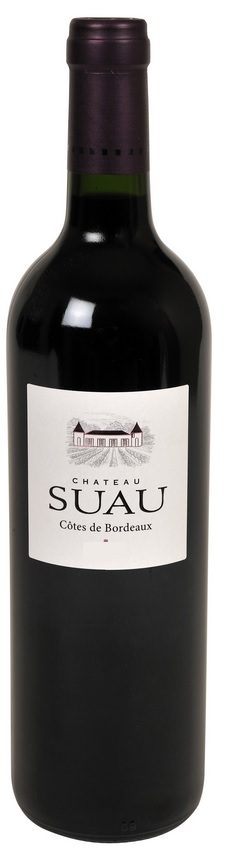
The Chateau Suau Estate
Hidden behind a row of 100-year-old oaks, Chateau Suau was once the hunting lodge of the Duc d'Epernon. It was restored in the 16th century and in 1687, during the reign of Louis XVI, the chateau was owned by the Suau family of Capian. Monique Bonnet purchased the Château in 1986. She lends her impeccable style and elegance to this Bordeaux estate that represents a great value in today’s French wine market.
Important changes have been implemented at Chateau Suau since 2008 :
1/ A change in the AOC. From the 2008 vintage on, Chateau Suau's « Premieres Cotes de Bordeaux » will now be known as « Cotes de Bordeaux and « Cotes de Bordeaux -Cadillac ».
There will no longer be « Premières Cotes de Bordeaux »
Château Suau will use the appellation "Cadillac" on its labels due to its area of production. This "village" appellation lends itself to its enduring notoriety and the image that it represents. As with its namesake, the luxury Cadillac, this wine is the "Cadillac" of wines!
As a result of these changes, all the labels and packaging have been redesigned to reflect the new appellations. These labels will be a reflection of the strong and symbolic identity with Cadillac. This AOC is made with a rigorous set of specifications, which allow it to be named after the village of Cadillac.
Chateau Suau Tradition "Premieres Cotes de Bordeaux" becomes Chateau SUAU Cotes de Bordeaux
Chateau Suau Prestige "Premieres Cotes de Bordeaux" becomes Chateau SUAU Cotes de Bordeaux - Cadillac
2/ Since 2008, Chateau Suau has been converting its vineyard to organic agriculture techniques. Certified by Ecocert, sensitive to environmental problems and consumer-concerns, this healthy, progressive and sensitive conversion will be completed in the year 2012. This action also stays true to Chateau Suau's history for exceptional quality as it was once the home of Joseph Guenant, Vice President of the Agricultural Society.
Chateau Suau is one of the first vineyards of Bordeaux to start its ISO 14 001 certification. This process begins by implementing an EMS, Environnemental Management System (SME in French) of the wines of Bordeaux, intiated by our CIVB. The EMS aims to reduce the impact of wine production on the environment while improving overall productivity.
This environmental management tool integrates both energy consumption, the sorting and recycling of waste, methods of pest control, cropping patterns, health and safety of employees, residents and consumers.....We feel that these changes complement perfectly with our approach to an organic farming culture.
The Chateau Suau Vineyard
The vineyard is situated in the Cotes de Bordeaux-Cadillac appellations, and encompasses 65 hectares (160.55 acres) of red grapes: 10% Cabernet Franc, 55% Merlot and 35% Cabernet Sauvignon; and 7 hectares (17.3 acres) of white grapes: 50% Sémillon, 30% Sauvignon, and 20% Muscadelle. The vines, planted in gravel and clay "terroir", benefit from favorable south-south east facing slopes and plateaus.
The vineyard is farmed with the culture raisonnée method, in conversion to an organic farming. The soil has a gravel and clay base. The red wines are aged in a combination of French oak barrels. No oak is used for the dry white wine produced.

Avennia Sestina Cabernet Sauvignon is made from 77% Cabernet Sauvignon, 17% Merlot, 6% Cabernet Franc.
The story of this wine - The Sestina is an ancient form of poetry from Medieval France. Just as a modern poet can fill this form with new expressions, Avennia uses the traditional Bordeaux blend to express Washington. Sestina is their vision for an old vine, complex blend where all of the components complement each other. This wine is designed for the cellar, so the emphasis is on structure, balance, and complexity.
Winemaker Tasting Notes - “Good deep ruby/garnet color, with aromas of black cherry, fresh black currant, dark mocha, cigar box, and graphite. The palate is lively and dense with mountain berries, mocha, vanilla honey, damp earth, and wildflowers. The finish shows a distinct chalky minerality and beautiful tension. This is a classically balanced and ageworthy Sestina. Drink 2025-2040.” - Chris Peterson, Winemaker
Review:
"The Cabernet Sauvignon-dominated release from Peterson, the 2017 Sestina comes from the Red Willow, Bacchus, and Dionysus vineyards. Rocking levels of crème de cassis, sappy herbs, violets, and cedar pencil all flow to a full-bodied, incredibly pure, polished 2017 that offers flawless balance, ripe tannins, and a great, great finish. It's more approachable than normal yet is still going to evolve for 15 to 20 years. The blend is 77% Cabernet Sauvignon, 17% Merlot, and the rest Cabernet Franc, all raised 20 months in 50% new French oak."
- Jeb Dunnuck (April 2020), 95 pts

Thorn Clarke William Randell Shiraz is made from 100 percent Shiraz
The William Randell range of wines were created in honor of our family ancestor - the esteemed pioneer William Richard Randell (1824 - 1911). The wines are sourced solely from grapes grown on our estate vineyards. Wines in this range are only made in exceptional vintages.
Deep red with inky purple hues. This classic Barossa style shows rich blackberry, licorice, spice plum and smoky oak on the nose. The palate is dense with ripe mulberry and berry compote and generous supporting oak. The tannins are savory and long with spicy refined finish
Following harvest the fruit was crushed into a variety of small fermenters (4 to 6T in capacity). Fermentation was carried out at a warm temperature (25-28 degrees ). The ferments were manually pumped over to provide good control of tannin extraction. Each fermenter was treated as a separate parcel of wine and once dry was filled to American oak (40% new). Following malolactic fermentation the wines were racked and returned to the same oak. Parcels remained in barrel for an average of 18 months prior to blending. Only the best barrels from the multiple parcels were used to make the final blend. Once blended the wine was prepared for bottling.