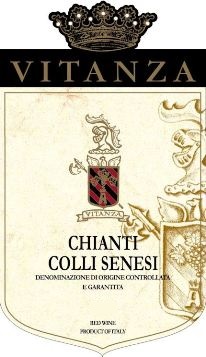
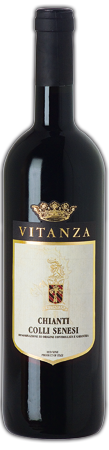
" We don't sell the wine without touching the vine "
| Country: | Italy |
| Regions: | Tuscany Chianti |
| Winery: | Tenuta Vitanza |
| Grape Type: | Sangiovese |
| Vintage: | 2013 |
| Bottle Size: | 750 ml |
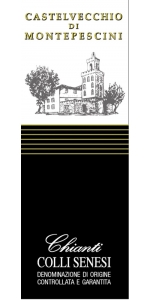
Montepescini Chianti Colli Senesi is made from 90% Sangiovese and 10% Canaiolo.
Deep ruby red in the glass with an intense nose holding blackberry and violet notes. On the palate it is rounded and robust with hints of wild berries, dark cherry and spice. This Chianti has excellent acidity and a long and satisfying finish.
Alcohol: 14.0%
Aging: 8 months in French oak barrels and an additional 3 months in bottle
Vinification: 13 to 15 days of skin contact maceration.
Vineyards: south sun exposure at 350 meters of altitude (1150 feet)
Grapes: 90% Sangiovese and 10% Canaiolo
Pairs well with roasted red and white meats, aged cheeses, dishes with rosemary and garlic or mushrooms.
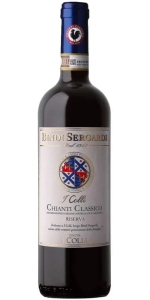
Intense ruby red color. Hints of spices, fruit and flowers, a bouquet that reflects the soil on which it is born, rich in Alberese. In the mouth it is soft, with a pleasant acidity that makes the wine fresh and lively. Sweet and ripe tannins give the wine a pleasant persistence. Riserva dei Colli is an excellent expression of the Estate's Sangiovese, so much so that it bears its name.
Review:
Bordering on opulent, this red features blackberry, black currant, plum, iron and spice aromas and flavors, matched to a velvety texture. Firms up as the resonant tannins emerge, yet remains harmonious and long. Drink now through 2032. 1,700 cases made, 570 cases imported.
-Wine Spectator 93 Points
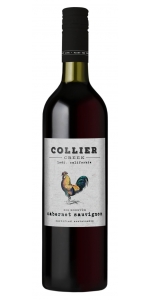
Collier Creek Big Rooster Cabernet Sauvignon is made from 90% Cabernet Sauvignon and 10% Teroldego.
Nestled in the heart of the Lodi Appellation, where farmland ran as far as the eye could see, Collier Creek is a place that reminds us of simpler times. With notes of dark fruit, vanilla and full bodied, we're cocky about how good this Cabernet is. The Big Rooster lands in dry and fruit forward on the finish.
RS: 4.3 g/L
TA: 6.8 g/L
Pair with red meat and stews, or hard cheeses like cheddar.
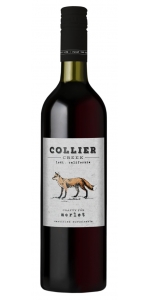
Collier Creek Crafty Fox Merlot is made from 93% Merlot and 7% Teroldego.
Nestled in the heart of the Lodi Appellation, where farmland ran as far as the eye could see, Collier Creek is a place that reminds us of simpler times. Make like a Crafty Fox and fill your den with Merlot that digs into notes of dark fruit and vanilla with a velvet mouthfeel and dry finish.
RS: 3 g/L
TA: 5.5 g/L
Pair with grilled tri-tip, veal scallopini, burger w/ gorgonzola & caramelized onions, classic baked lasagna.
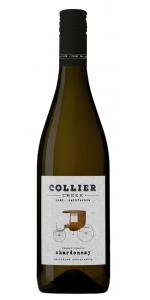
Collier Creek Front Coach Chardonnay is made from 100 percent Chardonnay.
Nestled in the heart of the Lodi Appellation, where farmland ran as far as the eye could see, Collier Creek is a place that reminds us of simpler times. A first class wine for the price of coach, this stainless steel fermented Chardonnay is driven by notes of pear and citrus, rolling out with a dry, refreshing finish.
RS: 3.75 g/L
TA: 6.2 g/L
Pair with grilled chicken, goat cheese, fish tacos w/ citrus slaw.
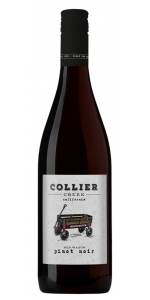
Collier Creek Old Press Zinfandel is made from 93% Zinfandel and 7% Petite Sirah.
Nestled in the heart of the Lodi Appellation, where farmland ran as far as the eye could see, Collier Creek is a place that reminds us of simpler times. The ol' press may look different these days, but this Zinfandel is still a classic with notes of dark fruit, baking spice, vanilla and a velvet mouthfeel.
Pair with blue cheese, bbq pork ribs, leg of lamb.
Vitanza Chianti Colli Senesi 2013 is made from 100% Sangiovese Grosso.
Ages of vineyards: 11 Years
Wine-making: Pre-soaking at a cold temperature for three days; pump-overs following the density and the temperature under computer control.
Aging: 4 Months in Slavonian oak.
Bottle refinement: 8 Months.
Time of Release: After 1 year from the harvest, in April.
Organoleptic Characteristics: Colour red ruby, clear and very fruitty.
Perfume: Intense of fresh cherry.
Taste: Dry, tannic with a smooth body.
The Tenuta Vitanza Estate
The story of Tenuta Vitanza begins in 1994, when Rosalba Vitanza and her soon-to-be husband, Guido Andretta, spent a romantic weekend in Montalcino.
Rosalba has a PhD in Philosophy, and was teaching at the University of Rome, La Sapienza branch. Guido Anderetta was working as an aerospace engineer, running his own consulting business based in the United Kingdom and the U.S.A.
In 1994, they united their efforts behind the purchase of Podere Rensione, a country home with two acres of vineyards. Their first vintage was 1995 and the couple received 93 points from the Wine Spectator. Today, they own 80 acres of vines (not all in production year), and have a long-term goal of 15,000 cases of production. Since 2002, the couple has been building a modern, gravity flow winery, computer controlled, and wi-fi connected, in the town of Torrenieri. The winery has 13 large stainless steel tanks, each signifying a specific vineyard area. Also, the winery has been designed with total traceability, meaning that each bottle is numbered. In the future, you will be able to access their website, punch in the bottle’s number, and receive the following information:
· bottle type
· cork used
· kind of aging & how much time
· vineyard location & exact parcel
· weather that particular vintage
The Tenuta Vitanza Vineyard
25.8 hectares in production now or 63 acres, broken down as follows:
Size Grape Wine Type
14.4 acres Sangiovese Brunello di Montalcino
3.0 acres Sangiovese Chianti, Colli Senesi
4.0 acres Sangiovese Orcia, DOC
1.4 acres Sangiovese Sant Antimo, DOC
3.0 acres Merlot for Quadrimendo & Chianti
25.8 hectares = 63.73 acres
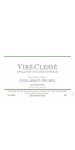
Guillemot-Michel Vire Clesse is made from 100 percent Chardonnay.
Beautifully expressive, with yellow fruits, orange blossom, smoke & flint. Thick and saline on entry, then seriously deep in the mid-palate, with suggestions of exotic fruits perfectly countered by strong minerality. This wine strikes a perfect balance between sweet and salty elements, and it shows vibrant acidity. It boasts a thickness that few other northern Mâconnais can match.
Enjoy with fish (such as sole meuniere), seafood, roasted chicken, goat cheese.
Review:
"The 2018 Viré-Clessé Quintaine is showing beautifully, wafting from the glass with a lovely bouquet of honeyed citrus fruit, fresh pastry and orange blossom. Medium to full-bodied, satiny and supple, it's elegantly textural and refined, with a fragrant core of fruit and a long, penetrating finish. Even though it will reward a bit of bottle age, it's slightly finer-boned than the more concentrated, muscular 2017, so I would opt to drink this immensely charming wine before its older sibling. – William Kelley"
- The Wine Advocate (Issue 249, June 30th 2020), 93 pts
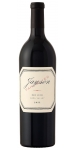
Pahlmeyer Jayson Red Napa Valley is made from 51% Merlot, 27% Cabernet Sauvignon, 11% Malbec, 7% Petit Verdot, 4% Cabernet Franc.
Voluptuousness meets vibrance in this classic Bordeaux-inspired blend. Ripe Merlot-dominant aromas of juicy macerated raspberry unfurl with hints of pencil lead, clove, cedar, and fresh sage. The compact fruit core, flanked by fine, polished tannin, surges open on a full, silky palate, giving way to complex underpinnings of earth and spice. A beam of bright acidity keeps the fruit fresh and focused through a soft, lingering finish of dusty plum and cocoa.
It’s best to serve this rich, layered wine at a temperature between 60°F and 65°F. Open and opulent in its youth, this wine is ready to match with a range of flavorful summer dishes such as Carolina-style pulled pork, bánh mì sandwiches, or bacon cheddar burgers.
Review:
This is a very polished wine in 2022, well-built with neatly knit tannins that form a solid foundation for the dark currant and blackberry fruit that floods the mid-palate. Good depth of concentration and driving energy create a sense of tension and vibrancy. Indeed not a shy wine, yet more approachable, with tannins almost melting away on the finish—very characteristic of the warm vintage. Grape sources include William Hill and Broken Rock in Napa, Stagecoach, Waters, and Round Pond in Rutherford, along with Cabernet Franc and Cabernet Sauvignon from the iconic Monte Rosso Vineyard in Sonoma. Grapes are sorted by hand, fermented in stainless steel with a small percentage in oak tanks, and then aged for 15 months in 80% new French oak. (JC)
-Decanter 94 Points