
" We don't sell the wine without touching the vine "
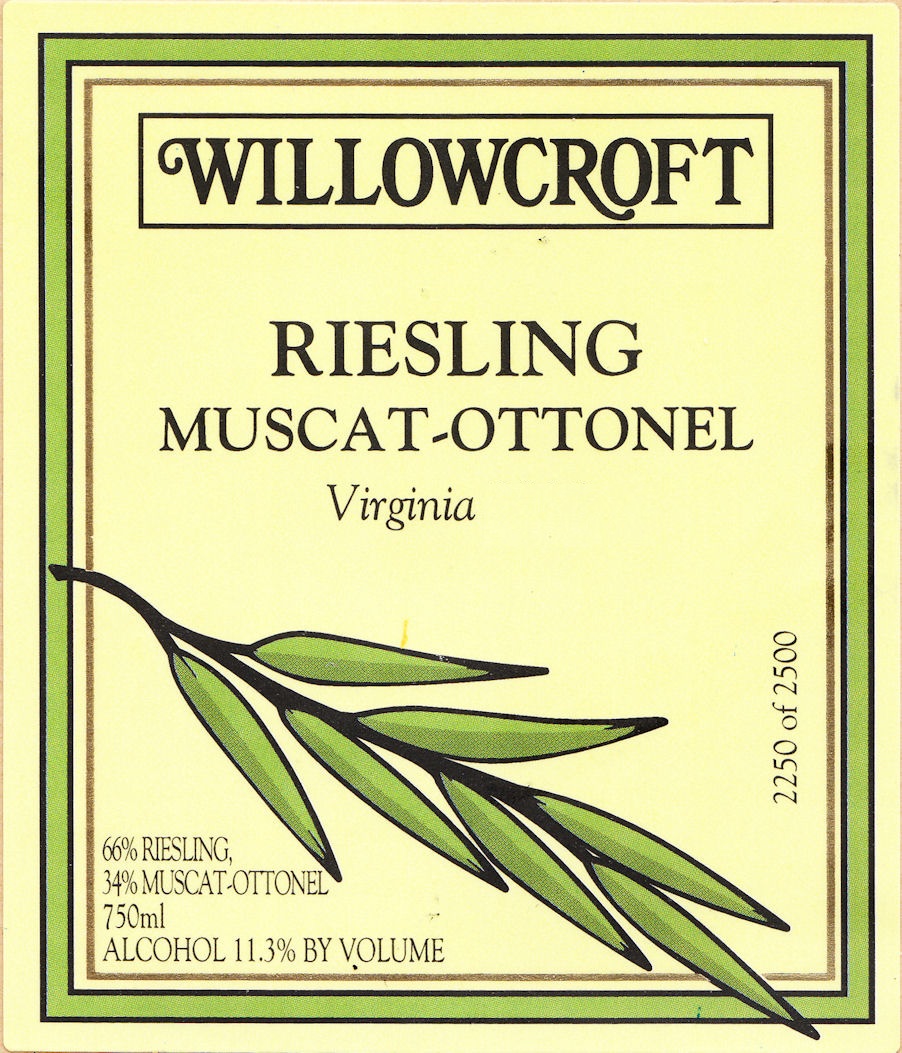
| Country: | United States |
| Region: | Virginia |
| Winery: | Willowcroft |
| Grape Type: | Riesling |
| Vintage: | 2016 |
| Bottle Size: | 750 ml |
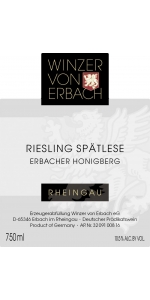
Honeyed style, rich minerality and luscious creaminess. Flavors of baked pineapple and pear. Fresh and juicy on the finish.
From the famous Erbacher Honigberg vineyard. Average of the vines is 20 years old.
Cool fermentation, matured on the lees for 2 months before bottling, with a slight filtration.
Riesling Rheingau Erbacher Honigberg Spatlese goes well with Indian Curry and blue Cheese

All older vintage wines have been purchased from a single collectors cellar. Pictures can be requested before shipment.
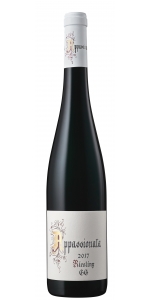
Inspired by the historical winemaking techniques of Erni Loosen’s great-grandfather, the Appassionata Riesling GG is made in the same way as the Dr. Loosen Grosses Gewächs (“Great Growth”) Rieslings he produces in Germany. The GG designation indicates a dry-style wine from a vineyard of special distinction — in this case, the old-vine Medici vineyard, planted in 1976. We farm this exceptional site, which is just a few miles east on the Chehalem Mountain ridge.
The fruit for this wine was harvested from old Rieslng vines (planted in 1976) in the Medici Vineyard, which is also in the Chehalem Mountains AVA, just a few miles from the winery. We lease this vineyard and have been farming it organically since 2015. The wine was fermented in a 3,000-liter German oak cask, and rests on the full lees for 12 months before bottling. The extended lees contact allows the wine to clarify and find its own harmonious balance naturally.
Production notes:
Whole-cluster pressing; natural fermentation in a neutral 3,000-liter oak cask; matured on the full lees for 12 months; no bâtonnage.
Review:
If you prefer a thinking person's wine you'll run out of superlatives to describe this Riesling from Dr Loosen's Oregon project with J Christopher Wines. From a personal favourite, the old vines of the Medici Vineyard, the winemaking shows serious patience and determination. Fermented in a 3,000-liter, neutral oak German Fuder cask. It rests on the full lees for two years and is then held in bottle for three to five years before release. Aged, savoury and delicious. Aromas are savoury and saline. Lanolin, dandelion, seafoam, and beeswax with hints of fresh herbs and dried lemon peel. The palate is brilliant, savoury and bright and complex. Energetic flavours of wet slate, savoury bee pollen, white tea and lanolin notes. The finish offers crushed stone vibrancy.
-Decanter 93 Points
Inspired by the historical winemaking techniques of Erni Loosen’s great-grandfather, the Appassionata Riesling GG is made in the same way as the Dr. Loosen Grosses Gewächs (“Great Growth”) Rieslings he produces in Germany. The GG designation indicates a dry-style wine from a vineyard of special distinction — in this case, the old-vine Medici vineyard, planted in 1976. We farm this exceptional site, which is just a few miles east on the Chehalem Mountain ridge.
The fruit for this wine was harvested from old Rieslng vines (planted in 1976) in the Medici Vineyard, which is also in the Chehalem Mountains AVA, just a few miles from the winery. We lease this vineyard and have been farming it organically since 2015. The wine was fermented in a 3,000-liter German oak cask, and rests on the full lees for 12 months before bottling. The extended lees contact allows the wine to clarify and find its own harmonious balance naturally.
Production notes:
Whole-cluster pressing; natural fermentation in a neutral 3,000-liter oak cask; matured on the full lees for 12 months; no bâtonnage.

No Syrah terroir in Sonoma County compares with Sonoma Mountain’s northwest crown—cool fog-affected mornings, sun-bathed afternoons, cooled by persistent coastal breezes, and temperate evenings. The soils in Steiner’s Syrah blocks — ashy and moondust-like, littered with decomposing sea bed — further contribute to the unique nature of this site. After a 3-vintage hiatus, I am thrilled to be back working with Steiner Vineyard’s Syrah. By its nature, this slow-to-ripen, cool-climate site produces fabulously deep, intense, structured wines. Now, raising a big, brawny Syrah is no rare act of alchemy. It is the wonder of Steiner’s terroir — a magical elegance and beauty, informing the inherent power, depth and intensity — that makes this bottling so special. 2016 produced a classic wine that deftly balances massive flavors and texture, while retaining vital freshness, and a palpable sense of cool. Production was low, so get it while you can. Simply a “WOW” wine, not to be missed.
VINEYARD: Steiner Vineyard. Located at 1,100 ft, on the northwest crown of Sonoma Mountain. CRUSH: Early morning harvest by hand, October 1st, cluster and berry sorted, destemmed and crushed. FERMENT: 5-day cold soaks, followed by 14 day native fermentation in open-top bins. AGING: 20 months, French oak, 100% new, mixture of 300L hogsheads and barrique shapes. Never racked prior to bottling. Bottled unfined, unfiltered.
Review:
"Refined and stylish, featuring a complex core wrapped in multilayered blackberry and blueberry flavors, laced with bitter chocolate, black licorice and smoky meat notes. Drink now through 2030.- Tim FISH"
- Wine Spectator Insider (January 15th 2020), 93 PTS
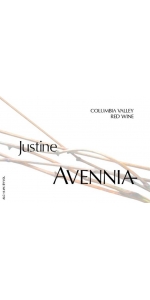
Avennia Justine Red Blend 56% Grenache, 31% Mourvèdre, 13% Syrah
Justine reflects our belief that Washington is capable of producing world class blends of grape varieties traditional to the Southern Rhone region of France. The name is inspired by one of the great heroines of recent literature, who also sprung from the imagination of the Mediterranean. Dark, seductive, complex, with a chasm of depth: The Justine is a great reflection of Avennia's mission of expression, and Washington's generous terroir.
Tasting Note: Big black cherry, blackberry, hints of orange peel, fresh herbs and loam on the nose. Plush and round on the palate. Dark earthy fruits from the Mourvedre, along with citrus high notes, mountain flowers, jasmine, and savory herbs. Balanced and complex without forgetting its hedonistic roots in the Southern Rhone.
Review:
A blend of 56% Grenache, 31% Mourvèdre, 13% Syrah brought up all in older oak, the 2016 Justine offers a great core of black fruits as well as lots of peppery herbs, earth, and classic meatiness. It looks to be a great vintage for this cuvée."
- Jeb Dunnuck (April 2018), 92-94 pts
Good presentation of the floral notes of the Muscat ottonel with the Riesling. These 2 grape varietals are complementing each others bringing some acidity and some rich fruit and floral flavors.
A very small residual sugar of 0.7% is kept for balance.
Willowcroft Riesling Muscat-Ottonel is made from 66% Riesling and 34% Muscat-Ottonel grapes grown on silty loam soils.
Average age of the vines is 30 years old.
No Malo-Lactic fermentation in order to preserve a good acidity and some freshness.
Fermented and aged for 7 months in Stainless steel tanks.
It was slightly filtered before bottling.
CELEBRATING 31 YEARS OF WINE MAKING EXCELLENCE.
Willowcroft boasts breathless panoramic views of Loudoun Valley and the Blue Ridge Mountains. Willowcroft’s personal attention to detail, both in the vineyard and the winery, has resulted in national award-winning wines, time after time. In the 1800s the slopes were recognized for their potential and were planted to orchards. Today vineyards, which have replaced the fruit trees, yield superior grapes. The rustic beauty of the winery, housed in the old red barn, and the award-winning wines, will give you reason to return to this peaceful spot.
Weingut Prager Achleiten Riesling Smaragd is made from 100 percent Riesling.
Franz Prager, co-founder of the Vinea Wachau, had already earned a reputation for his wines when Toni Bodenstein married into the family. Bodenstein’s passion for biodiversity and old terraces, coupled with brilliant winemaking, places Prager in the highest echelon of Austrian producers.
Smaragd is a designation of ripeness for dry wines used exclusively by members of the Vinea Wachau. The wines must have a minimum alcohol of 12.5%. The grapes are hand-harvested, typically in October and November, and are sent directly to press where they spontaneously ferment in stainless-steel tanks.
Achleiten sits east of Weißenkirchen and is one of the most famous vineyards in the Wachau. The steeply-terraced vineyard existed in Roman times. Some sections have just 40 cm of topsoil over the bedrock of Gföler Gneiss, amphibolitic stone, and slate. “Destroyed soil,” as Toni Bodenstein likes to say.
Tasting Notes:
Austrian Riesling is often defined by elevated levels of dry extract thanks to a lengthy ripening period and freshness due to dramatic temperature swings between day and night. Wines from Achleiten’s highly complex soils are famously marked by a mineral note of flint or gun smoke, are intensely flavored, and reliably long-lived.
Food Pairing:
Riesling’s high acidity makes it one of the most versatile wines at the table. Riesling can be used to cut the fattiness of foods such as pork or sausages and can tame some saltiness. Conversely, it can highlight foods such as fish or vegetables in the same way a squeeze of lemon or a vinaigrette might.
Review:
The 2020 Ried Achleiten Riesling Smaragd offers a well-concentrated, fleshy and spicy stone fruit aroma with crunchy and flinty notes. It needs some time to get rid of the stewed fruit flavors, though. Full-bodied, fresh and crystalline, this is an elegant, complex and finely tannic Riesling that needs some years rather than a carafe to polymerize the tannins and gain some finesse. Tasted at the domain in June 2021.
At Prager, I could not determine that 2020 would be inferior to the 2019 vintage; on the contrary, the 2020 Smaragd wines fascinated me enormously in their clear, cool, terroir-tinged way. A 38% loss had occurred mainly because of the hail on August 22, although predominantly in the Federspiel or Riesling vineyards. There was no damage in the top vineyards such as Ried Klaus, Achleiten or Zwerithaler. "Interestingly, the vines are in agony for about two weeks after the hail. There was no more growth, no development of ripeness and sugar," reports Toni Bondenstein. The Veltliner then recovered earlier, while even picking a Riesling Federspiel in October was still a struggle. "Why Riesling reacted more intensively to the hail, I don't know myself either," says Bodenstein. Whole clusters were pressed to preserve acidity and to compensate for the lower extract, and compared to 2019, the 2020s were left on their lees longer. In June, however, the 20s in particular showed outstanding early shape.
-Wine Advocate 94 Points
Light yellow-green, silver reflections. Yellow stone fruit nuances with a mineral underlay, notes of peach and mango, a hint of tangerine zest, mineral touch. Juicy, elegant, white fruit, acidity structure rich in finesse, lemony-salty finish, sure aging potential.
-Falstaff 95 Points
Wine Production: 100% whole bunches undergo a natural yeast fermentation. The wine is then left on lees for a year, with just one handling into the blending tank before bottling. A small amount of Sulphur is added at this point. Wines are bottled without fining or filtration.
Tasting Notes: Spicy and stalky, it has the customary black and red berry notes of Cabernet with a perfumed freshness and medium body. Fine-grained tannins are tempered by the influence of some carbonic maceration in the ferment.
“Cabernet from a north-facing slope on Hans and Anna Orth's vineyard in Coldstream. 100% whole bunches, matured in hogsheads (10% new). A bit darker and denser than last year's wine but equally elegant and perfumed with its scents of blackcurrant, cherry, blackberry leaf and violets. Medium bodied with balanced, mouthcoating yet fine tannins. A lovely wine, more reminiscent of great cabernet franc than sauvignon.”
- James Halliday 96 Points
“Superbly delineated aromas of dried sage, cassis, bay leaves, green beans and mossy forest scents. 100% whole bunch without an ounce of edginess or astringency. This is gorgeous, medium-bodied, perfumed and succulent. There’s a gentle raft of tannins rather than a chunky heaviness. Not dissimilar to the levity and élan of top Loire cabernet franc. Delicious.”
-James Suckling 95 Points



