
" We don't sell the wine without touching the vine "
| BUY MORE! SAVE MORE! | ||||||||||||||||||||
|
| Country: | Italy |
| Region: | Sicily |
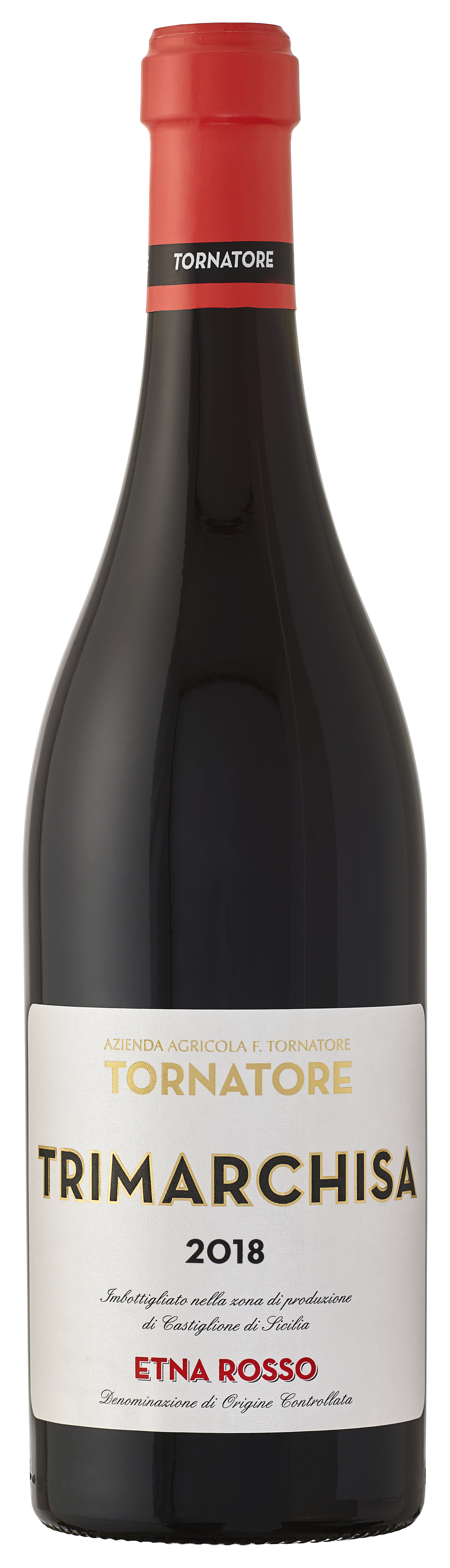
| Winery: | Cantine Tornatore |
| Grape Type: | Nerello Mascalese |
| Organic: | Yes |
| Vintage: | 2018 |
| Bottle Size: | 750 ml |
Ruby red with soft purplish reflections. Rich and complex on the nose, very reminiscent of small fruits of brambles, black cherry and a very delicate hint of softwood. On the palate it is decisive, complex and extraordinarily persistent.
Review:
-James Suckling 94 Points
A long story - of love and passion, of knowledge and respect for places - which has lasted for over a century and a half , since Francesco Tornatore's great-grandfather began farming back in 1865. The Tornatore family has continued, from generation to generation, in the path traced then, developing agricultural activity without ever neglecting the attachment and respect towards the traditions and the territory in which they have their roots.
Located on the fertile northern slopes of Etna, the Tornatore company boasts 100 hectares of lush land, with the largest extension of vineyards in the Etna Doc area , olive groves and hazelnut groves. Representing Sicilian excellence and tradition, our company grows native varieties in historic districts, combining traditional methods and modern technologies to produce superior quality wines. Our passion for wine is reflected in every bottle, celebrating the uniqueness of the Etna area.
Founded in 1865 by Francesco Tornatore's great-grandfather , the company has been carrying on a winemaking tradition that has its roots in the fertile lands of Etna for over 150 years . In 1910, grandfather Giuseppe consolidated the family business by building a millstone in the Piano Fiera district, marking the beginning of an expansion that would encompass other precious lands on the northern side of Etna. Our profound knowledge of the territory , enriched by decades of experience and passed down from generation to generation , allows us today to look to the future with the certainty of those who have always known how to respect the land and its traditions, continuing our commitment to excellence and innovation in the world of wine.
Making wine under the volcano is not easy, yet, for those who succeed, it is the most rewarding thing there is. The Tornatore company is located on the fertile northern side of Etna, whose lands, caressed by significant temperature variations due to the proximity of the Nebrodi Mountains, are home to vines that sink into an unrepeatable terroir , shaped by the activity of the highest volcano in Europe. The magical combination of terroir, climate and production knowledge makes the northern side of Etna an ideal territory for the production of unique wines of exceptional complexity and sensorial richness.

Castellare di Castellina 'I Sodi di San Niccolo' Toscana IGT is a blend of Sangioveto (85%-90%) and Malvasia nera (15-10%)
Castellare’s top wine, ranked in the Wine Spectator Top 100 on multiple occasions and recognised with the prestigious Gambero Rosso’s Tre Bicchieri and Bidenda’s Cinque Grappoli ratings. The company takes great pride in demonstrating the greatness of the Sangioveto variety, paired with Malvasia Nera, achieving a worldwide position of sixth place.
Pairs well with cold cuts and meat rich in flavour, cheeses with a strong and aromatic taste, in particular, Pecorino Toscano and Parmigiano.
The masterpiece of Castellare, I Sodi di San Niccolo, has twice placed in the top 100 of Wine Spectator, and has been awarded “Three Glasses” by Il Gambero Rosso.
I Sodi di San Niccolo is produced solely with native varieties: 85-90% of Sangioveto and 10-15% of Malvasia Nera, I Sodi comes from the two best crus of the farm.
The word "I Sodi" was used by the Tuscan farmers to describe those grounds which had to be processed by hand, being too hard (in fact firm) or too steep to allow for the employment of the horses, unlike the "fields" that make the grounds more easily cultivable.
Reviews:
Clear ruby with a fine garnet sheen. Impressive nose, very finely drawn, aromas of juicy cherries, blood orange and dried thyme, some liquorice in the background. Polished and precise from the attack to the finish, finely-meshed, very well-integrated tannins, flows beautifully, finely worked out fruit, long finish.
-Falstaff 97 Points
Complex and deeply embedded aromas of ripe blackberries, spices and aromatic bark. Full-bodied and very firm for now, with impressive concentration of fruit and tannin. Very long, balanced finish. Great to taste now, but this is one for the cellar. Patience will be rewarded. Sangiovese and malvasia nera. This has always been a top Tuscan red. Best from 2027.
- James Suckling 96 Points
Super fragranced nose, patchouli, pot pourri, Turkish Delight, rose with caramelised red berries and a touch of smoke and incense - all quiet forward and expressive. The nose alone you could smell for hours such is its complexity and beguiling nature. Powerful and concentrated on the palate, this is broad and muscular, sinewy with depth and determination. Tannins are well integrated, really giving the support to the fruit and acidity, driving the flavours forward despite the clear weight and hold. Fragranced red berries continue on the palate with a touch of stone, graphite and matchstick. Rich and big on the mid palate, becoming more focussed towards the finish. Cleary well made with lots going on. Acidity is great, it's cool, clean, sleek and packed full of flavour. Almost too much, this is a big wine, so needs time, but has lots of appeal and mouthwatering freshness throughout. Released on the 9th March. Director and winemaker Alessandro Cellai.
- Decanter 96 Points

Deep red with a slight purple hue on release. The wine has a rich mix of dark chocolate infused with coffee bean and black liquorice, then scents of tar, aniseed, raw (pure) soy and black olive on the nose. The palate is expansive, and yet balanced and finessed. An amalgam of dark berried flavors and textural sensations. The 100% new oak is completely absorbed, meshed with ripe tannins, completing a palate of impressive length and youthfulness.
Parcels of fruit for this wine were identified in the vineyard by the winemakers. Daily fruit inspection led to the fruit being harvested at optimum flavor ripeness. The fruit was harvested at night and quickly transported to the winery. The fruit was destemmed to 6T open fermenters for fermentation. A Shiraz specific yeast was selected to ferment the wine and fermentation was carried out at a maximum of 28°C. The fermenter was manually pumped over twice daily in the first half of fermentation to give the winemakers control of color, flavor and tannin extraction. Pump over regimes were adjusted toward the end of fermentation to suit the tannin and flavor extraction of the wine. The cap was completely broken up on each pump over. The wine remained in fermenters for 6-8 days (dependent on parcel) before being pressed, inoculated with malolactic bacteria and filled to American oak (100% new barrels). The wine was racked post malolactic fermentation and returned to the same barrels. The wine was topped every month and after six months racked and returned to the same barrels again. Prior to bottling the parcels were emptied from oak and blended. Minimal fining and filtration was carried out prior to bottling.
Review:
-Jeb Dunnuck 96 Points
-Wine Spectator 94 Points

Argyle Reserve Pinot Noir is made from 100 percent Pinot Noir.
Pinot Noir thrives in Willamette Valley's long growing seasons with cool autumn breezes and sunny days. This culmination of extra time on the vine yields aromatics of crunchy dried leaves, pomegranate molasses, black tea leaves, and tart cherries. Earthy undertones and great textured tannins that continue to smooth out with time - adding to the body and longevity.
Review:
-Wine Spectator 93 Points

Ferrata Frevi Reserve Etna Rosso is made from 100% Nerello Mascalese.
Intense ruby red witth great structure, silky tannins, soft and elegant.
Pairs well with strong cheeses.
No irrigation. Harvest absolutely by hand as the tradition wants. Best grapes selected by hand from the oldest vines of the vineyard growed with the alberello training system only. Grapes are destemmed and not totally crushed, then kept in thermo-controlled fermentation vats where they macerate for 10/12 days at a temperature ranging between 18 and 22°C. After alcoholic fermentation the grapes are racked with soft presses. This wine is aged for about 24 months in French oak tonneau of 550 LT.
After bottled is aged minimum 10 months in the bottle.

Ferrata Punta Drago Etna Rosso is made from 100% Nerello Mascalese.
Pale ruby red color, elegant bouquet of red berries, spicy notes and underbrush. Great structure, silky tannins, soft and elegant.
Suitable with hors d'oeuvres of cured meats, aged cheese, meat dishes but also fish recipes.

G.D. Vajra Freisa 'Kye' Langhe Rosso is made from 100% Freisa.
DESCRIPTION: In 2004, Freisa was discovered to be the closest relative to Nebbiolo, thus explaining the deep bond this variety has with Piemonte and its people. With a noble profile and similar characteristics to the Nebbiolo, we have been bottling a dry Langhe DOC Freisa ever since 1989. Kyé means ‘who is?’ and represents the surprise for this indigenous and forgotten grape.
VINEYARD AND TERROIR: Estate vineyards, the oldest located in San Ponzio, on the lower west border of Bricco delle Viole. This is the closest vineyard to the winery, and a selezione massale planted by Aldo in 1980.
GROWING: In 1971, Aldo Vaira was one of the earliest adopters of organic farming in Piemonte. Vineyards have been nurtured and soil preserved by grassing and cover crop for almost 50 years now. With an incredible ratio of manual work per hectare, farming at Vajra is a labor of love and “recipe-free” attention. Intense research is also placed into monitoring and improving the biodiversity of both flora and fauna not just in the vineyards, but also in the winery fields and forests. The winery is sustainably certified (UNI EN 11233:2009) and will be again fully organic certified since 2019.
Langhe DOC Freisa Kyè displays a beautiful, translucent garnet color. The aromatics are a combination of redcurrant and wild mountain berries, layered with a touch of sweet spices, fresh leather, and candied japonica prune. The mouth is juicy, succulent, with lots -yet never hefty- tannins. There is a beautiful structure in this vintage and a lovely, lovely finish.
Review:
-Vinous 93 Points

Tenute Mannino Etna Rosso Vasadonna Prefillossera is a red Etna obtained from old vineyards that give life to the typical grapes of the volcano, Nerello Mascalese and Nerello Cappuccio. The wine, with a beautiful light, presents a ruby red color, hints of good finesse with hints of spices and red fruits, aromatic herbs and mineral notes to the nose. The mouthfeel is full, warm and well balanced with tannins that express all the minerality of the volcano, and its freshness that lead to a long and persistent finish.
Then the wine is aged in French Oak barrels for 2 more years.Manual harvest in the second half of October. Spontaneous alcoholic and malolactic fermentation in stainless steel tanks for 6 months.
The vineyards are located in the districts Bragaseggi in the Municipality of Castiglione di Sicilia, on the North side of the volcano at 620 meters above sea level.
Review:
-James Suckling 91 Points

Rinaldi Panta rei Monferrato Rosso is a blend of 50% Barbera and 50% Cabernet Sauvignon.
This wine is quite tasty, smooth, silky and powerful.
It is loaded with dried red fruit notes from the appassimento of the grapes and it also has a lot of spicy aromas and flavors from the oak ageing.
Grown on limestone soils.
The average age of the vines is 30 years old.
10% of the wine is appassimento. Appassimento is an Italian term for drying harvested grapes, traditionally on bamboo racks or straw mats, for a few weeks up to several months to concentrate the sugars and flavors. This process is used in making Amarone, Recioto and Sforzato.
This drying method is not traditional in Piemonte but is popular in other part of Italy like in the Veneto region.
Thanks to this new method the wine is rounder and softer, boasts beautiful notes of red dried fruits.
Pantarei is aged 14 months in French oak ((the wood is Allier, medium toast) barrels and 6 months in bottle before release.
Delicious with wild game, grilled meat and strong cheese.

Capra Marco Doppiadi Barbera d'Asti is made from 100 percent Barbera.
Azienda Agricola Marco Capra was founded in 1945 by Tommaso Capra in the hills of Santo Stefano Belbo, in Piedmont, and today Marco Capra farms some eighteen hectares across the Langhe, Roero and Monferrato. "Doppiadi" is the estate's Barbera d'Asti, grown on calcareous clay soils from vines of twenty to twenty-five years, trained in the traditional Guyot.
Barbera is the everyday red of the region, and this is a fine example: a deep, bright ruby with violet glints, a nose of ripe plum and black cherry, and a palate that is full and generous yet kept lively by Barbera's signature fresh acidity. A natural partner for the table.

“1752” is the name of the Damilano Barolo Cannubi Riserva, in honor of the year in which the historic bottle was first marked “Cannubi”. It still exists today perfectly conserved by the Manzone family in Bra, close to Barolo. The bottle is clearly marked as being of “1752” vintage, indicating that Cannubi historically precedes Barolo.
About the Vineyard:
The Cannubi Cru is in found within one of the 6 core zones which comprise a UNESCO heritage site in Italy. A mixture of Tortonian and Helvetian calcareous marl gives the grapes intense aromas of cherry, plum and tobacco, rose and violet in sequence. Its low potassium and high calcium/magnesium content offer the wine a fine and polished touch. The vineyard is located at about 270 m. a.s.l. and has a south-east sun exposure. Barolo Riserva Cannubi 1752 It is a small plot of about 2 hectares of Nebbiolo vines, currently between 30 and 50 years of age.
Tasting Notes:
Garnet ruby red in color, the bouquet is intense and balanced, with notes of violet, red fruit, cherry and plum, spices, liquorice, cocoa, leather and tobacco. Dry, robust, full-bodied, very persistent, rich and velvety
Food Pairing:
This wine is excellent with typical piedmontes pasta (tajarin, ravioli); perfect with red meat, braised and roast meat, game and absolutely ideal with all types of cheeses.
Review:
-James Suckling 100 Points

Pago de los Capellanes Reserva is made from 100% Tempranillo.
After carefully monitoring the vineyards, the harvest date is set by the maturity of the grapes, which are collected and fermented separately. They are given a six-day pre-fermentation cold maceration below 14ºC, then about 30 days of alcoholic fermentation at a controlled 28ºC, after which the wine is drawn off without pressing the skins; malolactic fermentation is slow and relaxed at 20ºC. The wine is aged 18 months in new French oak barrels, racked into fresh barrels every six months, then blended and bottled without filtration, clarification or cold treatment.
Ruby red with pure, intense garnet tones. The bouquet has fine complexity, with ripe fruit — especially cherry, blueberry and blackcurrant — in harmony with good wood, spice (vanilla and coconut) and a liquorice undertone. The palate shows great balance: pleasing, sweet-tannined from ripe fruit and exuberant on a pleasant level of acidity. Clay and chalk soils; 100% French oak, medium toast. Uncork and decant one hour before serving at 16–18ºC.
Review:
This is poised and polished, with fine acidity and a lingering mineral note grounding the rich blackberry, cassis, and dried cherry fruit. It's framed out by scents of violets, tobacco, incense, and coffee-toffee. It'll make for a beautiful wine at the table over the next 7-10 years.
- Wine Enthusiast 93 Points
Fresh blackberries with a herbal undertone. The palate is fleshy with firm fine-grained tannins and a savory touch. Drink or hold.
- James Suckling 91 Points



