" We don't sell the wine without touching the vine "
| Country: | France |
| Regions: | Languedoc Faugeres |
| Winery: | Les Crus Faugeres |
| Grape Type: | Roussanne |
| Vintage: | 2020 |
| Bottle Size: | 750 ml |

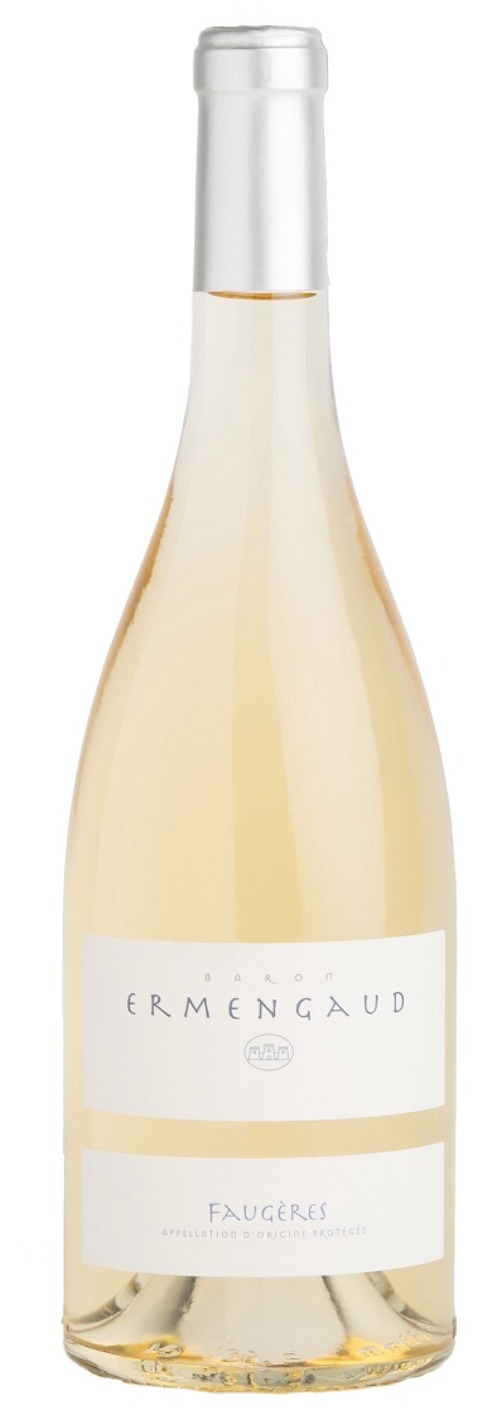
Shiny gold the wine is lively and crisp, with medium-bodied notes of melon, citrus blossom and flowers. Perfectly balanced between richness, fruitiness and freshness.
Excellent with seafood (scallops and fish) as well as poultry (chicken and turkey)

Baron Ermengaud Faugeres Rouge is made from 80% Syrah, 10% Grenache, 5%, Mourvèdre and 5% Carignan.
The Baron Ermengaud cuvée is named after the lord Ermengaud de Fouzilhon. In the 12 century, the Lord gave land, which was located in Laurens Village, to monks, who built a monastic barn. The monks (Benedictine and then Cistercian) used to cultivate the vineyards, using techniques that were quite wise and modern at the time. The people of Laurens enjoyed and benefited from learning their methods.
This Faugeres is dark red with shades of black cherry. A large complexity of aromas allows us to savor a mix of sun fruits and spices. This powerful and full-bodied wine, with a deep consistency, offers an intensity of ripe fruits. It has a long, rich palate on velvety tannins with raised hints of pepper.
Pairs with roast saddle of lamb with juniper berries; peppered venison with pears.

Marie Baron Coteaux du Giennois Blanc is made from 100 percent Sauvignon Blanc.
Coteaux du Giennois is an appellation in the upper Loire Valley, near Sancerre and Pouilly-Fumé. These hillside vineyards benefit from a continental climate with flint and limestone soils that give the wines their distinctive mineral character.
This wine presents a bright pale yellow color with aromas of citrus, white flowers, and flinty minerality. On the palate, it is crisp and vibrant with lively acidity, flavors of grapefruit and lemon, and a refreshing mineral finish.
Excellent with goat cheese, oysters, grilled fish, or fresh salads.

Marie Baron Sancerre Blanc is made from 100 percent Sauvignon Blanc.
Sancerre is one of the most iconic white wine appellations in the world, located in the eastern Loire Valley on steep hillsides overlooking the Loire River. The appellation's Kimmeridgian marl, limestone, and flint soils produce Sauvignon Blanc of exceptional minerality and elegance.
This wine shows a bright, pale straw color with aromas of gooseberry, citrus, and white flowers, underscored by a characteristic chalky minerality. On the palate, it is vibrant and refreshing with crisp acidity, flavors of lime and green apple, and a clean, lingering finish.
Classic pairing with fresh goat cheese (especially Crottin de Chavignol), oysters, grilled fish, or asparagus.

Ferme Blanche Cassis Blanc is made from 40% Marsanne, 20% Ugni Blanc, 20% Clairette, 10% Sauvignon Blanc and 10% Bourboulenc. .
The wine has a pale golden color and offers subtle aromas of citrus fruits, peach and apricot, and floral notes of acacia and linden. Crisp and lively on the palate, good tension and length and a refreshing finish.
Sea stews, shellfish, traditional fish and chips, octopus salad.

Boussey Monthelie Blanc is made from 100 percent Chardonnay.
The name Monthelie comes from Mont Lyoei, mountain of Bacchus.
The Boussey Monthelie Blanc has a nice pale yellow color with green reflections. Aromas of white flowers, fresh almonds, lemon and minerality. The finish is long with a very good balance between the acidity and the ripeness.
Goes well with poultry, fish and crab cakes.
Shiny gold the wine is lively and crisp, with medium-bodied notes of melon, citrus blossom and flowers. Perfectly balanced between richness, fruitiness and freshness.
Excellent with seafood (scallops and fish) as well as poultry (chicken and turkey)
Les Crus Faugères is located in the heart of the Faugères Appellation, in the Languedoc Roussillon.
It is a major player, as it is the only cave cooperative in the area. They manage 900 hectares (2,223 acres) of vineyards, out of the 2,000 hectares (4,940 acres) of Faugeres planted. Let's say that 1 bottle of Faugeres out of 2 is made in this cellar!
Faugeres was recognized as an exclusive quality terroir in 1955, when it was classified as VDQS (Vin De Qualité Supérieure).
Because of the specific soil type and the uniqueness of the terroir, Faugeres became its own AOC in 1982.

Pio Cesare Ornato Barolo is made from 100 percent Nebbiolo.
Vineyards
The very first Single Vineyard Barolo produced by the Pio Family, for the first time in 1985. Great structure, power, concentration, with a very long life. Produced in small quantities.
Vinification
In stainless steel tanks at high temperatures. Maceration for 30 days. Ageing In large oak “botti” for about 30 months; a small amount in French oak barriques for the first 12 months.
Review:
Complex on the nose, offering a blend of ripe red berries, nutty minerals, orange-peel and spice. Some savory, almost meaty notes, too. Full, compact and intense, yet there’s a graceful feel to the palate, thanks to the really fine web of tannin. Super polish and promise here. Classy. Needs some time.
-James Suckling 96 Points

Collemattoni Adone Rosso Toscano is made from 95% Sangiovese and 5% Merlot
ruby red in color, bouquet of violet, cherry and blackberry, pleasant, dry and well balanced mouthfeel.
Coming from a parcel with 5-8 year old vines planted in sandy clay and marl soils.
Harvest is 100% destemmed with a soft pressing, fermentation in stainless steel tanks at controlled temperature of 28-30°C, maceration for 10 days.
Malolactic fermentation completed.
Wine is slightly filtered before bottling.