
" We don't sell the wine without touching the vine "
| Country: | Italy |
| Region: | Abruzzo |
| Winery: | Barone Cornacchia |
| Grape Type: | Montepulciano |
| Vintage: | 2013 |
| Bottle Size: | 750 ml |

Cortenova Montepulciano d' Abruzzo is made from 100% Montepulciano d'Abruzzo
Deep ruby red color with violet highlights and a pleasant and fruity bouquet. Full bodied, soft tannins and good acidity.
Excellent with pasta dishes and red meats.
Cortenova Montepulciano d' Abruzzo is made from 100% Montepulciano d'Abruzzo
Deep ruby red color with violet highlights and a pleasant and fruity bouquet. Full bodied, soft tannins and good acidity.
Excellent with pasta dishes and red meats.

“1752” is the name of the Damilano Barolo Cannubi Riserva, in honor of the year in which the historic bottle was first marked “Cannubi”. It still exists today perfectly conserved by the Manzone family in Bra, close to Barolo. The bottle is clearly marked as being of “1752” vintage, indicating that Cannubi historically precedes Barolo.
About the Vineyard:
The Cannubi Cru is in found within one of the 6 core zones which comprise a UNESCO heritage site in Italy. A mixture of Tortonian and Helvetian calcareous marl gives the grapes intense aromas of cherry, plum and tobacco, rose and violet in sequence. Its low potassium and high calcium/magnesium content offer the wine a fine and polished touch. The vineyard is located at about 270 m. a.s.l. and has a south-east sun exposure. Barolo Riserva Cannubi 1752 It is a small plot of about 2 hectares of Nebbiolo vines, currently between 30 and 50 years of age.
Tasting Notes:
Garnet ruby red in color, the bouquet is intense and balanced, with notes of violet, red fruit, cherry and plum, spices, liquorice, cocoa, leather and tobacco. Dry, robust, full-bodied, very persistent, rich and velvety
Food Pairing:
This wine is excellent with typical piedmontes pasta (tajarin, ravioli); perfect with red meat, braised and roast meat, game and absolutely ideal with all types of cheeses.
Review:
The purity of this wine is pretty phenomenal with blackberries, strawberries, fresh flowers and licorice. Hints of tar. It’s full-bodied, yet composed and compact with ultra fine tannins and a long, flavorful finish. Very structured. Try after 2024.
-James Suckling 97 Points

Bindella Vino Nobile di Montepulciano is made from 85% Sangiovese, 15% Colorino del Valdarno, Canaiolo nero and Mammolo.
Elegant, with typical hints of iris, rose and red berries together with balsamic notes after several years of ageing in the bottle. Balanced, pleasantly tannic and well-bodied on the palate.
A wine of great authenticity to accompany pasta with elaborate sauces, red meat, truffles and soft or mature cheeses.

Charles Heidsieck Vintage Brut is made from 57% Pinot Noir, 43% Chardonnay.
A beautiful golden robe offers glints of green accentuated by a delicate, dynamic effervescence. The initial nose introduces intense toasted and smoky notes along with ripe fruit. When swirled in the glass, the nose takes on a heartier dimension with touches of apricot and vineyard peaches. The aromatic concentration, due to a heat wave of several weeks, is reminiscent of the summer sun. The attack is taut and decisive. the creamy texture, the crisp fruitiness and spiced notes of cinnamon, licorice and pepper are the hallmark of the House style.
Review:
Aged for eight years on the lees before disgorgement, the Champagne is deliciously toasty with acidity and fine dryness.
-Wine Enthusiast 96 Points
Disgorged in January of 2023, the 2013 Champagne Millésime Brut was the last vintage from the cellar master for Heidsieck prior to Cyril Brun. The 2013 Champagne Millésime Brut is a bright straw yellow color and is based on the crus of Les Mesnil, Avize, Averney, and Aÿ. It’s fresh with aromas of wet stones, fresh quince, and fresh jasmine flowers. It has a chalky and focused texture, with ripeness to balance it out, and a long, graceful finish. At this stage, it feels more forward with 57% Pinot Noir and the rest Chardonnay. A more mineral-tinged expression, it has a lot of charm and the promise of longevity over the coming two decades. Drink 2024-2044. It will be interesting to see how the Pinot shows itself over time. 8 grams per liter dosage.
-Jeb Dunnuck 95 Points

The Stone Corral Vineyard is planted on a southeast slope on the west side of the Edna Valley which has an east/west orientation opening up to the Pacific Ocean from Morro Bay and Pismo Beach. Approximately 120 to 300 feet above sea level, the climate is strongly influenced by the ocean providing ideal temperate growing conditions for Pinot Noir. Early spring warming, mild summer temperatures and late arriving cold fall temperatures and rain provide a long growing season for the development of rich color, concentrated and complex flavors. Soil profiles vary between blocks from sand, sandy loam, loamy sand, pebbly sandy clay loam, all fine angular blocky , including decomposing sandstone layers and numerous fossil rocks. The soils are well drained and marine in origin, resulting in an elegant Pinot Noir with extraordinary attributes.
This gem is a blend of a few precious, select barrels hailing from the finest blocks of Stone Corral Vineyard. Offers blue-toned fruit on the nose and a pretty bouquet of black raspberry, sandstone, marzipan and wild lupine flowers. Opulent, yet delicate on the palate, with velvety layers of cola nut, cherry, dried herbs and pecan sandie cookies.
Wine analysis – 13.7% Alcohol, .69 TA, 3.5pH
- A barrel select Stone Corral Vineyard bottling, utilizing the finest blocks and clones of the 2013 vintage
- Blend of clones 115, 777 and 667 on 101-14 and 3309 rootstalks
- Hand harvested, cold fruit from night picks during the month of September 2013
- Yield about 2 tons per acre between 23.8 and 24.5 ° Brix
- Destemmed with nearly 100 % whole berries remaining
- Fermented in small open top tanks
- 4 day cold soak, average 14 day fermentation, peak temperature 83°
- Hand punched down several times daily as needed
- Pressed off just dry, tank settled then racked to barrels
- Aged in small French oak barrels for 18 months
- Once the fresh wine is transferred from the press pan, all moving of the wine is done with inert gas pressure.
When handling the wine, care is taken at all opportunities to avoid shear.
"This bottling comes from the best blocks and barrels from this single vineyard, co-owned by a number of Edna Valley luminaries. The result is stunning, with baked raspberry, strawberry, maple, and peppery bacon aromas comprising a spicy, exotic nose. Black plum fruit melds with white pepper and crushed herbs, diving into tangy strawberry and sandalwood incense notes on the finish. - Matt Kettmann"
- Wine Enthusiast Magazine (April 1st 2017), 95 pts
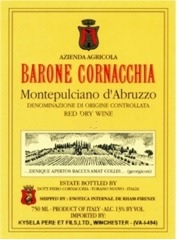
Barone Cornacchia Montepulciano d'Abruzzo 2013 is 90% Montepulciano 10% Sangiovese
Deep ruby red with violet-purple reflections.
Huge, fruity bouquet, black cherry and herb scented.
Lush currant fruit with velvety soft tannins and perfect fruit acid balance. A wine of great harmony and intensity. The finish is long and spicy.
Area of production: Torri di Torano Nuovo Harvest: October– by hand. Vinification: 15 to 18 days maceration on the skins with a daily pumping over of the juice. Fermentation takes place in stainless steel at 28-30 °C. Alcohol: 13% by vol.
Grilled or roasted white and red meats, dishes flavored with mushrooms, garlic and rosemary. Excellent with polenta dishes and game.
The Barone Cornacchia Estate
Barone Cornacchia was first established in Montepucliano in the end of the 19th Century and is considered a pioneer in the aging and bottling of Montepulciano d'Abruzzo. Located in the province of Teramo, the estate dominates the fertile valley of the Vibrata, lying at 240 meters above sea level.
The Barone Cornacchia Vineyard
Cornacchia currently has 32 hectares (79.04 acres) of vineyard and the vines are 20 to 40 years old. The soil is calcareous and stony which is excellent for drainage. Moderate influences from the sea, only 15 km away, allow for perfect ripening.

In 1992 the Hill-Smith family counted themselves amongst those fortunate enough to own a vineyard upon the famous Coonawarra terra rossa soil over limestone. Experimentation, innovation, minimalist intervention and small batch winemaking has resulted in The Menzies’ reputation as a wine of longevity, elegance and structure.
Situated in the heart of Coonawarra’s terra rossa strip, The Menzies Estate vineyard lies on a flat plain, approximately 70km from the coast. Given the terrain and influence of the cooling Bonney upwelling, Coonawarra is an ideal location to grow premium Cabernet Sauvignon. Our soil is red sandy loam over limestone, which is classic Cabernet Sauvignon country. The grapes for The Menzies 2017 are from vines planted in 1994 and 1996. Bunches are usually small with small berries, giving concentration via an ideal skin to juice ratio favouring the making of fullbodied reds.
Experimentation, innovation, minimalist intervention, and small batch winemaking has resulted in The Menzies' reputation as a wine of longevity, elegance, and structure.
Aromas of fresh rosemary, mulberry, violets and exotic spices. Take a sip and you will feel the poise and tension for which great Cabernet is renowned. A wine of great complexity with flavors of blackcurrant, bitter chocolate, and mulberries, wrapped in divine tannins and a lovely sweet, dark fruit finish. With decanting in its youth, it is enjoyable as an elegant full-bodied red wine.
Review:
The 2017 The Menzies Cabernet Sauvignon is looking good next to the 2016 tasted beside it. It is fresh and vibrant, with layers of complexing dark earth characters, with cigar box, black olive brine, cassis, bramble, milk chocolate and cracked black pepper. This is very good, and it has what I am coming to recognize as a "Yalumba red character": dried herbs, particularly oregano. The juicy splay of fruit through the finish is a highlight.
-Wine Advocate 95 Points

Segla Rauzan Margaux is made from 54% Cabernet Sauvignon, 41% Merlot, 4% Petit Verdot, 1% Cabernet Franc.
Deep ruby in appearance, Segla delivers aromas of blueberry and vanilla on the nose. On the palate it is medium bodied with silky tannins.
Review:
Takes a very fresh approach, with an open-knit feel to the mulled raspberry and red currant fruit. Pretty lilac, incense and singed apple wood notes underscore the fruit, while silky but persistent tannins carry the finish. Shows latent depth and precise balance, so don't let this early charm fool you, as this should unfurl beautifully in the cellar. Best from 2022 through 2040. 10,000 cases made.
-Wine Spectator 95 Points



