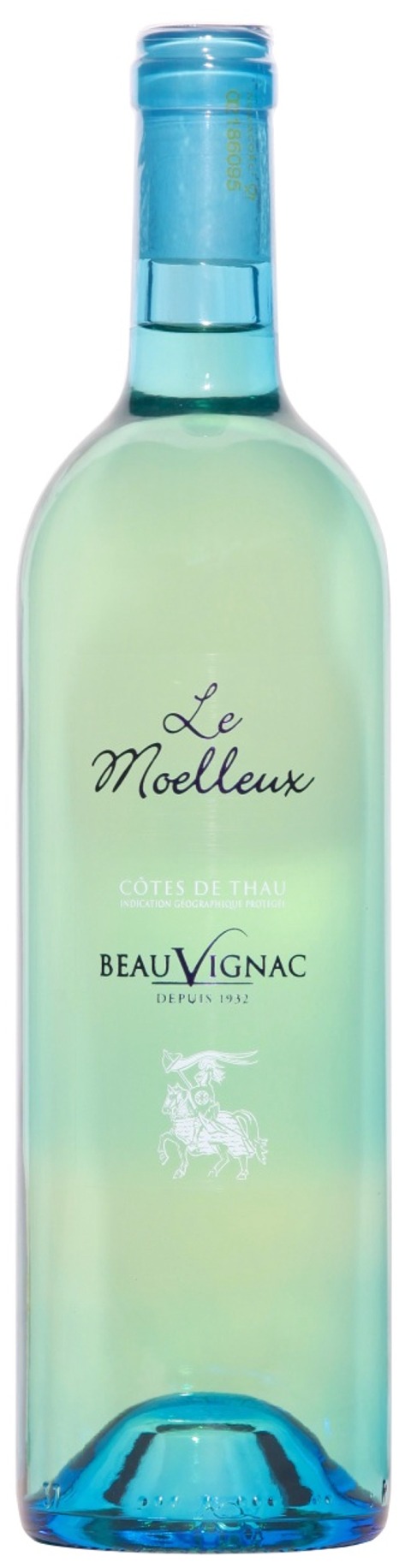
" We don't sell the wine without touching the vine "
| Country: | France |
| Region: | Languedoc |
| Winery: | Cave de Pomerols |
| Grape Type: | Colombard |
| Vintage: | 2018 |
| Bottle Size: | 750 ml |
Picpoul de Pinet H.B. Chevalier Patience is a white wine made from 100% Picpoul.
Clear and crystalline color of an intense pure yellow with golden reflections.
The aromas in retro-olfaction are particularly faithful to direct olfaction, also intense, complex and extend long in the final too.
It is a fresh, generous and round wine with a rich taste balance.
The entry is supple, the beautiful natural freshness of this exceptional Picpoul is revealed from the middle of palate and extends beautifully on the finish.
The nose is very expressive, flattering and complex.
Alejandro Bulgheroni Lithology Beckstoffer Las Piedras Cabernet Sauvignon is made from 100 percent Cabernet Sauvignon.
From a St. Helena vineyard planted by early Napa settler Edward Bale more than 150 years ago, and later serving as the estate vineyard for the area’s first winery built by Henry Pellet in 1860, the Las Piedras site always gives us our prettiest wine. When placed next to Dr. Crane and To-Kalon wines, the Las Piedras show a certain elegance, with a very graceful entry and finely detailed complexity. We produce it with at least 75% new French oak, so there is a floral, spicy, and vanilla accent to the intense red and black fruits, cassis, and black cherry liqueur. What distinguishes this bottling is the beautifully fine tannins, delicate texture, and stunning purity. (Less than 100 cases made.)
Fermentation 70% Oak, 24% Concrete, 6% Puncheon
Review:
"The 2018 Cabernet Sauvignon Lithology Beckstoffer Las Piedras Vineyard comes from a world-class site outside of St. Helena and is all Cabernet that spent 20 months in 80% new oak. It offers a touch more red fruit as well ample cassis, spring flowers, loamy earth, and spice-like aromas and flavors. It has a wonderful sense of minerality, ultra-fine tannins, a dense, layered texture, and incredibly purity of fruit. It’s another just about off the charts release from this estate."
- Jeb Dunnuck 98 Points
Argot Chardonnay Sonoma County is made from 100 percent Chardonnay.
Pouring a green-tinted gold, our Sonoma County Chardonnay is a beautiful wine from word go. Radiating from within, a blast of apple/pear fruit informs this wine both aromatically, and on the palate. As flavors unfurl, a progression of orange blossom, pineapple, white peach, and hazlenut are followed by a finish dominated by ginger, baked apple, with a trailing kiss of mint’s freshness. A stunning wine — wholly informed by the perfection of 2018’s growing season — defined by its dichotomy of massively intense flavors, and superb acidity and freshness.
Raised by minimalistic methods, often associated with the classic Chardonnay winemaking techniques of Meursault. With a focus on the coolest Chardonnay region in Sonoma County, 2018’s long, even growing season favored our vineyards’ moderate climate, old vines and deep volcanic soils. These grapes were allowed an extended ripening period on the vine, resulting in perfect balance and concentrated flavors.
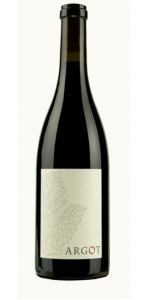
Argot Pinot Noir Sonoma County is made from 100 percent Pinot Noir.
Everything you have come to expect from an Argot Pinot Noir, shone through the filter of a textbook-perfect vintage. We simply can not get over the quality of fruit this wine displays! Intense, yet fresh; fruity, yet spicy; brambly, yet juicy; immediate, yet lingering. A Pinot Noir that displays the variety’s natural come-hither attitude, while succinctly capturing its intriguing nature. There are not enough superlatives to describe this wine. Almost too easy to love!
VINEYARD Multiple vineyards throughout Sonoma County, including both valley floor and high-elevation hillside sites
PRODUCTION 600 cases
VARIETAL 100% Pinot Noir
CRUSH Night harvested by hand beginning in mid-September, concluding at our coolest sit on October 13. Cluster and berry sorted by hand, de-stemmed, no crushing
FERMENT 7-day cold soaks, followed by native fermentation in open-top containers, with the grapes fermenting on their skins for an average time of 14 days.
AGING 16 months, French oak barrels, 7% new, remainder once-used. Never racked prior to bottling. Bottled un-fined, unfiltered.
NOTES Singularly great. 2018 was an all-time vintage for California’s North Coast, achieving rarely before experienced heights. A mild summer gave way to Autumnal perfection, allowing cooler areas the opportunity to ripen their crop while chemistries remained perfect. What arrives in bottle is nothing short of a pinnacle representation of Sonoma County Pinot Noir — profound depth of pure, red Pinot Noir fruits, caressing textures balanced by deep minerality and a quenching acidity.
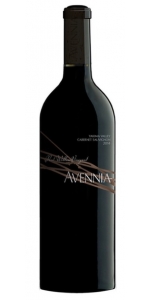
Avennia Red Willow Cabernet Sauvignon is made from 100% Cabernet Sauvignon.
The Red Willow Cabernet is a true blockbuster.
Coming from one specific block of 30 year old vines at this iconic vineyard, then strictly barrel selected, this is the essence of powerful, old vine Washington Cabernet. After all of our efforts promoting the idea of the Bordeaux blend, it would take a pretty compelling argument to suspend that idea and make a 100% varietal Cabernet. In 2016 Red Willow provided us with just that. Each time we tasted it in the barrel, the belief grew that this was something special. Something we can't make every year. In the end we were won over, and decided to make a limited amount of this wine. But don't be fooled, as this too is a blend and a selection. Each year as we are tasting the grapes as harvest approaches, we notice that the vines near the bottom of this long, steep west-facing slope, are a little different. The vines at the bottom are in a little richer soil, and get a little more water, so we pick them separately, sometimes even a week or ten days apart, and keep them separate in barrel.
This wine is all from the top of the vineyard, with its lower yield and poorer soils giving more concentration and interest. Then further, nearly every combination of new and used French oak barrels were trialed to find the best blend. It's not enough just to use the four best barrels, but to trial each combination to see how they complement each other. For a wine with this much mass, 100% new French oak was used for the first time at Avennia. It is a wine that needs a little cellaring to start, but should last a very long time.
Review:
The flagship Cabernet, the 2018 Cabernet Sauvignon Red Willow Vineyard is all varietal, from old vines in a great vineyard in Yakima Valley, that spent 20 months in 80% new French oak. It reveals a deep purple hue as well as a backward, brooding nose of smoked blackcurrants, tobacco, scorched earth, and violets. It has beautiful richness yet takes plenty of coaxing to open up. On the palate, it's medium to full-bodied and has a nicely textured, balanced mouthfeel, plenty of tannins, and outstanding length. It's mostly potential at this point and is going to benefit from at least 4-5 years of bottle age, but my money is on it having 20+ years of prime drinking.
-Jeb Dunnuck 96 Points
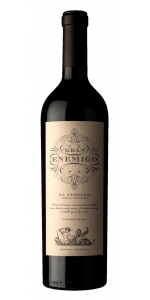
Enemigo El Enemigo Gran Enemigo is made from 100% Cabernet Franc.
In the spectrum of people who pay attention to detail, winemakers are often incredibly detail-oriented. This can sometimes spill over to become an internal battled, and, as Alejandro Vigil and Adrianna Catena state, "We are our own worst enemy." El Enemigo pays homage to this internal struggle.
The nose presents sweet aromas of black ripen fruits with hints of vanilla and chocolate, which appear after the oak ageing. The mouthfeel is sweet with structured, persistent tannins due to the natural acidity of this wine, leading into an excellent long finish.
Review:
The nose of the 2018 Gran Enemigo El Cepillo Single Vineyard, from a low-yielding and drier year, is full of curry, a note that was a constant across the three vintages I tasted together, but it tends to be stronger in low-yielding and dry years like this. It's also floral and comes through as aromatic and a little exotic, in a good way, with elegance, persistence and very pure flavors. It has fine-grained tannins, great acidity and balance. 7,200 bottles. All these single-vineyard bottlings mature in ancient 4,000-liter oak foudres for some 15 months.
-Wine Advocate 97 Points"Pretty and inviting on the nose with gorgeous aromas of floral violet, cassis and completed with a lifted, delicate liquorice note. The palate is graced with deep herb, pepper, crunchy red fruit and graceful, silky tannins."
-Decanter 97 Points
Beauvignac Moelleux Picpoul is made from 60% Colombard and 40% Picpoul de Pinet.
There is some sweetness, all natural, coming from the ripeness and the natural sugar of the grapes as the fermentation was stopped before all the sugar was transformed into alcohol during alcoholic fermentation.
The Cave de Pomerols Estate
Founded in 1932, this Cave Cooperative is located in the top commune of Pomerols, located between the garrigue of Pezenas and the sea dominated by the Mont St Clair in Sete. The co-op has merged with the Cave de Castelmau de Guers. They include 320 members and produce 55,000 hectoliters of wine (600,000 cases).
The Cave de Pomerols Vineyard
The members control 1,200 hectares of vineyard land (2,964 acres) of which 330 hectares (815.1 acres) are Picpoul de Pinet. Six communes are entitled to the name Picpoul de Pinet: Florensac, Pomerols, Pinet, Castelnau de Guers, Montagnac, Meze. The Pomerols vineyards stretch over vast sun-light terraces with clay/calcareous soils.
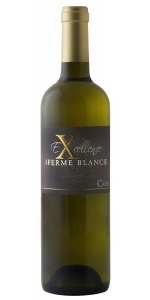
Ferme Blanche Cassis Blanc Excellence is made from 50% Marsanne and 50% Clairette.
On the nose, white fruits, citrus zest, hint of vanilla. Velvety well balanced mouth of ripe fruits and minerality.
Pair with trout, Scallop, or better yet lobster would complement this wine perfectly.
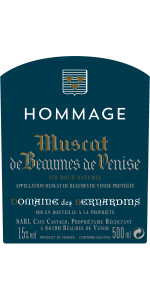
Bernardins Muscat de Beaumes de Venise Hommage is made from 75% Muscat petits grains blancs, 25% Muscat petits grains noirs.
The wine shows a golden hue with orangy highlights. Endearing nose of grape, orange peel and a honeyed accent. Mild at point of entry, spendid aromatic intensity, sultana, candied orange, rose petal and refined spice. Our Muscat de Beaumes de Venise has a great age ability.
For every vintage of our Muscat de Beaumes de Venise, the grapes are picked by hand. We press them straightaway to ferment the juice without skins. We don’t add any yeasts and keep the alcoholic fermentation in check by temperature control. Vin Doux Naturel winemaking involves stopping fermentation to preserve the grapes’ natural sweetness. During vinification, we watch the vats day and night and add 95% grape spirit just at the right moment. At this stage, the wine’s final balance is at stake. For the Hommage, we blend different vintages, aged in stain steel vats, to create the complexity of a long lasting wine.
The Hommage is a versatile companion to many deserts. Most expressive with dry biscuits and dry fruits, it retains all its character served with a fruit tart, puff paestry and chocolate or coffe desserts. To appreciate as well with duck breasts and figs. Served with a roquefort or a silton, it is marvellous. Simply as an aperitif with some dry fruit or grilled almonds. It's also a good compagnion for a classy cigars.
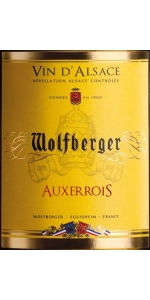
Wolfberger Auxerrois is made from 100% Auxerrois
Auxerrois blanc is thought to have originated in Lorraine, rather than near Auxerre in the Yonne. Recent DNA fingerprinting suggests that it is a cross between Gouais blanc and Pinot noir, the same ancestry as Chardonnay. The name Auxerrois blanc has actually been used as a synonym for Chardonnay in the Moselle region in France, which explains why there is also a longer name (Auxerrois Blanc de Laquenexy) for the grape variety.
This pale yellow Auxerrois Pinot Blanc shows an intense nose of fresh white fruits, rhubarb and spring flowers. Easy to drink and fresh on the palate, this wine ends on a fruity and crunchiness tast.
Alcoholic fermentation at 16°C followed by a short fermentation at 18°C allowing to keep some crispiness to the wine.
Then the wine was aged on the fine lees for 6-7 months. No Oak.
No Malo-Lactic fermentation.
Right before bottling, the wine was filtered using a tangentiel filtration system.
Quiche, grilled fish, rhubarb pie, mixed salad, and also fresh sheep milk cheese.

Fonseca Vintage Port 1966 has been pulled from a Gentleman's cellar, all wines from this cellar have been purchased by the owner either from the importer or direct from winery. They stayed in his cellar until being moved to the Timeless Wines warehouse.
Segries Tavel Rose is made from 50% Grenache, 30% Cinsault, 15% Clairette, 5% Syrah.
The age of the vines is 30 years. Traditional vinification at low temperature, "vin de saignée" with a maceration during one night in cement vat.
This is large for a Rose...structured and focused, with the color of dark ruby. The nose is loaded up with fresh fruit. Strawberry, blackcurrant, and raspberry beam from the glass. On the palate, the mouth-feel is ripe and succulent. It has strength, but maintains its fresh and crisp expression. The finish is filled with Asian spice and slight hints of smoke. Drink this juice now or over the next year or two.