" We don't sell the wine without touching the vine "
| Country: | France |
| Region: | Rhone |
| Winery: | Bernardins |
| Grape Type: | Muscat |
| Organic: | Yes |
| Vintage: | 2020 |
| Bottle Size: | 750 ml |

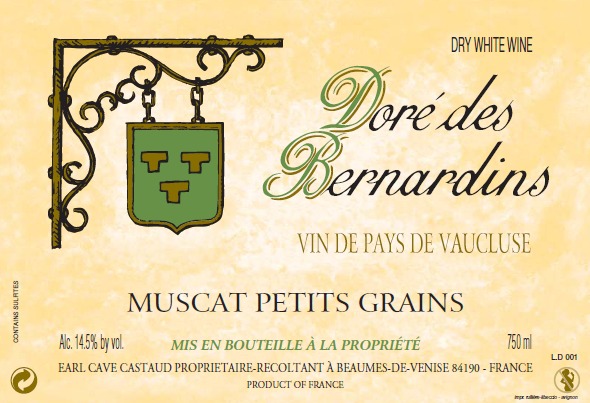
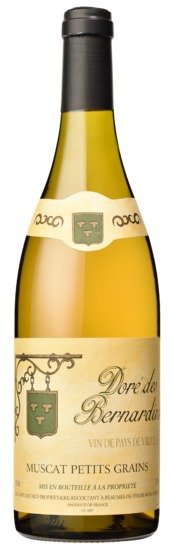
Bernardins Dry Muscat Dore des Bernardins is made from 100% white Muscat petit grains.
Doré des Bernardins is a dry white wine that is only produced in years when the Muscat à petit grains crop is large enough. Grapes are picked at the same ripeness level as for the Vin Doux Naturel. In contrast to Muscat de Beaumes de Venise, the fermentation isn’t stopped, giving a fruity dry wine with intense Muscat aromas.
Dry Muscat with a fruity, nice perfume, honeysuckle and melon aromas, lively rounded mouth-feel. Elegant, fresh and medium-bodied.
Situation
Spreads out over the south-east side of the Dentelles de Montmirail hills, in Beaumes de Venise in the southern part of the Rhone valley.
Terroir
On a poor sandy, hungry and arid soil consisting of tender limestone and gritty zones of sandy mollasse.
In the vineyard
The vineyards and their terroir are the essence of our wines. This is where everything starts and where we focus our efforts throughout the year. You can’t make great wine without great grapes.
The viticulture is essentially done by hand. Five people work full-time in the vineyards. They are supplemented by seasonal employees who work during bunch thinning and the harvest in order to bring out the very best in our vines. Working by hand and the attention each vine gets are fundamental. Pruning, de-budding, trellising, leaf removal and picking are thus carried out by hand with the utmost care.
We prepare the soil by using good old-fashioned ploughing. Organic compost is made from grape marc (the discarded stalks and skins).
As a way of protecting the plants, we only use phytosanitary products when necessary and within strict guidelines by staggering the treatments appropriately, to minimise the amount of chemicals used. We prefer to use as much as possible manual and organic techniques. Leaving natural grass cover, removing buds and leaves from the vines, preserving biodiversity around the vineyard: olive, almond and cypress trees, wild rosemary and capers.
Winemaking
Our Doré des Bernardins is a dry white wine that we only produce in years when the Muscat à petits grains crop is large enough. We pick the grapes at the same ripeness level as for the Vin Doux Naturel. In contrast to Muscat de Beaumes, the fermentation isn’t stopped, giving a fruity dry wine with intense Muscat aromas.
Nicely chilled, this dry white wine is great as an aperitif or with asparagus, seafood, king prawns, fish.

Bernardins Muscat de Beaumes de Venise Hommage is made from 75% Muscat petits grains blancs, 25% Muscat petits grains noirs.
The wine shows a golden hue with orangy highlights. Endearing nose of grape, orange peel and a honeyed accent. Mild at point of entry, spendid aromatic intensity, sultana, candied orange, rose petal and refined spice. Our Muscat de Beaumes de Venise has a great age ability.
For every vintage of our Muscat de Beaumes de Venise, the grapes are picked by hand. We press them straightaway to ferment the juice without skins. We don’t add any yeasts and keep the alcoholic fermentation in check by temperature control. Vin Doux Naturel winemaking involves stopping fermentation to preserve the grapes’ natural sweetness. During vinification, we watch the vats day and night and add 95% grape spirit just at the right moment. At this stage, the wine’s final balance is at stake. For the Hommage, we blend different vintages, aged in stain steel vats, to create the complexity of a long lasting wine.
The Hommage is a versatile companion to many deserts. Most expressive with dry biscuits and dry fruits, it retains all its character served with a fruit tart, puff paestry and chocolate or coffe desserts. To appreciate as well with duck breasts and figs. Served with a roquefort or a silton, it is marvellous. Simply as an aperitif with some dry fruit or grilled almonds. It's also a good compagnion for a classy cigars.

Mordoree Chateauneuf-du-Pape La Reine des Bois is made from Grenache 75 %, Mourvèdre 10%, Syrah 10 % , Counoise 3% & Vaccarese 2%.
This premium cuvee - whose name means "Queen of the Woods" - is from 65-year-old vines, planted on Villafranchian-era terrasses. Yield is 30 hl/ha.
Deep ruby red; opaque. Aromas of red fruits change to wooden touches of leather, black truffles and coffee. Fat, concentrated and full flavored with a very long liquoriced and fruity finish.
Pairs with red meats, sauce dishes, game animals (woodcock, wild boar) and semi mature cheeses.
Review:
-Jeb Dunnuck 96 Points

Bernardins Muscat Beaumes Venise VDN 2025 is made from Muscat.
Winery Info: Domaine des Bernardins, a family estate in Beaumes-de-Venise in the southern Rhone, is one of the historic producers of this appellation's vin doux naturel — a naturally sweet, lightly fortified Muscat.
Fragrant with orange blossom, apricot and honey. A classic partner for fruit desserts and blue cheese, or on its own. This is the 375ml half-bottle.

Mordoree Lirac Blanc Reine des Bois is made from Grapes : Grenache 35 % Clairette 25 % Viognier 10 % Roussanne 15 % Marsanne 10 % Picpoul 5%>
Color : green gold
Aromas : white fruits, peach, apricot, pear, violet.
Palate : rounded, long finish, highly flavoured.
Ageing Potential : 4-5 years.
Surface : 4 Ha. Yield : 35 Hl./Ha. Vineyard age : 30 years Terroir : Clay / chalk with pebble stones. Harvest : by hand Vinification : skin maceration and direct pressing with temperature control. Fermentation : oak barrel fermentation for 25% of the total volume
Pairs well with appetizers, fish, seafood.
Review:
-The Somm Journal 94 Points
-150x300.jpg "Bernardins Muscat Beaumes Venise VDN 2023")
Bernardins Muscat Beaumes Venise VDN 100% Muscat petits grains (75% Blanc, 25% Red)
Copper/rose hue and ripe soft aromas of orange, spice and flowers. The wine is full bodied with the texture of silk and flavors of orange custard, white peach, pear, apricot, toffee and orange peel.
The vineyards and their terroir are the essence of our wines. This is where everything starts and where we focus our efforts throughout the year. You can’t make great wine without great grapes.
The viticulture is essentially done by hand. Five people work full-time in the vineyards. They are supplemented by seasonal employees who work during bunch thinning and the harvest in order to bring out the very best in our vines. Working by hand and the attention each vine gets are fundamental. Pruning, de-budding, trellising, leaf removal and picking are thus carried out by hand with the utmost care.
We prepare the soil by using good old-fashioned ploughing. Organic compost is made from grape marc (the discarded stalks and skins).
As a way of protecting the plants, we only use phytosanitary products when necessary and within strict guidelines by staggering the treatments appropriately, to minimise the amount of chemicals used. We prefer to use as much as possible manual and organic techniques . Leaving natural grass cover, removing buds and leaves from the vines, preserving biodiversity around the vineyard: olive, almond and cypress trees, wild rosemary and capers.
In the spirit of respecting traditional techniques and the best elements of modern technology, cellar manager Andrew Hall and his winemaker son Romain Hall take family traditions very seriously.
When making our wines, the Muscat de Beaumes de Venise plays a central role and requires great care. After picking the grapes by hand, we press them straightaway to ferment the juice without skins. We don’t add any yeasts and keep the alcoholic fermentation in check by temperature control. Vin Doux Naturel winemaking involves stopping fermentation to preserve the grapes’ natural sweetness. During vinification, we watch the vats day and night and add the fortifying spirit just at the right moment. At this stage, the wine’s final balance is at stake. The wine is then aged in stainless steel tanks for 6 months before bottling.
Review:
"Butterscotch and apricot jam aromas. A lighter vintage of this cuvée, but very fresh and drinkable, and the best Muscat of the vintage by far. 110g/L residual sugar. In conversion to organic. - Matt WALLS"
- Decanter (November 2024), 91 pts
Bernardins Dry Muscat Dore des Bernardins is made from 100% white Muscat petit grains.
Doré des Bernardins is a dry white wine that is only produced in years when the Muscat à petit grains crop is large enough. Grapes are picked at the same ripeness level as for the Vin Doux Naturel. In contrast to Muscat de Beaumes de Venise, the fermentation isn’t stopped, giving a fruity dry wine with intense Muscat aromas.
Dry Muscat with a fruity, nice perfume, honeysuckle and melon aromas, lively rounded mouth-feel. Elegant, fresh and medium-bodied.
Situation
Spreads out over the south-east side of the Dentelles de Montmirail hills, in Beaumes de Venise in the southern part of the Rhone valley.
Terroir
On a poor sandy, hungry and arid soil consisting of tender limestone and gritty zones of sandy mollasse.
In the vineyard
The vineyards and their terroir are the essence of our wines. This is where everything starts and where we focus our efforts throughout the year. You can’t make great wine without great grapes.
The viticulture is essentially done by hand. Five people work full-time in the vineyards. They are supplemented by seasonal employees who work during bunch thinning and the harvest in order to bring out the very best in our vines. Working by hand and the attention each vine gets are fundamental. Pruning, de-budding, trellising, leaf removal and picking are thus carried out by hand with the utmost care.
We prepare the soil by using good old-fashioned ploughing. Organic compost is made from grape marc (the discarded stalks and skins).
As a way of protecting the plants, we only use phytosanitary products when necessary and within strict guidelines by staggering the treatments appropriately, to minimise the amount of chemicals used. We prefer to use as much as possible manual and organic techniques. Leaving natural grass cover, removing buds and leaves from the vines, preserving biodiversity around the vineyard: olive, almond and cypress trees, wild rosemary and capers.
Winemaking
Our Doré des Bernardins is a dry white wine that we only produce in years when the Muscat à petits grains crop is large enough. We pick the grapes at the same ripeness level as for the Vin Doux Naturel. In contrast to Muscat de Beaumes, the fermentation isn’t stopped, giving a fruity dry wine with intense Muscat aromas.
Nicely chilled, this dry white wine is great as an aperitif or with asparagus, seafood, king prawns, fish.
The Bernardins Estate
Domaine des Bernardins is a sixth generation family owned estate on the edge of the tiny village of Beaumes de Venise. The owners are Elizabeth Hall (the granddaughter of Louis Castaud) and her husband Andrew Hall. The area has been populated since the time of the cave dwelling peoples (the name "Beaumes" means caves) who came from the town of Venise which existed near Carpentras. The first Beaumes de Venises granted A.O.C. status was in 1945 with the 1943 vintage.
The Bernardins Vineyard
The vineyards consist of 22 hectares (54.34 acres) in total, 15 hectares of Muscat (which yields 30 hl/ha) and 7 hectares of red grapes (Syrah and Cinsault) for Cotes du Rhone Rouge production.

Wolfberger Auxerrois is made from 100% Auxerrois
Auxerrois blanc is thought to have originated in Lorraine, rather than near Auxerre in the Yonne. Recent DNA fingerprinting suggests that it is a cross between Gouais blanc and Pinot noir, the same ancestry as Chardonnay. The name Auxerrois blanc has actually been used as a synonym for Chardonnay in the Moselle region in France, which explains why there is also a longer name (Auxerrois Blanc de Laquenexy) for the grape variety.
This pale yellow Auxerrois Pinot Blanc shows an intense nose of fresh white fruits, rhubarb and spring flowers. Easy to drink and fresh on the palate, this wine ends on a fruity and crunchiness tast.
Alcoholic fermentation at 16°C followed by a short fermentation at 18°C allowing to keep some crispiness to the wine.
Then the wine was aged on the fine lees for 6-7 months. No Oak.
No Malo-Lactic fermentation.
Right before bottling, the wine was filtered using a tangentiel filtration system.
Quiche, grilled fish, rhubarb pie, mixed salad, and also fresh sheep milk cheese.

When we set out to produce Pinot Noir at Donelan Family Wines, we wanted to make a wine that embraces our favorite aspects of great Pinot from Sonoma County. The journey has taken us to the Two Brothers Pinot Noir where we believe terroir and technique have met at a beautiful crossroads. The composition of the Two Brothers wine is rooted heavily in Bennett Valley and Russian River Valley lending spice and earth to the nose, while the Sonoma Coast fruit gives an aromatic lift to the wine and brings length to the palate.
Named after siblings Tripp and Cushing Donelan, the Two Brothers Pinot Noir has become a fan favorite of our customers. It’s an extremely versatile wine. For one, it’s ready to drink upon release, but will also age beautifully for years if you throw a few bottles in your cellar. Our preferred food pairing with the Two Bros is always a game bird. Turkey, wings, quail, dove, or duck recipes are all super complimentary with this Pinot Noir’s dark fruit, spice, and freshness. We tend to recommend this wine for Thanksgiving every year.
Aromas recall a bouquet of rose petals and gingersnaps. A full, fleshy mouth-feel on the mid-palate with a beautiful fruit composition of plum sauce, cranberries, and fresh flowers.
Review:
-Jonathan CRISTALDI" Decanter 95 Points
-Jeb DUNNUCK 94 Points

Luigi Baudana Barolo Baudana is made from 100 percent Nebbiolo.
A deep red in the glass introduces aromas of pure cherries and plums accented with spice, graphite, eucalyptus and licorice. Warm and dry character with firm tannins balanced by a fresh and gentle acidity. A unique soil composition with blue clay translates in a wine with a powerful elegance.
Luigi Baudana is a small, historic estate in Serralunga d'Alba, farmed since 2009 by the Vaira family of G.D. Vajra, who kept the Baudana name and its old vines — including a parcel planted in 1960 — intact. Serralunga's calcareous, magnesium-rich soils give Barolo its most structured, long-lived expression, and the balanced 2022 vintage produced perfumed, firmly tannined Nebbiolo built for the cellar.
Review:
An incisive, compelling nose, showing wild berries, a touch of smoke and an equally vivid eucalyptus note. The deep palate has pronounced, integrated acidity and juicy yet delicate, transparent fruit so typical of the vintage. Balanced, focused tannins combine with freshness, adding further dimension. This needs a couple of years to come together. From vines planted in 1960. Better in 2028.
James Suckling, 96 points
Review:
-James Suckling 96 Points
-Monica Larner (Robert Parker) 94 Points