
" We don't sell the wine without touching the vine "
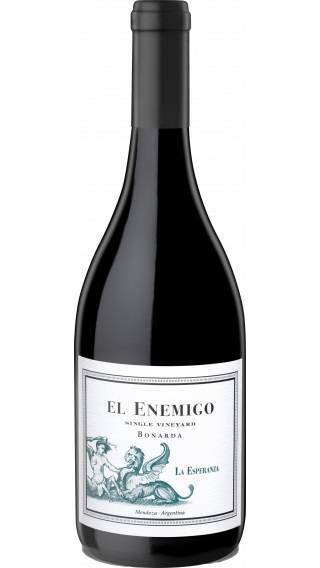
| Country: | Argentina |
| Region: | Mendoza |
| Winery: | El Enemigo |
| Grape Type: | Bonarda |
| Organic: | Yes |
| Vintage: | 2018 |
| Bottle Size: | 750 ml |

Enemigo El Enemigo Gran Enemigo is made from Cabernet Franc.
Gran Enemigo Agrelo is intense, balanced, and elegant. Cabernet Franc brings light notes of eucalyptus and thyme, Malbec provides ripe black fruits, and oak provides a touch of chocolate and vanilla. Certified Sustainable by Bodegas de Argentina.
Gran Enemigo Agrelo pairs beautifully with steak, veal, and roasted game birds such as chicken, turkey, and duck.
Reviews:
The 2019 Gran Enemigo Agrelo Single Vineyard shows the completeness of the vintage, a year with good yields and a cooler winter and summer. The result is a very balanced wine with full development of aromas and flavors, moderate ripeness and good freshness and balance. It has a fine texture, some chalky sensations and a dry finish, despite the fact that the soils have no limestone. The vines here are over 40 years of age.
-Robert Parker's Wine Advocate 97 Points
#73 Wine Spectator Top 100 of 2023
The 2019 Cabernet Franc Gran Enemigo Single Vineyard Agrelo also includes 15% Malbec from the clayish soils of Luján de Cuyo. Aged for 15 months in foudres, this purplish wine reveals enticing cigar ash notes alongside blueberry and plum aromas, with a subtle cedar backdrop. Dry, rich and plush on the palate, it quickly tightens due to its fine-grained, reactive, clay-like tannins. This long-lasting red lingers on the ashy notes, beautifully layered and crafted with a modernist touch in a slightly cool vintage.
- Vinous 97 Points

Gran Enemigo Chacayes is dark and firm, with notes of blueberries, black currants, lavender, tobacco, walnuts, and black peppercorns. The finish has a savory mineral character. Certified Sustainable by Bodegas de Argentina.
Gran Enemigo Chacayes is a perfect match for grilled lamb, chimichurri roasted vegetables, or beef stew.
Review:
Blueberries, blackcurrants, hot stones, tobacco leaves, dried lavender, walnuts and cracked pepper on the nose. Medium-to full-bodied with firm, fine-grained tannins. Dark and mineral character to this. Solid, compact cabernet franc. Firm and savory finish. Try from 2024.
- James Suckling 96 Points

Sojourn Chardonnay Sangiacomo Vineyard is made from 100 percent Chardonnay.
The core of Sojourn Sangiacomo Vineyard Chardonnay is from the same vineyard source as the highly-acclaimed Sojourn Sangiacomo Vineyard Pinot noir wines. This wine features a combination of Clone 95 Chardonnay from Sangiacomo Roberts Road Vineyard and Old Wente Clone from Sangiacomo Vella Ranch. The Roberts Road block, planted in 1998, provides minerality and vibrancy. The Old Wente Clone selection is known to produce distinctively small clusters, low yields, and results in elegant, complex wines that round out this blend. These ranches are perfectly suited for growing Chardonnay, with cool climates and well-draining soils.
Sojour Chardonnay is fresh and lively, fruit-forward with bright acidity, stone fruit, citrus and apple flavors that leave your mouth watering.
Review:
-International Wine Report 93 Points
-Jeb Dunnuck 92 Points

Black Stallion Napa Valley Limited Release Red.
The winery takes its name from a major equestrian area that once occupied the grounds. Its calling card is Cabernet Sauvignon, made in a classic Napa Valley style that offers richness and finesse. While single-vineyard wines are occasionally bottled, most Black Stallion wines are made from small lots cherry-picked from the valley’s disparate winegrowing zones. These are then painstakingly blended to create luxurious, unforgettable wines that capture the depth and brilliance of Napa Valley’s diverse growing regions.
Review:
-Wine Enthusiast 90 Points

La Spinona Barbaresco Secondine is made from 100 percent Nebbiolo.
This single-vineyard Barbaresco comes from his 3.5 hectares on the cru of Secondine. It is the commune of Barbaresco below the zone of Rabaja Basa and Paje and is where Gaja’s San Lorenzo is located. It is 230 meters above sea level with a southern exposure.
Excellent with game, red meats, truffle dishes and aged cheeses.
Color: Deep ruby red with a hint of garnet in the reflections.
Bouquet: Bright bouquet full of cherries, raspberries, licorice and floral notes.
Taste: Elegant and refined with delicate, soft tannins. It is fresh, velvety and extremely well balanced.
Review:
-Antonio Galloni (Vinous) 94 Points
-Wine Enthusiast 93 Points

Siegel Single Vineyard Los Lingues Cabernet Sauvignon is made from 100% Cabernet Sauvignon.
Viña Siegel Single Vineyard Cabernet Sauvignon is the result of our family's continuous search for quality wines with personality which faithfully reflect the best of our terroir. This wine comes from selected grapes from our "Los Lingues" vineyard in Alto Colchagua.
Located in the foothills of the Andes where the influence of the Andean winds result in an elegant Cabernet Sauvignon with great concentration of ripe red fruits, cassis and chocolate, and a balanced, richly structured, and long finish.
An intense violet color. Smells of cassis and is complemented with notes of mature red fruit and chocolate. A round and elegant wine with an excellent final persistence.
After carefully determining the moment for the harvest, the grapes are harvested by hand and later de-stemmed and marinated in cold temperatures for 5-6 days. Alcoholic fermentation is between 26ºC and 29ºC during which daily reassembly is implemented according to taste.Post-fermentation infusion lasts for two or three weeks. Once the blend is made, the wine is gently clarified and stabilized in cool temperatures if necessary.
Review:
"The 2017 vintage of the Los Lingues Cabernet Sauvignon is in every respect the equal of the 2016, which we rated highly. It begins with smoky, dark fruited nose and proceeds to a round, silky, well balanced palate of mineral-inflected, herbal-tinged dark cassis. There’s a sense of refinement and balance to this wine."
- I-winereview.com (March 2022), 92+ pts
Cellar for up to 8 years. No need to decant before serving.
El Enemigo was founded by historian Adrianna Catena, who is also Nicolas Catena’s youngest daughter, and Catena Zapata’s chief winemaker Alejandro Vigil in 2009. These two legendary figures on the Argentine wine scene came together over a mutual love for literature and philosophy, and decided to create their own wine label that would offer a unique taste of Argentina’s exceptional terroir and its Old World winemaking heritage.
Today the brand is responsible for many of the most exciting wines coming out of Argentina, including this sensational single vineyard Bonarda. Bonarda is little-known in Europe these days, but it has a special place in Argentina where it’s considered the nation’s second red wine after Malbec. La Esperanza is a very special 150 year old vineyard that was about to be uprooted when it was discovered by Alejandro Vigil. Luckily he was able to save 5 hectares from which he makes a few hundred bottles of this wine each vintage.
Once in the winery this precious fruit is vinified with wild yeasts and the young wine ages in large foudres that are over 100 years old. The result is a remarkably elegant and vibrant red that’s bursting with luscious red cherries, plums and blackberries as well as hints of dark chocolate. A charming wine to serve with tomato-based dishes thanks to the refreshing acidity, smooth tannins, and bright fruit flavours.
Review:
Blackberry, red-plum and graphite on the nose, as well as herbal and smoky notes. It’s medium-to full-bodied with firm tannins. Fleshy texture on the palate with structure and a ink-like feel. Savory finish. Hints of chocolate at the end. Try after 2023.
-James Suckling 94 Points
El Enemigo translates as the enemy. Nodding to the fact that at the end of any journey, most remember only one battle — the one fought within (the original enemy). This is the battle that defines us. The wines of El Enemigo are a tribute to those internal battles that make us who we are, brought to fruition by a winemaker, Alejandro Vigil, and a historian, Adrianna Catena who share a love of wine and reach back in time to capture the era when European immigrants first settled in Argentina. These settlers sought to make wines as fine, and finer, than those of their old homeland. By 1936, Malbec and Petit Verdot were the most widely planted fine varietals in Argentina, their blend considered the ultimate in refinement and aging potential.
Adrianna Catena is the daughter of Nicolás Catena. She has a Master’s Degree in Early Modern Iberian Atlantic history from the University of Oxford. Her dream is to continue the family legacy of winemaking while pursuing a passion for history and writing from a cottage surrounded by vineyards in the Argentine Andes.
El Enemigo is produced at BESA, located in the Vista Flores district in Tunuyán, Mendoza. The facility is named for the unique aspect of Mendoza’s high-altitude winemaking region nestled in the foothills of the Andes Mountains.
Alejandro Vigil is a soil expert, winemaker, and agronomist. He is the Chief Winemaker at Bodega Catena Zapata, the former head of the soil division at Argentina’s Wine Institute, and the former head of the soil division of INTA.

I feel this wine expresses the greatness of California and its hidden pockets where Cabernet can excel. The cold Pacific Ocean running the entire length of the state presents maritime influences – and with each small distance eastward the climate warms. Stony soils, south facing slopes and moderately warm conditions are the keys to producing dark, rich and good tasting Cabernet.
A small release from Caymus Vineyards, this wine is a California-appellation Cabernet Sauvignon – supple, dark and rich, bearing the signature hallmarks of Caymus. It is sourced from sites throughout the state which feature climatic conditions, soils and topography that are ideally suited to Cabernet. This project stems from excitement over California's diverse vineyard land, often in lesser-known areas, with the potential to produce exceptional Cabernet.

Thibaut-Janisson Blanc de Chardonnay is made from 100% Chardonnay
Appellation 100% Virginia
Winemaking Notes The grapes are handpicked in small baskets late August and are gently pressed as whole clusters. After a settling of 24 hours, the juice is inoculated with selected Champagne yeast and ferments in stainless steel tanks at low temperature. Once the fermentation is over, the wine ages on the fine lees until the spring of the following year. The blend is then put together and cold-stabilized prior to bottling. The bottling occurs in the spring when the cellar temperature is conducive to a second fermentation in the bottle. The now sparkling wine will age on the yeast for over 24 months. At disgorging, a small amount of dosage liquor is added in order to balance the natural acidity.
Clean, crisp and refreshing! With scents of white flowers, apples and pears. This sparkling wine is elegant and complex with vibrant aromas, and fine active streamers. The depth of complexity is elegant and the intricate nuances of the terroir fill the nose and stimulate the palate. It’s full of youthful, bright and alert acidity.

A slope (un talud) leading up to a mountain where centuries of rock falls have left the soil beneath full of large angular rocks, and therefore useless for most agriculture. Deposited hugger-mugger amongst the clay and sand however, they offer perfect drainage and allow vines to grow, forcing their roots ever downwards in search of water, picking up minerals along the way. If you wanted to explain to someone what Cabernet Sauvignon tasted like, you could do a lot worse than showing them this beautiful expression of the variety which demonstrates great purity, concentration and elegance.
Review:
Talud is from the oldest cabernet sauvignon vineyards on Tabalí’s estate in the coastal Maipo zone, 50 kilometers from the Pacific, planted in 1999. The soils are colluvial, which often deliver firm, pointed tannins, and those are present here, but they’re very nicely accompanied by juicy red fruit and bright acidity that allows this wine to put its fresh, vibrant facet in the foreground. Take note, however, there are deep, dense flavors here. It’s still a very young cabernet, so make room in the cellar.
-Patricio Tapia - Descorchados 95 Points

Burgo Viejo Rioja Gran Reserva is made from 100 percent Tempranillo. 30 year old vines.
Burgo Viejo Gran Reserva shows a deep red ruby color and offers powerful aromas of blackberry jam, spice, leather, chocolate with toasty nuances. Smooth yet full-bodied with firm tannins and a long finish.
Review:
-Antonio Galloni's Vinous 92 Points
-Wine & Spirits 91 Points
-Antonio Galloni's Vinous 91 Points

Intense mahogany. Deep aroma of dried fruits (raisins, figs) bouquet subtle notes of chocolate and coffee. Smooth and velvety in the mouth with a long after taste.
To be served with desserts, at room temperature or slightly chilled, delicious poured over ice cream.
Review:
"Violet color. Aromas and flavors of mashed raisins and prunes and chocolate nuts with a bright, sweet medium-full body and a subtle, long fig paste, mincemeat pie, and baklava finish with no oak. A rich and toothsome PX Sherry with great length and depth."
- Tastings, 2018 World Wine Championships, 93 pts - "EXCEPTIONAL"

James Goddard was an ancestor of the Clarke family. Born in West Sussex, England in 1823, James spent his 74 years as a sailor, a whaler, a bullock driver, farmer, prospector, miner and hotel keeper. From an illiterate runaway living rough on the streets of London, he became a rich, successful and admired pillar of South Australian society.
James arrived in Adelaide in 1839 as a 16-year-old sailor. Twelve years later, his life changed forever with the news of gold findings. For the next 20 years, James roamed the country learning the geology that improved his chances of prospecting.
James Goddard Shiraz is made from 100 percent Shiraz.
In 1870, he tried his luck near his farm in the Barossa Valley and discovered the region’s first gold deposits, creating the prosperous Lady Alice Mine. The Lady Alice Mine, though it is no longer operational, was & still is the most successful gold mine in South Australia. From these roots, the Thorn-Clarke family has been connected to the region for the last 150 years.
James Goddard Shiraz is a blend Shiraz sourced from the Milton Park vineyard in the north of Eden Valley, and the St Kitts vineyard in the far northern area of the Barossa. Fruit is harvested in the cool of the night to maintain maximum flavour and freshness and it is fermented for 8 days. The ferment is pumped over twice daily to extract the colour and flavour from the fruit. Once finished fermentation the wine was then matured in a blend of French and American oak for a period of 10 to 12 months depending on the vintage.
Deep vibrant red with purple hues to the rim. The nose shows lifted plums, vibrant purple berries and a delicate spice note. The palate has concentrated satsuma plum, blackberry with lovely charry oak in the background. Long, juicy and even with plush fruit on the finish.
Review:
“Blended from two estate vineyards, St. Kitts and Milton Park, this shiraz offers its richness without any aggression or overt perfume. It’s just lush and delicious, a friendly embrace of firm tannins and purple-red fruit. The texture and flavor combine in a saturated meatiness, for Korean barbecue.”
- Wine & Spirits Magazine, 92 points

Domaine Jean Grivot Nuits-Saint-Georges Premier Cru Aux Boudots is made from 100 percent Pinot Noir.
Domaine Jean Grivot is among the great names in Burgundian wine. Étienne Grivot and his wife Marielle took over from Étienne’s father Jean Grivot in 1987. The vineyards are densely planted and farmed organically “sans certification” while the aim in the cellar is for balance and clear expression of terroir.
Jean Grivot’s 38.3 acres spread across 22 appellations with vineyards in the communes of Vosne-Romanée, Vougeot, Chambolle-Musigny, and Nuits-Saint-Georges. Besides the three grand crus, there are 8 premier crus including the much lauded Les Beaux Monts and Suchots in Vosne-Romanée. The grapes are completely de-stemmed and fermentation is spontaneous.
Nuits-Saint-Georges Aux Boudots 1er cru lies in the “Zone Vosnoise” or northern end of Nuits-Saint-Georges just below Les Damodes. It borders Vosne-Romanée Aux Malconsorts 1er just to its north. Its position slightly lower on the slope with deep soil full of pebbles results in a richer and fuller wine.
The grapes are destemmed and maceration à froid usually lasts just a day or two. The alcoholic fermentation is spontaneous and malolactic fermentation occurs in barrel. Depending on the vintage, the proportion of new oak is around 30-60% for the premier crus.
The wine shows aromas and flavors of red berries, herbs, and purple flowers. The palate is rich with ripe fruit and medium weight with bright acidity and fine tannins. Aging in 30-60% new Burgundian pièce brings notes of vanilla, toast, and baking spices.
Red Burgundy might be the world’s most flexible food wine. The wine’s high acidity, medium body, medium alcohol, and low tannins make it very food-friendly. Red Burgundy, with its earthy and sometimes gamey character, is a classic partner to roasted game birds, grilled duck breast, and dishes that feature mushrooms, black truffles, or are rich in umami.
Review:
-Jasper Morris MW 95 Points
-Neal Martin 95 Points
-Decanter 94 Points
-Burghound 92 Points

Clos du Val Napa Valley Cabernet Sauvignon 2023 is made from Cabernet Sauvignon.
The Wine
This is Clos du Val's Napa Valley Cabernet Sauvignon — the house's classically styled, broadly sourced Cabernet drawn from vineyards across the valley floor and surrounding benches. The 2023 is a blend of 75% Cabernet Sauvignon, 10% Merlot, 6% Cabernet Franc, 5% Malbec and 4% Petit Verdot. It pours a deep ruby and opens with pure cassis and black cherry lifted by graphite, tobacco leaf, sweet brown spice and a whisper of cured herbs. Medium- to full-bodied and beautifully balanced, it is firm without ever turning hard, with fine-grained tannins, bright acidity and a long, silky, cocoa-dusted finish. A polished, food-friendly Napa Cabernet that drinks wonderfully now and will hold comfortably into the early 2030s — and, at this price, one of the genuine values in classic Napa Valley Cabernet.
Winery Info
Clos du Val was founded in 1972 in the Stags Leap District of Napa Valley by French-born winemaker Bernard Portet and American proprietor John Goelet. Portet grew up at Château Lafite-Rothschild, where his father was technical director, and he set out to make Napa wines in a restrained, ageworthy Bordeaux idiom rather than the bigger, riper California style of the day. The bet paid off almost at once: at the legendary 1976 Judgment of Paris, Clos du Val's debut 1972 Cabernet was one of only a handful of California reds chosen to stand against first-growth Bordeaux — and in the celebrated ten-year rematch of that tasting, it finished first of all the wines. More than fifty years on, Clos du Val remains one of Napa's benchmark houses, its wines prized for elegance, balance and a graceful capacity to age. The engraving of the Three Graces on the label is a nod to the harmony the family has always chased in the glass.
Review:
Refined and earth-driven, showing tightly wound black-fruit aromas. The palate is focused and pure with finely tuned tannins and a generous yet precise palate. A lovely wine to drink now or cellar.
James Suckling, 94 Points



