
" We don't sell the wine without touching the vine "
| Country: | France |
| Region: | Loire |
| Winery: | Domaine de Brize |
| Grape Type: | Cabernet Franc |
| Organic: | Yes |
| Vintage: | 2021 |
| Bottle Size: | 750 ml |

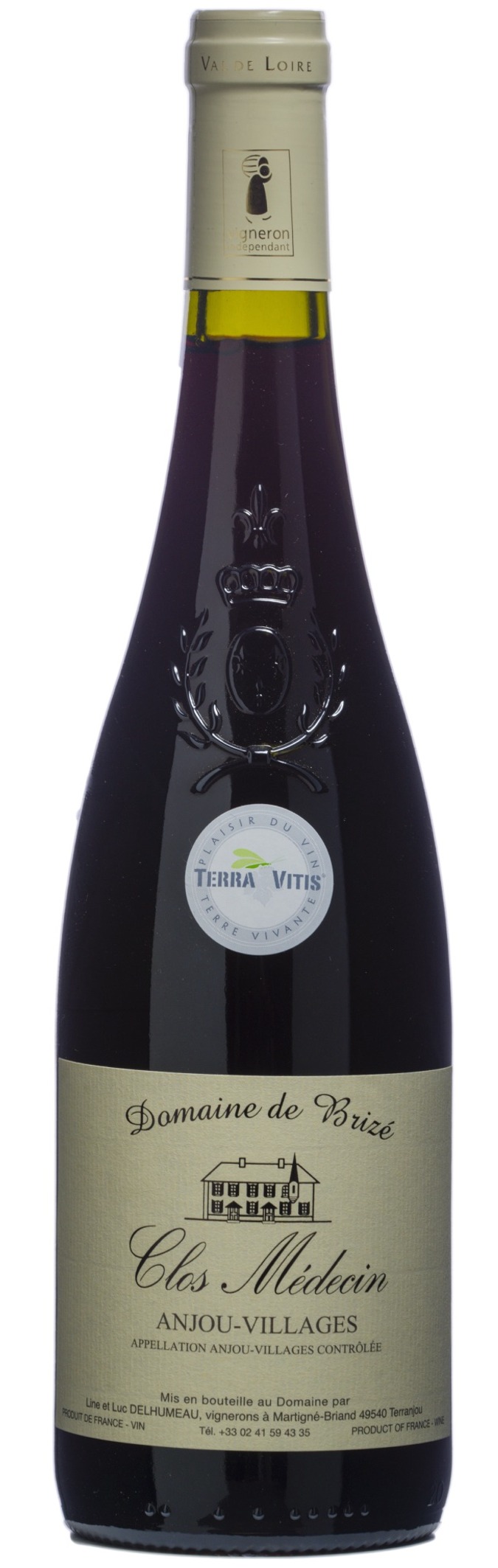
Brize Clos Medecin Anjou Villages Rouge is made from 60% Cabernet Franc and 40% Cabernet Sauvignon.
This is the flagship of the Estate. Clos Medecin has been produced at the estate for 90 years. All the grapes for this wine come from a very special parcel. The wine offers red fruit aromas. It is fresh, round and ample in the mouth.

Brize Loire Renaissance Anjou Blanc is made from 100% Chenin Blanc.
Anjou Blanc Renaissance was entirely fermented and aged in French oak barrels. The wine is dry and powerful with an intense bouquet of apricot, vanilla and honey.
Excellent when paired with lobster or white fish with a creamy sauce.

Bertrand Bachelet Maranges Rouge 1er Cru Les Clos Roussots is made from 100 percent Pinot Noir.
The Maranges appellation is the youngest of the Côte de Beaune family, making its debut in May 1989. It spans three villages: Dezize-lès-Maranges, Cheilly-les-Maranges and Sampigny-les-Maranges. Several hills and slopes make up the appellation; they face south/south-east, at an altitude of between 200 and 400 meters. This appellation produces mainly red wines comprising 95% of total production.
The Maranges 1ers Crus are spread over seven distinct terroirs: "Les Clos Roussots", which represents the second largest terroir of the appellation, spans the Cheilly-les-Maranges and Sampigny-les-Maranges areas.
The wine boasts a beautiful bright red color. The nose provides subtle harmony between red and black fruits, spices and vanilla. On the palate, this wine is both solid and fresh, harmonious and bold.
Enjoy with a veal roast and sweet potatoes or matured cheeses.

Clos Saint-Jean Chateauneuf Du Pape Vieilles Vignes is made from a Grenache, Syrah, Mourvedre, Cinsault, Vaccarèse and Muscardin, the Châteauneuf-du-Pape Vieilles Vignes is made from old vines located in and around Le Crau. The Grenache is aged in concrete for 12 months while the remainder is aged in demi-muid.
Review:
This has good concentration and energy to the dense core of dark fruit and bitter cherry, with great poise and elegance despite its ripeness (an impressive feat for the vintage). Guided by finely crushed mineral accents and tannins, this reveals pretty high-toned floral notes and leafy tobacco. Grenache, Syrah, Mourvedre, Cinsault, Vaccarese and Muscardin. Drink now through 2032. 900 cases made.
-Wine Spectator 95 Points

Clos Saint-Jean is a 41-hectare estate in Châteauneuf-du-Pape run by brothers Vincent and Pascal Maurel. Considered by many critics and wine-writers as the preeminent estate espousing the modern style of winemaking in Châteauneuf, this cellar is one of the oldest in the region, having been founded in 1900 by the greatgreat-grandfather of Vincent and Pascal, Edmund Tacussel. A short time after its founding and well before the AOP of Chateauneuf-du-Pape was created in 1923, Edmund began bottling estate wines in 1910.
The farming at Clos Saint-Jean is fully sustainable due to the warm and dry climate, which prevents the need for chemical inputs. Instead, Vincent and Pascal employ organic methods for pest control, mainly pheromones, to prevent pests from taking up residence in their vines, a process called amusingly enough in French, confusion sexuelle. The vines tended manually, and harvest is conducted in several passes entirely by hand.
Combe des Fous literally means, the hill of the fool. The hill, in this case, is located in the far southern reach of Le Crau which was left barren for many centuries because the layer of galets was so exceedingly deep that everyone assumed vines could never survive there. The fool in this situation is Edmund Tacussel, the great-great-grandfather of Vincent and Pascal Maruel who planted a Grenache vineyard on this site in 1905. That old-vine Grenache form the heart of this cuvée with a small amount of Syrah, Cinsault and Vaccarèse. La Combe des Fous is only made in the best vintages.
Review:
This has good concentration and energy to the dense core of dark fruit and bitter cherry, with great poise and elegance despite its ripeness (an impressive feat for the vintage). Guided by finely crushed mineral accents and tannins, this reveals pretty high-toned floral notes and leafy tobacco. Grenache, Syrah, Mourvedre, Cinsault, Vaccarese and Muscardin. Drink now through 2032. 900 cases made.
-Wine Spectator 95 Points

Bachelet Bertrand Chassagne Montrachet Rouge is made from 100 percent Pinot Noir.
The Chassagne-Montrachet appellation is originally better known for its white wines, but also produces high quality red wines. The complexity of the terroir allows both varieties to thrive side by side.
The wine is produced from vineyards located in the villages of Les Lombardes and Les Benoites that benefit from iron rich clay soils. A ruby garnet color, and an expressive nose of spices and red fruits that echo on the palate.
Pairs well with a nice cut of red meat.
Brize Clos Medecin Anjou Villages Rouge is made from 60% Cabernet Franc and 40% Cabernet Sauvignon.
This is the flagship of the Estate. Clos Medecin has been produced at the estate for 90 years. All the grapes for this wine come from a very special parcel. The wine offers red fruit aromas. It is fresh, round and ample in the mouth.
Domaine de Brize is located in the town of Terranjou, in the Maine-et-Loire department of the Loire Valley. The 40 hectare-estate was born in the middle of the 18th century, founded by the Delhumeau family. The winery strived between the two world wars under the leadership of Pierre, a young, innovative, ingenious and combative man who compensated the loss of his mutilated hand during the War. He transmitted his passion for wine to his grandson Marc who followed in his footsteps and ran the property for 30 years, with the assistance of his two brothers. His son Luc joined the family estate in 1989, then his daughter Line came on board in 1992 together with her husband Didier. Brother and sister Luc and Line represent the 5th generation of the family winemakers and the 9th generation in the farm.
The vineyard is planted on highly diversified soils dominated by silico-clay, shale-sandstone and faluns. The viticulture practices meet the 'Terra Vitis' approach in respecting nature, people, the environment and the soil.

Mordoree Cotes du Rhone Rouge La Dame Rousse is made from 40% Grenache, 35 % Syrah, 15% Cinsault, 5% Carignan, 5% Counoise.
100 % destemming, 15 day maceration with a maximum of 30° C temperature
Deep red color. Blackcurrant and violet aromas. Melted and fine tannins, good finish.
Food pairing: cold meats and delicatessen, grilled meats, semi-mature cheeses.

All the magic and personality of the ancestral Levantine varieties in a fresh and fluid wine.
It comes from two plots of old vines, of the Verdil and Merseguera and Moscatel varieties, cultivated in a traditional way.
Our respect for historical viticulture and enology leads us to minimal intervention crops and preparations. We reduce treatments as much as possible, seeking a balance between the vines and their environment



