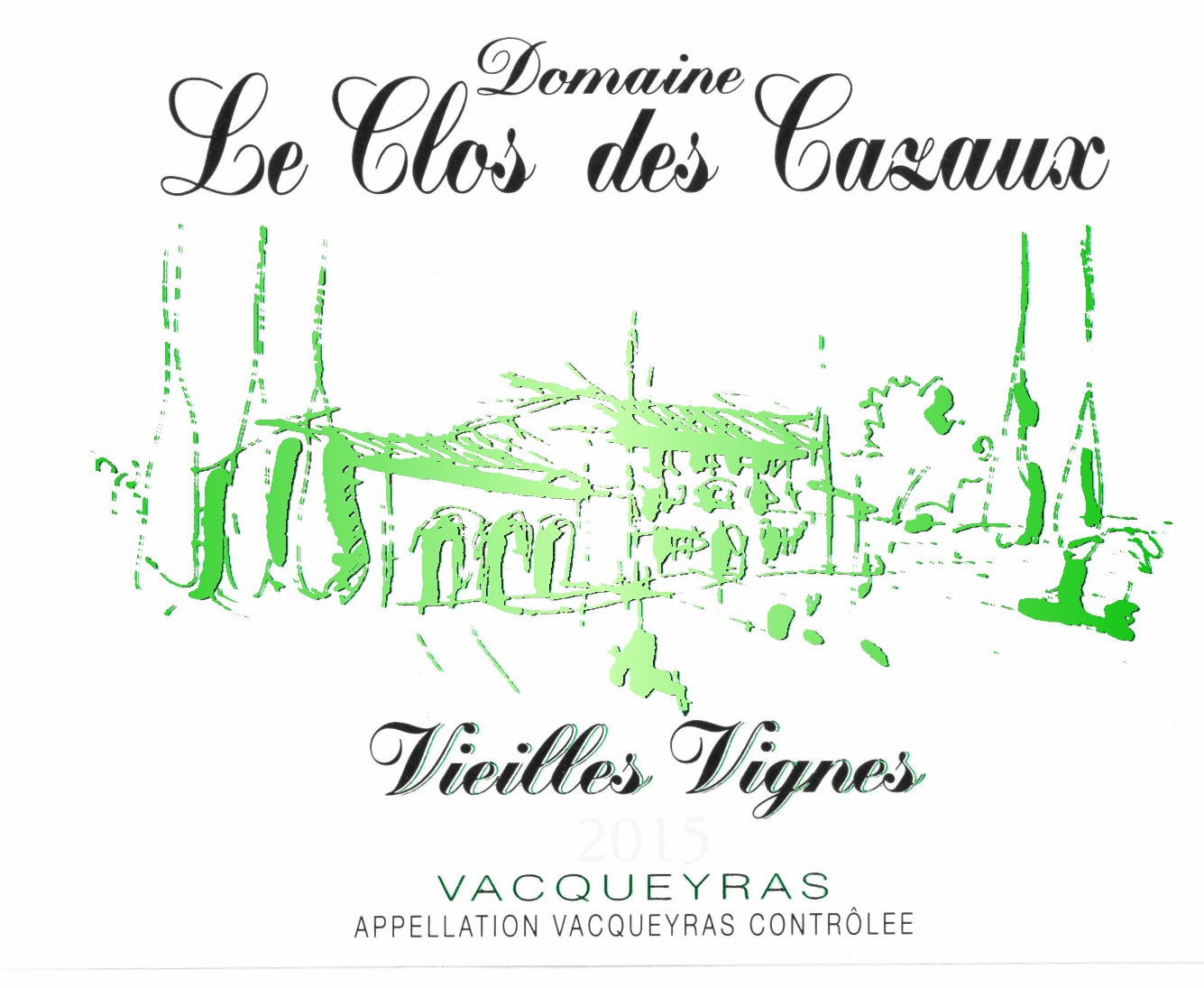
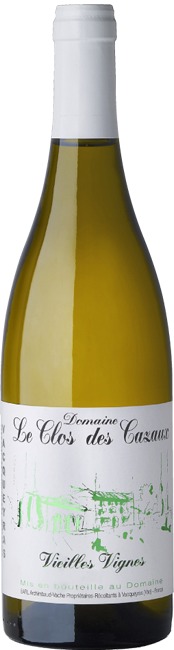
" We don't sell the wine without touching the vine "
| Country: | France |
| Region: | Rhone |
| Winery: | Clos des Cazaux |
| Grape Type: | Clairette |
| Vintage: | 2021 |
| Bottle Size: | 750 ml |

Cazaux Vacqueyras Blanc Vieilles Vignes 50% Clairette, 30% Roussanne and 20% Viognier
The wine has a beautiful golden color.
The aromas are rich and
exotic with mango, almonds, toast, lemon, pineapple white flowers and
papaye. These aromas will develop to honey, butter and pear after ageing
for a few years.
The finish is long, citrusy and toasty.
Terroir: Slopes of sandy soil or grey limestone.
Yield: 25 -30 hl/ha
Age of the vines: 70 years old minimum. The oldest are around 90 years old.
The
grapes are pressed pneumatically after a few hours contact with the
skins.The must is kept at 20°c during the alcoholic fermentation to
optimise the aromas and respect the wine’s suppleness.
Barrel fermented an aged in 228-liter French Oak barrel for 12 months with regular stirrings of the lees.
MaloLactic Fermentation also in barrel.
Enjoy this wine with rich dish, river fish or poultry cooking in creamy sauce. Delicious with a mushroom risotto.

Cazaux Vacqueyras Blanc Les Clefs d'Or is made from 50% Clairette, 30% Roussanne and 20% Grenache Blanc.
A wine with lively acidity, expressive aromas of fennel and white flowers. It is long and full in the mouth with minty and anisy aromas mixed with white peach flavors. Refreshing and mineral character.
Clairette grapes are green harvested to concentrate and harmonize aroma. Each grape varietal is hand picked separately. Pressing with skin contact at low temperature. Aged 12 months in stainless steel tank. (No oak)
Enjoy this wine with all sorts of fish starters, squid salad with olive oil and basil. A must try with fresh oysters.
Review:
"Exotic citrus, pineapple, baking spices, and minty flower notes emerge from the 2023 Vacqueyras Les Clefs D'Or Blanc, a medium-bodied, juicy, lively, balanced white that has the vintage's ripe yet pure, layered, focused style. It's incredibly well done and worth your time and money."
- Jeb Dunnuck (April 1st 2025), 92 pts

Cazaux Vacqueyras Cuvee des Templiers is a blend of 50% Syrah, 50% Grenache.
The Syrah vines are situated on the sandy, grey clay slopes of Vacqueyras near the estate. They are facing east west, so the sun warms the grapes early in the morning allowing a considerable synthesis of sugars. The sandy soil is poor giving a reduced yield. The resulting wine is very fruity with strong persistent aromas of red fruits, spices and violets brought by the Syrah. Intense black cherry, blackberry, blueberry and cherry flavors. Explosive fruit tannins give the sweet, creamy flavors structure and focus, bright and uplifting on the finish.
Enjoy this wine when young with grilled beef and bearnaise sauce, lamb and thyme. After 7-10 years excellent with game meats.
Review:
"Very dark in the glass. A spicy nose full of cardamom and cumin. Full-bodied but not overly. Feels rounded and powerful, but has seen no oak. Quite extracted, this certainly needs time but promises some future complexity. - Matt WALLS "
- Decanter (October 1st 2022), 91 pts
Cazaux Vacqueyras Cuvee des Templiers is a blend of 50% Syrah, 50% Grenache.
The Syrah vines are situated on the sandy, grey clay slopes of Vacqueyras near the estate. They are facing east west, so the sun warms the grapes early in the morning allowing a considerable synthesis of sugars. The sandy soil is poor giving a reduced yield. The resulting wine is very fruity with strong persistent aromas of red fruits, spices and violets brought by the Syrah. Intense black cherry, blackberry, blueberry and cherry flavors. Explosive fruit tannins give the sweet, creamy flavors structure and focus, bright and uplifting on the finish.
Enjoy this wine when young with grilled beef and bearnaise sauce, lamb and thyme. After 7-10 years excellent with game meats.
Review:
"Very dark in the glass. A spicy nose full of cardamom and cumin. Full-bodied but not overly. Feels rounded and powerful, but has seen no oak. Quite extracted, this certainly needs time but promises some future complexity. - Matt WALLS "
- Decanter (October 1st 2022), 91 pts

Cazaux Vacqueyras Rouge Cuvee Saint Roch 70% Grenache, 25% Syrah and 5% Mourvedre.
Deep color. Intense and persistent red fruits, such as strawberry and black cherry. Expressive and delicate at the same time. The finish is long and the tannins are quite round and well balanced.
Grapes are hand picked, destemmed 100% but not crushed. About 20 days fermentation according to vintage. Aged in stainless steel tanks for 12 months and an additional 12 months in enamel coated concrete tank. No fining, light filtration.
Enjoy this wine with meat cooked in red wine sauce (such as Boeuf Bourguignon).

Cazaux Vacqueyras Rouge Grenat Noble 100% Grenache.
This wine is the result of extraordinary weather conditions. The first cuvée was produced in 1992 when violent storms and floods affected the region (especially Vaison la Romaine). The following days were radiant and accompanied by Mistral winds. We could then continue to harvest or more precisely harvest what remained of a rotten crop - but a noble rotten crop!
Following our first involuntary test of 1992, we wanted to reproduce this wine but we had to wait until 1995 to isolate the parcels that were capable of producing this noble rot. Unfortunately, the "noble" phenomenon does not occur every year despite late harvests (October 15).
The resulting wine is offers aromas of small red berries (cherries, raspberries), liquorice, fig, honey, fruit brandy and plum. It is elegant, supple and smooth on the palate with a firm, generous and suave structure. A beautiful length on spices and cherry.
This Grenache nectar marries will with dishes such as pan-fried foie gras in honey and fig preserve, leg of lamb with preserved fruits accompanied by local cereal "epautre" or other sweet and sour dishes.
Cazaux Vacqueyras Blanc Vieilles Vignes 50% Clairette, 30% Roussanne and 20% Viognier
The wine has a beautiful golden color.
The aromas are rich and
exotic with mango, almonds, toast, lemon, pineapple white flowers and
papaye. These aromas will develop to honey, butter and pear after ageing
for a few years.
The finish is long, citrusy and toasty.
Terroir: Slopes of sandy soil or grey limestone.
Yield: 25 -30 hl/ha
Age of the vines: 70 years old minimum. The oldest are around 90 years old.
The
grapes are pressed pneumatically after a few hours contact with the
skins.The must is kept at 20°c during the alcoholic fermentation to
optimise the aromas and respect the wine’s suppleness.
Barrel fermented an aged in 228-liter French Oak barrel for 12 months with regular stirrings of the lees.
MaloLactic Fermentation also in barrel.
Enjoy this wine with rich dish, river fish or poultry cooking in creamy sauce. Delicious with a mushroom risotto.
The Domaine Le Clos des Cazaux Estate
The Domaine was founded in 1905 by Gabriel Archimbaud and is now run by Maurice Vache and his two sons Jean-Michel and Frederic. The Archimbaud and Vache families are among the oldest ones in Vacqueyras. The oldest part of the property dates back to the 12th century and belonged to "Les Chevaliers de l'Ordre des Templiers" (the Templar Knights). An ancient Moorish Tower sits on the property, the Tower of Sarrasine in ruins.
The Domaine Le Clos des Cazaux Vineyard
The estate spreads over 40 hectares (98.8 acres) of vineyard land:
- 25 ha in Gigondas. The quality of the soil is outstanding and the sun exposure is optimal due to the special location of the vineyard, surrounded by the rocky massif of the "Dentelles de Montmirail", upon which is built the Sarrasine tower.
- 15 ha in Vacqueyras, on sandy-clayey and sunny slopes.
The vineyards are planted to 60% Grenache, 30% Syrah and 10% Mourvedre. The vines are 40-50 year old. The annual production is 8,800 to 10,000 cases. The average yield is 28 hl/ha.
The vines are cultivated with utmost respect to the environment. Only Bordeaux mixture (antifungal agent consisting of a solution of copper sulfate and quicklime) and sulfur is used in the phytosanitary (pertaining to the health of plant) and vineyard treatment. At all times, the vineyards are manually tended, including manual harvest. To ensure optimal quality, only the best grapes are selected during a green harvest in Summer which eliminates at least 20% of the production.
Each grape variety is picked at its optimum maturity and vinified separately. Syrah is usually harvested first, followed by Grenache and then Mourvèdre. The whole clusters are placed into specially equipped bins having a screw in the bottom that allow the grapes to fall into the tanks without any crushing. This near carbonic fermentation period depends on the grape varieties and the conditions. When the fermentation is complete, the varietal wines are blended together (typically in November).
The maturation takes place first in stainless steel tanks for the juice to settle, then in concrete or enamel tanks. The wines mature in the cellars for at least 2 years before bottling. There is no fining, and only a light filtration to limit the natural deposit on the bottle.

Praia Aveleda Vinho Verde NV is made from 40% Loureiro, 20% Trajadura, 20% Arinto, 20% Azal.
Praia, which means "beach" in Portuguese, is a smooth and fresh wine with delicate and lovely fruity flavors. Slightly spritzy, it is well balanced and very refreshing.
The region is typical for its unique wines that are fresh and light, combined with a very well balanced acidity. These characteristics result from the region's unique soil and climate, with a strong Atlantic influence that you will identify when you taste it.
The wine is ideal as an aperitif or throughout a meal, especially with fish, seafood, white meat and salads. Due to it freshness, it is particularly pleasant in a relaxed and informal ambiance.

Jean-Michel Sorbe Quincy Blanc is made from 100 percent Sauvingon Blanc.
The first nose is expressive and opens up to notes of acacia, citrus (lemon, grapefruit). Full on the palate with lovely freshness. This wine boasts nice balance and good length.
The vines are 15 to 20 years old and are located on the left bank of the Cher River, southwest of Quincy. This vineyard enjoys good exposure to the sun and overlies hillocks composed of sandy alluvial deposits and gravel dating back to the Quaternary Period. Each terroir is managed with minimal intervention in an environmentally friendly approach. Vinification: Slow pressing. Fermentation took place under controlled temperatures (18°C).The wine was aged on fine lees for a minimum of 4 months. It was filtered only once before being bottled.
Pair with crustaceans, asparagus, or goat's cheeses.
After pouring, allow the wine to breathe for a few moments in the glass before enjoying so that it may fully release all of its aromas.

Leindl Riesling Zobinger Heiligenstein Kamptal is made from 100 percent Riesling.
Medium yellow green. Fine nuances of ripe apricot, a hint of yellow apple, delicate herbs and spices, mineral Touch, hints of candied orange zest. Juicy, elegant, fine stone fruit, touch of finesse acidity, salty minerality in the finish, remains long, already well to drink.
Cold Fermentation.
Aged on the lees for 12 months in Stainless Steel tank. No Oak.
No ML
Review:
"Aged on the lees for 12 months in stainless steel, this wine saw no oak. Its original name – Hellenstein -- referred to hell stone, as the vineyards are on a mountain where the “sun burns like hell.” It was later renamed Heiligenstein, which translates as holy rock, and is a geological island of desert sandstone, with volcanic matter. Its earthy slate character lends out scents and flavors of honeyed apricot, salty pears, and stone fruit pith."
-The Tasting Panel (May/June 2022), 94 pts

Mordoree Lirac Blanc Reine des Bois is made from Grapes : Grenache 35 % Clairette 25 % Viognier 10 % Roussanne 15 % Marsanne 10 % Picpoul 5%>
Color : green gold
Aromas : white fruits, peach, apricot, pear, violet.
Palate : rounded, long finish, highly flavoured.
Ageing Potential : 4-5 years.
Surface : 4 Ha. Yield : 35 Hl./Ha. Vineyard age : 30 years Terroir : Clay / chalk with pebble stones. Harvest : by hand Vinification : skin maceration and direct pressing with temperature control. Fermentation : oak barrel fermentation for 25% of the total volume
Pairs well with appetizers, fish, seafood.
Review:
"Iconic grapes of 35% Grenache, 25% Clairette, 10% Viognier, 15% Roussanne, 10% Marsanne, and 5% Picpoul from 40-year-old vines make up this organic Southern Rhône white. A floral bouquet of white tea and jasmine make their designs on a defined slate mouthfeel. Lime pops with a tart center, along with notes of peach and gingerbread on a keen, edgy finish."
- The Somm Journal (Feb/March 2022), 94 pts

Livia Fontana Barbera d'Alba Superiore is made from 100 percent Barbera.
Organoleptic characteristics: intense ruby red color. Fresh and intense aromas with currants and berries notes. Warm, full, rich and persistent taste, full body. Suitable for long aging.
Excellent accompaniment to warm appetizers, rich first courses, red meat and the medium-seasoned cheeses.

Milsetentayseis 1076 Ribera del Duero Tinto is made with 95% Tempranillo and 5% other native varieties.
TASTING NOTES: A product of its unique landscape, extreme altitude and mineral-rich soil, 1076 Tinto is a bold wine with a distinct character designed to evolve over time. Its freshness and intensely fruity expression are representative of a modern style, moving away from excess, in search of the elegance, smoothness and balance found in the great wines of the world.
TERROIR: A recently restored vineyard situated at over 3,280 feet of altitude where ancestral vines over 100 years old grow harmoniously together with new, indigenous plantings in varied soil comprised of red clay, sand and mineral deposits of quartz, mica, and feldspar.
WINEMAKING: Hand-harvested from a selection of the best plots in the vineyard then separated into concrete, oak or stainless steel fermentation vats depending on the characteristics of the grape and the soil where it was grown. Its production is defined by the team´s constant vigilance throughout the process and their in-depth knowledge of the region, the soil and the native varieties that thrive there.
AGEING: Aged for 18 months in French oak of various sizes and according to the needs of each plot. Bottled in June 2020.
VINTAGE: The 2018 vintage began with abundant rainfall that lasted until late spring. Budding had already begun by the end of April, and as is usual in the Ribera del Duero, mid-May posed great risk of frost. Thankfully, consistent high winds in the area kept it at bay allowing the vineyards to remain unaffected. Spring extended into June with rain and cool temperatures, unusual for this time of year, while summer did not arrive until July bringing with it dry, hot conditions that allowed for the fruit to reach optimal ripeness. The harvest ran from October 5th-October 13th.
Pair with spit-Fire Roasted Suckling Pig.
Reviews:
"Inky violet. Potent aromas of cassis, cherry preserves, incense and potpourri, plus oak spice and mineral topnotes. Alluringly sweet and concentrated, with a spine of smoky minerality supporting intense flavors of dark berry liqueur, bitter chocolate, cola and candied lavender. Youthful, slow-building tannins add shape and grip to an impressively long, juicy finish that echoes the dark berry and floral notes. - Josh Raynolds."
- Vinous (February 2021), 95 pts
"The wine is deep cherry in color exhibiting complex, expressive aromas. Its minerality comes from the soil, the black fruit from the Tempranillo and the spice from a sometime in oak. The combination leads to a full body that finishes with great length.
- Guia Penin, 95 pts
"Very fine-tannined Duero with berry, chocolate and walnut character. Medium body. Solid core of fruit. Linear and very long. Polished and thought-provoking. Drinkable now, but better in 2023."
- James Suckling (November 2021), 94 pts

Paul Hobbs Beckstoffer Dr. Crane Vineyard Cabernet Sauvignon is made from 100 percent Cabernet Sauvignon.
Grown on the west side of St. Helena, this distinctive cabernet sauvignon clearly displays its origins with a rich garnet hue and sophisticated aromas of cacao bean, crème de cassis, and sweet tobacco on the nose. Layered, with a superb structure, the wine offers impressions of blueberry coulis, black raspberry, and savory herbs like Herbs de Provence. The weighty mid-palate unveils anise spice and a graphite mineral note that combines with a fresh acidity that extends the long finish.
Review:
Needing plenty of air to show at its best, the 2019 Cabernet Sauvignon Beckstoffer Dr. Crane Vineyard is a sensational, gorgeous Napa Valley Cabernet that delivers the goods like only this region can. Pure Cabernet magic on the nose, with deep blackcurrants, smoked tobacco, lead pencil, and a kiss of spring flowers as well as a beautiful Pessac-Leognan-like scorched earth character, it hits the palate with full-bodied richness, silky tannins, no hard edges, and a great, great finish. It's one of those wines that builds incrementally on the palate and it's only after the second or third sip that you realize how special this wine is. It also offers that rare mix of power and elegance that's the hallmark of all great wines. It needs a couple of hours in the decanter if drinking any time soon. Hats off to Paul Hobbs for an incredible Napa Valley Cabernet Sauvignon.
-Jeb Dunnuck 100 Points

Ceretto Barbaresco DOCG is made from 100 percent Nebbiolo.
If we could sum this wine up in a single word, we wouldn’t hesitate to define it as “classic”. As tradition suggests, this Barbaresco is the fruit of the assembly of several parcels of land, coming from some of our most beautiful vineyards. The idea is that of naturally obtaining balance by harmonizing different expressions, often contrasting ones. The result is a liquid expression of a terroir, tempting and typical, a synopsis of one Langa, that of Barbaresco, which moves in the glass, alternating between structure and elegance.
Review:
This is a really solid, meaty and mouth-filling Barbaresco that offers vivid red fruit with floral and mineral nuances and hints of licorice and cedar. Medium- to full-bodied with compact, velvety tannins that form the backbone of the wine, showing impressive concentration and length. Drink from 2027.
- James Suckling 93 Points
Bright, brightening ruby garnet. Appealing and finely drawn nose with notes of strawberries, blood orange and sealing wax. Very juicy on the palate, fresh, precisely defined fruit, opens up with fine-meshed tannins, very tense, with a cherry finish.
-FalStaff 93 Points