" We don't sell the wine without touching the vine "
| Country: | Argentina |
| Region: | Mendoza |
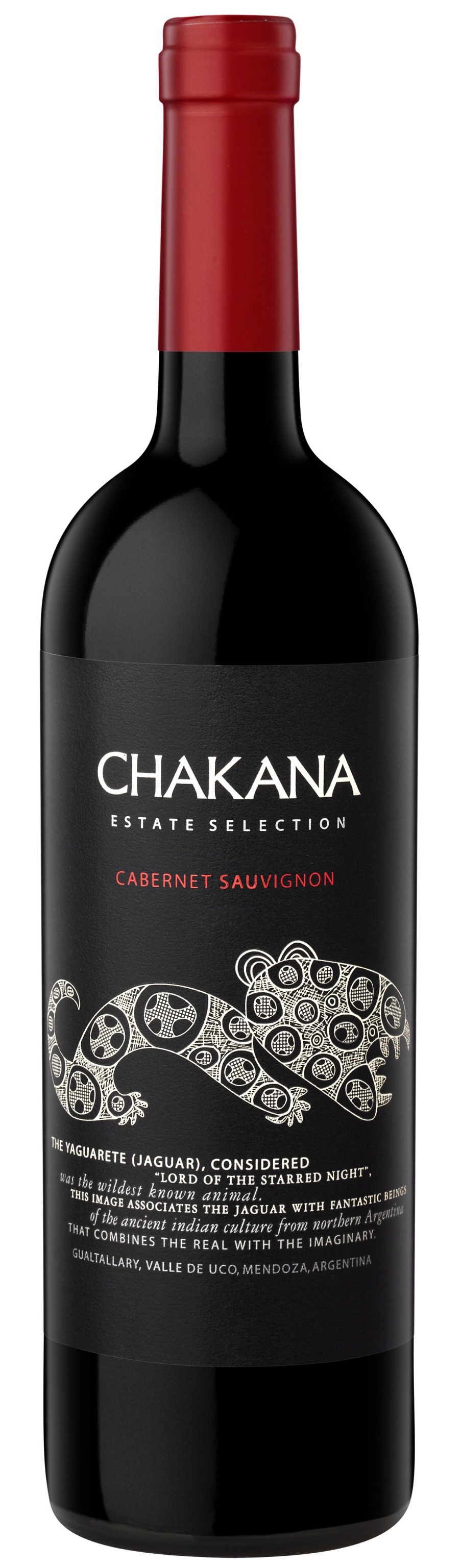
| Winery: | Chakana |
| Grape Type: | Cabernet Sauvignon |
| Vintage: | 2018 |
| Bottle Size: | 750 ml |

Calcareous gravels deposited by the Tunuyan river in the South of Valle de Uco and by the Las Tunas river in the North of Valle de Uco have created the two most promising growing areas of Mendoza, which are only now being developed and explored, bringing a new dimension to the wines of Argentina.
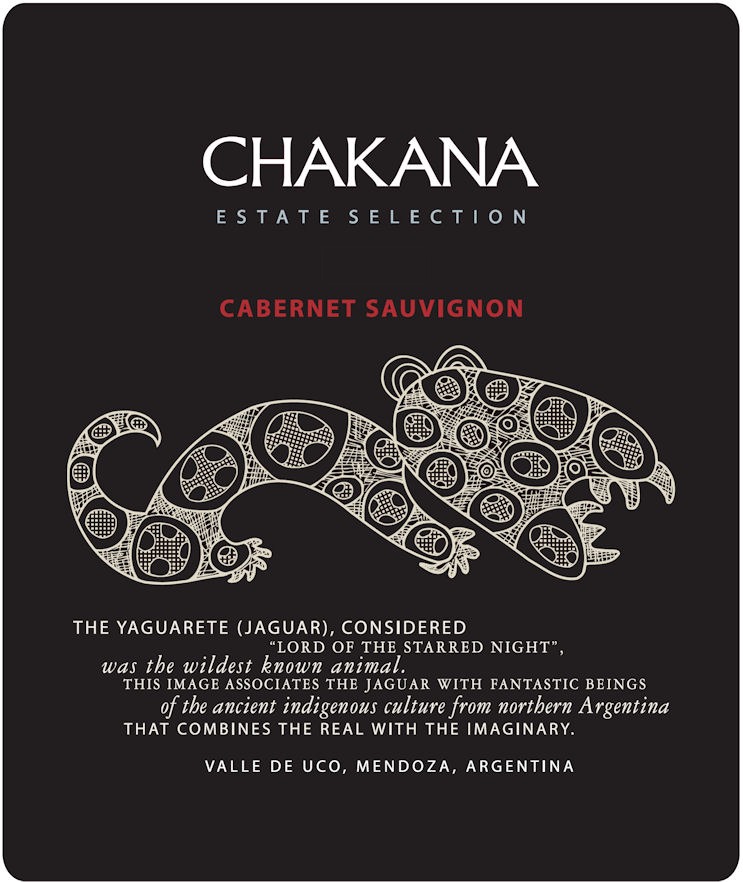
Aromas of black fruit and spices blended with mineral, graphite notes and freshness typical of calcareous soils. The palate demonstrates the power of Gualtallary combined with the structure of Cabernet Sauvignon. A fine finessed texture, which is tight and refreshing.
Vineyard: This wine is a blend of Cabernet Sauvignon from the two outstanding subregions of Valle de Uco - the power and structure of Gualtallary with the elegance and freshness of Paraje Altamira. 20-year old vines.
Soil: Sandy with calcium carbonate-coated fine gravel up to 45 cm deep
Vinification techniques are performed in the most gentle way, avoiding the use of enzymes and must amendments. Fermentation is performed with native yeast only.
Superb with grilled red meat and grilled vegetable (Argentinean Asado).

Chakana Estate Red Mendoza is made from 70% Malbec, 25% Cabernet Sauvignon, 5% Cabernet Franc
Deep red color with violet hints. Dark fruits and exotic spices with tobacco and mocha hints. Elegant, well balanced, harmonious, long persistence with chocolate flavors.
Vineyard: Gualtallary in Valle de Uco.
2 days maceration on skins in temperature controlled steel vats; 12 days fermentation with selected yeasts allowed to rise to a maximum of 28°C.
Review:
"Notes of fresh blackcurrants and dark cherries with subtle hints of nutshells, cocoa and spice box. Rich and flavorful on the palate with a medium to full body and ripe, glossy tannins. Succulent, lightly spicy finish. Malbec, cabernet sauvignon and cabernet franc. Vegan. Drink or hold."
- James Suckling (February 2024), 91 pts

It is hard to imagine with the Lithology range receiving 298 points out of 300 for the three single-vineyard wines, that there could possibly be a wine above them. But there is, and it is our Estate wine. Blended several times very intently by masters of their craft Philippe Melka and Michel Rolland, this is the ultimate expression of our house’s work. Positive, full-bodied, and quite powerful, there’s the expected crème de cassis and blackberry from St. Helena Cabernets, with mineral, herb, subtle tobacco and vanilla, plum skins, and pie crust, purple flowers, forest-conifer notes, and very fine tannic structure. It is a magnificent, and magnificently elegant expression of this house, and when asked recently, Monsieur Rolland stated plainly to me, “oh yes indeed – this is the best one, the best yet…”
Review:
The flagship 2018 Cabernet Sauvignon Alejandro Bulgheroni comes from a selection made by winemakers Philippe Melka and Michel Rolland, mostly from Rutherford and Oakville fruit. Aged 20 months in 78% new French oak, it has incredible aromatics of black and blue fruits, spring flowers, and graphite to go with a massive, full-bodied, concentrated style on the palate that somehow stays graceful, weightless, and elegant. This tour de force in Napa Valley Cabernet Sauvignon is guaranteed to put a smile on your face over the coming 20-25+ years.
-Jeb Dunnuck 99 Points

The unique volcanic soil composition of this site is exhibited in this Cabernet’s mineral texture and intensely structured palate. This latest release from the exceptional 2018 vintage presents a deep purple rim surrounding an opaque garnet core with an abundance of aromas emerging from bakers’ chocolate and dark cherry to crème de cassis to tapenade. Both graceful and bold on the palate, the broad tannins are balanced by pulsing acidity that brings tension and freshness throughout. Notes of boysenberry are interspersed with accents of sweet thyme against a backdrop of crush rock minerality, adding to the long finish and layers of complexity.

Alejandro Bulgheroni Lithology Beckstoffer Las Piedras Cabernet Sauvignon is made from 100 percent Cabernet Sauvignon.
From a St. Helena vineyard planted by early Napa settler Edward Bale more than 150 years ago, and later serving as the estate vineyard for the area’s first winery built by Henry Pellet in 1860, the Las Piedras site always gives us our prettiest wine. When placed next to Dr. Crane and To-Kalon wines, the Las Piedras show a certain elegance, with a very graceful entry and finely detailed complexity. We produce it with at least 75% new French oak, so there is a floral, spicy, and vanilla accent to the intense red and black fruits, cassis, and black cherry liqueur. What distinguishes this bottling is the beautifully fine tannins, delicate texture, and stunning purity. (Less than 100 cases made.)
Fermentation 70% Oak, 24% Concrete, 6% Puncheon
Review:
"The 2018 Cabernet Sauvignon Lithology Beckstoffer Las Piedras Vineyard comes from a world-class site outside of St. Helena and is all Cabernet that spent 20 months in 80% new oak. It offers a touch more red fruit as well ample cassis, spring flowers, loamy earth, and spice-like aromas and flavors. It has a wonderful sense of minerality, ultra-fine tannins, a dense, layered texture, and incredibly purity of fruit. It’s another just about off the charts release from this estate."
- Jeb Dunnuck 98 Points

Morlet Family Vineyards Mon Chevalier Cabernet Sauvignon is made from Cabernet Sauvignon (86%) Cabernet Franc (8%) Merlot (3%) Malbec (2%) Petit Verdot (1%) .
Located on the hillsides of Knights Valley, near Calistoga, this vineyard benefits from its proximity to Mount St. Helena, whose warm and windy climate is ideal for the long ripening of the Bordeaux red varietals. Handcrafted by using classical winemaking techniques, this special wine is dedicated to our son, Paul Morlet.
Dark red with a hue of purple. Intense and complex bouquet of red, black and blue berries intermixed with notes of blueberries, minerals (graphite, wet river rocks) licorice, fresh blond tobacco and a hint of lavender. Full bodied, the palate is reminiscent of the nose, with a richly tannic yet round frame and a great intensity. The hillside tannins and the classical aromatic complexity create a harmonious ensemble, leading to a very long and elegant finish. Built to age for decades, this collectible wine opens up after a few years of cellaring and is particularly representative of this special vineyard from the hillside of Knights Valley. Mon Chevalier features the interaction of the loamy, well drained and rocky volcanic soil, the typical sunny mountain climate and the low-interventionistic Morlet winemaking approach.
Property Name: Mon Chevalier
Name Meaning My Knight Named after our son, Paul Morlet
Type of wine Vineyard designated
Appellation Knights Valley
Vineyard singularity Morlet Family Estate Hillside 1100-1200 feet elevation Rhyolitic, loam & volcanic ash
Typical harvest date End of October
Picking Manual, small lugs, refer truck
Sorting Cluster by cluster, berry per berry
Fermentation Through native yeast Tank and Puncheons
Upbringing 16 months French oak from artisan coopers
Bottling Unfiltered
Cellaring time Decades
Serving Room temperature
Decanting recommended
Review:
The 2018 Cabernet Sauvignon Mon Chevalier comes from the Knights Valley, just north of Napa Valley in the larger Sonoma County, and it always seems to me to have one foot in Napa and one foot in Sonoma. Boasting a similar ruby/purple color (as do all of the releases here), it’s slightly more reserved and stately (knightly, if you will), with building aromas and flavors of blackcurrants, toasted bread, dried violets, baking spices, and loamy earth. These carry to a pure, full-bodied, multi-dimensional Cabernet that’s flawlessly balanced, has ripe yet certainly present tannins, a notable sense of minerality, and a great, great finish. It’s just another incredible wine from Luc Morlet that can be drunk today with ample pleasure or cellared for 20-30 years if, for some reason, you feel the need to delay gratification.
-Jeb Dunnuck 99 Points
Calcareous gravels deposited by the Tunuyan river in the South of Valle de Uco and by the Las Tunas river in the North of Valle de Uco have created the two most promising growing areas of Mendoza, which are only now being developed and explored, bringing a new dimension to the wines of Argentina.
Aromas of black fruit and spices blended with mineral, graphite notes and freshness typical of calcareous soils. The palate demonstrates the power of Gualtallary combined with the structure of Cabernet Sauvignon. A fine finessed texture, which is tight and refreshing.
Vineyard: This wine is a blend of Cabernet Sauvignon from the two outstanding subregions of Valle de Uco - the power and structure of Gualtallary with the elegance and freshness of Paraje Altamira. 20-year old vines.
Soil: Sandy with calcium carbonate-coated fine gravel up to 45 cm deep
Vinification techniques are performed in the most gentle way, avoiding the use of enzymes and must amendments. Fermentation is performed with native yeast only.
Superb with grilled red meat and grilled vegetable (Argentinean Asado).
The Chakana Estate
Looking for Chakana's other labels?
Click below:
Malbec, Bonarda Argentina, Cabernet Sauvignon
Elegant and mature wines with 12 months of oak aging, produced
only with grapes grown in our own estates.
Ayni is our icon wine. It is the result of our permanent quest
for the best Malbec terroirs that Mendoza can offer. This wine
comes from the gravely limestone soils of Altamira: powerful
but fresh and lively, this 100% Malbec has been aged in
French oak barrels for 18 months. It is presented in 6-bottle
wooden cases.
Chakana Estate Selection is a line of wines which represent the
best terroirs of each of our estates. Aged in French oak barrels
for 12 months these wines give pre-eminence to the expression
of terroir rather than oak. In every wine we try to craft a drinkable
and seductive style through the careful management of our
soils and grapes and in accordance with our consumers’ taste.
Chakana winery was founded by Juan Pelizzatti on May 2nd, 2002. Juan was driven to enter the wine industry first and foremost by his passion for wine, and also by the desire to invest his time and money on a product of agriculture. Although Juan did not know it at the time, the company was founded on the same day the Chakana was celebrated on the Andes highlands: on that same day, the Southern Cross (the Chakana for the Inca people) becomes vertical in the night Andean sky.
Juan's mission is to create an integral experience to introduce world consumers to the taste and culture of the Andes. His vision is to become one of the top 20 exporters of wine from Argentina, by consistently offering outstanding value for money.
"An incredible discovery for me, this winery was founded a decade ago and named after the Southern Cross ("Chakana" is the local Indian dialect for that constellation). It is located approximately 20 miles south of Mendoza in Agrelo. All three of these wines are highly recommended, and all are fabulous bargains in Malbec." - Robert Parker's Wine Advocate (June 2012)
Wine is currently produced in four different levels at Chakana, by winemaker Gabriel Bloise:
Entry Level: Maipe
Reserve Level: Maipe Reserve, Cueva de las Manos, Nuna
Estate Selection
Ayni
The Chakana Estate Vineyards
Our grapes are grown in our own estates located in diverse premium micro-regions of Mendoza.
Each of them contributes its character to the final blend of our top quality wines.
Our wines are made in a state-of-the-art 2 million liter facility located in our Agrelo estate.
The Three Chakana Vineyard Areas:
FINCA AGRELO
LOCATION: AGRELO, Lujan de Cuyo, Mendoza
Description: 120 ha. planted with different varieties between 2002 and 2010. Mainly Malbec,
Bonarda, Cabernet Franc, Viognier and Syrah.
Altitude: 960 meters above sea level.
TERROIR: Varied. Deep clay to loam. Gravel in some areas. Dry and cool climate with important
amplitude in temperature.
Wine Profile: Medium-bodied, elegant, fruity.
FINCA TERRADA
LOCATION: MAYOR DRUMMOND, Lujan de Cuyo, Mendoza.
Description: 21 ha. 100 year old Malbec.
Altitude: 919 metres above sea level.
TERROIR: Loam and clay with 70 cm deep gravel. Some limestone. Urban
influenced climate, relatively warm.
WINE PROFILE: Complex, ripe fruit.
FINCAS ALTAMIRA
LOCATION: ALTAMIRA, Valle de Uco, Mendoza
Altamira I |16 ha. Malbec. Altitude: 1,068 meters above sea level.
Altamira II |26 ha. Malbec, Pinot Noir, Chardonnay, planted in 2006. Altitude: 1,097 meters above sea
level.
TERROIR: Sandy-loam with gravel at 50 cm depth. Dominated by limestone. Temperate climate.
WINE PROFILE: Full-bodied and mineral.
They also source wines from contract suppliers in Ugarteche and Medrano, for entry level wines, and in Vista Flores, for Estate Selection & Ayni levels.
The Wine Making Team:
WINEMAKING CONSULTANT: ALBERTO ANTONINI. Alberto is an Italian winemaker with a pioneering role in
the discovery and development of high quality Malbec. Alberto has brought to us his profound knowledge of
the wine industry, his uncompromising commitment to authenticity and the belief that Argentina will become
one of the leading winegrowing regions of the world.
VITICULTURE CONSULTANT: ALAN YORK. Alan is one of the world’s leading consultants on biodynamic
viticulture. He is also a permanent source of inspiration and insight into the relationship between man, spirit
and nature.
WINEMAKER: GABRIEL BLOISE. Gabriel is one of the stars of the younger generation of Mendoza’s winemakers.
30 years old, he has already made 15 vintages in top estates in some of the most important winegrowing
areas in the world: Tuscany, Priorat, Australia, California, North Carolina, Salta and Mendoza. He is a tireless
explorer of the relationship between nature and its effect on the aromas in wine.
TERROIR CONSULTANT: PEDRO PARRA. Pedro's expertise helps us to understand how to identify and
manage the soil in each plot of our vineyards. His palate is fine-tuned to understanding the impact of soil
structure on the taste of wine. This has made him one of the 50 most influential people in wine according to
Decanter Magazine.

Domaine Jean Grivot Echezeaux Grand Cru is made from 100 percent Pinot Noir.
Domaine Jean Grivot is among the great names in Burgundian wine. Étienne Grivot and his wife Marielle took over from Étienne’s father Jean Grivot in 1987. The vineyards are densely planted and farmed organically “sans certification” while the aim in the cellar is for balance and clear expression of terroir.
Jean Grivot’s 15.5 hectares spread across 22 appellations with vineyards in the communes of Vosne-Romanée, Vougeot, Chambolle-Musigny, and Nuits-Saint-Georges. Besides the three grand crus, there are 8 premier crus including the much lauded Les Beaux Monts and Suchots in Vosne-Romanée. The grapes are completely de-stemmed and fermentation is spontaneous.
About the Vineyard:
Echézeaux grand cru is a large vineyard of 38 hectares divided into 11 individual climats. Grivot’s parcel is in the climat of Les Cruots and lies at the southern end of Echézeaux near the premier cru of Les Suchots. A good Echézeaux should have rich fruit, considerable earthiness, and be very complete on the palate.
Tasting Notes:
The wine shows aromas and flavors of red berries, herbs, and purple flowers. The palate is rich with ripe fruit and medium weight with bright acidity and fine tannins. Aging in 40-70% new Burgundian pièce brings notes of vanilla, toast, and baking spices.
Food Pairing:
Red Burgundy might be the world’s most flexible food wine. The wine’s high acidity, medium body, medium alcohol, and low tannins make it very food-friendly. Red Burgundy, with its earthy and sometimes gamey character, is a classic partner to roasted game birds, grilled duck breast, and dishes that feature mushrooms, black truffles, or are rich in umami.
Review:
A very elegant expression of Echezeaux, with a velvety black plum and rose petal fruit. There is a lovely freshness and so much finesse that the tannin and structure might surprise you at the end. This has the substance to age for decades. Produced from a 0.84ha parcel in Cruots next to Comte Liger-Belair. The vines were planted in 1954 and the destemmed fruit was gently fermented.
This is pure, racy and enticing, hosting aromas and flavors of black currant, blackberry, violet and iron. This is about finesse, grace and precision balance, with saturated fruit flavors persisting on the superlong aftertaste. Needs a decade in the cellar.
-Wine Spectator 97 Points

Vinsacro Dioro Seleccion is made from 100% Vidau (Blend of the de varietals Tempranillo, Graciano and Mazuelo with predominance of 70+ years old Garnacha).
A wine to enjoy.Vinsacro Dioro, a wine inspired by the Egyptian, Greek and Roman cultures that worshipped wine and gave it a sacred meaning associated with joy and festivity. It is the fruit of our best vineyards, living witnesses to the work and passion of the four generations that preceded us.
Pair with Roast lamb or pork, game, beef steaks, stewed meats. During the aperitive, it will accompany as well with aged and blue cheese.
14% Vol.
Grapes selected manually from our vineyards located on the southern slopes of Monte Yerga in the “Cuesta la Reina” estate. Grapes that are harvested with the utmost care, transported at low temperature in fruit boxes to the winery to avoid any damage to the fruit.
Fermentation is carried out with indigenous yeasts and the wine is kept in maceration for 30 days while breaking the cap daily. Afterwards, the wine is transferred to oak barrels where it remains for 17 months before bottling.
"Really sophisticated and polished with vanilla, coffee, earth and spice scents and oaky flavours. Long, brooding finish."
- Decanter World Wine Award (April 2022), 94 pts
"The 2019 Vinsacro Dioro Selección is a Vidau field blend sourced from Monte Yerga in Rioja Oriental. Aged for 18 months in French and Eastern European oak barrels, it is only released after five years in the cellar. Dark garnet in color, time in the glass reveals soy sauce, bay leaf and thyme notes, along with black fruit and chutney-like undertones. Dry and rich on the palate, it flows with softened tannins and a clingy mouthfeel, lingering long with an impression of tomato leaf. This is a complex, nuanced and solar red that will warmly captivate your palate. - Joaquin HIDALGO"
- Antonio Galloni's Vinous (April 2024), 94 pts