" We don't sell the wine without touching the vine "
| Country: | France |
| Region: | Rhone |
| Winery: | Charles Thomas |
| Grape Type: | Grenache |
| Vintage: | 2020 |
| Bottle Size: | 750 ml |

Segries Clos Jean Alesi Cotes du Rhone Rouge is made from 1/3 each of Grenache, Syrah and Mourvèdre.
This wine was originally called Segries Lanzac Clos Hermitage Cotes du Rhone Rouge
This 3.5 hectare vineyard, located in the famous “Quartier de la Chartreuse de Villeneuve-les-Avignon”, has been owned by the Formula 1 race car driver Jean Alesi since 1995. It is managed by Château de Ségriès.
This wine is a blend of 33% Grenache, 33% Syrah, and 33% Mourvedre sourced from 40-year-old vines. It was fermented in concrete vats then aged for nine months in 5% new oak barrels. The wine is a very grapey color in the glass. There is a light nose of tightly packed black fruit, dried herbs, pepper, and licorice. In the mouth there are tight-grained blue fruit, fine, powerful tannins, and a little strawberry flavor breaking loose. With air the wine reveals pencil and pepper flavors along with the structure for aging.
Yield: 40 hl/ha
Age of the vines: 40 years.
Vinification: 21 days skin maceration in temperature controlled concrete vats
Ageing: 9 months oak aging -5% new French oak from Seguin Moreau cooper and 95% of 1 year old barrels.
Delicious with roast meat, grilled vegetables, strong cheese and chocolate desserts.

Xavier Vignon Cotes du Rhone Rouge Vieilles Vignes is made from 70% Grenache, 15% Mourvèdre and 15% Syrah
Grenaches are almost hundred years old, Mourvèdres more than 60 years old and Syrahs are 45 years old in average.
There's a spicy, green peppercorn edge to the Cotes du Rhone Vieilles Vignes. It's medium to full-bodied, with svelte, supple tannins and plenty of plummy fruit that exhibits more savory notes and spice on the long finish.
Review:
-James Suckling 92 Points
-James Suckling 90 Points

Maison du Midi Cotes-du-Rhone Rouge Vielles Vignes is 80% Grenache, 10% Syrah and 10% Mourvedre.
This ruby red colored wine with purple glints develops red fruits aromas and spicy overtones. In the mouth, this wine is smooth and its supple structure emphasizes aromas. Fruitforward and easy drinking wine showing light spices and silky tannins. A perfect everyday wine.
This delicious juicy wine can be enjoyed now with steak frites, any Mediterranean dishes, pizzas, grilled chicken and cheese.

Alain Jaume Cotes Du Rhone Rouge Haut de Brun is made from 60% Grenache, 30% Syrah, 10% Cinsault
The colour is purple-tinged garnet.The aromatic range of the nose goes from fresh berries (wild raspberry, blackcurrant, blackberry) to spices.The palate is big and full-flavoured, with silky-smooth tannins and aromas of the fruit already mentioned. The finish introduces touches of liquorice and pepper. A Côtes du Rhône with great complexity for an every day drinking.
A classic Rhône to drink between 1 and 4 years. Best poured at 17°C.
Traditional wine making and ageing is performed in vats only. Bottling after 10-12 months.
Ideal throughout the meal, but particularly with poultry and other white meats, as well as mild cheeses.
Review:
-International Wine Review 92 Points
Alain Jaume Cotes Du Rhone Rouge Haut de Brun is made from 60% Grenache, 30% Syrah, 10% Cinsault
The colour is purple-tinged garnet.The aromatic range of the nose goes from fresh berries (wild raspberry, blackcurrant, blackberry) to spices.The palate is big and full-flavoured, with silky-smooth tannins and aromas of the fruit already mentioned. The finish introduces touches of liquorice and pepper. A Côtes du Rhône with great complexity for an every day drinking.
A classic Rhône to drink between 1 and 4 years. Best poured at 17°C.
Traditional wine making and ageing is performed in vats only. Bottling after 10-12 months.
Ideal throughout the meal, but particularly with poultry and other white meats, as well as mild cheeses.

Chateau Cabrieres Cotes du Rhone Rouge Vieilles Vignes is made from 50% Grenache and 50% Syrah.
Château Cabrières’ Côtes du Rhône vineyard is located south of Orange, on the edge of Châteauneuf-du-Pape. The area of the vineyard is 1.53 hectares. The soil is comprised of clay-limestone mixed with pebbles.
Bright cherry red color with an expressive red fruit nose (strawberry and raspberry). Soft tannins in mouth, with freshness and spices. This CDR tastes like a baby Châteauneuf-du-Pape!
Pairs with charcuterie, pizza, pasta and mild cheeses.
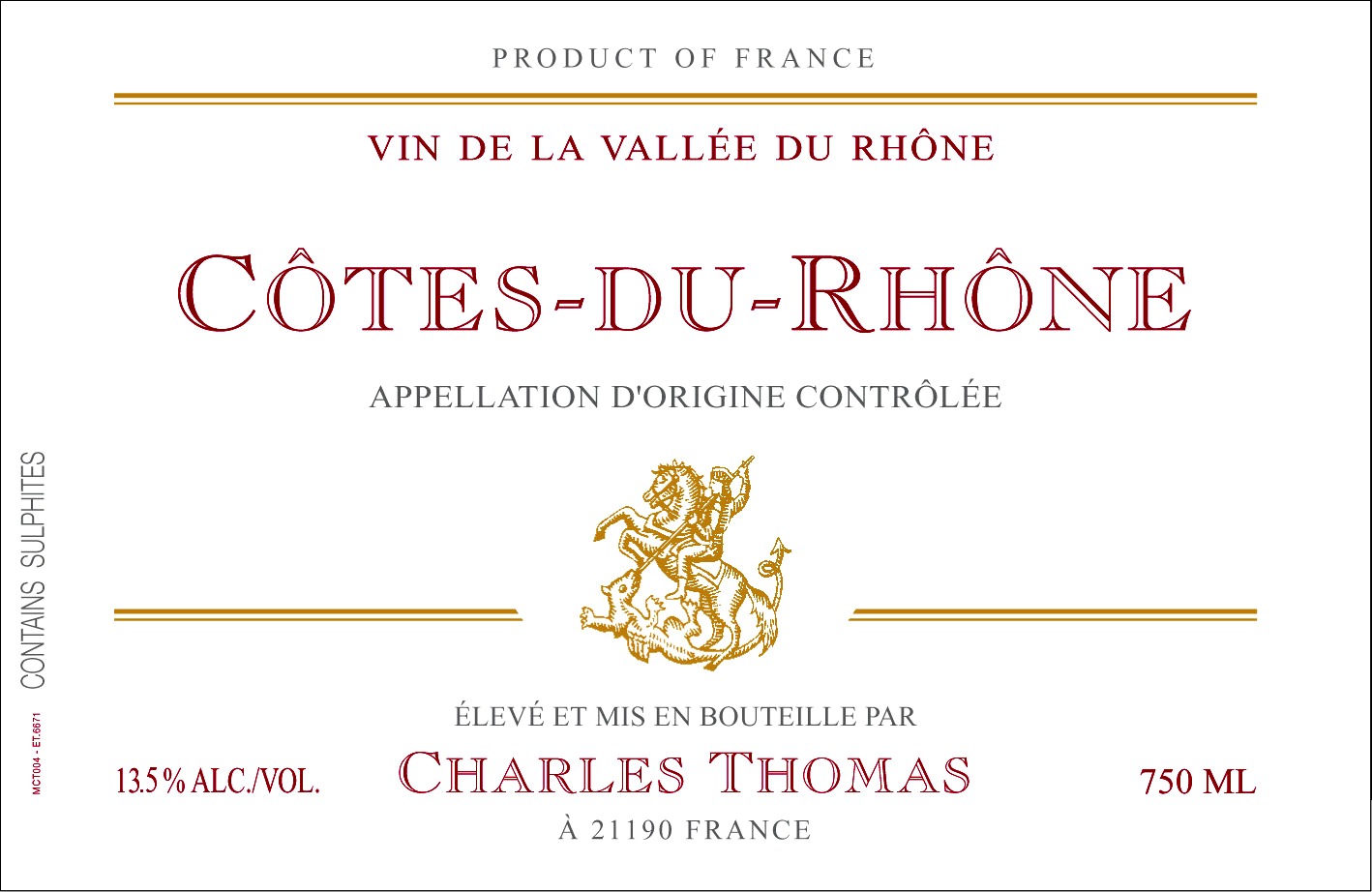
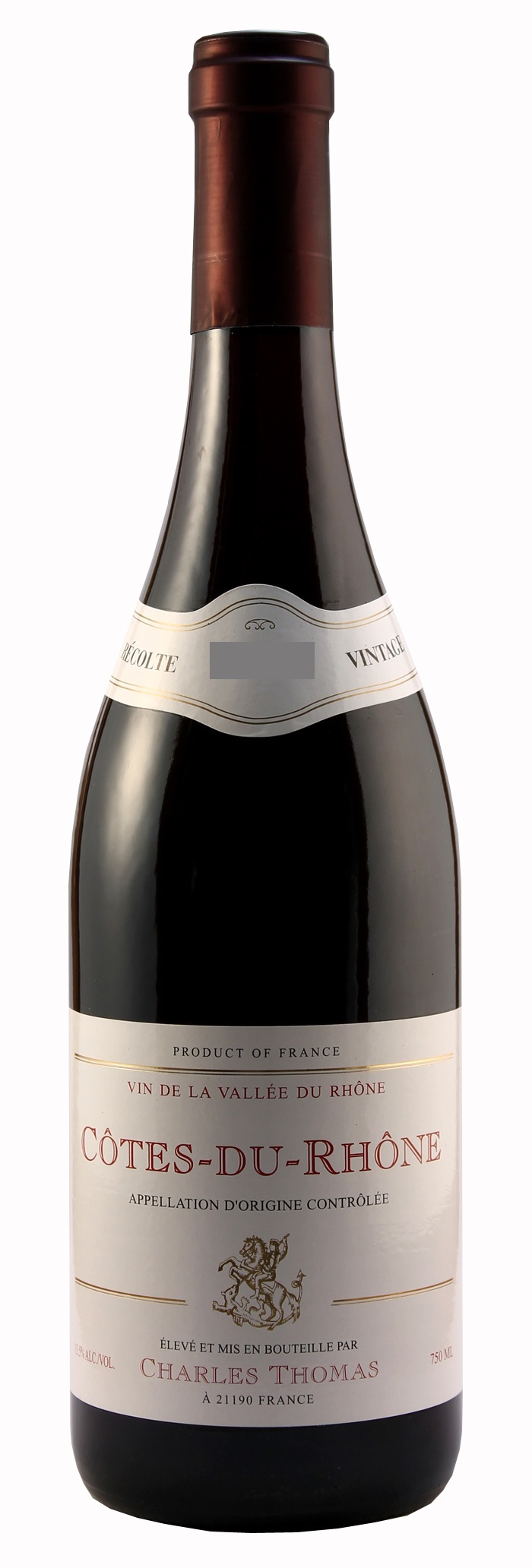
Charles Thomas Cotes Du Rhone Rouge is made from 50% Syrah, 40% Grenache, 10% Mourvèdre
Ruby wine with overtones of red berry fruits. Round and supple with smooth aftertaste.
56 Ha grown organically since March 2009 (in conversion). Part of the vineyard is plowed with horses. Mechanical harvest. Yields: 48 hectoliters per Hectares. Average age of the vines : 30 years old.
A good all round red wine for meat courses, poultry and light cheeses. Best drunk now while fresh with good keeping up to 4 years.
The Charles Thomas Estate
This Estate is located in the GARD department near Pont Saint Esprit (10 miles North-West of Orange).
The Charles Thomas Vineyard
56 Ha grown organically since March 2009 (in conversion).
Part of the vineyard is plowed with horses.
4 varietals are produced: 29 Hectares (72 acres) of Syrah, 22 Hectares (54.5 acres) of Grenache, 3 Hectares (7.5 acres) of Mourvedre and 2 Hectares (5 acres) of Carignan.
Mechanical harvest.
Yields: 48 hectoliters per Hectares.
Average age of the vines : 30 years old.
The vineyard is situated in an archeological site that has revealed many artifacts dating back from the 4th Century.

Wolfberger Auxerrois is made from 100% Auxerrois
Auxerrois blanc is thought to have originated in Lorraine, rather than near Auxerre in the Yonne. Recent DNA fingerprinting suggests that it is a cross between Gouais blanc and Pinot noir, the same ancestry as Chardonnay. The name Auxerrois blanc has actually been used as a synonym for Chardonnay in the Moselle region in France, which explains why there is also a longer name (Auxerrois Blanc de Laquenexy) for the grape variety.
This pale yellow Auxerrois Pinot Blanc shows an intense nose of fresh white fruits, rhubarb and spring flowers. Easy to drink and fresh on the palate, this wine ends on a fruity and crunchiness tast.
Alcoholic fermentation at 16°C followed by a short fermentation at 18°C allowing to keep some crispiness to the wine.
Then the wine was aged on the fine lees for 6-7 months. No Oak.
No Malo-Lactic fermentation.
Right before bottling, the wine was filtered using a tangentiel filtration system.
Quiche, grilled fish, rhubarb pie, mixed salad, and also fresh sheep milk cheese.

Wolfberger Alsace Edelzwicker is made from 40 % Pinot Blanc, 30% Riesling, 15% Gewurztraminer and 15 % Muscat
Edelzwicker has a nose of grilled almonds and walnuts, with a light floral hint following. The first sip shows its true character: fresh and lemony with vegetal, herbaceous flavor. It is round and easy drinking, not overpowering and finishes clean.
Each grape variety is harvested individually in early or mid-October on the most suitable date for each vineyard.
It is a good companion for food without ever dominating it. In Alsace it is served by the glass or in large jugs to partner regional specialties. In general Edelzwicker goes well with fresh salads, cold or warm starters, but also with oysters, mussels and seafood. It should always be served chilled, around 10 ° C.

The Black Oak Cabernet Sauvignon is garnet red in color, refreshing and inviting to the palate. The wine’s aromas are layered with rich plum notes and a warm cedar component. The ripe, dark cherry flavors, are reminiscent of decadent blackberries with a nice sprinkling of dried herbs. With a mellow tannin structure, this medium-bodied wine is delicious and well-integrated.

Klipsun Cabernet Sauvignon Red Mountain is made from 84% Cabernet Sauvignon, 4% Merlot, 4% Malbec and 8% Syrah.
The 2017 vintage started out with a cool, wet winter, with significantly above average snowfall in eastern Washington. Red Mountain had a 24% increase in rainfall in 2017 over the 10 year average. Going into spring, the cool trend continued. As a result, bud break at Klipsun was behind the historical average and significantly behind the most recent warm vintages of 2013 2016. Bloom was also slightly delayed. Because of the cool weather, set was lighter than usual which translated into significantly less fruit in 2017.
The early part of the summer saw average temperatures followed by above average temperatures in July and August. As a result, he at accumulation was a bit above average for the season, despite the cool start. And because of the smaller than normal yield, harvest began right on schedule, perhaps even a bit early for some of the whites. In the second half of September, when Klipsun traditionally harvests all the reds, the temperatures cooled considerably, which delayed ripening. This allowed for luxurious amounts of hang time without the threat of increased sugar accumulation, stretching harvest into the first week of October. A s a result, all fruit going into the 2017 Klipsun Cabernet Sauvignon could be picked at perfect sugars levels with great fruit maturity and flavors. Overall, the quality of t he 2017 harvest is as high as the 2016. However, the style is slightly different. The 2017 wine has a firmer structure, more spice & mocha in the nose and will take a few mo re years than the 2016 to reach a perfect balance between fruit and tannin.
Review:
The 2017 Cabernet Sauvignon Red Mountain is composed of 84% Cabernet Sauvignon, 4% Merlot, 4% Malbec and 8% Syrah, which immediately emanates with aromas of dark roasted espresso bean, toasted oak, dried tobacco and dusty black fruit tones of cassis, currant and blackberries covered in dark cocoa powder. Full-bodied, generous in complexity and still tight in the mouth, the wine unpacks layers of cedar and vanilla tones with dusty purple flowers and bitter dark chocolate across the mid-palate, giving way to fine-grained tannins that will loosen with time. As the wine sits on the palate, the 100% French oak regimen is on full display for all to see. The wine lingering long and continues to evolve in the mouth, ending with a drying finish that highlights the oak and terroir. It’s still a baby, and I would keep it in the cellar for another few years before popping the cork—this will effortlessly coast for more than a decade. The 2017 vintage marks the second release of this wine, with 6,300 bottles produced. It comes from its namesake vineyard, first planted in 1984 on Red Mountain. I’m keeping my eye on this producer. I’m impressed, and even though the oak may be a bit much at the moment, it's still delicious. - Wine Advocate 94+ Points
-Jeb Dunnuck 94 Points

Davila M100 White Blend Rias Baixas 2022 is made from Albariño, Caíño Blanco and Loureiro.
Adegas Valmiñor farms the O Rosal valley at the Atlantic edge of Rías Baixas, and the Davila range is where the winery showcases the native grapes of that corner of Galicia. The M100 is an O Rosal blend built around Albariño, rounded out with Caíño Blanco and Loureiro from the estate's older parcels.
The Albariño is cold-macerated and barrel-fermented in large French oak, aged three months on its lees with bâtonnage, then blended with the Caíño Blanco and Loureiro and given further time in tank. It is a richer, more structured Rías Baixas white — ripe orchard fruit and subtle spice over a firm mineral spine, deep and expressive on the palate.
Pairs beautifully with richer seafood, white meats, and creamy dishes.