" We don't sell the wine without touching the vine "
| Country: | France |
| Region: | Loire |
| Winery: | Ecu (Guy Bossard) |
| Grape Type: | Melon de Bourgogne |
| Vintage: | 2018 |
| Bottle Size: | 750 ml |

All older vintage wines have been purchased from a single collectors cellar. Pictures can be requested before shipment.

Domaine de la Janasse has been in the Sabon family since 1967, today run by siblings Christophe and Isabelle. Their Châteauneuf-du-Pape Blanc — Roussanne-led, with Grenache Blanc and Clairette — is consistently one of the finest whites in the appellation, combining richness with purity and the ability to age for two decades.
Review:
Based on 70% Roussanne and 15% each Grenache Blanc and Clairette and aged 12 months in 20% new French oak with the balance in used barrels and concrete. It has a medium gold hue and delivers remarkable intensity in its ripe stone fruits, fresh croissant, honeyed flowers, and orange blossom nuances. It's medium to full-bodied, has a pure, seamless, layered mouthfeel, beautiful balance, and a fabulous finish that will evolve for 20+ years if well stored. Drink 2025-2045.
Jeb Dunnuck 98 Points
-Jeb Dunnuck 91 Points

Domaine de la Janasse Chateauneuf-du-Pape Cuvee Chaupin is made from 100 percent Grenache.
Chaupin is Domaine de la Janasse's single-parcel expression of old-vine Grenache, drawn mostly from the sandy-soiled Chapouin lieu-dit with smaller parts from La Crau and Janasse, some of the oldest vines planted in the early twentieth century. The Sabon family has run the estate near Courthezon since 1967 - today the brother-and-sister team of Christophe and Isabelle - and Janasse stands among Chateauneuf-du-Pape's benchmark producers. Partially destemmed and aged twelve months in foudre and demi-muids, Chaupin is the purest, most perfumed side of Grenache in its homeland.
Review:
All Grenache sourced mostly from the Chapouin lieu-dit with a splash from Janasse, the 2023 Châteauneuf Du Pape Cuvée Chaupin shows a medium ruby hue followed by a pretty, perfumed, remarkably elegant profile. It has a core of sweet red and black berry fruits, absolutely heavenly Provençal aromatics of herbes de Provence, black olive, pepper, and flowers, plus ripe, velvety tannins, flawless balance, and a great finish. Partially destemmed and aged 12 months in 70% foudre and 30% demi-muids, this heavenly 2023 will drink beautifully over the coming two decades. There are roughly 1,500 cases produced. Drink 2025-2045.
-Jeb Dunnuck 99 Points

Domaine de la Janasse Chateauneuf-du-Pape Cuvee Vieilles Vignes is made from 65% Grenache, 20% Mourvèdre, 10% Syrah, 5% divers.
In contrast to Chaupin, which is made from old-vine Grenache on sandy soils, the cuvée Vieilles Vignes is from old vines of Grenache, Mourvedre, Syrah along with smaller percentages of other permitted varieties that are grown in these old vineyards. The wine is sourced from 4 terroirs: pebbly clay, sand, gravelly red clay and sandy limestone. Vieilles Vignes is always the most powerful and concentrated Châteauneuf-du-Pape cuvée made at Domaine de la Janasse.
Review:
-Wine Advocate 96 Points

Delas Hermitage Domaine des Tourettes is made from Syrah.
Sourced from Delas' holdings on the Hermitage hill, this 2021 has a deep, brilliant red hue. The nose is powerful and complex, expressing blackberries, spices and leather. On the palate the wine is firm but silky, with the tightly-knit tannic structure that is the hallmark of wines with a long future.
Pair this wine with rare or medium-cooked game, marinated meats and spicy stews. We recommend opening this bottle between one and three hours before drinking.
Reviews:
Some weight of fruit here underneath the measured clove oak. Smooth, ripe, with well-balanced acidity, this has a good sense of balance and elegance. Fresh, with plentiful cinnamon spice and forest berry fruit that's just-ripe, neither over nor under. A fairly compact, early-drinking Hermitage, not a powerful one, but one that has some natural class.
-Decanter 93 Points
Very complex nose with notes of candied orange, cocoa powder and spice. Remarkably harmonious for the vintage with almost silky tannins, then comes an intense flinty character that gives the slightly sweet finish so much excitement. Matured entirely in oak barrels with about one quarter new, but only for 12 months.
-James Suckling 93 Points
"In der Nase verhalten aber vielversprechend. Mit herbalen und waldig anmutenden Noten, auch Bohnerwachs und Pfeffer, ein Hauch von Waldbeeren. Im Gaumen vielschichtig ausgewogen, auch zupackend, mit feinkörnigem Tannin und einer angepassten saftigen Säure. Gute Länge. sehr gehaltvoll."
-Vinum Wine Magazine 95 Points

Bernardins Beaumes de Venise Rouge Cru Cotes du Rhone is made from 65% Grenache, 25% Syrah, 5% Mourvedre and 5% Grenache Blanc.
Bright ruby color with cherry tinges. Complex black fruit aromas on the nose enhanced by spicy notes. Rounded palate with good length.
The wine is drinking well right now and can be kept for another 10 years.
Situation
Spreads out over the south-east side of the Dentelles de Montmirail hills, in Beaumes de Venise in the southern part of the Rhone valley.
Terroir
On a poor sandy, hungry and arid soil consisting of tender limestone and gritty zones of sandy mollasse.
In the vineyard
The vineyards and their terroir are the essence of our wines. This is where everything starts and where we focus our efforts throughout the year. You can’t make great wine without great grapes.
The viticulture is essentially done by hand. Five people work full-time in the vineyards. They are supplemented by seasonal employees who work during bunch thinning and the harvest in order to bring out the very best in our vines. Working by hand and the attention each vine gets are fundamental. Pruning, de-budding, trellising, leaf removal and picking are thus carried out by hand with the utmost care.
We prepare the soil by using good old-fashioned ploughing. Organic compost is made from grape marc (the discarded stalks and skins).
As a way of protecting the plants, we only use phytosanitary products when necessary and within strict guidelines by staggering the treatments appropriately, to minimise the amount of chemicals used. We prefer to use as much as possible manual and organic techniques . Leaving natural grass cover, removing buds and leaves from the vines, preserving biodiversity around the vineyard: olive, almond and cypress trees, wild rosemary and capers.
Winemaking
We make two red wines at the estate. Terroir wines shaped by the two classic Côtes du Rhône varieties: Grenache and Syrah. We don’t follow any winemaking recipe but are constantly searching for the perfect expression of terroir and each vintage’s particular characteristics. We don’t go for overripe grapes and over-extraction, as we think the wine has to stay refreshing and balanced.
Leaving the wine for 15 days in concrete vats, we try to gently extract the tannins and anthocyanins essential for the wine’s structure and colour. The wine doesn’t come into any contact with wood during ageing. This way the characteristics of our terroir can fully express
Serve with a meal especially red meat, game and cheese.
Review:
-Decanter 95 Points
-Decanter 93 Points
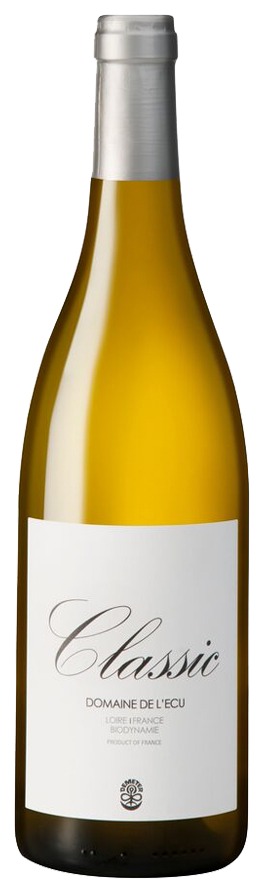
Domaine de l'Ecu Muscadet Classic is made from 100% Melon de Bourgogne
This vintage claims to be “Classic” purely to set itself apart from the tendancy to promote wines whose aromas have their origin neither in the variety of grape nor in the locality...This Muscadet is developed and vinified to be appreciated young “on the fruit”. It is crystal clear and the color of yellow straw. Lime, grapefruit, white fruits, pear and apple, salty and citrus notes are generously present on the nose.
The mouth is rich, straight, providing a beautiful acid screen; lime and soft notes of the sea provide a good balance and a great freshness in this Muscadet, superb landmarks which stretch to the end....
GRAPE-VARIETY: Melon de Bourgogne. (Local name of the Muscadet grape)
SURFACE: 4.50 ha (11.12 acres).
AGE OF VINES: 30-35 years old.
CARACTERISTICS OT THE TERRITORY: Loire Valley vineyard
Orientation of the slopes is WEST and NORTH WEST.
Soil is Siliceous with a sub-soil of metamorphic rock.
PRODUCTION: 45 hl/ha
Soil ploughing and soil scraping. Canopy management.
PRUNING: Simple Guyot.
VINIFICATION AND REFINING:
Organicly farmed since 1975.
Biodynamic – Demeter certified since 1998
- 100 % hand-picked grapes
- Reception of the grape harvest by gravity.
- No use of pumps.
- Pneumatic pressing.
- No racking of the must.
- Fermentation 100 % natural yeast.
- Aged “on the lees” in underground vats
covered with glass tiles during 14 months.
This Muscadet would be a good accompaniment to a seafood platter, an oily fish, a white meat or would, of course, be the ideal companion to your aperitif.
Review:
-Wine Spectator 90 Points
The Domaine de l'Ecu Guy Bossard Estate
The domaine is located in the hamlet of Le Landreau in Sevre et Maine, Muscadet's best region of production. The family has been producing wine there for 5 generations, but current owner Guy Bossard defies the prevailing view that organic producers can't make great wine. The estate became organic in 1975, and biodynamic in 1986. Guy Bossard makes his own compost using algae, forest brush and basalt. He produces 3 different cuvees, each masterfully crafted to highlight the expression of the specific soil types.
The Hermine d'Or designation is given to specially selected Cuvees of Muscadet, (tasted blind) that score highly. Hermine d'Or wines are picked for:
1. Typicity - Trueness to type (no oak here).
2. Ageability - The ability to improve in the bottle.
3. Minerality - Classic feature of wines of this region.
This insignia, Hermine d'Or, is as near a guarantee of quality as can be found in the region.
Matt Kramer, the Wine Spectator - My Wines of the Year -
"Ah, my beloved Muscadet always pops up on this list, as I like to buy'em and age'em for upward of a decade. Guy Bossard, the owner-winemaker of Domaine de l'Ecu, is obsessed with Muscadet. His vines and winemaking are fully biodynamic. If Burgundy's Domaine Leroy made Muscadet, it would be Domaine de l'Ecu. In the classic 2002 vintage, Bossard offered multiple bottlings based on soil types. His Expression de Granit is all about intense minerality; Expression d'Orthogneiss is spicier, richer and denser. Both need 10 years of age. The prices are absurdly low."
"The gifted, highly regarded Guy Bossard produces serious Muscadets, built to age; fully biodynamic since 1986." - Anthony Dias Blue's pocket guide to wine 2006
The Domaine de l'Ecu Guy Bossard Vineyard
Guy Bossard farms 17 hectares (42 acres) entirely using biodynamic methods. The average age of the vines is 45 years.
The wines are fermented "sur lie", on the yeast, to prevent oxidation and impart full flavor and a slight spritz to the finished product.

Lokoya Spring Mountain Cabernet Sauvignon is made from Napa Valley Cabernet Sauvignon.
Review:
-Jeb Dunnuck 98 Points
-Robert Parker's Wine Advocate 97 Points
-Antonio Galloni 97 Points

Opus One 2023 is made from Cabernet Sauvignon.
Opus One was founded in 1979 as a partnership between Baron Philippe de Rothschild of Chateau Mouton Rothschild and Napa Valley pioneer Robert Mondavi, a meeting of two great winemaking cultures with a single ambition: a Bordeaux-style blend to stand among the finest wines in the world. From the heart of the Oakville district, every acre of the estate is farmed with meticulous, parcel-by-parcel attention under winemaking director Michael Silacci, and the fruit is shaped into one flagship wine each vintage.
The 2023 comes from a cool, balanced Napa growing season and is a classic, finesse-driven Opus One, aged in French oak and built for decades in the cellar.
Review:
The 2023 Opus One is a super classic wine. Brisk acids, fine tannins and lifted aromatics signal an Opus One of exquisite finesse and class. Red/purplish fruit, mint, orange peel and chalk are all woven together in a fabric of nearly indescribable class. The 2023 floats on the palate with understated finesse and lightness, but it's not light in any way. This is class personified.
-Antonio Galloni, Vinous 98 Points
The bouquet is utterly enticing, offering cool blue-fruit notes and a dusting of cocoa-powder freshness that stirs anticipation for the first sumptuous sip. On the palate, satiny richness unfolds, imbued with crunchy red cherry and juicy blackberry fruit, alongside refined sagebrush and tobacco nuances. There is a sense of intricately fine-knit tannins – compact yet impressively integrated at this youthful stage – framed by subtle, refined oak spice. The finish is long and mineral, marked by graphite and a touch of black sea salt. The wine was fermented entirely with native yeasts in stainless steel, with a portion aged in amphora in this vintage, before maturing for 19 months in 95% new French oak. The blend is rounded out by small additions of Malbec and Petit Verdot. In 2023, the vines were farmed regeneratively for the first time, with harvest completed by mid-October.
-Decanter 98 Points