" We don't sell the wine without touching the vine "
| Country: | France |
| Region: | Languedoc |
| Winery: | Chateau de Mus |
| Grape Type: | Roussanne |
| Vintage: | 2017 |
| Bottle Size: | 750 ml |

All older vintage wines have been purchased from a single collectors cellar. Pictures can be requested before shipment.
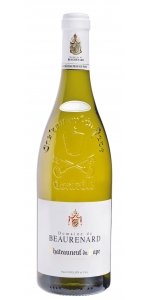
Domaine de Beaurenard Chateauneuf-du-Pape Blanc is made from Clairette blanche & Rose, Grenache Blanc & Gris, Bourboulenc, Roussanne, Picpoul and Picardan.
Gold bright green color. Expressive nose with pear and stone fruits aromas (peach, apricot) with jasmine and roasted almonds notes. The mouth is smooth and fleshy like stone fruit we can smell, with a long a nice finish.
Review:
Always terrific, the 2023 Châteauneuf Du Pape Blanc is no exception, and readers who love vibrant, age-worthy Rhône whites can safely buy this cuvée in just about every vintage. Based on 30% Clairette, 20% Grenache Blanc, 25% Bourboulenc, 22% Roussanne, and splashes of Picardan and Picpoul Blanc, the 2023 reveals a medium gold hue as well as textbook aromatics of pear and orchard fruits intermixed with honeyed flowers, chalky minerality, and subtle green almond nuances. This balanced, medium-bodied, vibrant white is very much in the fresh, focused, yet still textured, approachable style of the vintage.
-Jeb Dunnuck 93 Points
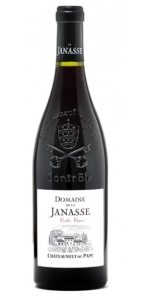
Domaine de la Janasse Chateauneuf-du-Pape Cuvee Vieilles Vignes is made from 65% Grenache, 20% Mourvèdre, 10% Syrah, 5% divers.
In contrast to Chaupin, which is made from old-vine Grenache on sandy soils, the cuvée Vieilles Vignes is from old vines of Grenache, Mourvedre, Syrah along with smaller percentages of other permitted varieties that are grown in these old vineyards. The wine is sourced from 4 terroirs: pebbly clay, sand, gravelly red clay and sandy limestone. Vieilles Vignes is always the most powerful and concentrated Châteauneuf-du-Pape cuvée made at Domaine de la Janasse.
Review:
The 2020 Châteauneuf Du Pape Vieilles Vignes also saw some stems (the estate started keeping some stems with the 2016 vintage) and was 75% destemmed, with the blend being 70% Grenache, 20% Mourvèdre, and the rest Syrah, Cinsault, and Terret Noir. As usual, it’s a more powerful, black-fruited wine comparted to the Cuvée Chaupin and has lots of crème de cassis, liquid violet, crushed stone, woodsmoke, and peppery herbs. It displays the vintage’s purity and freshness yet brings the concentration as well as the structure. I’ll be shocked if it’s not in the handful of top wines in the vintage.
-Jeb Dunnuck 96-98 Points
Domaine de la Janasse Chateauneuf-du-Pape Cuvee Vieilles Vignes is made from 65% Grenache, 20% Mourvèdre, 10% Syrah, 5% divers.
In contrast to Chaupin, which is made from old-vine Grenache on sandy soils, the cuvée Vieilles Vignes is from old vines of Grenache, Mourvedre, Syrah along with smaller percentages of other permitted varieties that are grown in these old vineyards. The wine is sourced from 4 terroirs: pebbly clay, sand, gravelly red clay and sandy limestone. Vieilles Vignes is always the most powerful and concentrated Châteauneuf-du-Pape cuvée made at Domaine de la Janasse.
Review:
The advantages of old vines are perhaps most evident in the more difficult vintages (whether hot and dry or cool and rainy). The 2021 Chateauneuf du Pape Vieilles Vignes is a strong effort, delivering supple, velvety waves of ripe black cherries and black raspberries. Medium to full-bodied, it's rich and concentrated without seeming at all heavy or unbalanced, finishing long and juicy. It's approximately 75% Grenache, 15% Mourvèdre, 5% Syrah and 5% other varieties, keeping in mind that up to 15% of the old Grenache vines are actually Clairette Rose.
-Wine Advocate 96 Points
All older vintage wines have been purchased from a single collectors cellar. Pictures can be requested before shipment.
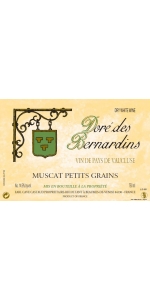
Bernardins Dry Muscat Dore des Bernardins is made from 100% white Muscat petit grains.
Doré des Bernardins is a dry white wine that is only produced in years when the Muscat à petit grains crop is large enough. Grapes are picked at the same ripeness level as for the Vin Doux Naturel. In contrast to Muscat de Beaumes de Venise, the fermentation isn’t stopped, giving a fruity dry wine with intense Muscat aromas.
Dry Muscat with a fruity, nice perfume, honeysuckle and melon aromas, lively rounded mouth-feel. Elegant, fresh and medium-bodied.
Situation
Spreads out over the south-east side of the Dentelles de Montmirail hills, in Beaumes de Venise in the southern part of the Rhone valley.
Terroir
On a poor sandy, hungry and arid soil consisting of tender limestone and gritty zones of sandy mollasse.
In the vineyard
The vineyards and their terroir are the essence of our wines. This is where everything starts and where we focus our efforts throughout the year. You can’t make great wine without great grapes.
The viticulture is essentially done by hand. Five people work full-time in the vineyards. They are supplemented by seasonal employees who work during bunch thinning and the harvest in order to bring out the very best in our vines. Working by hand and the attention each vine gets are fundamental. Pruning, de-budding, trellising, leaf removal and picking are thus carried out by hand with the utmost care.
We prepare the soil by using good old-fashioned ploughing. Organic compost is made from grape marc (the discarded stalks and skins).
As a way of protecting the plants, we only use phytosanitary products when necessary and within strict guidelines by staggering the treatments appropriately, to minimise the amount of chemicals used. We prefer to use as much as possible manual and organic techniques. Leaving natural grass cover, removing buds and leaves from the vines, preserving biodiversity around the vineyard: olive, almond and cypress trees, wild rosemary and capers.
Winemaking
Our Doré des Bernardins is a dry white wine that we only produce in years when the Muscat à petits grains crop is large enough. We pick the grapes at the same ripeness level as for the Vin Doux Naturel. In contrast to Muscat de Beaumes, the fermentation isn’t stopped, giving a fruity dry wine with intense Muscat aromas.
Nicely chilled, this dry white wine is great as an aperitif or with asparagus, seafood, king prawns, fish.
Closeout:
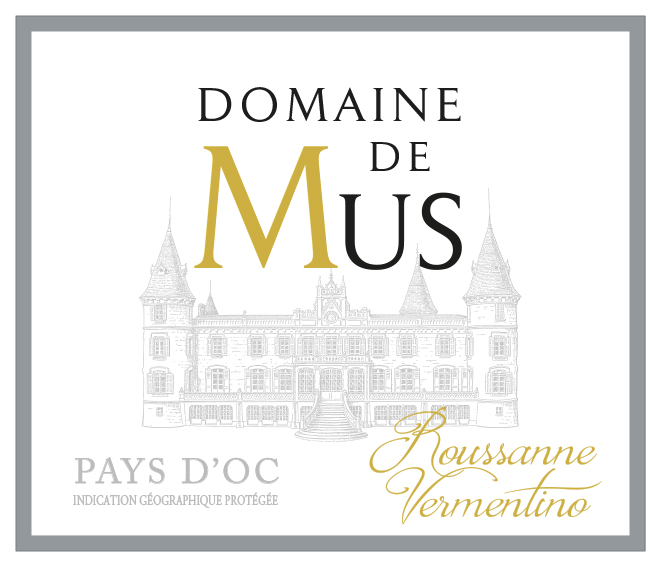
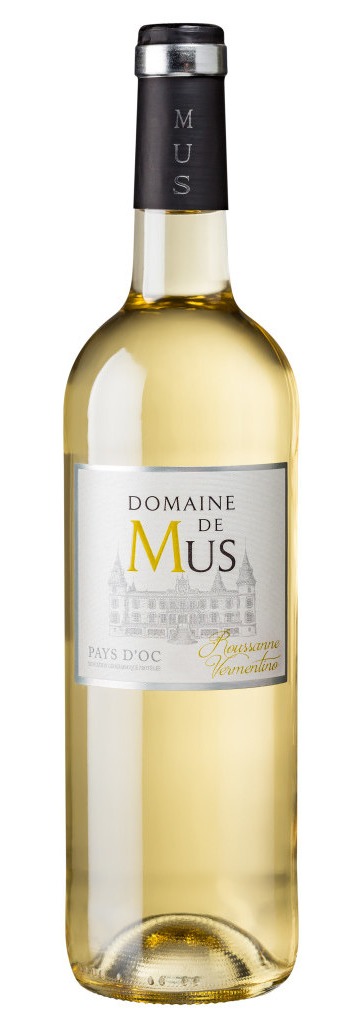
Domaine de Mus Roussane-Vermentino is an original blend of Roussanne (85%), Vermentino (15%). Separate wine-making, blending before bottling operations. No Oak.
The wine is an unoaked blend of Roussanne (85%), Vermentino (15%). Separate wine-making, blending before bottling operations. Brilliant light color. On the nose aromas dominated with orange blossom and lemon notes.Fresh and complex on the palate, with citrus flaoting on a crisp finish.
Grapes are very carefully protected against any oxidization, as soon as picked up and during the carriage into the cellar. Night harvesting, when the temperature is the lowest. Complete destalking, direct pressing into CO2 atmosphere. Stalling for 24 hours, and immediate racking at 8°C : the clearest juices only are selected. Fermenting process set off with selected yeasts addition, in stainless steel tanks, under heat monitoring, during 30 to 40 days.
Maturing on fine lees, all winter long, with regular stirring of the lees. Fining and bottling.
Review:
"Mostly Roussanne (there’s just 15% Vermentino), the 2017 Roussanne-Vermentino is a fresh, vibrant white that over-delivers at the price, giving up lots of citrus, lemon, and minty notes in a medium-bodied package. It has a touch of minerality, fleshes out nicely with time in the glass, and is an outstanding white to enjoy over the coming year or two."
- Jeb Dunnuck (March 27th 2019), 90 pts
The Chateau de Mus is located in Murviel-Les-Beziers in the Languedoc region.It is home to a gorgeous Renaissance-style castle.
The Julien Family has been working hard in the vineyards, in the cellars, but they also have a restoration project for the chapel and the castle located on the property. Today, Yannick and Brice are representing the 5th generation of winemakers in the Family.
Date Founded: 2004
Dating back at least 800 BC, the Château de Mus represents one of the largest archaeological sites in Hérault, illustrating the prehistoric, Celtic, Roman, Greek and Etruscan ages. The estate was named after an ancient fortified place called « Murus » («city wall» in Latin), built up on a promontory over the Orb river. At MUS, a Romanesque church was built in 1070 (today its restoration is in progress) such as one of the six first castles of the area. Twice destroyed during the crusade against the Cathars in the 13th C. the former mansion was replaced in 1848 by a Renaissance-style castle, prefiguring the great times of the “wine chateaux” in Languedoc.
The JULIEN'S bought the CHATEAU DE MUS in 2004
The vineyard is planted to traditional grape varieties of the Languedoc’s AOP, Grenache, Syrah, Mourvèdre, Cinsault, in the estate’s AOP area, and also of a range of different French varieties planted in the Vin de Pays area, mainly Cabernet Franc, Cabernet Sauvignon, Merlot, Petit Verdot, Malbec, Pinot Noir, Tannat, Marselan, Muscat, Grenache Gris, Sauvignon blanc, Sauvignon, Vermentino, Viognier.
The winery is modern and the temperature controlled vinification is a huge part of the quality process. Concrete tanks, stainless steel and open top fermenters are used for almost all of their wines
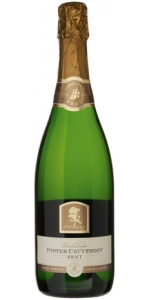
Dry but fruity with a complex nose of tropical fruit and enhancing biscuit flavours. Crisp acid ensures a fresh, clean and verydrinkable sparkling wine.
Serving suggestion: Well chilled to make any occasion festive.
THE LEGEND
Dispatched by Jan van Riebeek in search of the perfect place to grow provisions for the Dutch East India Company, Pieter Cruythoff stumbled upon a beautiful valley. But it was more than just the scenic beauty of this valley that had caught his eye; situated in the lee of the majestic Kasteelberg, the winters were mild, the summers were hot and the soil was uncommonly fertile. What's more, ships spotted from the lookout point on Kasteelberg were just a day away from Cape Town, and so were the wagons that went to meet them, laden with the treasures of the Riebeek Valley.
TIMELESS JEWELS
While he humbly named the valley after his patron, Jan van Riebeek, we feel it is only fitting that our valley's most coveted treasure should carry the name of its founder. So, in honour of Pieter Cruythoff, this range of fine wine bears his name.
From the vibrant whites to the seductive reds, each one is a gem gently coaxed from the fertile soil of that same magical valley. Ironically, much of the valley's bounty still finds its way to Europe, and in particular to the Netherlands, the land of Cruythoff's birth.
Intense violet, hints of lavender, black cherry, fresh leather and spicy flavors (white pepper and clove), rich and concentrated with a lingering spicy finish. Will age gracefully for several decades.
Review:
Morlet doesn’t make much of it, but their Syrah is beautiful and well worth seeking out. The 2018 Syrah Bouquet Garni comes from the cool climate, higher elevation Bennett Valley in Sonoma and offers a big, exotic nose of blackberry and blackcurrant fruits as well sandalwood, dried flowers, new leather, and white pepper. The fruit is ripe and opulent, yet it still holds onto loads of classic cooler-climate Syrah gaminess and peppery notes. Full-bodied on the palate, it’s balanced and has a lively, clean texture, beautiful depth of fruit, and a great finish. Enjoy bottles any time over the coming decade.
-Jeb Dunnuck 97 Points

Hugl Gruner Veltliner (liter) is 100% Grüner Veltliner
This is an intense and concentrated wine offering pleasant citrus and grapefruit aromas, exotic tropical fruits with a hint of freshly ground white pepper. Full-bodied dry wine with a firm mineral backbone.
A firm mineral backbone, gives it the strength of character to work well with many cuisines.