" We don't sell the wine without touching the vine "
| Country: | Germany |
| Region: | Mosel |
| Winery: | Dr. Leimbrock |
| Grape Type: | Riesling |
| Vintage: | 2017 |
| Bottle Size: | 750 ml |

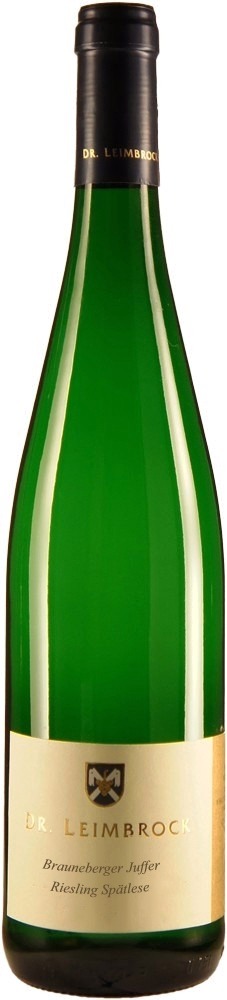
A late harvest Riesling with fruity sweetness and great aging potential, aromatic bouquet of honey, melon, ripe fruits. Grapes come from Brauneberger Juffer and Juffer-Sonnenuhr - one of the most prestigious vineyards in the Mosel winegrowing region. The vineyard faces south and provides the best conditions for growing Riesling.
Pairs well with pâté, Asian cuisine.

Dr. Leimbrock Brauneberger Juffer Sonnenuhr Riesling Kabinett is made from 100 percent Riesling.
Brauneberger Juffer and Juffer-Sonnenuhr are one of the most prestigious vineyards in the winegrowing region Mosel. The vineyard faces south and provides best conditions to plant the Riesling vines.
Juicy and aromatic with a wonderful drinking flow and aromas of melon, stone fruit and apple. Makes you want the next sip.
ABV: 9.1%
TA: 7.5
RS: 36.5 g/liter
Dr. Leimbrock Brauneberger Juffer Sonnenuhr Riesling Kabinett is made from 100 percent Riesling.
Brauneberger Juffer and Juffer-Sonnenuhr are one of the most prestigious vineyards in the winegrowing region Mosel. The vineyard faces south and provides best conditions to plant the Riesling vines.
Juicy and aromatic with a wonderful drinking flow and aromas of melon, stone fruit and apple. Makes you want the next sip.
ABV: 9.1%
TA: 7.5
RS: 36.5 g/liter

Dr. Leimbrock Mulheimer Sonnenlay Riesling Spatlese is made from 100 percent Riesling.
A classic in the residual sweet range that impresses with filigree fruit and mineral spiciness.
The circulating mountain "Mülheimer Sonnenlay" represents a geographical feature of the Moselle. Due to the strong meandering of the Moselle, the mountain was surrounded by the course of the river in geological development in such a way that a so-called circulating mountain arose from it. Located in the northeast-southwest direction, vines are cultivated on both sides of the mountain. The site name "Sonne" and "Lay" (Mosel Franconian for slate) combines the most important prerequisites for the cultivation of Riesling vines. Soils are skeletal-rich, weathered clay-ish shale enriched with sand, stones, and clay. At the beginning of the 1930s, the Mülheim winegrowers proudly pointed out that the local wine was served in the elegant restaurant of the airship "Graf Zeppelin" on its world trips and was obviously very popular.
Pair with spicy dishes, soft cheese, cakes.

Dr. Leimbrock Estate Riesling is made from 100 percent Riesling.
Typical Riesling, fresh and fruity, easy drinking. Grapes come from Brauneberger Juffer and Juffer-Sonnenuhr - one of the most prestigious vineyards in the Mosel winegrowing region. The vineyard faces south and provides the best conditions for growing Riesling.
Pairs well with barbecue meats, pasta dishes.

St. Nikolaus Brauneberger Juffer-Sonnenuhr Riesling Spatlese is made from 100 percent Riesling.
"Sonnenuhr" means sundial. The vineyard is facing the small town of Brauneberg formerly Dusemond. It's a steep slate slope on the Mosel, with a south-southeast exposure.
Full-bodied Riesling with typical Devonian slate qualities. Luscious fruit; nice minerality, length and acidity.
A late harvest Riesling with fruity sweetness and great aging potential, aromatic bouquet of honey, melon, ripe fruits. Grapes come from Brauneberger Juffer and Juffer-Sonnenuhr - one of the most prestigious vineyards in the Mosel winegrowing region. The vineyard faces south and provides the best conditions for growing Riesling.
Pairs well with pâté, Asian cuisine.
Dr. Leimbrock has been family-owned for more than 250 years and looks back on a long tradition of producing fine wines. The main focus of our wines are the dry and semi-dry Rieslings. Only when nature allows – which in recent years has increasingly only been possible through the selective picking of the grapes – resulting in the delicate and aromatic Spätlese and Auslese wines. The excellent Leimbrock wines have received both national and international awards. Our wines are only harvested from our own vineyards, only fermented in our own cellars and bottled at our own winery Date Founded: 1750
Owner: Ulrike Oeffling (Leimbrock) Winery Philosophy: Tradition meets Care The Dr. Leimbrock – C. Schmidt winery has been family-owned for more than 250 years and looks back on a long tradition of producing fine wines. The current vineyard of Dr. Leimbrock – C. Schmidt was founded in 1967 by Friedhelm Leimbrock and Lore Leimbrock nee Schmidt from the companies of their forefathers Friedrich Herrmann, Dr. Wilhelm Leimbrock and Conrad Schmidt. Winery/Vineyards Winery Acreage: 22 acres Winery Production: 7,500 cases / 9L cases Varietals Produced: Riesling, Weißer Burgunder, Kerner Winemaker: Dr. Friedhelm Leimbrock We cultivate our Riesling on 8.5 hectares in the best locations in Veldenz, Mülheim, Brauneberg, Bernkastel and Graach.
The soils of our vineyards originate from the ‘Devon’ soil and are composed of weathered slate. 60% of the hills of our vineyard are aptly named – their slopes are 30-80% steep! Ideal locations for Riesling where each area possesses an unmistakable character. Whether Mülheimer Sonnenlay, Veldenzer Bitsch, Brauneberger Juffer, Brauneberger Juffer-Sonnenuhr, Graacher Himmelreich, or the Bernkasteler Badstube, we have some of the best locations on the Mosel. The vineyard is led by Mrs. Ulrike Oeffling. The vines are cultivated in a natural way. We follow guidelines for fertilization, planting and soil protection that are the best for the environment.
The grapes are carefully pressed, the must is fermented in a naturally cooled cellar and the wine is finished in traditional style. Love of the vines, the soil and the wine as well as the certitude of living in one of the most beautiful wine regions is our passion. It is our belief that we can improve our lifestyle through moderate enjoyment of wine. – Lore Leimbrock nee Schmidt, Ulrike Oeffling nee Leimbrock, Rolf-Bernd Leimbrock and Dr. Friedhelm Leimbrock. Acreage per vineyard: Graacher Himmelreich (0,3 ha), Bernkasteler Bratenhöfchen/Badstube (0,4 ha), Brauneberger Juffer-Sonnenuhr (0,6 ha), Brauneberger Juffer (0,9 ha), Mülheimer Sonnenlay (2,8 ha), Other (4 ha)

Honeyed style, rich minerality and luscious creaminess. Flavors of baked pineapple and pear. Fresh and juicy on the finish.
From the famous Erbacher Honigberg vineyard. Average of the vines is 20 years old.
Cool fermentation, matured on the lees for 2 months before bottling, with a slight filtration.
Riesling Rheingau Erbacher Honigberg Spatlese goes well with Indian Curry and blue Cheese

St. Supery Dollarhide Estate Cabernet Sauvignon is made from 98% Cabernet Sauvignon, 2% Petit Verdot.
This Cabernet Sauvignon presents with deep, dark reds and purples. Aromas are opulent with ripe blackberry, black plum, cassis, chocolate, and toasted oak. A rich, dense profile follows with flavors of cassis and ripe black fruits, espresso, mocha, and molasses with subtle oak in influence. It is a deep, structured wine with excellent fine-grain tannin.
Review:
100% estate-grown single vineyard Cabernet Sauvignon hails from the winery’s Dollarhide Ranch. The property is known for its steep rolling hills—reaching upwards of 1,100 feet—as well as some flatlands and seven lakes rife with wildlife. Aged for 20 months in 100% French oak (54% new), the wine offers a broad and generous mouthfeel with chewy tannins. The fruit is ripe and almost gobby, becoming more streamlined as it opens up. Dark berries are lush and sweet with hints of brown sugar. Acidity and chalky lift are well defined and have the mouth imploring for that next sip. Refined, elegant, polished, and poised
-Tasting Panels 96 Points
This 100% estate-grown single-vineyard Cabernet Sauvignon hails from the winery’s Dollarhide Ranch. The property is known for its steep rolling hills—reaching upwards of 1,100 feet—as well as some flatlands and seven lakes rife with wildlife. Aged for 20 months in 100% French oak (54% new), the wine offers a broad and generous mouthfeel with chewy tannins. The fruit is ripe and almost gobby, becoming more streamlined as it opens up. Dark berries are lush and sweet with hints of brown sugar. Acidity and chalky lift are well defined and have the mouth imploring for that next sip. Refined, elegant, polished, and poised.
-Somm Journal 96 Points

Segla Rauzan Margaux is made from 54% Cabernet Sauvignon, 41% Merlot, 4% Petit Verdot, 1% Cabernet Franc.
Deep ruby in appearance, Segla delivers aromas of blueberry and vanilla on the nose. On the palate it is medium bodied with silky tannins.
Review:
Takes a very fresh approach, with an open-knit feel to the mulled raspberry and red currant fruit. Pretty lilac, incense and singed apple wood notes underscore the fruit, while silky but persistent tannins carry the finish. Shows latent depth and precise balance, so don't let this early charm fool you, as this should unfurl beautifully in the cellar. Best from 2022 through 2040. 10,000 cases made.
-Wine Spectator 95 Points